Category: Agama

  • Ustaz Abd Al-Halim: The Ummah Should Be More Concerned About ARS

    Ustaz Abd Al-Halim: The Ummah Should Be More Concerned About ARS

    AsSalaam’alaikum!

    I attended the ARS seminar days ago – the first one in English – and cannot shake off the feeling that there is more that needs to be discussed. Though I brought up quite a few issues that need addressing and were responded to, many agree that some of the responses were not assuring. I think that the ummah should be more concerned about the ARS then they are now. I, like others, worry that it is becoming a mechanism for control.

    May Allah swt preserve the well-being of the true knowledgeable ulama and protect the ummah from being misled by the ulama suu’ as well as the asatizahs who actually have little knowledge and yet dare to teach and guide the ummah.


    Source: Ustaz Abd’ Al-Halim

  • The Myanmar Times Journalist Fired After Reporting On Military Rape In Rakhine State

    The Myanmar Times Journalist Fired After Reporting On Military Rape In Rakhine State

    A journalist was fired from The Myanmar Times after she reported on military rape in Rakhine State. More staff might be fired; others have resigned/are considering resignation. See: http://frontiermyanmar.net/…/reporters-sacking-followed-moi…

    To publicly indicate their anger and dismay, The Myanmar Times editorial staff took out an ad in their own paper.

    When you face censorship, quiet negotiations don’t address the systemic issue. Closed-door dialogue doesn’t challenge power; you’re playing by the rules of the powerful. You might get a story in the paper this time, or prevented a sacking another time, but it doesn’t mean you’ve won freedom. Here’s to journalists who aren’t afraid to take a stand together, and to let the public know about it.


    Source: Kirsten Han

  • Cape Town’s Gay Mosque Provides Rare Haven

    Cape Town’s Gay Mosque Provides Rare Haven

    CAPE TOWN — Friday prayers at the People’s Mosque in Cape Town looks like any other around the Islamic world, except in this South African city the imam is openly gay and the teaching promotes homosexual rights.

    It is a stance that provokes outrage from many Muslims, but Mr Muhsin Hendricks has built up a small, loyal congregation by helping worshippers try to reconcile their sexuality and their religion.

    “There is this love-hate relationship from the Muslim community,” Mr Hendricks told AFP.

    “Sometimes they feel that I should be thrown from the highest mountain, and sometimes they appreciate that there is one imam who is willing to work with people who they are unwilling to work with.”

    Cape Town has an active gay scene, and is often described as the “gay capital” of Africa, with a district of gay-friendly restaurants, bars, guesthouses and clubs near the city centre.

    In 1996 Mr Hendricks founded “The Inner Circle”, a support group for Muslims living in Cape Town who felt rejected due to their sexual orientation, which led to him setting up the mosque five years ago.

    In contrast to the emotions that surround the explosive topic of Islam and homosexuality, the mosque offers a calm and open place for gay Muslims to worship together.

    “I got divorced at the age of 29 after being married (to a woman) for six years,” Mr Hendricks, 48, said.

    “That was the point where I just felt — no more double life. I needed to be authentic with myself, and part of that process was to come out.

    “This is who I am and if that means I am going to be killed because of my authenticity, then that is how I choose to meet God.”

    ‘HOMOPHOBIC MESSAGING’

    Today the mosque, located at the Inner Circle offices, has about 25 regular worshippers, and even offers a marriage blessing to gay couples.

    South Africa’s 1996 constitution was the first in the world to protect homosexuals’ rights, and the country is the only one in Africa that allows same-sex marriages.

    But many South Africans of all religious groups are less tolerant, and LGBT (lesbian, gay, bisexual, and transgender) people are often subject to discrimination and violence.

    There are about 300,000 Muslims in Cape Town and most mosque leaders in the city take a clear stand against homosexuality, even encouraging home imprisonment and “corrective treatment”.

    “Homosexuality is unacceptable and the punishment will be the fire,” Imam Pandy, leader of a mosque in Mowbray, a busy central district of Cape Town, told AFP.

    “How can you be homosexual? It is forbidden. And it is your duty as an imam or as a Muslim to go and speak to them and say ‘no, it cannot be’.”

    The Inner Circle group has worked for 20 years to support gay Muslims, often struggling to survive against overwhelming opposition from orthodox Islamic leaders.

    “The messaging that the Muslim community gets about queer issues comes from a clergy that is completely homophobic,” said Mr Abdul Karriem Matthews, programme manager at the Inner Circle.

    ‘PIONEERS OF CHANGE’

    For worshippers like Mr Zaid Philander, a local art teacher, the mosque provides a welcome refuge, as well as access to counselling after he endured a harrowing “corrective” ritual conducted by a quack “doctor” in Cape Town.

    “There are a lot of lives being destroyed based on sexuality and religion, and that needs to change,” he said. “Here they are the pioneers of this change, and this is a good place to start.

    “I choose to be in a place where I can have a healthy relationship with God, and the Inner Circle gives me the freedom to be the person I am.”

    At one recent Friday prayers attended by AFP a female visitor from the Middle East gave a sermon to about 30 people citing passages from the Koran to promote an accepting version of Islam.

    She asked not to be identified or quoted for fear of hostile reprisals in her native country, where open worship by gay Muslims would be unimaginable.

    Mr Hendricks, whose father was also an imam, travels worldwide to spread his message to other gay Muslims that the answer is to stay positive.

    “I want to… arrive at a point where we can include queer people,” he said. “I don’t see the Muslim community as the enemy.”


    Source: www.todayonine.com

  • Aung San Suu Kyi: Keadaan Di Wilayah Rakhine Disiasat

    Aung San Suu Kyi: Keadaan Di Wilayah Rakhine Disiasat

    TOKYO: Pemimpin Myanmar Aung San Suu Kyi berkata hari ini (4 Nov) siasatan sudah bermula terhadap keadaan di wilayah Rakhine, di mana ramai anggota minoriti Muslim menetap dan juga di mana para pekerja hak asasi manusia berkata konflik di sana membawa kepada penganiayaan awam oleh pihak tentera.

    Suu Kyi, bercakap semasa lawatan ke Tokyo, memberitahu sidang media bahawa pemerintah Myanmar tidak cuba menyembunyikan sebarang perkara dan sedang cuba untuk mencari punca masalah itu, dan tidak akan menuduh sesiapa sehingga siasatan selesai dijalankan.

    Sebarang tindakan akan dilakukan mengikut proses yang sah di sisi undang-undang, tambah beliau.

    Suu Kyi belum lagi memberi komen secara langsung mengenai pakar-pakar hak asasi manusia yang menggesa pemerintah Myanmar untuk menyiasat dakwaan-dakwaan penganiayaan.

    Ini termasuklah insiden rogol dan pembunuhan, atau mengenai kenyataan-kenyataan dikeluarkan para pemantau hak asasi manusia, walaupun beliau sudah menggesa pihak tentera untuk mengawal tindakan mereka.

    Source: http://berita.mediacorp.sg

  • Jakarta Anti-Governor Protest: Cars Burnt, 1 Dead And Many Injured

    Jakarta Anti-Governor Protest: Cars Burnt, 1 Dead And Many Injured

    Indonesian police have used tear gas and water cannon to subdue protesters as thousands of hard-line Muslims marched against Jakarta’s governor.

    Basuki Tjahaja Purnama, a Christian, is the first ethnic Chinese to hold the governor’s post in the capital of majority Muslim Indonesia.

    The demonstrators accuse him of having insulted Islam’s holy book, the Koran, and want him to be prosecuted.

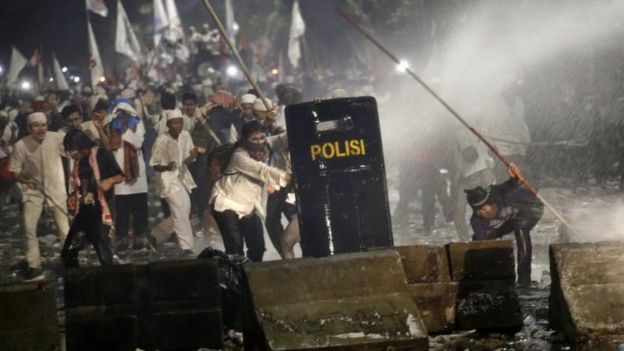
    Clashes broke out between police and protesters who refused to disperse.

    One elderly man died, the Associated Press reports, citing police. Several other people, including police officers, have been injured.

    Protesters had earlier marched upon the presidential palace.

    Police had been braced for the possibility of religious and racial tensions erupting at the rally, which an estimated 50,000 people attended.

    It had mostly been peaceful but groups of angry demonstrators clashed with police after nightfall and set vehicles alight.

    In 1998, a wave of anti-Chinese sentiment led to mobs looting and burning Chinese-owned shops and houses. Ethnic Chinese make up about 1% of Indonesia’s population of 250 million people.

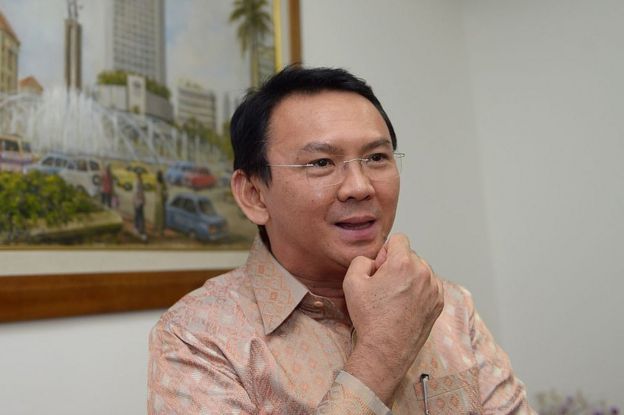
    Basuki Tjahaja Purnama, known by his nickname Ahok, speaks to journalists at his office in Jakarta in 2014
    Protesters are sprayed with water from a police water cannon truck during a clash outside the presidential palace in Jakarta, Indonesia, Friday, Nov. 4, 2016

    The protest was held to demand that Mr Purnama be prosecuted for blasphemy over comments he made in September that were seen as criticising a Koranic verse.

    He said that Islamic groups using a passage of the Koran to urge people not to support him were deceiving voters, who will go to the polls in February.

    The verse is interpreted by some as prohibiting Muslims from living under the leadership of a non-Muslim.

    Mr Purnama has since apologised but formal complaints were lodged against him by Islamic groups for defamation. He is now being investigated by police.

    Who is Governor Ahok?

    Some protesters at Friday’s rally carried signs calling for the governor’s death, the BBC’s Rebecca Henschke in Jakarta says.

    Representatives met with Vice-President Yusuf Kalla, who promised that the investigation into Mr Purnama would be completed within two weeks.

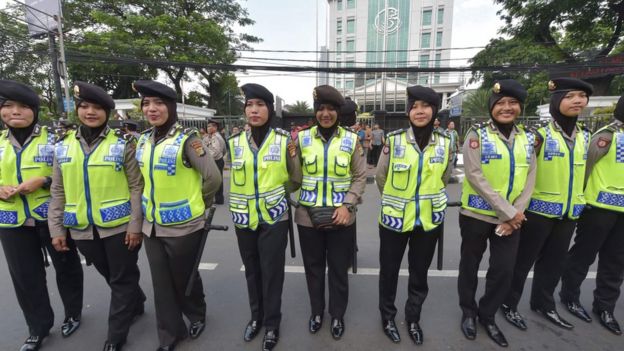
    Indonesian policewomen stand guard as Muslims march towards the presidential palace during a protest against Jakarta governor Basuki Tjahaja Purnama also known as Ahok over an alleged blasphemy in Jakarta on November 4, 2016

    There have long been tensions around Mr Purnama political role.

    In 2014, he was the deputy governor under Joko Widodo. When Mr Widodo was elected president the main group behind the current protest – Islamic Defenders Front (FPI) – did not want Mr Purnama to succeed him.

    They argued that a Christian should not govern a Muslim-majority city. The campaign against him has since taken on anti-Chinese overtones, though the FPI said the rally was not about the governor being from a minority group.

    Jakarta police said there were “provocative statements and images” on social media urging people to take violent action against Mr Purnama, including calls to kill him.

    Despite being seen as brash and outspoken, the governor is popular among many in the capital and has been praised for his effectiveness.

    Muslims in Indonesia are largely moderate and the country’s largest Islamic organisation, Nahdlatul Ulama, had advised its 40 million members not to take part in the protest.


    Source: www.bbc.com

deneme bonusu