KUALA LUMPUR, July 23 ― Any male Kelantan PAS lawmaker who quits the party will be considered to have divorced his wife “automatically”, the state Mentri Besar Datuk Ahmad Yaakob has said in the wake of the controversial set-up of a new political outfit by splinter group Gerakan Harapan Baru (GHB).
Several Malay dailies reported Ahmad insisting that the divorce was legit under an oath called the “third talaq bai’ah”, sworn by all its assemblymen and MPs dating back to at least 2004.
“The oath is true… When it happens, in Islam, even if we utter it once, the effect will be long-lasting,” the PAS deputy spiritual leader was quoted telling reporters in Kelantan yesterday.
“Like what have been said by Kelantan Chief Shariah Judge Datuk Daud Muhammad, don’t take light of this because the effect is lasting… Don’t play around with this,” he added.
The oath has since resurfaced on social media after PAS’ progressives were ousted at the party elections last month and went on to set up GHB as a precursor to the new Islamist political party they hope to register on September 14.
The oath is allegedly a must for Kelantan PAS lawmakers before accepting their posts and requires them to swear to divorce their wives with the “third talaq” the moment they join a new party.
Talaq ― or talak as it is spelled locally ― is a type of divorce in Islam which provides the man an avenue to initiate a divorce through simply pronouncing the word; if the man pronounces a “third talaq”, he is then prohibited from getting back with his wife again, unless he takes another woman as his wife and then divorces her afterwards before remarrying the first woman.
Malay Mail Online cannot yet verify if a similar oath exists for Kelantan PAS’ women lawmakers too, such as Demit assemblyman Mumtaz Md Nawi and Tanjong Mas assemblyman Rohani Ibrahim.
Kelatan’s chief Shariah judge had reportedly warned PAS members that such talaq was considered valid although it was recited in an oath or in jest, and breaking the oath would require them to proceed to the Shariah Court to verify the divorce.
There are at least six Kelantan PAS lawmakers who are expected to join GHB’s new party: Tumpat MP Datuk Kamarudin Jaafar, Kuala Krai MP Dr Mohd Hatta Ramli, Pasir Puteh MP Datuk Dr Nik Mazian Nik Mohamad, Kelaboran assemblyman Mohamad Zaki Ibrahim, and Tendong assemblyman Rozi Mohamad.
PETALING JAYA: The trend of adopting Arab attire and words is harmless as long as it does not drown out the Malay Nusantara heritage, says Datuk Noor Farida Ariffin (pic).
Adding to the debate on whether the alleged “Arabisation” of Malay Muslims is a cause for concern, the G25 coordinator said that only small parts of Arab culture were being absorbed.
“You have the overt symbols in the sense that you see a lot more people are wearing the abaya (black robe for women), and there are a lot of Arab words being used now,” she said.
Noor Farida also noted that while Malay Muslims today tend to prefer words like “solat” to “sembahyang” and “iftar” instead of “buka puasa”, the changes in vocabulary are minimal.
She, however, refuted the claims of an online news portal columnist that baju kurungs are now difficult to come by in shops as they have been replaced by abayas.
Noor Farida said that while traditionally, baju kurungs are tailored, one can easily still purchase them in shops.
“We Muslims pray five times a day. Many Muslim women feel that by wearing the abaya and the tudung (headscarf), they don’t even need to wear the telekung (white prayer garb) so in that way it is more convenient for them,” said the former Malaysian Ambassador to the Netherlands.
Noor Farida added that she too wears the abaya to the mosque as its more convenient.
“I hope that it is just for convenience rather than the fact that they think they should discard the Malay baju kurung or kebaya because it is unIslamic. So long as it is confined to harmless manifestations, it is fine, but if it’s going to go beyond that and we are going to adopt their (Arab) conservative values then that would be a cause for concern. Especially if we totally lose pride in our own culture,” she said.
“I hope it will not be widespread as to threaten our own Malay Nusantara culture, Islam Nusantara, which is a centuries-old culture which we ought to be proud of,” she said.
Noor Farida does not believe, however, that the Malay community are adopting Arab culture wholesale.
“I don’t think the word ‘culture’ is very apt in the circumstance. If you talk about culture, it’s also about adopting their music and their values,” she said.
Noor Farida, who is also the former director-general of the Foreign Ministry’s Research, Treaties and International Law Department, explained that certain Arab values, such as with regard to the treatment of women, had not seeped into Malay culture as Malay women were still very independent and are given a greater amount of respect.
“I really would not like to see Arab values, especially Saudi Arab values, being adopted by us as they are not very respectful of women. Women occupy very low standing in the eyes of many Arabs. In that sense, I think we are still very different from them because women’s rights groups here are still very active and there is no legal impediment to women’s upward mobility in professions,” she said, adding that in the Malaysian working sector, women could “aim for the sky”.
That being said, Noor Faida stressed that Arab culture was also very diverse. For example, Saudi culture, which is influenced by the strictly conservative Wahhabi interpretation of Islam, is far more rigid than the North African Arab culture.
Noor Farida said that the Saudi culture’s view towards woman was not necessarily Islamic.
She explained that during Prophet Muhammad’s time, women in Arabia were given a vast amount of rights. For example, women then had rights to property and the right to retain their own names after marriage.
“Don’t forget that the Prophet’s first wife, Siti Khadijah, was a very successful businesswoman. In those days, women were still confined to their homes in medieval Europe. Unfortunately, we seem to be regressing. We seem to be going back to the age of ignorance, the age of jahiliyyah. In that sense it would be a pity if we were to regress and adopt conservative Arab values, especially with regard to women’s rights,” she said.
“Many Malay Muslims equate Arab culture with Islam. They don’t realise that not all Arabs are Muslims. There are many Christian Arabs in Palestine and Syria. In Egypt, you’ve got the Coptic Christians so Islam should not equate Arab and vice versa,” she said.
“(It is fine) for the moment so long as it is confined to attire and the absorption of a few Arab words,” she said.
However, some elementes of “Arabisation” have also got Noor Farida peeved like the time someone gave her a “lexicon of Arabic words” to replace existent Malay greetings.
“Honestly, I was quite irritated by that. Please let us respect our values and our culture so long as it is not against Islamic teachings,” she said.
On Dec 8, 2014, The Star published G25’s open letter calling for a review of syariah and civil law in line with the supremacy of the Federal Constitution.
Originally consisting of 25 prominent Malays, most of whom are former high-ranking civil servants, the group now has 53 members and many supporters among other prominent figures.
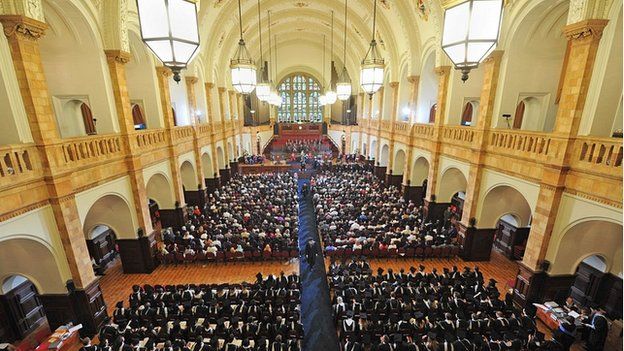
What may be the world’s oldest fragments of the Koran have been found by the University of Birmingham.
Radiocarbon dating found the manuscript to be at least 1,370 years old, making it among the earliest in existence.
The pages of the Muslim holy text had remained unrecognised in the university library for almost a century.
The British Library’s expert on such manuscripts, Dr Muhammad Isa Waley, said this “exciting discovery” would make Muslims “rejoice”.
The manuscript had been kept with a collection of other Middle Eastern books and documents, without being identified as one of the oldest fragments of the Koran in the world.
Oldest texts
When a PhD researcher looked more closely at these pages it was decided to carry out a radiocarbon dating test and the results were “startling”.
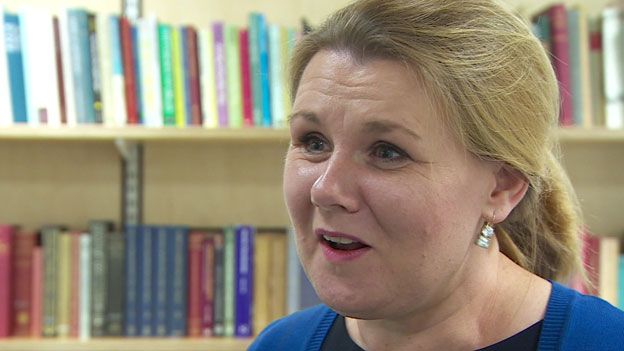
The university’s director of special collections, Susan Worrall, said researchers had not expected “in our wildest dreams” that it would be so old.
“Finding out we had one of the oldest fragments of the Koran in the whole world has been fantastically exciting.”
The University of Birmingham’s manuscript was in a collection brought back from the Middle East
The tests, carried out by the Oxford University Radiocarbon Accelerator Unit, showed that the fragments, written on sheep or goat skin, were among the very oldest surviving texts of the Koran.
These tests provide a range of dates, showing that, with a probability of more than 95%, the parchment was from between 568 and 645.
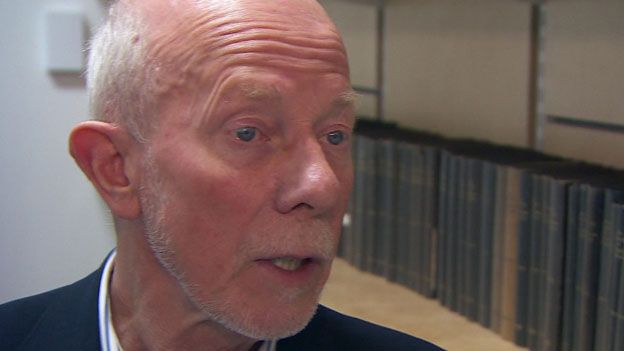
“They could well take us back to within a few years of the actual founding of Islam,” said David Thomas, the university’s professor of Christianity and Islam.
“According to Muslim tradition, the Prophet Muhammad received the revelations that form the Koran, the scripture of Islam, between the years 610 and 632, the year of his death.”
Prof Thomas says the dating of the Birmingham folios would mean it was quite possible that the person who had written them would have been alive at the time of the Prophet Muhammad.
“The person who actually wrote it could well have known the Prophet Muhammad. He would have seen him probably, he would maybe have heard him preach. He may have known him personally – and that really is quite a thought to conjure with,” he says.
First-hand witness
Prof Thomas says that some of the passages of the Koran were written down on parchment, stone, palm leaves and the shoulder blades of camels – and a final version, collected in book form, was completed in about 650.
Prof Thomas says the writer of this manuscript could have heard the Prophet Muhammad preach
He says that “the parts of the Koran that are written on this parchment can, with a degree of confidence, be dated to less than two decades after Muhammad’s death”.
“These portions must have been in a form that is very close to the form of the Koran read today, supporting the view that the text has undergone little or no alteration and that it can be dated to a point very close to the time it was believed to be revealed.”
Susan Worrall says the university wants to put this internationally significant discovery on public display
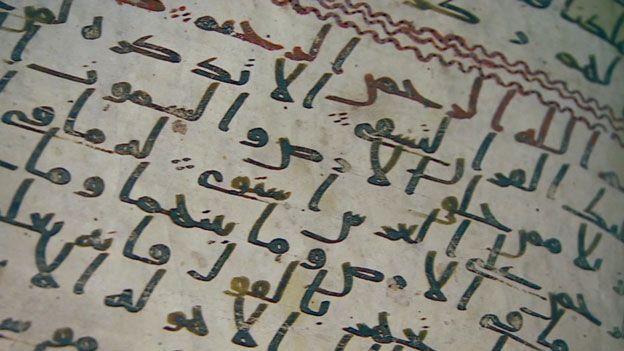
The manuscript, written in “Hijazi script”, an early form of written Arabic, becomes one of the oldest known fragments of the Koran.
Because radiocarbon dating creates a range of possible ages, there is a handful of other manuscripts in public and private collections which overlap. So this makes it impossible to say that any is definitively the oldest.
But the latest possible date of the Birmingham discovery – 645 – would put it among the very oldest.
‘Precious survivor’
Dr Waley, curator for such manuscripts at the British Library, said “these two folios, in a beautiful and surprisingly legible Hijazi hand, almost certainly date from the time of the first three caliphs”.
The first three caliphs were leaders in the Muslim community between about 632 and 656.
The fragments of the Koran are still clearly legible
Dr Waley says that under the third caliph, Uthman ibn Affan, copies of the “definitive edition” were distributed.
“The Muslim community was not wealthy enough to stockpile animal skins for decades, and to produce a complete Mushaf, or copy, of the Holy Koran required a great many of them.”
Dr Waley suggests that the manuscript found by Birmingham is a “precious survivor” of a copy from that era or could be even earlier.
“In any case, this – along with the sheer beauty of the content and the surprisingly clear Hijazi script – is news to rejoice Muslim hearts.”
Muhammad Afzal of Birmingham Central Mosque said he was very moved to see the manuscript
The manuscript is part of the Mingana Collection of more than 3,000 Middle Eastern documents gathered in the 1920s by Alphonse Mingana, a Chaldean priest born near Mosul in modern-day Iraq.
He was sponsored to take collecting trips to the Middle East by Edward Cadbury, who was part of the chocolate-making dynasty.
The local Muslim community has already expressed its delight at the discovery in their city and the university says the manuscript will be put on public display.
“When I saw these pages I was very moved. There were tears of joy and emotion in my eyes. And I’m sure people from all over the UK will come to Birmingham to have a glimpse of these pages,” said Muhammad Afzal, chairman of Birmingham Central Mosque.
Prof Thomas says it will show people in Birmingham that they have a “treasure that is second to none”.
This post is directed to a certain someone yang tidak tau menghormati sesama manusia.
Firstly mohon maaf kalau ada yg terasa atau tersinggung.Alhamdulillah,dah setahun saya mulakan perniagaan ini saya pun tak menduga mendapat sambutan yang baik terhadap lampu ini.Ramai yang bertanya mcm mana saya boleh mendapatkan idea untuk menjual lampu ini.Dengan jujur saya katakan ianya adalah pemberian dari Allah swt.Hanya mereka yang rapat dengan saya tahu cerita sebenarnya disebalik lampu ini dan maknanya dalam kehidupan saya.Ianya bukan setakat satu perniagaan.
Saya pernah menerima tawaran dari sekumpulan jejaka Melayu untuk memasarkan lampu saya di Malaysia dengan confirmed order seribu unit setiap bulan,which they wanted to make an advanced payment for 2 months,mereka hanya meminta saya menambahkan audio ‘zikir’ yang telah mereka siapkan.Pada luaran CDnya nampak biasa. Bila saya mendengar CD tu permulaannya pun biasa,but bila middle part dah masuk chanting yang lain yang bukan dari agama kita.Cik Puan kalau saya mengejar kekayaan saya takkan even mendengar CD tu saya akan terus menerima tawarannya.Saya tahu tanggungjawap dan amanah saya sebagai seorang umat Islam.
Saya ini manusia biasa yang tidak lari dari melakukan dosa setiap hari,jadi siapalah saya untuk menilai pelanggan yang membeli lampu saya.Kalau awak nak katakan seorang itu tidak boleh membeli lampu ini hanya kerana kelainannya,tidak pernah pulak saya terbaca atau dengar yang mereka ini tidak boleh membeli sesuatu yang ada kaitan dengan agama.Ada ke hadis2 untuk support ulasan awak. Boleh tak awak yang bijaksana jelaskan pada saya.Tolonglah jangan menghina golongan tertentu terlalu sangat they pun manusia biasa yang mempunyai perasaan seperti kita.
Saya memang ada pelanggan dari agama lain.Sebelum awak tanya saya mengapa saya menjual pada mereka kenapa awak tak tanya mengapa mereka membeli.Untuk pengetahuan awak saya amat tersentuh hati bila diberitahu lampu2 yg dibeli adalah hadiah untuk teman2 Islam mereka.Cuba tanya pada diri sendiri pernah ke awak membeli sesuatu yang memberi kebaikan pada teman2 awak. Janganlah menilai seseorang tanpa mengetahui niat mereka.
Dalam perniagaan yang singkat ini saya dah banyak menerima rejection oleh pihak2 tertentu just because this is an Islamic product,saya pun dah biasa dgn msg2 yang tak bermakna seperti ini walau macam mana pun ianya tidak akan mematahkan semangat saya.Saya yakin pada ketentuan Allah.HE IS THE BEST PLANNER N INSYAALLAH HE WILL EASE MY PATH.Janganlah soalkan adat dalam perniagaan when u have yet to walk the path that I have walked,u never knew the sweat n tears that I went thru in this biz.
Just a little note for you kalau awak membenci seseorang istighfar dan hadiahkan surah Fateha untuknya.InsyaAllah akan ada kelegaan dihati.
KUALA LUMPUR, July 21 — Perak mufti Tan Sri Harussani Zakaria urged authorities to reconsider awarding licences for cinemas today, claiming that Muslims frequent them not to watch films but to indulge in “hanky panky”.
In a report by news portal Astro Awani, Harussani was quoted saying cinemas are a form of “vice” that is detrimental to the faith of Muslims in this country.
“The cinemas themselves are a vice, what more sitting at couple seats that encourage others to commit vice in the cinemas,” Harussani told Awani.
“No licence should have been awarded, they are there not to watch movies, but to ‘beromen’,” he added, using the Malay slang that roughly means “hanky panky”, but which is also used to mean “having sex”.
Harussani also urged religious enforcers to nab unmarried couples whenever they see any, and not just in cinemas.
“We spend so much money for preaching, but our own side is encouraging vice,” said Harussani.
“The cinemas are already showing ‘romen’ stories, people who watch them want to ‘romen’ at their own seats; I don’t get why all this is happening.”
Awani reported earlier today that a cinema outlet has banned unmarried Muslims from selecting couple’s seats — adjoining seats without an armrest separating the two — when frequenting its outlets in Perak.
The report said that the Lotus Five Star (LFS) cinema in Seri Iskandar, a township with several tertiary education institutions, had issued the ban following “advice” from the Perak Tengah Municipal Council.
It is unknown what by-law authorises the council to advise LFS’s management to implement the ban.
It is also unclear how the cinema enforces the ban or what action will be taken for those who defy it.
Malay Mail Online cannot yet reach LFS or the council for verification.
LFS operates over 25 cinemas across the country, and is popularly known for showing Hindi and Tamil films.