Category: Komentar

Send in your opinion to [email protected].
Kirimkan pandangan anda kepada [email protected].

  • Children In Singapore Start Consuming Alcohol At Increasingly Younger Age

    Children In Singapore Start Consuming Alcohol At Increasingly Younger Age

    Ben had his first drink of whiskey and cola when he was 13 and in Secondary One. It was with a group of friends, after school at a staircase near his Redhill home.

    It was not a big deal, insists Ben (not his real name), now 18. “My older brother was already drinking and my father drank at home all the time,” he said.

    He is part of a new generation of teenagers who are beginning to drink younger, say social workers concerned about a trend they started noticing about four years ago.

    “In the past, most teenagers would start drinking at 15 or 16, but now we are seeing 12- or 13-year-olds,” said Dr Carol Balhetchet, senior director for youth services at the Singapore Children’s Society.

    One of the main reasons is a growing tolerance for social drinking. “Nowadays, it’s not uncommon for adults to drink socially in front of children,” said Dr Balhetchet.

    That was how a seven-year-old girl had her first drink.

    “The mother was drinking wine and left it unfinished on the table, the girl just went up and took a sip,” she said.

    Figures for alcohol abuse among youth are mostly anecdotal, with VWOs saying they deal with between five and 10 cases each year.

    The National Addictions Management Service (NAMS) deals with 10 to 15 cases of problem drinking among youth aged 19 or below each year.

    Dr Gomathinayagam Kandasami, a NAMS consultant and head of addiction medicine at the Institute of Mental Health, said that while some teenagers might miss classes because of a drinking binge or argue with their parents, they are unlikely to experience the serious loss in functioning long-time alcoholics grapple with.

    “Younger people may not experience the full range of alcohol-related problems,” he said.

    Many of them only get help for their drinking habits when the law catches up to them for other offences.

    For Ben, that was in 2012 when he stole a bottle of blackcurrant-flavoured vodka from a convenience store.

    “I hadn’t had a drink in two weeks and I couldn’t afford alcohol. I couldn’t control myself,” said Ben, who is from a single-parent family and currently serving national service. He was caught on the store’s CCTV cameras and arrested.

    The legal age for buying alcohol is 18, but younger people do not have difficulty getting their drinks, social workers said.

    “They can easily get older friends to buy drinks for them,” said Ms Lena Teo, assistant director of counselling at the Children-at-Risk Empowerment Association (Care Singapore). “Some buy rice wine from supermarkets, and easily say it is for their mothers to use in cooking.”

    Ms Sheena Jebal, principal counselling psychologist at NuLife Care and Counselling Services, said teenagers may pour the liquor into soft drink cans so they can drink undetected in public – under void decks and in parks. “I can say now every youth-at-risk would have experienced drinking at least once,” she said.

    The problem is worrying because many go on to more serious vices, she noted. “It’s thrill-seeking behaviour. One starts with smoking first, then drinking – and if they can smoke and drink and not get caught, they will move on to the next level,” she said, adding that some move on to drugs such as Ice and Ecstasy.

    This appears to corroborate Central Narcotics Bureau data which shows that drug addicts under 30 now make up two-thirds of new abusers.

    Mr Moses Huang, counselling therapist at Ain Society, said the common thread that unites young alcohol abusers tends to be parental neglect. “They can come from low-income families or the super rich. If parents don’t spend time with them to educate them about drinking, they can be easily influenced,” he added.

    The VWOs said a concerted effort is needed to address the problem – with education both in schools and in the home.

    The Liquor Control Bill – which bans public consumption of alcohol after 10.30pm, and is expected to come into force in April – will also help, said Ms Sheena.

    She said the ban is coming at the right time, and added: “If not, you would see more and more young people wasting their lives away drinking.”


    Source: www.straitstimes.com

  • Singapore Needs To Look Beyond ‘Swamp To Skyscraper’ Narrative

    Singapore Needs To Look Beyond ‘Swamp To Skyscraper’ Narrative

    It’s good for a country to look back on its history once in awhile. Good to stop and take stock of how far we’ve come, how much more we’ve got to go. It makes sense that we’re doing this on a massive scale during Singapore’s Jubilee year, but there’s one myth that really, really needs to be busted: the narrative of “fishing village to sparkling metropolis”.

    A recent BBC article framed Singapore’s growth as “swamp to skyscrapers” – a narrative most Singaporeans are familiar with by now. It’s a story we were told in schools, reinforced by numerous National Day Parades and referred to so regularly that it’s often left unquestioned.

    Yet it doesn’t take very long to find the flaws in the story. Colonised by the British in the early 1800s, Singapore was a major hub of entrepôt trade. It was an important wealth-spinner for the colonial masters; they would never have left it primitive and under-developed. Infrastructure needed to be built to support all the administrative and commercial activities that came with establishing a major port, and build it they did.

    In fact, the British were only the latest – and most remembered – to have carried out significant activities in Singapore. Textbooks in schools have been revised to go beyond the 1800s, so as to better reflect the richness of Singapore’s history. They now include, for example, Singapore’s role as a trading post in the 1300s – over six centuries before Singapore became a sovereign nation-state.

    The importance of dismantling the “swamp to skyscrapers” myth is not just about correcting historical accuracy. It’s also about politics.

    This narrative – with all its connotations of “swamps” being rough, poor and undesirable, while “skyscrapers” are modern, wealthy and impressive – suggests that Singapore had nothing when we were first required to stand on our own two feet in 1965. If we accept that premise, it then follows that everything we have today came from the efforts and genius of the political leaders who governed this country.

    By the time we get to this point of the story, the politics of gratitude and obedience would have already kicked in. Implicit behind all this is also that fearful, anxious voice, whispering: “How easily all this can be lost, if we make the wrong move, if we vote for the wrong party, if we allow too much dissent!”

    There’s no denying that, for better or worse, the PAP has had a huge impact on Singapore’s development. That our political leaders – especially those in the early years of independence – have accomplished a remarkable feat of forward-looking city planning.

    But to buy into the “swamp to skyscrapers” or “fishing village to metropolis” narrative is to fail to see the full story. It’s to fail to see that by the time Singapore achieved full independence it already had an established legal system and penal code, with administrative centres and even Southeast Asia’s first air-conditioned skyscraper (as pointed out on Twitter). It’s to fail to see that Singapore is, and has always been, far more than the PAP, far more than the colonial masters, far more than any partisan politics or economic philosophy or political ideology we have ever encountered.

    That’s a perspective I find far more honest and exciting than the that of sudden transformation from tropical swampland to glass-and-steel megacity. It’s the idea that Singapore has endured, can endure,will endure far beyond what we can conceive for it – and that leaves us with so much more space to dream, to imagine, and to dare.

    Kirsten Han is a Singaporean blogger, journalist and filmmaker. She is also involved in the We Believe in Second Chances campaign for the abolishment of the death penalty. A social media junkie, she tweets at @kixes. The views expressed are her own.


    Source: https://sg.news.yahoo.com

  • Improve Public Transport To Curb Car Usage

    Improve Public Transport To Curb Car Usage

    I refer to the letter “Reasons for petrol duty hikes sound” (Feb 26).

    Curbing carbon emissions and car usage may seem sound enough reasons for the hikes, but the frequent jams and slow traffic on our roads are underlying symptoms of a bigger problem: A lack of efficiency in our public transport system.

    On the day the Budget and the petrol hikes were announced, the irony was not lost on us that a track fault caused a disruption in train service. (“North South Line hit by hours-long train service disruption”; Feb 23, online)

    Other everyday problems, such as being unable to board a packed train or attempting to board a single-deck bus during peak hours, are some of the factors that push people to own a car.

    I do not own one and the writer might consider car ownership as a privilege, but with the problems many of us face when using public transport, owning a car has become a necessity, especially for families with young children or seniors.

    As the writer mentioned, an array of measures is required to ensure that our roads are smooth. Then, the best way to curb car usage is to improve our public transport and make people want to use an efficient, world-class system.

    After all, if one is going out with one’s elderly parents, would they rather be seated comfortably in a car or squeezed into a packed train without a seat?


    Source: www.todayonline.com

  • Rote Learning Is Not The Way To Learn Science

    Rote Learning Is Not The Way To Learn Science

    From ‘Only one right answer to science questions?’23 Feb 2015, article by Amelia Teng and Pearl Lee, ST

    EXPLAIN how the hard, bony body of a seahorse could be an advantage. The right answer, according to one Primary 6 science teacher, is: “It protects the seahorse from injury and reduces the chances of predators successfully feeding on it.”

    But the child who wrote “It acts as an armour that protects the seahorse from predators” was told that her answer was wrong. This was one of several examples thrown up by parents, who have complained recently that primary school science teachers are too rigid in marking open-ended questions, and are emphasising rote learning over the understanding of concepts.

    This, despite schools having shifted to an inquiry-based learning approach in science since 2008. With the approach, pupils are encouraged to ask questions, analyse data and come to their own conclusions.

    Several parents wrote to The Straits Times Forum page earlier this month, calling for schools to be more flexible. Most said their children were unduly penalised for answers that had the same meaning as the correct ones, but did not contain the right “key words”.

    The children had been told by teachers to stick to key phrases and words found in textbooks, in order to get full marks in assignments or tests.

    Here’s another Primary 3 head-scratcher for you:

    What is the difference between a bird and a lion?

    If you said the ‘bird has feathers but the lion does not’, you’re wrong. You’re also wrong if you said ‘The bird can fly but the lion can’t’, ‘birds evolved from flying dinosaurs but not lions’, or even ‘birds poop on cars but lions poop on the ground’ (assuming the question involves you staring at a picture of a bird and a lion). The correct answer, according to a parent complaining to the ST Forum earlier this month (‘Good science=Poor English’, Feb 5 2015) is ‘The bird has feathers but the lion does NOT HAVE FEATHERS’, which basically means the same damn thing as your original answer, except annoyingly repetitive. (Well if you want to be even more specific: a bird has feathers but a lion has fur, not feathers).

    Clearly, the student knows what he’s talking about, that a lion does not have feathers, but the science teacher here doesn’t give a hoot about your ‘understanding’ if it does not fit into the template answer scheme, even if the same statement in a composition about bird and lions would make your English teacher squirm in her seat, and accuse you of trying to make up the 500 word quota with redundancies. The parent summed it up perfectly in his letter: “Is there rigidity in the teaching of science? It would certainly appear so (that there is rigidity in the teaching of science)”. Take that, Rigidity!

    Not convinced that teachers can be anal about science answers? Here’s another puzzler on animals.

    You could be thinking of the following possible answers:

    1) Both the bull and the lion give birth to their young
    2) Both the bull and lion poop and pee
    3) Both the bull and lion can kill you
    4) Both the bull and lion are mammals

    ALL OF THE ABOVE ARE WRONG. (The answers are ‘4 legs’, ‘have hair’, or ‘similar body shape’ i.e something you can actually see from the illustration). The thing that you should be staring hard at isn’t the actual drawing, but the phrase ‘STUDY the animals BELOW’. Gotcha.

    Let’s up the ante with a dreaded multiple choice question about the properties of a light bulb.

    Now read the last option carefully before you make your choice. If you chose ‘all of the above’, you are interpreting D as ‘the bulb lights up only when electricity passes through it’. If you chose ‘A, B and C’ you read it as ‘light energy is the only energy that is given off when electricity passes through it’. The correct answer happens to be the latter. Answer D, in the spirit of the other animal questions, happens to be the grammatical equivalent of the rabbit/duck gestalt optical illusion. Given the ambiguity of this shitty question, no student should be penalised for seeing a rabbit when the answer scheme says duck.

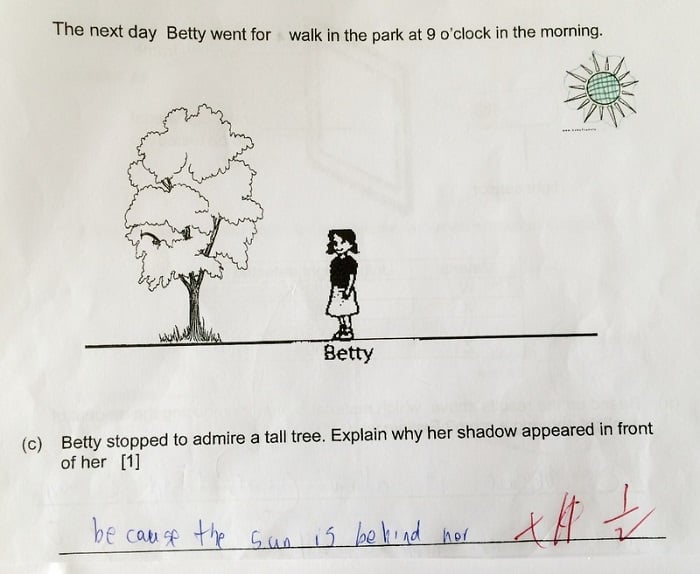
    Do you know how a shadow is formed? Here’s one student’s answer to a puzzle that has tickled the intellect of many an ancient Greek philosopher.

    The complete answer is ‘Because the sun is behind her and she is blocking the path of the light’. You know what this obsession with ‘complete’ answers will do to our kids? They’ll never be able to complete their paper on time because they’d want to add details like ‘because light travels in straight lines and Betty is an opaque human being and she will generate a penumbra and umbra depending on the angle and intensity of the sunlight’. Just to play safe. Except that some teachers will still mark you wrong for ‘trying to be clever’ when penumbrae and umbrae are not taught until you’re in secondary school. If you mention anything about photons or the particle-wave duality you may be suspended from school altogether.

    But back to the seahorse question. If I were grading the student I’ll not only let it go, I would also give her BONUS marks for using her imagination and drawing a figurative analogy between ‘hard skin’ and ‘armour’. By our school standards, this paper published in the rather obscure ‘Acta Biomaterialia’ journal is pure BULL. Its title?Highly deformable bones: Unusual deformation mechanisms of seahorse armor(Porter et al).

    All this nitpicking over ‘key words’ will not only kill our children’s love for science, but also restricts how individuals grasp concepts, punishing those who, well, ‘think outside the box’. A student who sees beyond 4 legs and digs deeper into the taxonomic characteristics of mammals vs birds is given zero marks vs another who memorises ‘key words’ because his tuition teacher said so. Flowery language, like ‘armour’, is not ‘scientific’ and has no place in a science paper, they say. Well try describing DNA to laymen without ‘unscientific’ analogies like zippers and enzyme/cell receptor interactions without using ‘lock and key’.

    Final question: What’s the difference between a robot and a typical Singaporean Science student?

    Answer: The robot needs electricity to recharge but the student does not need electricity to recharge.


    Source: http://everythingalsocomplain.com

  • Practising Islam In Short Shorts

    Practising Islam In Short Shorts

    The scenario I’m about to describe has happened to me more times than I can count, in more cities than I can remember, mostly in Western cities here in the U.S. and Europe.

    I walk into a store. There’s a woman shopping in the store that I can clearly identify as Muslim. In some scenarios she’s standing behind the cash register tallying up totals and returning change to customers. She’s wearing a headscarf. It’s tightly fastened under her face where her head meets her neck. Arms covered to the wrists. Ankles modestly hidden behind loose fitting pants or a long, flowy dress. She’s Muslim. I know it. Everyone around her knows it. I stare at her briefly and think to myself, “She can’t tell if I’m staring at her because I think she is a spectacle or because I recognize something we share.”

    I realize this must make her uncomfortable, so I look away. I want to say something, something that indicates I’m not staring because I’m not familiar with how she chooses to cover herself. Something that indicates that my mother dresses like her. That I grew up in an Arab state touching the Persian Gulf where the majority dresses like her. That I also face East and recite Quran when I pray.

    “Should I greet her with A’salamu alaikum?” I ask myself. Then I look at what I picked out to wear on this day. A pair of distressed denim short shorts, a button-down Oxford shirt, and sandals. My hair is a big, curly entity on top of my head; still air-drying after my morning shower. Then I remember my two nose rings, one hugging my right nostril, the other snugly hanging around my septum. The rings have become a part of my face. I don’t notice them until I have to blow my nose or until I meet someone not accustomed to face piercings.

    I decide not to say anything to her. I pretend that we have nothing in common and that I don’t understand her native tongue or the language in which she prays. The reason I don’t connect with her is that I’m not prepared for a possibly judgmental glance up and down my body. I don’t want to read her mind as she hesitantly responds, “Wa’alaikum a’salam.”

    I’m guilty of judging and projecting my thoughts onto her before giving her a chance to receive this information and respond to it. It’s wrong. My hesitation in these scenarios comes from knowing that a sizable number of people from my religion look at people dressed like me and write us off as women who have lost their way and veered off the path of Islam. I don’t cover my thighs, let alone my ankles. (The most dominant Islamic schools of thought consider a woman’s ankles to be ‘awrah, meaning an intimate part of her body, and revealing it is undoubtedly a sin.) Nothing in my outward appearance speaks to or represents the beliefs I carry. Some might even get to know me and still label me as a non-practicing Muslim—I drink whiskey and I smoke weed regularly.

    However, I am a practicing Muslim. I pray (sometimes), fast, recite the travel supplication before I start my car’s engine, pay my zakkah (an annual charitable practice that is obligatory for all that can afford it) and, most importantly, I feel very Muslim. There are many like me. We don’t believe in a monolithic practice of Islam. We love Islam, and because we love it so much we refuse to reduce it to an inflexible and fossilized way of life. Yet we still don’t fit anywhere. We’re more comfortable passing for non-Muslims, if it saves us from one or more of the following: unsolicited warnings about the kind punishment that awaits us in hell, unwelcomed advice from a stranger that starts with “I am like your [insert relative],” or an impromptu lecture, straight out of a Wahhabi textbook I thought was nonsense at age 13.

    Islamic studies was part of my formal education until I graduated from high school in the United States. The textbooks we used were from Saudi Arabia, which is the biggest follower of the Wahhabi sect of Islam. The first time I realized it was okay to verbalize how nonsensical these books were was when I was watching a movie with my mother about a family that lost one of their children due to a terminal disease. I must have been 6 or 7 years old. My mother said something to the effect of, “I know Allah has a special place in heaven for mothers that lose their children at a young age.” I looked at my mom and asked her, “Even if they’re not Muslim?” Without breaking eye contact with the TV set she responded, “Even if they’re not Muslim.”

    That was all the permission I needed to allow myself to believe in a more compassionate God than the one spoken about in these textbooks. My parents are pretty religious. They don’t know I smoke or drink. I’m honestly not quite sure how they would react to knowing that I do, but I’m not exactly ready to find out. They encouraged me and my sister to wear headscarves, but they didn’t force us to. Like most parents they didn’t want us wearing anything too revealing or attention grabbing. They would not approve of my wearing shorts.

    When it became fairly evident that we weren’t always praying five times a day, they mostly stayed quiet and occasionally spoke to us about the benefits of prayer. My mother loved reading novels by American writers. She loved movies. She loved music. She tried hard to memorize the Quran, but thought she started too late. They welcomed our male friends and didn’t look at us with suspicion when we walked out of the house with them. My parents hoped their children would closely follow in their footsteps, but trusted us with our own choices.

    I’m steadfast in my belief that exploring and wandering are the reasons I know I am Muslim. Learning about Buddhism brought me closer to Islam because it taught me what surrendering means, a lesson none of my Islamic studies teachers have been able to teach me even though that’s literally what Islam means. My Islamic studies teachers taught me how to how to obsess about the mundane—about all the things I’m doing incorrectly and therefore my prayers will not be accepted. They taught me guilt. They taught me fear. They taught me that being a good Muslim is difficult.

    I never quite rejected Islam, I just took a break from going through the motions of prayer out of guilt. I wanted to see if I could be compelled to return to my prayer rug. I did. I returned when I felt like my life was empty without worship. I prayed out of gratitude. I prayed and it gave me solace. Ablution became less about splashing water over various parts of my body and felt more like a daily cleanse. A baptism. I stopped obsessing about the small things and my new mantra was “Al-‘amal bil niyat,” which means actions are dependent on their intentions. My other mantra was “Al deen yusr,” which translates to religion is ease.

    Exploring and wandering gave me the tools I needed to critically look at the hypocrisy of the ‘ulama’a (Islamic elites/scholars/clerics). I realized that I did not have to practice my religion from the point of view of a largely misogynistic group of people. Two years ago, I denounced most hadith (prophetic traditions and sayings), fiqh (Islamic jurisprudence) and tafseer (interpretation) because these three things, all of which play a huge part in how Islam is practiced today, are filtered through the perspective of Muslims born into normalized extreme patriarchy.

    I haven’t denounced all hadith. I kept the ones that undisputedly made me a better person by teaching me a lesson in morality, kindness, and patience. The two mantras I mentioned above were, in fact, adopted from hadith. The mantra, “Religion is ease” is from a hadith related byAbu Hurayra, one of the Prophet’s companions and the mantra, “actions are dependent on their intentions” is from a hadith related by Umar ibn al-Khattab, one of the successors of the Prophet.

    I mentioned before that there are many like me. Outliers, outsiders, passing as non-Muslims in the vicinity of other Muslims. When confronted, our stance on religion is waived off as a rebellious phase or an urge to fit in with the dominant non-Muslim society we live in. Despite this feeling of not belonging, we are, generally speaking, not tormented by this existence. We live very healthy, dynamic, and diverse lives. We’ve established connections and common ground with many different groups of people and we don’t feel like pariahs. We’ve accepted that until a drastic cultural change happens, we’re going to continue to lead dual or multiple lives.

    I have a new mantra these days, a short surah titled Al-Kafirun (the Disbelievers). For me, the disbelievers, commonly understood to mean those who don’t believe in God and the prophet, also take the form of those who disbelieve that I, too, am a Muslim. The last ayah states, “Lakum deenakum wa liya deen,” meaning for you is your religion, and for me is my religion. A simple phrase that holds the power of interconnectedness in spite of our differences. A verse that can empower me to smile at and greet the woman in the headscarf without fear of judgment.

    Thanaa El-Naggar has been living in the U.S. for the last 19 years and currently resides in Brooklyn, NY.

    [Illustration by Jim Cooke]

    Source: http://truestories.gawker.com

deneme bonusu