Category: Komentar

Send in your opinion to [email protected].
Kirimkan pandangan anda kepada [email protected].

  • Paper Generals Should Be Left Out Of Politics

    Paper Generals Should Be Left Out Of Politics

    The Singapore Cabinet comprises the PM, 2 DPMs and 15 ministers. 5 of them, or slightly more than a quarter, had been generals/equivalent in the military before becoming politicians.

    Another country with many high ranking military officers in the government is North Korea. Myanmar which used to parachute generals into top positions in the government have recently begun a cabinet reshuffle to replace ministerial positions held by the military with scholars. It appears Singapore has regressed – the number of ex generals increased after the last election (ex general George Yeo replaced by Chan Chun Sing and Tan Chuan Jin).

    Military men do not make good leaders in the government for the simple fact that they are used to giving orders. They are not listeners but control freaks. This is evident in Singapore where the mainstream media, grassroots organisations and government bodies continue to be controlled by the PAP.

    Our leader, PM Lee, is himself an ex general, the youngest in Singapore’s history. That PM Lee does not listen is obvious from his ‘solutions’ to our chronic problems ie.

    – Overcrowding/increased cost of living – increase the population to 6.9 million under PAP’s PWP.
    – CPF retirement shortfall – sell HDB homes and downgrade with assistance from HDB.
    – CPF and statutory board failure – edit government web pages and continue to conceal data from the public.
    – High cost of public housing – change the Resale Price Index to make prices look lower.
    – Rat infestation – HDB, town council and NEA not responsible but blame feeding of stray dogs.
    – Foreigners displacing Singaporean employees – employ more foreigners because Singaporeans are overpriced and foreigners help to create jobs for us.
    etc.

    Ten years under ex-general PM Lee’s leadership, Singaporeans have only experienced policy failure after failure. Instead of addressing them, the PAP only masks its failure with the implementation of the PGP, dishing out more grants, shoves its own ‘right’ version of Singapore’s history down our throat, attempts to control online media, silence the CPF ‘noises’ at Hong Lim Park, etc.

    What’s worse about our system is that ALL the generals DO NOT have any combat experience. These paper generals have been fast-tracked because of their stellar academic results and nothing else. What are their real achievements? Transformation of the army by throwing tax dollars at costly state-of-the-art weapons? Introducing pixelised uniforms which have been ditched by the US army? It’s a waste of tax dollars to have about 20 to 30? paper generals on a little red dot.

    SAF/President’s scholars are destined for top jobs in the military since day one. These scholars are ‘untouchable’ and their superiors are acutely aware of their limitations. They simply are not able to understand what the rank and file/ordinary citizens go through.

    The 5 (ex) paper generals in our cabinet are:

    1 (Major General) Chan Chun Sing

    Chan is a PAP MP of Tanjong Pagar GRC which was a walkover in the 2011 election. As such, the popularity or unpopularity of Chan is unknown. Chan has not even spoken at an election rally but from this video, you can be certain he will be a flop without the GRC system.
    Chan has not worked a single day in the private sector and his understanding of local issues is suspect. He served in the army from 1987 to 2011 and was (coincidentally) promoted to army chief during his last year in the army.

    Chan was promoted to Brigadier General (BG) in June 2007. Three short years later, he was promoted to Major General (MG) without accomplishing anything significant. He stayed on as the chief of army and ‘retired’ after only 1 year of service/OJT, wasting precious tax dollars. If Chan had already decided to go into politics, he should have allowed others who would have stayed on to contribute to the army. Or was Chan promoted to look better in politics? Combat experience – zero.

    2 (Brigadier General) Tan Chuan Jin

    Like Chan, Tan also served in the army from 1987 to 2011. Among all the newbie ministers, Tan was the most respected. But from Tan’s handling of the CPF issue and the MOM’s reluctance to address the flawed immigration policy, Tan’s credibility has taken a beating. Tan’s fast-tracked career in the military has disconnected him from ordinary citizens. He has yet to realise PAP’s policy failure and prefers to continue with tweaks.

    3 (Rear Admiral) Lui Tuck Yew

    As an SAF scholar, Lui was fast-tracked to top navy position within 20 years, including his taxpayers-funded studies of course. He was also the CEO of HDB in 2005.

    4 (Rear Admiral) Teo Chee Hean

    Like scholar Lui, Teo’s military career saw him promoted to head the navy within 20 years.

    5 (Brigadier General) Lee Hsien Loong

    Lee joined the SAF in 1971 and rose through the ranks to become the youngest BG in 1983 within a mere 13 years. Excluding the 5 years of studies funded by taxpayers, Lee achieved his miraculous promotion within 8 years. According to Dr Michael Barr, Lee “graduated in 1980 …by this stage he had risen to the rank of Major .. despite having only served for about three years on operational duty”.
    The interesting thing is Lee’s final years in the army where he had received a promotion every year from 1981 to 1983 without a single day in combat!

    In other democratic countries, it takes ‘forever’ to be promoted when one is already holding a very high ranking position. Guess our generals are not known as ‘paper generals’ for nothing.

    Lee’s phenomenal rise in the SAF?
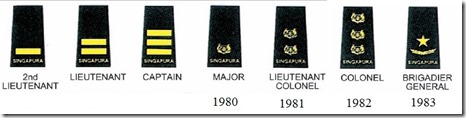
    With a military career as smooth as silk, it is not that PM Lee doesn’t want to understand the reality of mere mortals like us but he really can’t.

    The table (below) is a summary of our paper generals.

    NAME ENLIST RESIGN YEARS RANK
    LEE HSIEN LOONG 1971 1984 13 BRIGADIER GEN
    TEO CHEE HEAN 1972 1992 20 REAR ADMIRAL
    LUI TUCK YEW 1983 2003 20 REAR ADMIRAL
    CHAN CHUN SING 1987 2011 24 MAJOR GEN
    TAN CHUAN JIN 1987 2011 24 BRIGADIER GEN

    * Lee Hsien Loong holds the world record for attaining the rank of BG in the shortest time, without any combat experience, in a democratic country. Our military is designed by scholars, for scholars. Every Tom, Dick and Harry scholar will become a general so long as he toes PAP’s line.

    PM Lee and DPM Teo were both born with a silver spoon in the mouth. One shouldn’t expect them to understand the struggles of ordinary/low wage citizens and PAP’s flawed policies confirm their disconnect.

    Real leaders should never be fast-tracked to top positions based on academic results. Currently, all paper generals are not really elected because of our unique GRC system designed to perpetuate PAP’s power.

    Running a government requires a consultative approach while it’s a top-down approach in the military. After years of a top-down approach, it becomes impossible to teach old dogs new tricks. Paper general George Yeo has already paid the price for not listening. Paper generals are failed politicians as is evidenced by their refusal to engage in a meaningful manner with their ‘wayangs’.

    Without a doubt, generals are army-trained and best left in the military. If paper generals can run our country, pigs should be able to fly.


    Source: http://likedatosocanmeh.wordpress.com


  • Poor Urban Town Planning Leads To Much Unhappiness Among Residents

    Poor Urban Town Planning Leads To Much Unhappiness Among Residents

    Future residents of Build-To-Order (BTO) project Fernvale Lea are up in arms over a planned Chinese temple with columbarium next to their flats. The columbarium, where funeral urns will be stored, will take up 15 per cent of the temple it will be housed at.

    About 400 would-be residents of Fernvale Lea attended a closed-door dialogue with Dr Lam Pin Min, MP for Sengkang West, on Jan 4. There have even been requests to get refunds from the Housing Board.

    There have been other cases of people not wanting certain types of amenities in their neighbourhood – or, as many know it, the not-in-my-backyard (Nimby) syndrome. Here are some past incidents:

    1. October 2013 – International school in Pasir Ris

    Issue: Building of international school near homes

    A group of residents in Pasir Ris were against the idea of a 12-storey international school looming over their homes and causing traffic congestion. They also wanted to preserve the forested area that had to be cleared for the building.

    Outcome: New roads off Pasir Ris Drive 3 and opposite Pasir Ris Drive 10 were created to ensure smooth traffic. Academic buildings were tilted at an angle to reduce the sense of “towering” over the homes, which are mostly terrace or semi-detached homes. The school amenities which generate higher level of noise – such as the school bus drop-off points, sports facilities and the school canteen – were built farthest from the neighbouring residences, nearer to Pasir Ris Drive 3.

    2. February 2013 – Nursing home in Yew Tee

    Issue: Some Yew Tee residents were against plans to build a nursing home in their neighbourhood. They raised concerns like noise pollution during construction, traffic congestion in the single-lane roads that serve the area, and the nursing home blocking their view.

    Outcome: The nursing home was built to be seven storeys, instead of eight, and the single lane in Choa Chu Kang North 6, towards Choa Chu Kang North 5, was expanded into a dual lane.

    3. May 2012 – Nursing home in Bishan East

    Issue: Residents said their view would be blocked by the nursing home, and that air flow would be restricted by the building.

    Outcome: The building was capped at six instead of eight storeys.

    4. May 2012 – Tall condominiums in Upper Bukit Timah

    Issue: Dairy Farm, Chestnut and Cashew estate residents were concerned about taller condominiums being built in the area blocking their green view of a secondary forest, and towering over their low-rise homes. They were also worried that the development may harm the plant and animal life, and increase surface runoff into a canal, which already fills when it rains. They were also upset that a planned road in the area would cut into a canal-side jogging trail popular with residents.

    Outcome: The housing blocks on the site were limited to 15 storeys, and a proposed commercial property next to the site was relocated elsewhere. The construction of the road was held off.

    5. March 2012 – Studio apartments for elderly in Toh Yi

    Issue: Residents in Toh Yi were unhappy with the idea of studio apartments for the elderly being built in their estate. Plans were for the apartments to be built where the area’s main recreational facilities – a basketball court, jogging track and community garden – were. Residents were concerned that these facilities would be taken away from them. Some also questioned if the site was suitable for building apartments for the elderly because of the slopes.

    Outcome: HDB decided to build a children’s playground and community garden on the second floor of the studio apartment building that would be open to everyone. A jogging path was also planned. Fifty carpark spaces were added to relieve the parking shortage in nearby blocks, and footpaths were added to link the studio units seamlessly to the surrounding neighbourhood.

    6. October 2008 – Workers’ dormitory in Serangoon Gardens

    Issue: Serangoon Gardens residents were up in arms over plans to build a workers’ dormitory in their estate. They cited noise and pollution from buses ferrying workers, a possible increase in crime, traffic congestion, and lower market value for their properties in the upper-middle class neighbourhood as reasons for their unhappiness.

    Outcome: No more than 600 foreigners – generally factory workers in the IT and electronics industries in Ang Mo Kio – were housed at the dormitory, although a feasibility study showed that the space could accommodate 1,000 people. An access road to the building was built, so that buses transporting workers to and from the dormitory need not wind through the estate, and would not worsen traffic congestion problems. The facility came with amenities, designed to ensure that workers would spend most of their time in the dormitory. The area for the site also ended up smaller than planned, making it farther from homes.

    7. October 2007 – Funeral home in Sin Ming

    Issue: A proposed building in Sin Ming for funeral parlours triggered protests among some of the area’s residents, who said there were already too many of them in the estate. They said that placing it near their residential blocks was not ideal, taking into account traditional superstitions which associate death and dying with bad luck. Some also feared a drop in the value of their properties. The site for the proposed building was an empty plot next to Bright Hill Temple, which is near Ai Tong School and residential areas, including HDB blocks and private condominiums.

    Outcome: The Government brought forward the development of an adjacent industrial site so it can serve as a buffer between the funeral parlour site and the nearest residential areas and school. Work on the funeral parlour started only after the industrial site developed. The Government also increased the number of car parking lots. The operator of the parlour was also given conditions such as having fully enclosed and air-conditioned premises and confining all activities indoors. All services and activities were screened off from public view through the design and landscaping of the development.


    Source: www.straitstimes.com

  • Tommy Koh: I Am Disturbed By The Inequality In Singapore

    Tommy Koh: I Am Disturbed By The Inequality In Singapore

    Dr Tommy Koh has revealed that the poverty rate in Singapore can be as high as 33 percent in Singapore and 60 percent of university students come from families which cannot earn enough to survive.

    “I am disturbed by the inequality in Singapore,” Dr Koh wrote in an opinion piece in The Straits Times on Jan 3.

    “We have one of the highest Gini coefficients in the world. I am unhappy that many of our children are growing up in poverty. About a third of our students go to school with no pocket money to buy lunch.”

    Indeed, the poverty rate in Singapore has been estimated to be as high as 30 percent. National University of Singapore economist Tilak Abeysinghe has also calculated that 30 percent of Singaporeans cannot earn enough and have to spend 105 percent to 151 percent of their incomes.

    “As a trustee of two education trusts, I am reminded each year of the large number of needy students in our schools and tertiary institutions. I was shocked when the president of one of our universities told us recently that 60 per cent of his students need financial assistance,” Dr Koh also said.

    Indeed, a Straits Times survey had shown that two-thirds of middle-income households in Singapore are able to earn enough only to spend on basic necessities and nothing else.

    “At the other end of the spectrum, I am worried about the growing number of the elderly poor. Many of them are in poor health and have inadequate savings. Many of them live in loneliness, having no family or been abandoned by family and relatives,” he said.

    It is indeed the case that over the past few years, there have been a growing number of stories of how older Singaporeans have chosen to die because they cannot afford their medical fees.

    What Dr Koh say is not new but it is the first admission from someone who is close to the establishment to have detailed these facts.

    Today, Singapore has risen to become the most expensive country and city in the world.

    But Singaporeans still continue to earn one of the lowest wages among the developed countries in the world. In fact, there is still no minimum wage in Singapore – one of only 10 percent of countries in the world not to have one.

    In 2012, Dr Koh also wrote in an article comparing the GDP per capita of Singapore with the Nordic countries. Singapore’s GDP per capita was on par with the Nordic countries, but wages are drastically different.

    Dr Koh revealed that cleaners in Singapore would only earn $800 when cleaners in the Nordic countries would earn between $2,085 to $5,502, or several times more.

    However, because Singaporeans also have to pay for the highest cost of living in the world, this has also meant that Singaporeans have the lowest purchasing power among the developed countries.

    Dr Koh had then also written, “The truth is that we pay these workers such low wages not primarily because their productivity is inherently low, but largely because they are competing against an unlimited supply of cheap foreign workers.

    “The solution is for the State to reduce the supply of cheap foreign workers or introduce a minimum wage or to target specific industries, such as the hospitality industry, for wage enhancement.”

    It is debatable whether the government has done so. The government has said that the basic wages of cleaners will be increased to $1,000 every month and for security guards, this will be increased to $1,100 but the new base salary will only take effect in 2016 for the latter.

    However, critics argue that $1,000 or $1,100 is still insufficient when Singaporeans have estimated that a minimum wage of $1,700 or more would be necessary to have the most basic of living in Singapore.


    Source: www.therealsingapore.com

  • PAP: Change Or Out The Door You Go

    PAP: Change Or Out The Door You Go

    Single-party governments in Southeast Asia are failing across the region unless they are able to reinvent themselves.

    This was what Norshahril Saat, a PhD candidate at the Department of Political and Social Change, Australian National University and a graduate of the National University of Singapore, wrote, in The Straits Times.

    “Are dominant parties of the last century doomed to fail in the 21st?” he asked.

    “Twenty years ago, dominant single-parties were a recognisable feature of South-east Asian politics. Indonesia’s Golkar, Malaysia’s Umno and Singapore’s People’s Action Party were marching to the beat of their own drums, proving to be too formidable for opposition parties.

    “Today, however, the drumbeats are not as confident as in the 1990s: the rhythm has either slowed down – as in Malaysia and Singapore – or is in disarray, as in Indonesia,” he said.

    He pointed how “all three parties have held their congresses” over the last month.

    “Umno and PAP leaders told cadres to persevere or risk losses in the next elections, while Golkar’s leaders acknowledge their crisis.”

    Already, change has taken place in Indonesia.

    “For the first time in its 50-year history, Golkar has become an opposition party,” Mr Norshahril said.

    “During former president Suharto’s New Order administration (1966-1998), Golkar’s authority was unmatched by the opposition parties PDI and PPP. Even after Mr Suharto’s resignation in 1998, Golkar was somehow able to stay in government through forming coalitions with the winning parties and appointing members to the Cabinet.

    “After this year’s legislative and presidential elections, Golkar chose Mr Prabowo Subianto’s opposition Red-White coalition.”

    Golkar lost.

    In Malaysia, even though the dominant party has also weakened tremendously, it has however managed to retain government.

    “In contrast, Malaysia’s Umno stayed united after the disastrous 2013 elections, though the possibility of splits looms large in the years to come,” Mr Norshahril said.

    “At this year’s Umno General Assembly, Prime Minister Najib Razak, who is Umno president, warned party members to unite and to kick-start the party’s renewal process. He urged senior members to give young members a chance to lead the party. The party’s deputy president, Tan Sri Muhyiddin Yassin, also urged party members to work harder to regain grassroots support, saying: “…do or be dead!””

    “Similar alarm bells sounded during the PAP’s 60th-anniversary rally,” Mr Norshahril noted.

    “Party secretary-general Lee Hsien Loong warned cadres to treat the next election, due by early 2017, as a national contest. He also cautioned members about possible losses if they did not work hard.

    “Calling the next election “a deadly serious fight”, Mr Lee also spoke about the possibility of a freak election result that could see the party lose power.”

    However, Mr Norshahril is more lenient in his assessment of the PAP.

    “So far, the PAP has done everything right to avoid Umno’s and Golkar’s mistakes,” he said.

    “First, PAP has given its young members more say in the party’s decisions. It has not repeated Golkar’s failures, of totally ignoring the renewal process, or Umno’s, of leaving the renewal agenda till too late.”

    But Mr Norshahril questioned the wisdom of PAP’s use of “young candidates”.

    “Mr Lee’s decision to place young candidates in the 2011 election appears to have backfired at first glance. Netizens questioned the fielding of Ms Tin Pei Ling – then 27 years old – who was considered lacking in political experience.

    “Still, the decision has allowed the young candidates to make their mark at the grassroots level,” Mr Norshahril thought.

    He also said that, “populism is necessary in politics, but does not guarantee election success”.

    “PAP politicians have been actively posting selfies on social media, telling the public of their outreach.

    “However, as Umno members will tell them, repeated selfies, Facebook and Twitter updates and “I Love PM” campaigns do not automatically translate into votes.

    “Thus, the PAP must not rely too much on such populist moves.

    This is even though the PAP has claimed that it is not a populist government. It looks like its action suggest otherwise and the PAP does seem to want to pander to populist sentiments.

    However, even so, this is unlikely to matter.

    What is more important is for “the PAP needs to be daring enough to break from its past, including its past ideology,” Mr Norshahril said. “Political ideologies have to be made relevant to the political realities of the day.”

    However, Mr Norshahril believes that the PAP is on the right track.

    “The PAP has taken tentative steps to strike out on a new path. For the first time in 32 years, it has amended the party’s Constitution, calling for a “compassionate meritocracy” and “democracy of deeds”. The party has pledged more help for those in the lower-income group and the pioneer generation.”

    “The party would be wise to continue to refresh its ideology, and to allow current leaders to state their disagreements with their predecessors in a respectful manner,” he ended by saying.

    However, what Mr Norshahril did not point out was that when the PAP first started out, it has started out on a constitution of “equality” but it removed this in 1982.

    The latest amendment to its constitution does not include any mention of “equality”.

    Moreover, it is unlikely that Singaporeans’ assessment of the PAP is as generous as Mr Norshahril.

    Where wages in Singapore are one of the lowest here, as compared to the other developed countries and where Singapore has become the most expensive place to live in the world, many Singaporeans are now unforgiving towards the PAP government, believing that the PAP has “lost touch with the ground”.

    Many also believe that the PAP no longer has the heart of the people and do not trust the PAP to lead Singapore anymore.

    Mr Norshahril’s opinion piece seems to act as a warning to the PAP but also as a simplistic hope that the speeches that the PAP has made would actually translate into actual change. Seasoned political observers would understand that the PAP’s current behaviour is only a continuation of its use of its typical rhetoric to sway the people’s minds without any actual change to the policies.

    As the Asia Regional Director for the Centre for Humanitarian Dialogue, Michael Vatikiotis, said, “for established elites in the region it’s that last point about a genuine democratic system that is hardest to swallow. Power can be responsibly wielded, even in the name of the people, but is not easily surrendered.”

    It is unlikely that the PAP would give up its throne without a fight.

    Indeed, the soon-to-be general election will be a “deadly fight” because the PAP will fight to the end for its hold onto power.


    Source: www.therealsingapore.com

  • Defining The Moderates In The Malay Muslim Community – Are Majority Of Us Extremists?

    Defining The Moderates In The Malay Muslim Community – Are Majority Of Us Extremists?

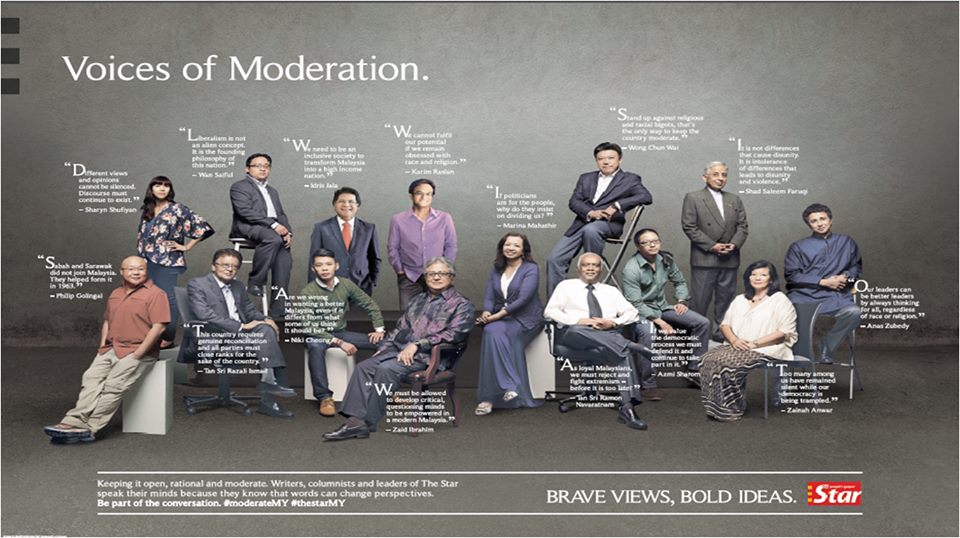
    It is indeed funny to see how the star lined up a band of people whom it called the voices of moderation.

    Well I don’t care about the non-Muslim (not Malay) in the line up because it is none of my business to interfere with how they want to define the term moderation, but it is kind of appalling to see the Malays in the list. They are

    • Marina Mahathir
    • Zaid Ibrahim
    • Razali Ismail (chairman of Global Movement of Moderates)
    • Zainah Anwar (Sisters in Islam co-founder)
    • Karim Raslan
    • Azmi Sharom
    • Anas Zubedy
    • Wan Saiful Wan Jan
    • Sharyn Shufiyan (Tunku Abdul Rahman’s great granddaughter)

    I want to clarify that I have nothing against them personally. What I am against is the people who put them in the list and claimed that they are the voices of moderation that represent the Muslims whereas many Muslims (including me) and Malays are against their thinking and ideology. What more when some of them are well known for carrying ideology that is against the main stream understanding of Islam. Take for example the ladies in the list, whom none is wearing tudung. Zainah Anwar is also known to claimed that covering one’s hair is unnecessary in Islam, whereas the mainstream Muslim understanding all over the world is that it is compulsory. So how can the person ever claimed that Zainah Anwar is the voices of moderation for the Muslim while clearly she is the minority. If Zainah Anwar represents the voices of moderation for the Muslim, does that mean 90% (or probably 99%) of Malaysian Muslim women who believe hair as aurat which needs to be covered in public are the extremist? This is indeed insulting.

    I am not sure if the person who put up the list is a Muslim or not, but for me, as a Muslim, it is a blatant misused (and wrongly used) of the term moderation for the Muslim. Firstly, the term moderation is a very misunderstood terminology. Secondly, for the Muslim, the term moderate is a religious definition where there are hadiths from the prophet S.A.W. that explains about the meaning of moderation. Therefore, to put these Malays (Muslims) as role model of moderation is an insult to the Muslim especially when some of them is known to have ideology and understanding of Islam that is against the understanding and practice of the mainstream Muslim.

    It is Tolerate, not Moderate

    When I dropped the word Moderate into Google, this is what I got

    moderate

    Moderate, by its adjective definition is the average in amount, intensity, quality, or degree. You cannot have an average if you only have one extreme. For example, what is the average of 10? No one can tell you. But if  you ask what is the average between 1 to 10, then the answer is 5. So we can say that 1 is the extreme to the left and 10 is the extreme to the right. So 5 is the moderate value which is in between the two intensities!

    extreams

    The misconception comes in the noun definition. It says that moderate is a person who holds moderate views, especially in politics. Now the problem is that views in politics are subjective. What someone view as moderate may not be viewed as moderate by others. For example, to the non-Muslim, a Muslim who is not wearing tudung is a moderate Muslim. To the many Muslims, she is not a good Muslim. To the non-Muslim, a person who drink only in social occasion is a moderate drinker. To the Muslim, if a Muslim drink at any occasion, he is a sinner. People like Marina, Zainah and Zaid Ibrahim may think that they are the moderate, but to the many they are the liberals and to some they are the deviants.

    The more correct definition that fits them is Tolerate. These people are not moderate, they are just more tolerable, for example, some are more tolerable to western lifestyle where they don’t mind to wear bikini or drinking in a party with alcohol. So does in political view. Some are more tolerable to opposing views.

    There is no point arguing who is indeed the moderate. We can never agree to such a subjective matter. What is unbecoming is for the Star to put up these people and claimed that they are the voices of moderation among the Muslim. it is like the Star trying to shovel the definition Moderation into the throats of Muslim. Who is the Star to tell the world that those people represent the moderate voices of Muslim in Malaysia? That is why I say it is insulting.

    A Religious Definition

    Islam has clear definition moderation. It is in the Quran and there are numerous hadiths from the Prophet s.a.w. about moderation.

    In the Quran, Allah S.W.T. says

    “We made you to be a community of the middle way, so that (with the example of your lives) you might bear witness to the truth before all mankind.” (Qur’an, 2:143) 

    In one of the hadith,

    ‘Abdullah ibn Masood (Allah be pleased with him) reported that once Allah’s Messenger (Peace be upon him) drew a line in the dust with his hand and said, “This is the straight path of Allah.” Then he drew a series of lines to the right of it and to the left and said, “Each of these paths has a devil at its head inviting people to it.” He then recited (Qur’an 6:153), “Verily this is my straight path so follow it and do not follow the (twisted) paths.” (Collected by Ahmad, Nisai and Darimi; see Mishkat ul-Masabih, 1/166)

    If you look back at the adjective definition, you will understand better the concept of moderation in Islam. In every moderation, there is always an extreme left and extreme right. So the moderate is the middle path in between the extremes. Picture speaks a thousand word. By looking at the picture below, you should understand better. This is off course according to Ahlul Sunnah definition.

    moderate2

    What it clearly tells you is that Zainah, Marina, and the other ladies in the list are not the moderate according to the Muslim standard. They are indeed the extremists, the liberals!

    I will list few more examples of moderation in Islam

    EXTREME LEFT MODERATE EXTREME RIGHT
    Marriage
    Priesthood, complete refrain from marriage Marriage up to 4 wives (in this respect, Sister in Islam by Zainah Anwar is against polygamy, so she is not the moderate) More than 4 and unlimited number of concubines
    Relationship with Non-Muslim
    Extreme enimity against non-Muslim irrespective of whether they have peace agreement with the Muslim or not. Treat and deal with those who have peace agreement with Muslim with kindness, honor, respect. Befriend those who are an obvious enemy to Muslim who are known of ploting to destroy Islam and the Muslim
    Ibadah
    Monastery life, i.e. spend whole life doing nothing except in prayer and worship Balance between worldly life and time spend in prayer and worship of God Only focus on world life and ignore worshipping of God
    Charity
    People who give everything and left nothing for themselves Give some part of their wealth for charity and keep the remaining for own use Do not give charity or alms at all

    So it is not difficult to understand moderation in Islam. It is something very clear cut and obvious. There is a law in Islam. Some will take it extremely lightly and some will take it rigidly. The moderate is the one who take the middle path.

    Trying to tell Muslim how to practice Islam

    This is the alter ego and ignorance of many of the non-Muslim today. What exhibits by the Star is the result of this alter ego. They believe these few figures are the “moderates” so they put them as the moderate voices of Malaysia without an iota to think if the mainstream Muslim actually agree with them. Arrogance is one thing, but such ignorance is unacceptable. Even for those non-Muslims, do you think they really represent the voices of moderate among the non-Muslims? Don’t they know that Zainah is one of the most loathe personality among the mainstream Muslim community in Malaysia. How can you ever shovel such person into throats of Muslim forcing them to accept her as role model. This is an utter demonstration of low class journalism.


    Source: https://grandmarquis.wordpress.com