Category: Politik

  • NSP: Workers’ Party Left Us With No Choice, We Had To Enter Into 3-Cornered Fight In MacPherson

    NSP: Workers’ Party Left Us With No Choice, We Had To Enter Into 3-Cornered Fight In MacPherson

    In the wake of a frantic few hours on Nomination Day, which saw three multi-cornered fights emerge in the General Election, the leaders of the National Solidarity Party came forward to say they were “the most active party promoting Opposition unity”.

    NSP candidate Cheo Chai Chen will face a three-cornered fight in MacPherson SMC, where he will come up against the People’s Action Party’s Tin Pei Ling, 31 – the incumbent after the ward was carved out of Marine Parade GRC – and the Workers’ Party’s Bernard Chen, 29.

    Said party Acting Secretary-General Lim Tean, at a press conference where the party’s Tampines GRC team was introduced: “I believe to a very large extent we have avoided multi-cornered fights but for MacPherson we had to do it. MacPherson used to be part of Marine Parade. We did very well in the last GE and we have already made a huge concession to WP there.”

    An NSP team featuring Ms Nicole Seah took 43.36 per cent of the vote against the PAP in 2011.

    “If WP wanted to avoid a three-cornered fight they should have allowed us to fight with PAP in MacPherson,” said Mr Lim.

    “That decision to contest in MacPherson was made a few weeks ago, and we’ve never departed from that decision. NSP has been the most active party promoting Opposition unity. We initiated talks to avoid three-cornered fights.”

    The decision to contest in the SMC led to fissures within the party, including the departure of then-Acting Secretary-General Hazel Poa. Mr Lim said that the lessons learnt over the past few weeks will make the party “stronger for the battle ahead”.

    “We are a democratic party and in a democratic party run on democratic principles you’re going to have a difference in opinions. I think that’s healthy,” said Mr Lim.

    “As for party members who have left, we cannot stop people from leaving – it’s their right to join any party they wish. And as for why we have been so quiet in the last couple of weeks, I think the media made a lot of the disunity and turmoil, so we decided that it’s best not to add to the frenzy, and instead regroup to prepare for the coming GE.”

    NSP President Sebastian Teo – part of the party’s Tampines GRC team that includes Mr Lim, Ms Nor Lella Mardiiah Mohamed, 41, Mr Fong Chin Leong, 46, and Mr Choong Hon Heng, 45 – said that if elected, the party did not think think it would face any problems running a Town Council in Tampines.

    Said Mr Teo: “It’s not that difficult to run a Town Council. I’m sure we have all that we need to put in place and to run a Town Council. It’s not difficult like the PAP say. You need capital, you need manpower. So I don’t understand – what’s so difficult about running a Town Council?”

    The NSP will face a People’s Action Party team led by Education Minister Heng Swee Keat at the polls on Sep 11.


    Source: www.channelnewsasia.com

  • How Worker’s Party’s Bernard Chan Worked To The Top

    How Worker’s Party’s Bernard Chan Worked To The Top

    The Workers’ Party has unveiled grassroots organiser, political activist and recent Oxford graduate Bernard Chen as a candidate for the Sep 11 general elections in Singapore. In an interview conducted by Bryan Kwa in early July 2014, Bernard said he did not harbour intentions in being a Member of Parliament but that politics should be about selfless service and that the Singapore narrative should include the peoples’ history.

    This interview is republished with permission and edited to reflect accuracy in dates. The original interview can be viewed here.

    Bernard Chen is a walking contradiction in terms. He has spent close to a decade as a political activist and speaks like a wise statesman even though he is still in his twenties. Moreover, he has just graduated from the University of Oxford despite failing his GCE ‘A’ levels.

    Bernard, who is 29 this year, enrolled in Temasek Polytechnic after his National Service in 2006 for his “last ticket to university”. In 2013, he graduated with honours from the National University of Singapore with a Bachelor of Arts in History. He then went on to pursue a Masters’ degree in Global and Imperial History at the University of Oxford on a Tan Ean Kiam postgraduate scholarship in the humanities.

    On Grassroots Politics

    He joined The Workers’ Party (WP) when he was 21, as he believed that political competition is needed in Singapore and “it’s the most credible and responsible opposition party around”.

    “I wasn’t pissed off with something that compelled me to join the WP. And I don’t think we should wait for the chance for it, for the moment that you get disappointed with the government.”

    He feels that a culture of service “should permeate throughout society” so that Singapore will be “robust, dynamic and sustainable”.

    Bernard wishes to see the zeitgeist of the first generation of Singapore leaders — that is the willingness to sacrifice personal time and serve just for the sake of service — in today’s generation. He feels that there is a need to “cultivate” such a “mindset”.

    “Where is the public-spiritedness? Where is the ability to see things above and beyond themselves?” he asks.

    Bernard has been a legislative assistant since May 2010. It is a part-time job and he is paid a monthly stipend. His main focus is on the Meet-the-People sessions where he helps the Member of Parliament (MP) draft letters based on the constituents’ complaints.

    “It’s very down-to-earth, very ground work. You just have to be there, speak to people, and understand what their needs are,” he says.

    He started as the legislative assistant to Low Thia Khiang, who was the MP for Hougang and subsequently for Aljunied GRC. Since February 2012, he is the legislative assistant to the MP for Aljunied GRC, Muhamad Faisal.

    Bernard harbours no aspirations to be a minister or MP. Instead, he hopes that his story of a 21-year-old with “no job security, no educational security, no achievements to date” devoting his time to politics can inspire others to come forward to serve, and that “anybody can do it”.

    “You don’t have to wait until you are 50, you are super established, and you have a lot of money,” he says.

    He hopes that his “little act of service… can inspire more intelligent young Singaporeans to come forward” to be “politically-involved, whether it is WP or PAP”. PAP refers to the People’s Action Party, which is the ruling party of the day.

    Moreover, he wants Singaporeans to see that politics can be “responsible, constructive and beneficial”. He contends that politics needs not be adversarial and confrontational.

    Bernard thinks Singapore has the potential to have a “number one” political system, one where “national interest is above partisan interest”. He acknowledges that some see this as empty rhetoric but he thinks that Singapore “can actually” make this a reality.

    “We can. But it is difficult. It is challenging because the ball is not only in the court of the political parties, it is also in the court of the electorate,” he opines.

    “Singapore has always prided itself on our airport, shipyards, efficiency, of our standing in the corruption index or what forms of education index. Why can’t our politics be a shining example to the rest of the world?”
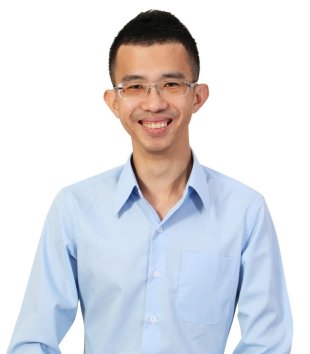
    Bernard Chen - Copy

    On Singapore Narrative

    Given his academic training as a historian, Bernard thinks the Singapore narrative is “quite problematic”. He cites the title of former prime minster Lee Kuan Yew’s memoir “My Singapore Story” as an example of a “problematic” phrasing of the narrative.

    “It serves a very political purpose to once and for all put the nail into the coffin saying that this is the narrative that we want to have,” he suggests. While he does not think it is wrong, he “thinks it is not fair, from the view of a historian”.

    “This is what people usually call the elite discourse. So people who wins power, gets it. So just as someone below should not totally dismiss the Singapore narrative, people on top should also not dismiss subaltern history or peoples’ history of Singapore.” Subaltern history refers to history told by people outside the hegemonic class. (See Singapore Memory Project below)

    “The study of history is never meant to be politicised. It’s meant to be enlightening, to bring light to grey areas, to bring light to areas that are totally dark. That’s history’s contribution. If I can shine a light into a corner, it may not be complete, but someone after me will shine another light to bring out the issue. That’s my contribution. My contribution is to shine the light, his contribution is to shine the light from a different perspective.”

    He posits historians should not “make moral value judgments” but “see where it’s lacking and try to fill it”. He points out that we lack a “comprehensive history of the PAP from a non-Lee Kuan Yew perspective”.

    This is significant. Tham Yuen-C writes in a commentary published in The Straits Times on February 16, 2014 that “a new narrative… forged together by the masses… reminds us that Singapore got to where it is today through the efforts of an entire generation”.

    Bernard continues, “Have we actually asked about the grassroots worker standing beside LKY when he first won Singapore from the government of the British? No. Is it valuable? Yes. What was he thinking? Where does he come from? What is the occupational make up of LKY’s first group of volunteers? It tells a lot about the kind of Singapore we have and how far we have come.”

    Fortunately, a step in this direction has been taken. During the National Day Rally, Prime Minister Lee Hsien Loong highlighted the contributions by Lee Kuan Yew’s former driver Rahmat Yusak, who drove the former prime minster around the island in the 1960s to rally support for the battle against the communist.

    His Singapore Dream

    For Bernard, an ideal Singaporean society is “one that Singaporeans are able to see things above and beyond themselves. A society that is fair and just”.

    “One that a person like me who is born into a working class family, whose father has a secondary three education, whose mother has a secondary four education, has never achieved anything much in life, can still ensure that their children can have a brighter future than they do.”

    At the heart of all his grassroots and political work is his wish to leave a stronger Singapore that is better than the one he inherited.

    “I inherited a good Singapore and it is a privilege to give back to what this country has given me. So for those who have been given much, I think much should be given back to the country by them,” he says.

    Singapore Memory Project

    The Singapore Memory Project (SMP) is a nationwide movement, created with the objective of documenting and collecting noteworthy memories associated with Singapore. Established in August 2011, the objective of the project is to gather five million personal memories and a significant amount of published materials on Singapore by 2015.

    One recent campaign by the SMP, titled A Tribute To Our Pioneer Generation, ran from February to June. It focused on preserving stories of the Pioneer Generation, where thoughts and reflections of nation builders such as hawkers, teachers and builders are collected and showcased to the public – thereby ensuring that the people’s history is included in the Singapore narrative.

    Featured photo: Courtesy of Bernard Chen for Bryan Kwa
    In-line photo: The Workers’ Party


    Source: https://sg.news.yahoo.com

  • How Bukit Batok SMC Came To Have 3 Corners

    How Bukit Batok SMC Came To Have 3 Corners

    Out of nowhere, an independent candidate popped up to contest the Bukit Batok single-member constituency (SMC). His presence greatly upset some Singapore Democratic Party (SDP) supporters who were expecting a straight fight between their candidate Sadasivam Veriyah and the People’s Action Party’s (PAP) David Ong. This made Bukit Batok one of three SMCs that will see three-cornered fights this general election.

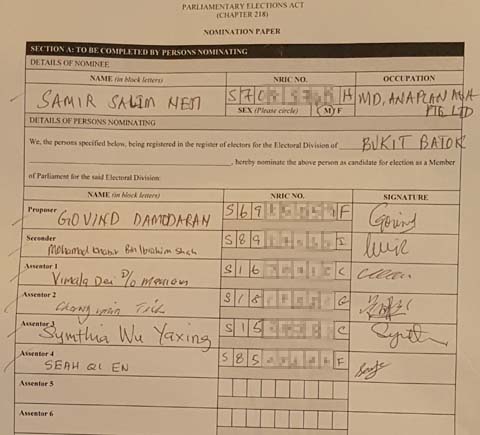
    Independent candidate Samir Salim Neji’s nomination attempt was first disqualified by the election returning officers at Keming Primary School which served as the nomination centre for Bukit Batok and three other constituencies. He came to the centre with three other persons, when the rules require that each nominee should present a proposer, a seconder, four assentors, and can also have “one other person” present, making a total of eight persons including the nominee/candidate. With only four persons in Samir Salim’s group, it didn’t look as if he met the criteria.

    pic_201509_02The proposer, seconder and assentors must all be registered voters in the respective constituency. The “one other person” is typically the election agent who attends to all supporting activities to aid the candidate in his or her campaign.
    Jaslyn Go is the SDP candidate for Yuhua

    I was in the nomination centre to observe all this as I had agreed to be one of the assentors for SDP’s candidate for Yuhua, Jaslyn Go. Keming Primary School also served as the nomination centre for Yuhua constituency.

    It took only a few minutes for the officials to turn Samir Salim away. A few SDP supporters went over to speak to him, and (I was later told), it seemed that his problem was that his other assentors were either overseas or failed to show up at the nomination centre. I also heard that he had been “in Singapore” for fifteen years.

    It should be noted — not that race is any issue here, but just to help understand the next part of the narrative — that all four persons in Samir Salim’s group were non-Chinese.  They appeared to be of South Asian origin.

    It wasn’t long before a flurry of conversations occurred among the PAP people in the nomination centre, and ten or fifteen minutes later, fresh documents were brought before the nomination centre officials. It turned out that the PAP had offered three persons living in Bukit Batok to be Samir Salim’s assentors, thus saving his candidacy from disqualification. At the close of the one-hour nomination window, this form was posted for public viewing, showing three Chinese names as his assentors, making the requisite four:

    pic_201509_05

    After 12:30pm, the accepted nominees were formally announced, and all candidates had a chance to make a short speech to the assembled crowd, which mostly comprised PAP supporters, with a sprinkling of red-shirted SDP supporters. Samir Salim spoke only in English. “No Tamil?” I whispered, to no one in particular. “He’s from Kerala,” came a reply from a stranger close by. How true that is I cannot say, but I’m sure we will know over the next few days from other sources.

    The SDP supporters were quite upset by this turn of events. Their knee-jerk reaction is understandable: they think the third candidate’s presence on the ballot will split the “opposition vote”. First of all, I think it’s a caricature to speak of a unified “opposition vote”, but secondly, I think it can very well be argued that giving voters a choice can’t be bad thing. Of course the counter-point can also be made that if one of the more established opposition parties were short of assentors, the PAP wouldn’t be lending them any, so it’s not as if we can read this gesture from the PAP to be as noble as it may first appear.

    * * * * *

    Here are a few other photos I took this morning:

    Sadasivam Veriyah of SDP (second from left) leading his supporters as they walk to the nomination centre

    Unions come out in support of a PAP candidate

    Singapore First Party organise their election materials at a coffee shop


    Source: https://yawningbread.wordpress.com

  • GE2015: Who’s Contesting Where?

    GE2015: Who’s Contesting Where?

    For the first time since Independence, all seats are contested at the General Election. Nine parties are set to vie for 89 seats in 13 SMCs and 16 GRCs. Here’s a quick look at the contenders across the board.

    Party Total seats GRCs SMCs Total electoral divisions
    PAP 89 16 13 29
    WP 28 5 5 10
    NSP 12 2 2 4
    SDP 11 2 3 5
    RP 11 2 1 3
    SingFirst 10 2 0 2
    SDA 6 1 0 1
    SPP 8 1 3 4
    PPP 4 1 0 1
    Independents 2 0 2 2
    SMCs Candidates
    Bukit Batok David Ong (PAP) Sadasivam Veriyah (SDP)
    Samir Salim Neji (Independent)
    Bukit Panjang Teo Ho Pin (PAP) Khung Wai Yeen (SDP)
    Fengshan Cheryl Chan (PAP) Dennis Tan (WP)
    Hong Kah North Amy Khor (PAP) Ravi Philemon (SPP)
    Hougang Png Eng Huat (WP) Lee Hong Chuang (PAP)
    MacPherson Tin Pei Ling (PAP) Bernard Chen (WP)
    Cheo Chai Chen (NSP)
    Mountbatten Lim Biow Chuan (PAP) Jeannette Chong-Aruldoss (SPP)
    Pioneer Cedric Foo (PAP) Elvin Ong (NSP)
    Potong Pasir Sitoh Yih Pin (PAP) Lina Chiam (SPP)
    Punggol East Lee Li Lian (WP) Charles Chong (PAP)
    Radin Mas Sam Tan (PAP) Kumar Appavoo (RP)
    Han Hui Hui (Independent)
    Sengkang West Lam Pin Min (PAP) Koh Choong Yong (WP)
    Yuhua Grace Fu (PAP) Jaslyn Go (SDP)


    4-Member GRCs Candidates
    Chua Chu Kang Gan Kim Yong (PAP)
    Zaqy Mohamad
    Low Yen Ling
    Yee Chia Hsing
    Goh Meng Seng (PPP)
    Low Wai Choo
    Lee Tze Shih
    Syafarin Sarif
    East Coast Lim Swee Say (PAP)
    Lee Yi Shyan
    Maliki Osman
    Jessica Tan
    Gerald Giam (WP)
    Daniel Goh
    Fairoz Shariff
    Leon Perera
    Holland-Bukit Timah Vivian Balakrishnan (PAP)
    Sim Ann
    Christopher de Souza
    Liang Eng Hwa
    Chee Soon Juan (SDP)
    Paul Tambyah
    Sidek Mallek
    Chong Wai Fung
    Jalan Besar Yaacob Ibrahim (PAP)
    Heng Chee How
    Denise Phua
    Lily Neo
    L. Somasundaram (WP)
    Frieda Chan
    Redzwan Hafidz
    Adrian Sim
    Marsiling-Yew Tee Lawrence Wong (PAP)
    Halimah Yacob
    Ong Teng Koon
    Alex Yam
    Bryan Lim (SDP)
    Damanhuri Abas
    John Tan
    Wong Souk Yee
    West Coast Lim Hng Kiang (PAP)
    S Iswaran
    Foo Mee Har
    Patrick Tay
    Kenneth Jeyaretnam (RP)
    Andy Zhu
    Noraini Yunus
    Darren Soh


    5-Member GRCs Candidates
    Aljunied Low Thia Khiang (WP)
    Sylvia Lim
    Chen Show Mao
    Pritam Singh
    Faisal Manap
    Yeo Guat Kwang (PAP)
    K. Muralidharan Pillai
    Victor Lye
    Chua Eng Leong
    Shamsul Kamar
    Bishan-Toa Payoh Ng Eng Hen (PAP)
    Josephine Teo
    Chee Hong Tat
    Saktiandi Supaat
    Chong Kee Hiong
    Benjamin Pwee (SPP)
    Hamim Aliyas
    Law Kim Hwee
    Abdillah Zamzuri
    Bryan Long
    Jurong Tharman Shanmugaratnam (PAP)
    Desmond Lee
    Ang Wei Neng
    Rahayu Mahzam
    Tan Wu Meng
    Tan Peng Ann (SingFirst)
    Wong Soon Hong
    David Foo Ming Jin
    Sukdeu Singh
    Wong Chee Wai
    Marine Parade Tan Chuan-Jin (PAP)
    Goh Chok Tong
    Seah Kian Peng
    Fatimah Lateef
    Edwin Tong
    Yee Jenn Jong (WP)
    Terence Tan
    Firuz Khan
    He Ting Ru
    Dylan Ng
    Nee Soon K Shanmugam (PAP)
    Louis Ng
    Muhammad Faishal Ibrahim
    Lee Bee Wah
    Henry Kwek
    Kenneth Foo (WP)
    Cheryl Denise Loh
    Luke Koh
    Ron Tan
    Gurmit Singh
    Sembawang Khaw Boon Wan (PAP)
    Vikram Nair
    Lim Wee Kiak
    Ong Ye Kung
    Amrin Amin
    Spencer Ng (NSP)
    Eugene Yeo
    Kevryn Lim
    Yadzeth Haris
    Abdul Rasheed
    Tampines Heng Swee Keat (PAP)
    Masagos Zulkifli
    Baey Yam Keng
    Desmond Choo
    Cheng Li Hui
    Sebastian Teo (NSP)
    Lim Tean
    Reno Fong
    Nor Lella Mardiiiah Mohamed
    Choong Hon Heng
    Tanjong Pagar Chan Chun Sing (PAP)
    Indranee Rajah
    Chia Shi-Lu
    Joan Pereira
    Melvin Yong
    Tan Jee Say (SingFirst)
    Ang Yong Guan
    Chirag Desai
    Melvyn Chiu Weng Hoe
    Fahmi Rais


    6-Member GRCs Candidates
    Ang Mo Kio Lee Hsien Loong (PAP)
    Ang Hin Kee
    Intan Azura Mokhtar
    Gan Thiam Poh
    Koh Poh Koon
    Darryl David
    M. Ravi (RP)
    Roy Ngerng
    Osman Sulaiman
    Gilbert Goh
    Siva Chandran
    Jesse Loo
    Pasir-Ris Punggol Teo Chee Hean (PAP)
    Teo Ser Luck
    Janil Puthucheary
    Zainal Sapari
    Ng Chee Meng
    Sun Xueling
    Desmond Lim (SDA)
    Harminder Pal Singh
    Ong Teik Seng
    Abu Mohamed
    Sunny Wong
    Arthero Lim
     

    Source: www.straitstimes.com


  • GE2015: Election Rally Sites Announced

    GE2015: Election Rally Sites Announced

    The list of sites where political parties can hold rallies at for the General Election (GE) was released by the police on Tuesday (Sep 1).

    Rallies may be held from Sep 2 to Sep 9 between 7am and 10pm at the following designated sites:

    PUBLIC TRANSPORT

    With large crowds expected at the rallies, the Police said members of public should take public transport, while those driving within the vicinity of the rallies should be prepared for traffic diversions or lane closures.

    “The Police seek the cooperation of supporters and members of the public to assemble at and disperse from the rally sites in an orderly manner.  Police officers will be deployed at the rally sites to maintain law and order. The Police will not hesitate to take action against any person who is unruly or who commits any offence at the election rallies,” the Police said.

    The Police added that the operation of Unmanned Aerial Vehicles or drones is prohibited for public safety reasons. The Police will take action against any person who does so.

    “Election meeting organisers are reminded to comply with the conditions and restrictions on election meetings stated under the Public Order (Election Meetings) Regulations 2009 before, during and after the election meetings. Candidates and their agents should take note that the breach of a permit condition is an offence for which the permit holder may be held responsible and action may be taken against him,” the police said.

    SPEAKERS’ CORNER

    The police also announced that from Sep 1 to 11, the status of the Speakers’ Corner as an “Unrestricted Area” under the Public Order Act will be revoked. Exemptions for the conduct of public entertainment activities at the Speakers’ Corner under the Public Entertainment and Meetings Act will also be revoked during the same period.

    “This is to ensure that the permit regime governing election meetings is not circumvented,” said the Police.

    The “Unrestricted Area” status and exemption status of the Speakers’ Corner will be reinstated after Polling Day, the Police added.


    Source: www.channelnewsasia.com

deneme bonusu