Category: Politik

  • The Workers’ Party Calls For More Flexibility In CPF Draw Down Age, De-Link From Retirement Age

    The Workers’ Party Calls For More Flexibility In CPF Draw Down Age, De-Link From Retirement Age

    By Non-Constituency MP, Gerald Giam
    [Delivered in Parliament on 3 Mar 2015]

    Mdm Speaker,

    The DPM and Finance Minister has laid out the key thrusts for the Government in his Budget statement. My speech will focus on retirement adequacy and the CPF scheme in particular.

    Th CPF scheme has a long history in Singapore that pre-dates our independence. The Central Provident Fund Bill was introduced by the Singapore Progressive Party in the Legislative Council in 1951, while Singapore was still a British Colony. The CPF scheme provides a mandatory retirement savings plan for local workers. It is a “defined contribution” scheme, whereby every member takes out only what he has contributed. This has helped the Government avoid the heavy burden of Budget-financed pension liabilities that many other countries face.

    While CPF provides a basic payout for retirees, it does not assure full retirement adequacy, particularly for those in the lowest income groups, including home-makers and people with disabilities.

    Minimum Sum

    The Minimum Sum requirement, which has been renamed to “Retirement Sum” by the CPF Advisory Panel, was introduced in 1987. It prevents CPF members from withdrawing their entire CPF savings in one lump sum when they retire. They are only allowed to withdraw amounts in excess of the Minimum Sum, plus another $5,000, at age 55.

    This has been deeply unpopular among many Singaporeans. Many feel that since the money in our CPF accounts belongs to us, why should the Government control when and how much we can withdraw? “We’re not children after all,” some would say. A recent poll by Channel NewsAsia found that the majority of respondents would like a choice to withdraw all of their CPF money at age 55.[1]

    I empathise and identify with these sentiments. I too would like to be able to withdraw all my CPF when I turn 55. Apart from paying off day-to-day expenses, I feel confident of being able to manage my own money well and not squander it. However, the reality for me, and I think many other working Singaporeans, is that if not for the forced savings that CPF has imposed, we would probably have saved much less for retirement.

    As pointed out by Mr Donald Low from the LKY School of Public Policy in a commentary in The Straits Times last week, faced with a choice between an immediate reward and a larger delayed benefit, people often choose the former.

    Also, even if CPF members make an effort to invest their retirement savings after they are withdrawn, not many have investment skills that are good enough to consistently beat the current 4% CPF Retirement Account interest rate in the long term.

    We also have to be on guard against swindlers who will try to find ways to persuade vulnerable elderly folks to part with their CPF money if they withdraw the full amount at one go.

    Therefore, while we understand Singaporeans’ strong sentiments about the Minimum Sum “locking up” our CPF money, for the reasons I just mentioned, the Workers’ Party is not asking for CPF members to be allowed to withdraw all their CPF money in a lump sum, except under special circumstances.

    Flexibility in Draw-Down Age

    Having said that, there is still room for providing CPF members with more flexibility in determining when to start receiving monthly payouts from their CPF. Currently, members can start drawing down their CPF only upon reaching their DrawDown Age, now known as the Payout Eligibility Age, which will be 65 from 2018 onwards.

    Some CPF members may have genuine reasons for needing monthly payouts to start earlier than age 65. For example, they may have been retrenched and, because of a skills mismatch or age discrimination, may not be able to secure another job. Or they may be labourers who are simply be too old to do manual work. When I observed the young men who helped me move the heavy furniture in my home recently, I wondered how long they would be able to continue in that role, and what jobs they would do once they are not strong enough to carry such heavy loads.

    The Workers’ Party therefore proposes lowering the Payout Eligibility Age to 60. This will give CPF members the flexibility to start receiving CPF monthly payouts earlier, if they need to, instead of having to wait until age 65. This was a call made by my colleague, the Member for Hougang, Mr Png Eng Huat, in May 2014.

    I agree with the CPF Advisory Panel’s recommendation to give members flexibility to defer their Payout Start Age to as late as 70, with a permanent 6 to 7% increase in monthly payouts for every year that they defer.[2] In line with this, under the Workers’ Party’s proposal, there would be a permanent 6 to 7%decrease in payouts for every year that members choose to bring forward their Payout Start Age. Members must be made aware that their monthly payouts could be significantly less should they choose this early payout option.

    De-link Payout Eligibility Age from Retirement / Re-employment Age

    Many Singaporeans have expressed frustration about the constantly increasing Payout Eligibility Age. It is was 63 last year, 64 this year and will be 65 in 2018. It seems to be moving up together with the Re-employment Age. Perhaps it is assumed that people are able to work until the Re-employment Age and do not need to draw down their CPF savings before that.

    However, just because the Re-employment Age has been raised does not mean that everyone will be able to work until 65, as I explained earlier. Furthermore, the statutory Retirement Age is now only 62. This leaves a gap of 3 years that a retiree will have to tide over, should his company not offer him re-employment until 65.

    I would like to reiterate the Workers’ Party’s earlier calls for the Payout Eligibility Age to be de-linked from either the Retirement Age or the Re-employment Age. Even if the Retirement Age is increased, the Payout Eligibility Age should remain constant at 60. This will provide members with more assurance of when they are eligible to start drawing from their CPF, regardless of their employment status, instead of wondering when the target will move again.

    Public education on CPF system

    Madam, I would like to touch on the public education aspects of the CPF scheme. The CPF Scheme is not easy to understand, regardless of one’s level of education. The large amount of technical jargon, acronyms, figures and different conditions that apply to people with different birth years, all add to the confusion.

    There is a pressing need to increase and improve public education about the CPF scheme. The CPF Advisory Panel has also recommended that more public education on CPF is needed.

    A recent poll by REACH, the government feedback unit, found that only 13% of respondents under 55 were able to provide the estimated monthly payout amount under CPF LIFE if one met the Minimum Sum requirement. With greater choices provided in the CPF scheme, it is important that CPF members are fully aware of the implications of their choices, including the lower payouts if they choose to start withdrawals earlier or withdraw a lump sum.

    I am aware that there are many ways in which CPF Board tries to get its message out, including pamphlets, public seminars and even advertisements on YouTube. However, none of these ensures that a CPF member is fully aware of the choices he has to make at critical junctures, like at age 55 and 65. A letter is sent to CPF members just 1 to 2 months before they turn 55, to inform them that they can apply to withdraw their CPF. This may not give them enough time and information to consider their choices carefully.

    My observation is that public education on CPF currently focuses a lot on how CPF benefits Singaporeans, or to clarify misunderstandings about CPF. The questions asked in the REACH poll are quite telling. They include questions like “If you do not meet your Minimum Sum requirement, do you need to top up the shortfall in cash?” and “Do you think you will receive a monthly payout from age 65 if you do not meet the full Minimum Sum?”

    Public education on CPF should be more tailored to individual members, focusing on the information and numbers that are directly relevant to them and the choices they have to make. We should not confuse people with numbers that are irrelevant to them, like the different Minimum Sum amounts and Draw-Down Ages for different age groups. While the CPF website has a number of useful calculators, not every retiree is technically-savvy enough to access and use them correctly.

    I would therefore like to suggest that before reaching the age of 55, every CPF member should be invited to meet one-on-one with a CPF Board officer, who should explain the details of the scheme, including how much he has in his account, how much he can withdraw, when he can withdraw, the choices of CPF LIFE plans and what his monthly payouts will be. This should be conducted in a language or dialect that he is comfortable with, and he should be allowed to bring a few family members to the meeting. It should be done at least a 3 months before the member becomes eligible to withdraw his CPF.

    This personalised meeting should be done on top of the public seminars that are available to CPF members. It will provide a channel for important information to be explained personally to the member and to give him an opportunity to seek clarifications from the officer.

    Silver Support Scheme

    The last matter I wish to raise concerns the Silver Support Scheme. While CPF payouts are usually enough to meet the retirement needs of seniors who have the Full Retirement Sum or more at retirement, there is a sizeable number of Singaporeans whose CPF payouts are insufficient to meet basic household expenditure.

    The solution for these individuals cannot be to postpone their CPF withdrawals or place further restrictions on their use of CPF and Medisave. This will only exacerbate their difficult financial situation. I am glad the Government has finally acknowledged that individual responsibility through the CPF system has its limits, and that it is time to provide a form of old age support for needy senior citizens.

    While the details of the Silver Support Scheme are still being worked out, I would like to make some remarks on the scheme based on what the Finance Minister has announced.

    First, the Silver Support quantum seems rather low, ranging from $100 to $250 per month. This is much lower than what even the poorest 20% of households spend each month on basic household necessities, which is $761 per month for all households[3] and $317 per month for retiree households, according to last year’s Household Expenditure Survey.[4]

    Can the DPM share his basis for deriving the Silver Support quantum? Does it look at household expenditure, and does it assume that all retirees receive additional forms of income like children’s contributions?

    Given the increasing cost of living in Singapore, I urge the Government to ensure that Silver Support is enough to cover retirees’ basic household expenses and that it also increases over time to account for inflation.

    Second, while I agree that the Silver Support Scheme should provide targeted support, the evaluation criteria should take into account the current financial situation of the seniors and should not be so stringent that genuine cases end up being excluded. In particular, the “household support” criteria must not deny Silver Support to seniors whose children are unable to support them or whom they are estranged from. Needy seniors should not have to suffer for their children’s inability or unwillingness to support them.

    My third request on Silver Support is that it should be paid out monthly instead of quarterly. Silver Support recipients are not working and receiving a salary, unlike Workfare recipients, yet they still have monthly household expenses like bills, food, transport and rental. A monthly payout would help seniors in their cash flow management.

    Conclusion

    Madam, in summary, I would like to reiterate the four main proposals in my speech:

    First, more flexibility should be given to CPF members to start receiving CPF payouts as early as age 60, if they need to, so as to help those who are not able to find work at that age. Second, the CPF Payout Eligibility Age should be de-linked from the Retirement or Re-employment Age, to provide more certainty for seniors.

    Third, personalised public education should be conducted for all CPF members, in their preferred language or dialect, well in advance of their 55th birthday, so as to give them more time to consider their options and discuss with family members. And fourth, the basis for calculating the Silver Support quantum should be made public and it should take into account the current financial situation of seniors to ensure that the needy are not excluded. It should also be paid out monthly instead of quarterly.

    Thank you, Madam.


    Source: http://wp.sg

  • MPs Question Fiscal Sustainability Of Budget Schemes

    MPs Question Fiscal Sustainability Of Budget Schemes

    About a week after the Republic unveiled a Budget that was hailed by various quarters for its generosity and far-sightedness, several Members of Parliament (MPs) yesterday raised concerns about the Government’s fiscal sustainability, given that the projected spike in social spending coincides with a moderating economy.

    An ageing population would also mean less revenue that could be derived from taxes, they added, stressing that the Republic’s healthy reserves should not be taken for granted.

    In all, 25 MPs rose to speak during the first day of the Budget debate. Apart from concerns about fiscal sustainability, MPs generally welcomed Budget measures such as the SkillsFuture initiatives and the Silver Support Scheme, and offered suggestions on the implementation of the new programmes. They also highlighted the continuing struggle among businesses to raise productivity, but stressed the need to stay the course.

    The introduction of more social safety nets and other measures to mitigate social inequality prompted Workers’ Party chairman Sylvia Lim to observe a “leftwards” shift.

    In particular, she said the Silver Support Scheme — which gives cash payouts to needy elderly — came as a surprise to most. “It embodies what the People’s Action Party government has always eschewed — having any form of rights-based, ‘defined benefits’ welfare scheme,” Ms Lim said. “Up to now, government assistance schemes were usually temporary and subject to continuous means-testing and conditions, with applicants needing to fill up forms and provide documentary proof of illness and family income.”

    She added: “This Budget explicitly talks about strengthening social safety nets. This suggests a shift to the left, a direction which I believe is right … A shift left does not necessarily undermine economic performance, but could well enhance it.”

    Holland-Bukit Timah GRC MP Liang Eng Hwa said the Budget signalled a further shift to the left, but this was possible only because “over the past 50 years, we have built a stronger and more sustainable financial position through careful budgeting and sheer discipline”.

    Still, Nominated MP (NMP) Chia Yong Yong urged prudence, quipping: “If we lean too much to the left, we will not have much left.”

    Deputy Prime Minister and Finance Minister Tharman Shanmugaratnam announced during the Budget statement last Monday that Temasek Holdings will be included in the Net Investment Returns (NIR) framework — joining GIC and the Monetary Authority of Singapore — so part of its projected long-term returns can be spent. Personal income taxes for the top 5 per cent income earners will also be raised. With these moves, the MPs felt the Republic has seemingly exhausted ways to boost its coffers, without raising taxes for the masses.

    West Coast GRC MP Foo Mee Har noted that this year’s budgeted expenditure was 19 per cent higher than that in the previous year.

    “While it is assuring to know that these expenditures can be provided for from current reserves accumulated since 2011, it appears that we have come to rely more and more on past reserves to fund our spending, and have now resorted to including Temasek in the NIR framework to make ends meet,” she said. “How will we know when we have gone too far, when we have crossed the line in fiscal prudence — that tried-and-tested principle that has seen Singapore through many economic crises?”

    Distributing a table showing figures from the Ministry of Finance, Bishan-Toa Payoh GRC MP Hri Kumar Nair pointed out that if Singapore had not been drawing from its reserves via net investment income contributions, it would have run up “large deficits for a number of years”.

    Noting that government expenditure will continue to rise, he warned: “We are running out of levers to pull. After Temasek, there is no next.”

    He added: “Increasing taxes on the top 5 or even 10 per cent will get you only so far, and there will be considerable pressure on the Government not to raise taxes for everyone else … There will no doubt be calls on the Government to raise the NIR contribution beyond 50 per cent, but that means leaving behind less for our children, so where do we go from there?”

    Mr Liang suggested that the Government regularly review the country’s fiscal sustainability, with additional scrutiny and oversight on spending programmes that last longer than 10 years.

    With the economy moderating, NMP Randolph Tan said, ultimately, the fiscal strength to fund more social programmes would have to come from strong economic growth. “Singapore has to be cautious and prepare for the possibility that — unlike resource-rich and larger economies —slower growth may not turn out to be the idyllic experience we imagine,” he said. “By simultaneously drawing on surpluses, proposing a deficit and announcing a surprise rise in taxes on the wealthiest, this Budget gives us a glimpse of the stark realities we face.”

    The Budget debate continues today.


    Source: www.todayonline.com

  • Singaporeans First Party’s Chance Encounter With DPM Tharman Shanmugaratnam In Taman Jurong

    Singaporeans First Party’s Chance Encounter With DPM Tharman Shanmugaratnam In Taman Jurong

    When Mature People Meet….. Collaboration Becomes Possible

    The walkabout at Taman Jurong Market and Food Centre on Sunday saw SingFirst achieving several “firsts”. This is what we mean:

    1. First walkabout when we met a minister making his round at the same location

    DSC_9553

    DSC_9551

    2. First attempt in getting the members and supporters to take public transport to the walkabout location

    DSC_9488

    DSC_9498

    DSC_9500

    DSC_9484

    3. First largest turn out by our members and supporters

    DSC_96434. First ever longest walkabout route

    DSC_95095. First ever most photo requests by members of the public with our chairman and secretary general

    DSC_9497

    DSC_9637DSC_9636DSC_9624Taking the public transport to the location was our first attempt in building the bond and rapport between the members and supporters. This arrangement also allowed us to gain exposure and to publicise our party name. Everyone was enthusiastic and admitted that it was indeed a refreshing idea.

    This walkabout was by far the largest turn out by our member and supporters. A total of 25 of us gathered at Lakeside MRT before making our way to Taman Jurong Market and Food Centre. SingFirst is encouraged by the great support by our members! It goes to show that we are growing in terms of membership.

    As the market and food centre occupies 3 storeys with several units on each floor, it made its way into our record book for the longest walkabout route. Apart from the market and food centre, we also seized the opportunity to visit the nearby flea market. We were pleasantly surprised that many patrons at the market and food centre immediately recognized our chairman, Dr Ang Yong Guan and secretary general, Mr Tan Jee Say. We were even more surprised when several of them came up to the duo and asked for their pictures to be taken together.

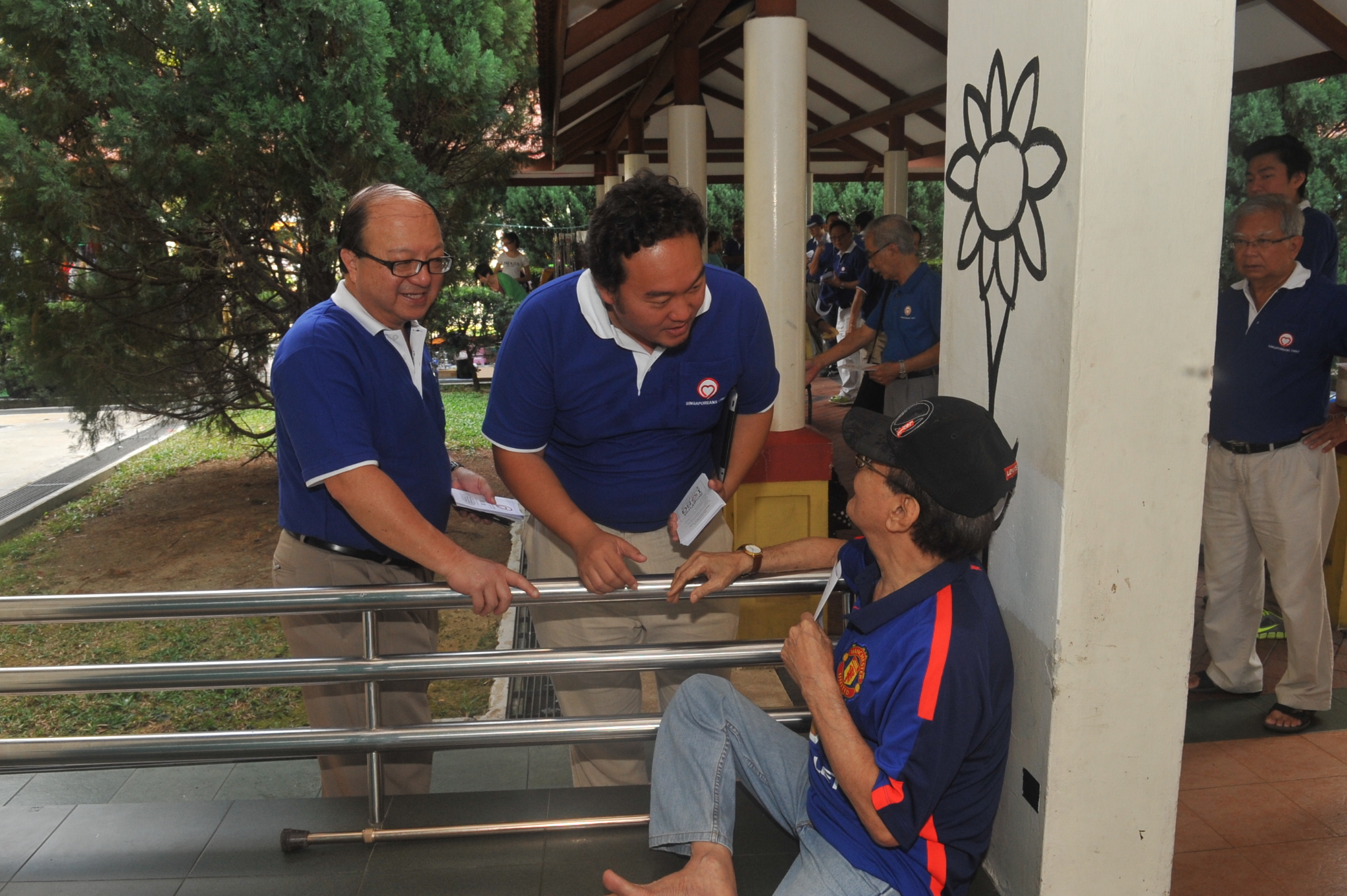
    The most pleasant encounter during this walkabout was the chance meeting with the finance minister, Mr Tharman Shanmugaratnam. He too was at the food centre greeting the residents. He was pleasant and greeted us with warm smiles and handshakes. We suggested having a photo together and he agreed without any hesitation. That wasn’t the end of our encounter with him. While taking a break from the walkabout at a nearby coffee shop, he came to us and said that the coffee shop has the cheapest food in the area.

    DSC_9647

    From this walkabout, we would like to highlight some interesting points from the residents and our brief meeting with Mr Tharman Shanmugaratnam:

    • The residents recognized that there is a need for a political change in Singapore. They are also curious who will be the candidates for SingFirst and whether we are up to the mark to take on the ruling party in the next election. Many still bear the scars from the memory of the 1960s and 1970s during the tussle between Barisan Socialis and the PAP.

    DSC_9545

    DSC_9597

    • They are sincere in their response when approached. The residents either stand up to greet or putting away their utensils to have a brief word with us. They also hope that SingFirst is able to do more to help the citizens.

    DSC_9615

    DSC_9573

    • They hope to see in the coming election younger candidates with a credible party running for the public office and who can take on the PAP.

    DSC_9629

    DSC_9519

    • MPs need to speak their language from the ground to represent them in parliament. They hope the MPs truly understand their plight.

    DSC_9588

    • There is no need for scholars to stand for elections or be MPs. They just need someone who is able to understand their concerns and have a heart to feel and fill their needs. The Punggol East by-election is a good example where a caring candidate won despite a four-corner fight.

    DSC_9566

    DSC_9583

    DSC_9602

    • The SingFirst logo is being etched into the minds of the Singaporeans. One elderly man said he recognized the logo because it resembles an ice cream brand.

    3

    Mr Tharman’s encounter was an encouraging one as he is so open. SingFirst hopes to see more of such PAP politicians to engage alternative parties. Only with such openness can we then build a better Singapore and move Singapore forward.

    DSC_9555e

    Taman Jurong walkabout was a new milestone set for SingFirst. We hope we will set a higher benchmark and be fortunate enough to meet more ministers or MPs in our future visits to the various GRCs.


    Source: http://singfirst.org

  • PAP Women’s Wing Urges Government To Provide More Assistance To Stay-At-Home Mothers

    PAP Women’s Wing Urges Government To Provide More Assistance To Stay-At-Home Mothers

    The People’s Action Party (PAP) Women’s Wing has urged the Government and families to do more to help stay-home mothers who will have little Central Provident Fund (CPF) savings of their own to draw on during their retirement years.

    The call was contained in a 10-point response to recent Government announcements that was endorsed by members at a special meeting held on Saturday (Feb 28) at PAP headquarters ahead of International Women’s Day and the Budget Debate.

    “For stay-home mothers, we are especially concerned that they do not get to benefit from the CPF system. As they do not receive formal payment and CPF contributions for their care-giving, they do not enjoy the attractive interest rates paid on CPF balances and the positive effects of interest compounding,” the PAP Women’s Wing said in a statement.

    “A sensible approach is for their husbands to make regular voluntary top-ups to their CPF accounts; likewise for their adult working children. We urge the Government to raise awareness of the benefits of such top-ups and the availability of GIRO transfer options,” the statement added.

    The PAP Women’s Wing also asked the Government to make special efforts to help stay-home mothers take advantage of SkillsFuture initiatives, so that they can keep their skills updated and remain employable should they decide to return to the workforce.

    For example, there can be more e-learning options that will allow stay-home mothers to access training from home.

    The Government could consider allowing husbands and children to make partial transfers of their unused SkillsFuture Credits to give more support to stay-home mothers who want to pursue training, the PAP Women’s Wing added.

    SkillsFuture is a national effort aimed at making it easier for students and workers to gain skills and continually improve on them during the working lives.

    Chair of the PAP Women’s Wing Grace Fu, who is also Minister in the Prime Minister’s Office, said many of the home-makers had found it difficult to return to the workforce and therefore could not build up their own CPF savings.

    “The SkillsFuture initiatives open up new opportunities for stay-home mums to access training. This was not possible before, but in future, it should become easier for women who take a break to care for their families to get back to work,” she said.

    Ms Fu had helmed the PAP Women’s Wing with Vice-Chairs Josephine Teo and Dr Amy Khor and District Advisor Jessica Tan. Around 80 women activists from various PAP branches attended the meeting.


    Source: www.channelnewsasia.com

  • Singapore Not Delaying Progress On Rapid Transit System

    Singapore Not Delaying Progress On Rapid Transit System

    Responding to media queries on Malaysian media reports that Singapore has been delaying a decision on the alignment of the Rapid Transit System (RTS) link connecting Singapore and Johor Baru, the Ministry of Transport (MOT) said yesterday in a statement that this was incorrect.

    “Singapore has informed Malaysia in June 2011 that the RTS terminus in Singapore would be located in Woodlands North near Republic Polytechnic. However, to date, Singapore has not received official confirmation of the location of Malaysia’s RTS terminus in Johor Baru. Only upon confirmation of the location of the terminus can both countries proceed to finalise the alignment of the crossing between Johor Baru and Singapore,” said the MOT in a statement.

    Malaysian media reports had quoted Johor State Executive Committee Member for Public Works, Rural and Regional Development Hasni Mohammad as saying that Singapore was holding back on deciding the alignment for the RTS.

    At the recent Malaysia-Singapore Joint Ministerial Committee (JMC) for Iskandar Malaysia meeting on Feb 6, Singapore and Malaysia agreed that the second phase of the joint engineering study on the RTS link would begin after the terminus location in Johor Baru is confirmed by Malaysia. This was stated in the joint statement issued by the Malaysian and Singapore governments immediately after the meeting. The Johor state government was represented at the meeting.

    The MOT said it looked forward to official confirmation from the Malaysian government on the location of the RTS terminus in Johor Baru. “Singapore remains committed to working closely with Malaysia on the RTS link, which will provide a boost to cross-border connectivity,” said the MOT statement.

    The RTS, if built, will connect Singapore’s Mass Rapid Transit (MRT) system to Johor Baru. It will be the second rail link between Singapore and Malaysia, after KTM Intercity’s North-South line. The RTS is a two-station line designed for high-volume transit, with both sides targeting to finish the project in 2018.

    The first phase of the RTS joint engineering study was endorsed by the JMC in January last year.

    In September last year, some Malaysian media reports said the Johor Baru terminus would be located in Bukit Chagar, but there has been no official word.

    One of the key engineering considerations for the line is whether to build it parallel to the Causeway and above ground; parallel to the Causeway and underground or diagonally opposite the Causeway.


    Source: www.todayonline.com