Category: Singapuraku

  • Jeannette Chong-Aruldoss Leads Resignations In NSP, Plans To Join SPP

    Jeannette Chong-Aruldoss Leads Resignations In NSP, Plans To Join SPP

    SINGAPORE – Former National Solidarity Party (NSP) secretary general Jeannette Chong-Aruldoss has quit the party and applied to join the Singapore People’s Party (SPP), helmed by veteran politician Chiam See Tong.

    The 51-year-old lawyer, who lost a bid to become NSP president in party polls held in January, left along with former council members Ravi Philemon, 46, and Bryan Long, 37, and party member Osman Sulaiman, 39.

    Speaking before she joined Mr Chiam and his wife, Non-Constituency MP Lina Chiam, for a walkabout at Bishan Street 24 on Sunday, she acknowledged that their decision to leave came in the wake of the central executive committee (CEC) election results.

    But she said that she and the others harboured no acrimony towards the NSP.

    Mrs Chong-Aruldoss, who joined the party in 2011 and became its secretary-general in October 2013, tendered her resignation last week

    So too did Mr Philemon, a community worker, and Mr Long, an entrepreneur. Both joined the NSP in July 2012 and were co-opted into the party’s previous CEC.

    Mr Osman, a human resources executive, joined the NSP in April last year. He contested in Ang Mo Kio GRC in the 2011 general election as part of the Reform Party’s team.

    All except Mr Osman have submitted their applications to join SPP. These are pending the approval of the party’s central executive, which is expected to meet this month.

    At the NSP’s CEC election in January, Mrs Chong-Aruldoss challenged party stalwart Sebastian Teo, 66, for presidency, while Mr Philemon stood against lawyer Tan Lam Siong, 53, for the secretary-general position. Mr Teo and Mr Tan won by a landslide.

    On Sunday, Mrs Chiam, who is the SPP chairman, said of the four: “They have good potential and they will help spearhead our party even more to greater heights.”

    While she did not want to say when asked whether the SPP will contest in Potong Pasir at the next general election – which must be held by January 2017 – Mrs Chiam said that it will put together a “very strong team” to contest in Bishan-Toa Payoh GRC.


    Source: www.straitstimes.com


  • 2014 Graduates Had Higher Starting Salaries Compared To 2013 Cohort

    2014 Graduates Had Higher Starting Salaries Compared To 2013 Cohort

    Those who graduated from Singapore’s big three autonomous universities last year were paid more than their counterparts who completed their studies in 2013, according to the results of the Joint Graduate Employment Survey.

    The survey was conducted by Nanyang Technological University (NTU), National University of Singapore (NUS) and Singapore Management University (SMU). Out of a total of 13,656 full-time, fresh graduates, 10,126 took part in the survey, the universities said in a joint news release on Friday (Feb 27).

    The mean gross salaries of fresh graduates increased 3.22 per cent on-year to S$3,333 in 2014, the universities said. The median gross salaries saw a 4.91 per cent increase to S$3,200 last year, from the year before, they added.

    MEDIAN MONTHLY SALARY BY FACULTY

    The survey also revealed that those from the law and medicine faculties remain the highest-paid fresh graduates when they enter the workforce.

    Median Monthly Salary By Faculty

    The survey showed that as of Nov 1, 2014, the overall employment rate was 89.1 per cent, and about four in five of these graduates were employed in full-time permanent jobs within six months of completing their final examinations. This is similar to the employment rates achieved in 2013.

    A survey was also conducted among NTU, NUS and SMU graduates from the Architecture Class of 2011 who completed their practical training, and Class of 2013 graduates from the Biomedical Science (Traditional Chinese Medicine), Law, Medicine, and Pharmacy courses who completed their one-year practicum last year.

    The mean gross monthly salary among these follow-up graduates in full-time permanent employment was S$4,751 last year, up from S$4,575 in 2013, the universities said. The median gross monthly salary also increased from S$4,500 in 2013 to S$4,800 last year.


    Source: www.channelnewsasia.com

  • Overnight Mass Fish Deaths Hit Changi Farmers Hard

    Overnight Mass Fish Deaths Hit Changi Farmers Hard

    Thousands of fish have died in coastal farms off Changi, in a repeat of last year’s nightmare for farmers.

    Farmers woke up yesterday morning to the sight of their fish floating belly up – the mass deaths had occurred through the night, so they had no opportunity to try to save their fish.

    Dead fish were also seen along the Pasir Ris shoreline.

    The Agri-Food and Veterinary Authority of Singapore (AVA) attributed the deaths to gill damage caused by plankton. Lab tests conducted so far did not detect biological toxins in the fish, and fish from local farms remains safe to eat, an AVA spokesman said.


    Source: www.straitstimes.com

  • Rote Learning Is Not The Way To Learn Science

    Rote Learning Is Not The Way To Learn Science

    From ‘Only one right answer to science questions?’23 Feb 2015, article by Amelia Teng and Pearl Lee, ST

    EXPLAIN how the hard, bony body of a seahorse could be an advantage. The right answer, according to one Primary 6 science teacher, is: “It protects the seahorse from injury and reduces the chances of predators successfully feeding on it.”

    But the child who wrote “It acts as an armour that protects the seahorse from predators” was told that her answer was wrong. This was one of several examples thrown up by parents, who have complained recently that primary school science teachers are too rigid in marking open-ended questions, and are emphasising rote learning over the understanding of concepts.

    This, despite schools having shifted to an inquiry-based learning approach in science since 2008. With the approach, pupils are encouraged to ask questions, analyse data and come to their own conclusions.

    Several parents wrote to The Straits Times Forum page earlier this month, calling for schools to be more flexible. Most said their children were unduly penalised for answers that had the same meaning as the correct ones, but did not contain the right “key words”.

    The children had been told by teachers to stick to key phrases and words found in textbooks, in order to get full marks in assignments or tests.

    Here’s another Primary 3 head-scratcher for you:

    What is the difference between a bird and a lion?

    If you said the ‘bird has feathers but the lion does not’, you’re wrong. You’re also wrong if you said ‘The bird can fly but the lion can’t’, ‘birds evolved from flying dinosaurs but not lions’, or even ‘birds poop on cars but lions poop on the ground’ (assuming the question involves you staring at a picture of a bird and a lion). The correct answer, according to a parent complaining to the ST Forum earlier this month (‘Good science=Poor English’, Feb 5 2015) is ‘The bird has feathers but the lion does NOT HAVE FEATHERS’, which basically means the same damn thing as your original answer, except annoyingly repetitive. (Well if you want to be even more specific: a bird has feathers but a lion has fur, not feathers).

    Clearly, the student knows what he’s talking about, that a lion does not have feathers, but the science teacher here doesn’t give a hoot about your ‘understanding’ if it does not fit into the template answer scheme, even if the same statement in a composition about bird and lions would make your English teacher squirm in her seat, and accuse you of trying to make up the 500 word quota with redundancies. The parent summed it up perfectly in his letter: “Is there rigidity in the teaching of science? It would certainly appear so (that there is rigidity in the teaching of science)”. Take that, Rigidity!

    Not convinced that teachers can be anal about science answers? Here’s another puzzler on animals.

    You could be thinking of the following possible answers:

    1) Both the bull and the lion give birth to their young
    2) Both the bull and lion poop and pee
    3) Both the bull and lion can kill you
    4) Both the bull and lion are mammals

    ALL OF THE ABOVE ARE WRONG. (The answers are ‘4 legs’, ‘have hair’, or ‘similar body shape’ i.e something you can actually see from the illustration). The thing that you should be staring hard at isn’t the actual drawing, but the phrase ‘STUDY the animals BELOW’. Gotcha.

    Let’s up the ante with a dreaded multiple choice question about the properties of a light bulb.

    Now read the last option carefully before you make your choice. If you chose ‘all of the above’, you are interpreting D as ‘the bulb lights up only when electricity passes through it’. If you chose ‘A, B and C’ you read it as ‘light energy is the only energy that is given off when electricity passes through it’. The correct answer happens to be the latter. Answer D, in the spirit of the other animal questions, happens to be the grammatical equivalent of the rabbit/duck gestalt optical illusion. Given the ambiguity of this shitty question, no student should be penalised for seeing a rabbit when the answer scheme says duck.

    Do you know how a shadow is formed? Here’s one student’s answer to a puzzle that has tickled the intellect of many an ancient Greek philosopher.
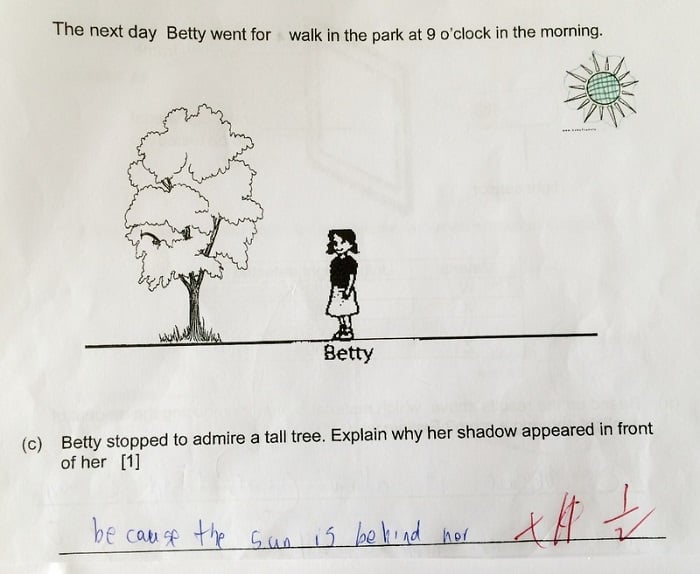
    The complete answer is ‘Because the sun is behind her and she is blocking the path of the light’. You know what this obsession with ‘complete’ answers will do to our kids? They’ll never be able to complete their paper on time because they’d want to add details like ‘because light travels in straight lines and Betty is an opaque human being and she will generate a penumbra and umbra depending on the angle and intensity of the sunlight’. Just to play safe. Except that some teachers will still mark you wrong for ‘trying to be clever’ when penumbrae and umbrae are not taught until you’re in secondary school. If you mention anything about photons or the particle-wave duality you may be suspended from school altogether.

    But back to the seahorse question. If I were grading the student I’ll not only let it go, I would also give her BONUS marks for using her imagination and drawing a figurative analogy between ‘hard skin’ and ‘armour’. By our school standards, this paper published in the rather obscure ‘Acta Biomaterialia’ journal is pure BULL. Its title?Highly deformable bones: Unusual deformation mechanisms of seahorse armor(Porter et al).

    All this nitpicking over ‘key words’ will not only kill our children’s love for science, but also restricts how individuals grasp concepts, punishing those who, well, ‘think outside the box’. A student who sees beyond 4 legs and digs deeper into the taxonomic characteristics of mammals vs birds is given zero marks vs another who memorises ‘key words’ because his tuition teacher said so. Flowery language, like ‘armour’, is not ‘scientific’ and has no place in a science paper, they say. Well try describing DNA to laymen without ‘unscientific’ analogies like zippers and enzyme/cell receptor interactions without using ‘lock and key’.

    Final question: What’s the difference between a robot and a typical Singaporean Science student?

    Answer: The robot needs electricity to recharge but the student does not need electricity to recharge.


    Source: http://everythingalsocomplain.com

  • McDonald’s Named Best Employer In Singapore!

    McDonald’s Named Best Employer In Singapore!

    SINGAPORE – Fast food giant McDonald’s Restaurants was named “Best of the Best” employer in Singapore in global HR management and consulting firm Aon Hewitt’s ranking of the best employers here for 2015.

    American Express International, Hongkong Land and Tan Tock Seng Hospital were among those named “Best Employer Singapore 2015” in an awards ceremony and learning conference on Friday.

    — PHOTO: AON HEWITT

    There were also awards for categories in hotels, and small and medium enterprises (SMEs). Goodrich Global clinched the title of best employer in the SME space, for instance.

    Aon Hewitt said its 3 criteria for Best Employer are:

    1. The organization inspires strong commitment and superior performance from its people;

    2. It drives business results through effective people practices; and,

    3. It manages its business in ways that build long-term success and sustainability.

    “Best employers clearly achieve better business results compared to market,” said Mr Jeremy Andrulis, South-east Asia’s chief executive for Aon Hewitt Consulting. “We found that (the) best employers in Singapore achieve significant higher growth in their income profits when compared to market average.”

    “This makes becoming a ‘Best Employer’ a business agenda and not just an HR agenda,” he added.

    McDonald’s Restaurants was named Outstanding Best Employer in the firm’s 2011 study.

    Aon Hewitt said its Best Employers study was first conducted in Asia in 2001, to learn about companies that are creating real competitive advantage through their people, find out what makes a workplace of choice and to identify the best employers in the region.

    — PHOTO: AON HEWITT

    It is run in 12 markets including China, Singapore, and New Zealand, and conducted over a nine-month period.


    Source: www.straitstimes.com

deneme bonusu