Category: Singapuraku

  • The Singapore Exception

    The Singapore Exception

    AT 50, ACCORDING to George Orwell, everyone has the face he deserves. Singapore, which on August 9th marks its 50th anniversary as an independent country, can be proud of its youthful vigour. The view from the infinity pool on the roof of Marina Bay Sands, a three-towered hotel, casino and convention centre, is futuristic. A forest of skyscrapers glints in the sunlight, temples to globalisation bearing the names of some of its prophets—HSBC, UBS, Allianz, Citi. They tower over busy streets where, mostly, traffic flows smoothly. Below is the Marina Barrage, keeping the sea out of a reservoir built at the end of the Singapore River, which winds its way through what is left of the old colonial city centre. Into the distance stretch clusters of high-rise blocks, where most Singaporeans live. The sea teems with tankers, ferries and container ships. To the west is one of Asia’s busiest container ports and a huge refinery and petrochemical complex; on Singapore’s eastern tip, perhaps the world’s most efficient airport. But the vista remains surprisingly green. The government’s boast of making this “a city in a garden” does not seem so fanciful.

    Singapore is, to use a word its leaders favour, an “exceptional” place: the world’s only fully functioning city-state; a truly global hub for commerce, finance, shipping and travel; and the only one among the world’s richest countries never to have changed its ruling party. At a May Day rally this year, its prime minister, Lee Hsien Loong, asserted that “to survive you have to be exceptional.” This special report will examine different aspects of Singaporean exceptionalism and ask whether its survival really is under threat. It will argue that Singapore is well placed to thrive, but that in its second half-century it will face threats very different from those it confronted at its unplanned, accidental birth 50 years ago. They will require very different responses. The biggest danger Singapore faces may be complacency—the belief that policies that have proved so successful for so long can help it negotiate a new world.
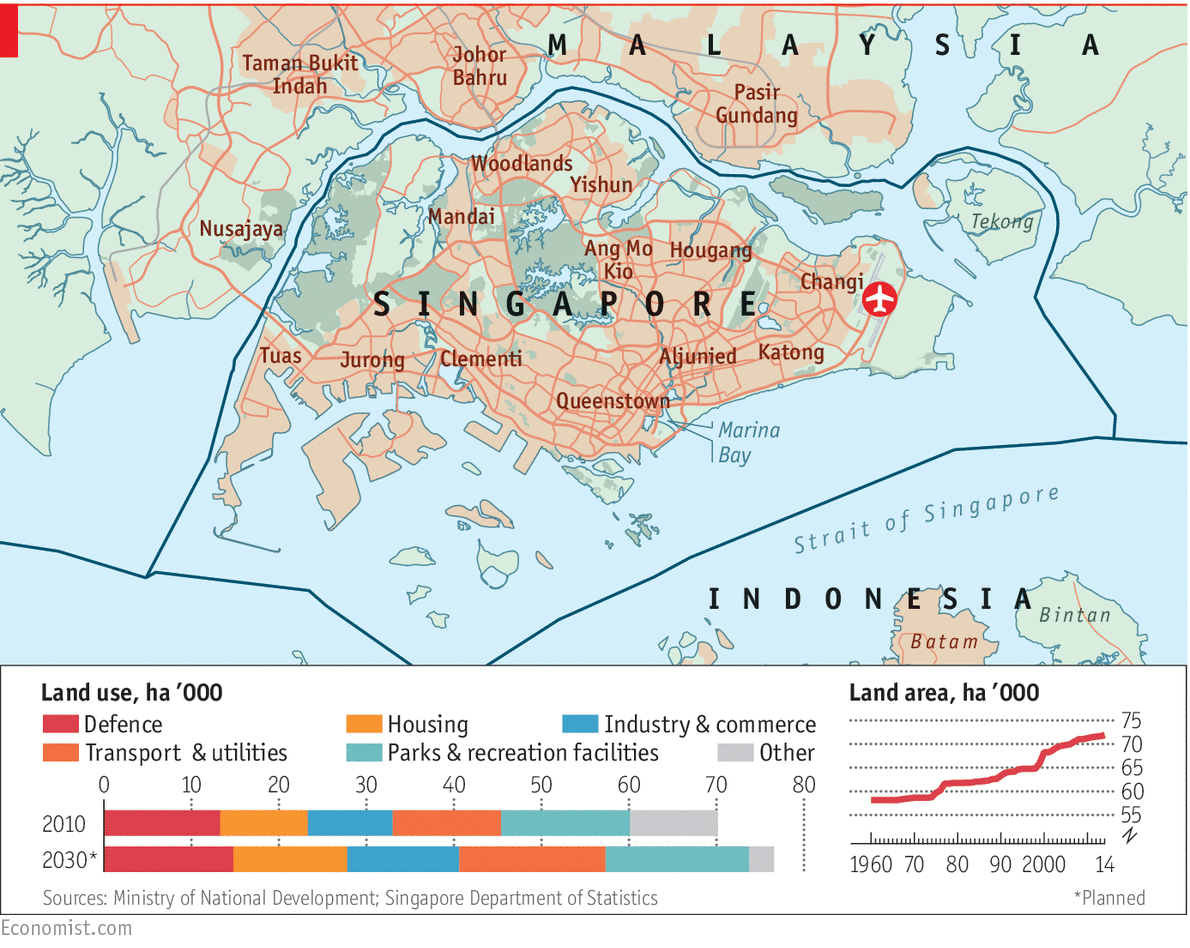
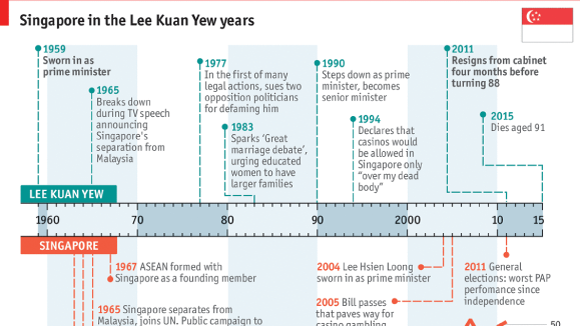
    In 1965 Singapore was forced to leave a short-lived federation with Malaysia, the country to its north, to which it is joined by a causeway and a bridge. Lee Kuan Yew, Lee Hsien Loong’s father, who became Singapore’s prime minister on its winning self-government from Britain in 1959, had always seen its future as part of Malaysia, leading his country into a federation with its neighbour in 1963. He had to lead it out again when Singapore was expelled in 1965. By then he had become convinced that Chinese-majority Singapore would always be at a disadvantage in a Malay-dominated polity.

    Mr Lee’s death in March this year, aged 91, drew tributes from around the world. But Mr Lee would have been prouder of the reaction in Singapore itself. Tens of thousands queued for hours in sultry heat or pouring rain to file past his casket in tribute. The turnout hinted at another miracle: that Singapore, a country that was never meant to be, made up of racially diverse immigrants—a Chinese majority (about 74%) with substantial minorities of Malays (13%) and Indians (9%)—had acquired a national identity. The crowds were not just mourning Mr Lee; they were celebrating an improbable patriotism.

    Lee Kuan Yew himself defined the Singapore exception. As prime minister until 1990, he built a political system in his image. In line with his maxim that “poetry is a luxury we cannot afford,” it was ruthlessly pragmatic, enabling him to rule almost as a (mostly) benevolent dictator. The colonial-era Internal Security Act helped crush opposition from the 1960s on. Parliament has been more of an echo-chamber than a check on executive power. No opposition candidate won a seat until 1981. The domestic press toes the government line; defamation suits have intimidated and sometimes bankrupted opposition politicians and hit the bottom line of the foreign press (including The Economist).
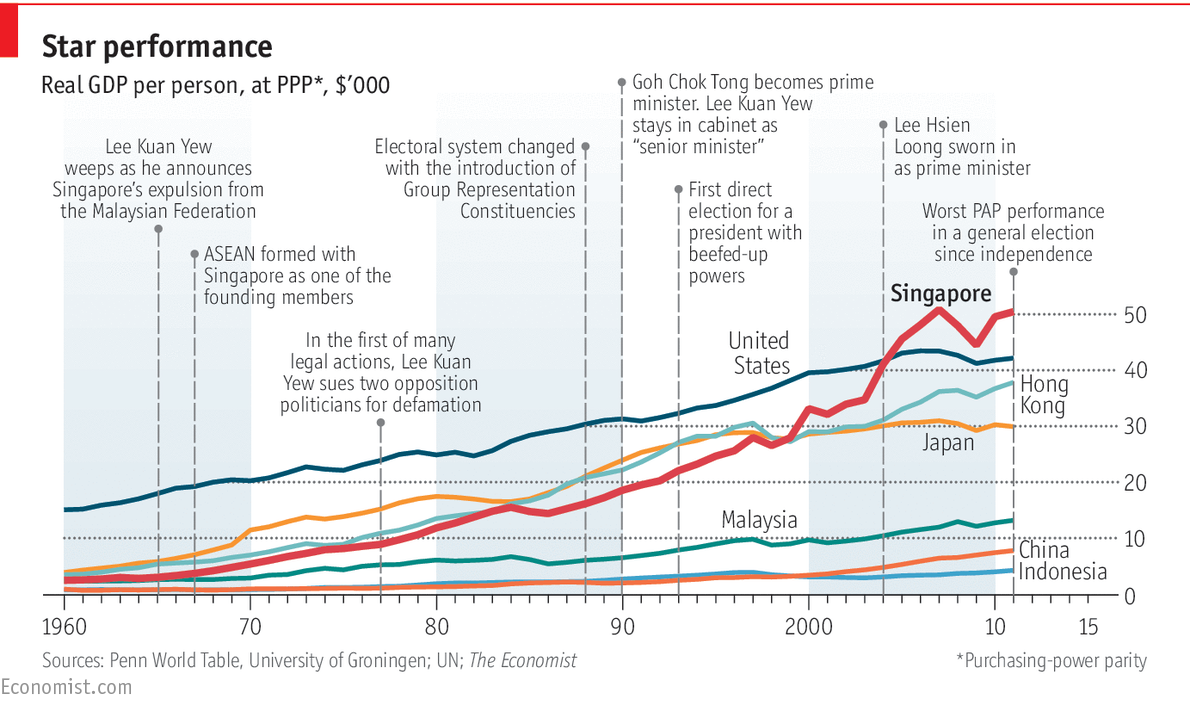
    Singapore, it is sometimes joked, is “Asia-lite”, at the geographical heart of the continent but without the chaos, the dirt, the undrinkable tap water and the gridlocked traffic. It has also been a “democracy-lite”, with all the forms of democratic competition but shorn of the unruly hubbub—and without the substance. Part of the “Singapore exception” is a system of one-party rule legitimised at the polls and, 56 years after Mr Lee’s People’s Action Party (PAP) took power, facing little immediate threat of losing it. The system has many defenders at home and abroad. Singapore has very little crime and virtually no official corruption. It ranks towards the top on most “human-development” indicators such as life expectancy, infant mortality and income per person. Its leaders hold themselves to high standards. But it is debatable whether the system Mr Lee built can survive in its present form.

    It faces two separate challenges. One is the lack of checks and balances in the shape of a strong political opposition. Under the influence of the incorruptible Lees and their colleagues, government remains clean, efficient and imaginative; but to ensure it stays that way, substantive democracy may be the best hope. Second, confidence in the PAP, as the most recent election in 2011 showed, has waned somewhat. The party has been damaged by two of its own successes. One is in education, where its much-admired schools, colleges and universities have produced a generation of highly educated, comfortably off global citizens who do not have much tolerance for the PAP’s mother-knows-best style of governance. In a jubilant annual rally to campaign for lesbian, gay, bisexual and transgender (LGBT) rights on June 13th, a crowd estimated at 28,000 showed its amused contempt for the illiberal social conservatism the PAP has enforced. Younger Singaporeans also chafe at censorship and are no longer so scared of the consequences of opposing the PAP.
    The PAP’s second success that has turned against it is a big rise in life expectancy, now among the world’s longest. This has swelled the numbers of the elderly, some of whom now feel that the PAP has broken a central promise it had made to them: that in return for being obliged to save a large part of their earnings, they would enjoy a carefree retirement. And it is not just old people who have begun to question PAP policies. Many Singaporeans are uncomfortable with a rapid influx of immigrants. These worries point to Singapore’s two biggest, and linked, problems: a shortage of space and a rapidly ageing population.


    Source: www.economist.com

  • Pump Attendant Infects Minors With STDs

    Pump Attendant Infects Minors With STDs

    A 24-year-old man who had unprotected sex with a 13-year-old girl on multiple occasions, passing on sexually transmitted diseases to her, was jailed for 30 months yesterday.

    Abdul Rashid Mohamed Sam pleaded guilty to three charges of sexual penetration of a minor. Another seven counts were taken into consideration for sentencing.

    The offences took place between October 2013 and January last year. At the time, Abdul Rashid was 22 and working as a petrol kiosk pump attendant.

    He got to know the girl through a 42-year-old cobbler who told him that he could have sex with her.

    The cobbler, Terence Ng Kean Meng, was the girl’s godfather.

    Ng was sentenced to 14 years in prison and 14 strokes of the cane in May, after he admitted to three counts of statutory rape and penetrating the girl with his finger.

    A few days after Abdul Rashid was introduced to the girl, he asked her to be his girlfriend.

    She agreed and met him at the void deck of an HDB block in the Holland Close area the same day.

    While at the void deck, the two began hugging and kissing.

    At about 1am, they went to a sports court, partially undressed themselves, and had unprotected sexual intercourse.

    Abdul Rashid’s offences came to light when the girl was taken by her secondary school teachers to lodge a police report last February.

    She was referred by the police for a medical examination, and tested positive for chlamydia and gonorrhoea. Police investigations revealed that Abdul Rashid sought and received medical treatment at the Department of Sexually Transmitted Infections Control Clinic in 2011 as well as on May 14 last year.

    He tested positive for both infections in February 2011, and for chlamydia in October 2011, December 2011 and May last year.


    Source: www.straitstimes.com

  • Imran Ajmain Beraya Di Amsterdam Demi Ibu Yang Kemurungan

    Imran Ajmain Beraya Di Amsterdam Demi Ibu Yang Kemurungan

    Beraya di Amsterdam iaitu di rumah kakak kandungnya! Itulah keputusan yang dibuat oleh penyanyi kelahiran Singapura, Imran Ajmain pada sambutan raya kali ini.

    Keputusan itu dibuat demi ibunda tercintanya yang sering saja mengalami masalah kemurungan yang agak kronik setelah kehilangan suaminya (bapa Imran Ajmain) yang tercinta kira-kira 2 tahun lalu dan Imrain pula perlu berada di sisi ibunya pada setiap masa.

    “Alhamdulilah ibu saya semakin pulih, jadi untuk raya tahun ini saya ambil keputusan untuk sambut raya di Limburg yang merupakan sebuah perkampungan gaya Holland di Amsterdam.

    “Saya memilih untuk beraya di sana kerana anak saudara saya tidak dapat bercuti untuk Aidilfitri tahun ini, jadi saya bawa ibu saya ke sana untuk bertemu dengan cucunya.

    “Kemungkinan saya berada di Amsterdam dalam seminggu atau 2 minggu, cuma ibu saya sahaja akan berada di sana lama sikit dan dia akan ditemani oleh kakak saya,” kata Imran kepada portal Murai.com.my

    Ketika ditanya apakah perbezaan beraya di Amsterdam berbanding Malaysia, lantas Imran menjawab apabila menjelangnya Syawal kesemua masyarakat Melayu akan saling kunjung mengunjungi di antara satu sama lain sambil menjamu selera.

    “Beraya di sana jadi seronok disebabkan oleh budaya kunjung mengunjung itu, padahal kami tidak mengenali antara satu sama lain.

    “Kami akan menghubungi menerusi laman sosial seperti Facebook, Twitter dan Instagram dan menerusi medium tersebut kami akan menghantar mesej secara peribadi untuk menanyakan lokasi rumah, masa dan waktu yang bersesuaian untuk bertemu.

    “Itulah budaya muafakat yang berjaya menyatukan orang Melayu di Amsterdam tanpa sebarang prejudis dan meraikan Syawal dengan penuh kesyukuran,” katanya

    Imran kini sudah menetap di Malaysia dan akan pulang ke Singapura sekiranya menerima undangan nyanyian mahu persembahan di majlis-majlis korporat.

    “Saudara mara saya masih ada, kalau nak bertemu pun mereka akan datang ke Kuala Lumpur. Begitu juga sepanjang Syawal ini nanti,” tambah Imrain mengakhiri bicara.-murai.com


    Source: http://peraktoday.com.my

  • 12 Year Old Abang Is Both Father And Mother To Young Siblings

    12 Year Old Abang Is Both Father And Mother To Young Siblings

    He cooks, dresses the kids up, takes them to school and stays up till 3am to finish his job.

    The 12-year-old is known simply as “Abang” (or big brother in Malay) to his siblings. We are not using his real name.

    He is a remarkable boy thrown into an unfortunate crisis. His biological father was allegedly abusive, his mother is unwell and his stepfather absent.

    To his younger siblings, including a 30-month-old brother, Abang is father, brother and when he feeds, mother too.

    His sad story begins with his parents’ divorce, five years after his birth.

    Abang’s mother, who wants to be known only as Madam Nora, 35, remarried in 2008.

    But Abang has not seen his stepfather since January after a slew of letters proclaiming outstanding credit card debts landed at Madam Nora’s mother’s flat in Woodlands.

    The couple moved to the current rental flat last August.

    Madam Nora, who has five children (three from her previous marriage and two with her current husband), says her husband owes $40,000.

    To make matters worse, doctors at Tan Tock Seng Hospital have deemed Madam Nora unfit for work until the end of this year because of her health.

    Before her injury, Madam Nora worked at the Woodlands Checkpoint as a Land Transport Authority customer service officer.

    With his mother visiting hospitals and clinics almost three times a week for diabetes and chronic shoulder injury, Abang has no choice but to hold the fort at home.

    “I need to help mama,” the soft-spoken boy tells The New Paper on Sunday during a visit to their two-room rental flat in Woodlands.

    He is set to take his Primary School Leaving Examination this year.

    “She is already sick and if I don’t help her, she will be alone,” he says.

    Every day after school, he prepares lunch – it is usually fried rice or instant noodles – for his four younger siblings.

    While his three siblings, aged 11, nine and seven, eat their lunch, Abang sits patiently feeding his 30-month-old brother.

    “I used to make lunch in the rice cooker. But now we have new pans, so it is easier to make makan (Malay for food) for my adik (Malay for younger siblings)”.

    The family is under the North West Home Fix Scheme, a collaborative effort between North West Community Development Council and Grassroots Organisations. The initiative aims to provide essential household items or repairs to upkeep basic living conditions.

    The family recently received donations comprising cookware, slow cooker, gas stove, kitchen cabinet and a mattress.

    ASSISTANCE

    They also get financial assistance from several agencies including the Islamic Religious Council of Singapore and the Ministry of Social and Family Development (MSF).

    Madam Nora says the family receives a combined total of $1,270 from the two in cash every month.

    The young boy, 12,  allows himself briefly to be a boy again when he plays with his precious kendama toy. He has no digital devices, and hardly watches TV. The toy is packed neatly away and has pride of place in the bare house when he is done. He then goes and gets the younger children to do their homework. TNP PHOTO: ARIFFIN JAMAR

    An MSF spokesman says Madam Nora and her children are also provided with “Comcare financial assistance and assistance for medical, rental, utilities, and service and conservancy charges for the six-month period from July to December 2015”.

    The family also gets $100 worth of North West Food Vouchers monthly as part of the North West Food Aid Fund.

    To supplement the financial aid her family gets, Madam Nora prepares food packets for people who like her cooking.

    Abang has to help her and because of that, he usually goes to sleep at 3am three times a week.

    He tries his best at school and has passed all the subjects except mathematics.

    “Sometimes, when I am in school, I feel tired but usually, it is okay. I can stay awake,” he says. Abang and his three siblings attend a primary school that is a 15-minute walk from their home.

    Abang does not ask for anything for himself. But he does have one wish – to meet his football heroes. He says: “The LionsXII footballers are good. My favourite players are Khairul Amri, Sahil Suhaimi and Faris Ramli.”

    When asked what he would do if he got the chance to meet them, he laughs and says: “I don’t think I will get to meet them. They are big stars.

    “If I ever get the chance to meet them, I won’t know what to do but I think I will ask them to teach me ball tricks.”

    He then excuses himself and goes back to helping his siblings with their homework.

    “Sometimes, when I am in school, I feel tired but usually, it is okay. I can stay awake.”

    – Abang, who often goes to sleep at 3am three times a week because he has to help his mother prepare food packets


    Source: www.tnp.sg

  • Selamat Hari Raya From Amos Yee

    Selamat Hari Raya From Amos Yee

    So I was awake at around 8am (It’s a miracle) and I wondered why the fuck is my mother telling me to ‘hang my clothes nicely’ at 8am, she usually does it at 9:30 at night. So I inquired on the divergence of the constant variable, and apparently, she had a weekday off (fuck), because it was Hari Raya.

    Now apparently, Hari Raya comparatively to the Chinese towards Chinese New Year (At least the ones in Singapore) Hari Raya is a fucking big deal to Malays, with their meetings of extended families that reach the 100s, profuse amounts of Malay delectables (Like the Onde-Ondes I treasure),and there’s only 1-2 days of the national holiday, but you guys can extend the celebration to over a week.

    However, other than the Malays,the 13.3% (~0.718067 million (2013)), or other races compelled by neighbor pressure, typically no one else gives a fuck about the festival other than the fact that there is a work/school holiday. And also seeing what I had planned to do today, watching Attack On Titan and indulging in the 1st social gathering since I’d been released from prison (Yeah it actually took that long, I’m still a loner, I’m really just leading the life of a famous hermit), I didn’t even know.

    Now most people opine that the majority of prisoners in Singapore, are black, and from what I have observed(Which of course, isn’t empirically substantive), they’re right. And if they’re mostly Black, they’re mostly Malay, which means my cellmates were mostly Malay, which means that most of them, celebrated Hari Raya. And since I was in prison for 5 weeks (Or 3 weeks in prison, and 2 weeks in the worst fucking place ever), that is the only reason I’m giving a solitary shit about this festival.

    Now the benefits of being in prison while Malays are fasting a month before Hari Raya, is that their desires to be generous (Does that come from fasting?) and their resolute spirit to either eat less daily or engage in a full day hardcore fast (Which unlike me, they didn’t have the assistance of a mental stimulus fueled by unrelenting thoughts of suicide) while we were transitioning a move to the yard, they’d cover the food with a travel catalog and sneak the bread into my cell, so that my buddies and I could eat it later.

    My Muslim cellmates, would tell me how important the festival was to them. One of them, dictated when he wanted to reveal his crime of Awol (which is apparently really easy to pull off), based on the date of Hari Raya, because if he admits his crime early enough, he could have the chance to finish his sentence before the festive season, so he can celebrate it with his children and family.

    One of my fellas at IMH, who was intended to be discharged during Hari Raya, (and then subsequently be sent back after it was over, in the eyes of the family, there’s somehow an exception for tolerance to mental hysteria during Hari Raya) made the highly compelling argument that he was obligated to be released earlier, because he had to attain a suitable Hari Raya Baju.

    Now, due to genetics or food (Probably the latter), he’s really fucking fat, and shops in Geylang Serai do not have shirts of sizes up to 3XL, and the man was measured to need 5, so if he wants the Malay shirt, it has to be tailor-made, and since he was probably released only like a day or two before, he probably won’t be able to get it. I hope he doesn’t have to celebrate Hari Raya nude, Muhammad wouldn’t like that, which is unfortunate for Australian Muslims.

    So as I was in prison, frequently exposed to my Malay buddies’ love and desires to celebrate Hari Raya, I recalled that quote from Roger Ebert, which I can’t seem to remember and fucking find, so somebody if they can, please identify it and write it down on the comments section, but he said something along the lines of, there’s always something fascinating from the things that people derive great joy from. And thus from there, I too, started to develop a liking (Just a little), of this festival, of Hari Raya.

    And this shows that even if initially you don’t give a solitary shit about something, if you take the chance to open your mind(or be obligated to due to boredom in Prison) from other people’s different passions and hobbies, you can develop an interest to those yourself, or at least, enough to write a Facebook post about.
    And as I wander the world rife with fans of Twilight, Transformers, Justin Bieber and fucking K-pop, I resolve that though I might disagree with their preferences, and interests and tastes in general, I sure as hell won’t say that mine is somehow better, unless of course it concerns the existence of God, in which case, it’s pretty definitive.

    And for all my Muslim pals who are unfortunate enough to have to be in prison during Hari Raya, because once I went out from prison, I heard from their family members that instead of backdating their months in remand, they were instead sentenced to RTC. It feels absolutely horrible I know, even more so when you can’t even see the message I’m writing that’s directed to you, it’s quite futile on my part I know. Do be assured, that for most cordial Malay families, they’re probably hoping that you’re doing well in prison, or gossiping and viciously lambasting you for committing a crime, either way, they’re thinking about you, which means you’re more important than the family member who attends the festive gathering, only to then sit quietly in the corner of the house, attempting to hide his complete inability to talk to people by flipping back and forth, the windows on his phone (That was me, it was fucking depressing) .

    So fellow Malay friends, as I stay confined in my room staring at blood-spilled gore bursting from the entrails of exploding Titans, I’m glad people outside are experiencing the pleasures of social activities and food that took more than 5 minutes to prepare.
    Happy Hari Raya. I hope you enjoy it.


    Source: https://amosyee.wordpress.com


deneme bonusu