Category: Sosial

  • Islam As A Defining Characteristic Of The Malays

    Islam As A Defining Characteristic Of The Malays

    Prof. S M Naquib Al-Attas defines Islamization, in a general sense as it occurred in history, as means towards “…liberation of man first from magical, mythological, animistic, national-cultural tradition (opposed to Islam), and then from secular control over reason and his language….

    It is also a liberation from subservience to his physical demands which inclines toward the secular and injustice to his true self or soul, for man as physical being inclines towards forgetfulness of his true nature, becoming ignorant of his true purpose and unjust to it. Islamization is a process not so much of evolution as that of devolution to original nature…”[1]

    With the coming of Islam to this region, this process of Islamization was catalytic towards the evolution of the Malay race, beyond the narrow definition of a tribe or dialect. The term “Malay” was synonymous to and became identified with the values, civilization and worldview which is Islamic. It was an effort towards forging hegemony amongst the various sub-groups of the region, raising them above the narrow confines of dialect and uniting them into an affiliation based on the universal teachings of Islam.

    The spread of Islam successfully galvanized them all towards acknowledging, accepting, and willingly identifying themselves with a greater community as Muslims. Unlike the Western Imperialist hegemony which uses political domination and colonialization, Islam came not as a political force but through what we may rather call “civilizational osmosis”, which emphasized attitude of tolerance and the sharing of truth and values which are universal.

    This would not have been possible without a common language. The early Muslims adopted the Riau-Malay (the dialect of a minority sub-group who was living around the coastal region then), and with its use it became the lingua franca. It is to be noted that through Islam and Islamization, the Arabiced script was introduced, and with it many new terms were added to this language, much of it borrowed from Arabic as well as Farsi (Persian) and Urdu. Islamic scholars have long contended that the Malay language indeed belongs to Islam, much in the same genre as Farsi (Persian), Urdu, Turkish etc.

    Incidentally, the proliferation and general acceptance of Malay as the lingua franca was not motivated by any political agenda or by political enforcement, but through knowledge-based culture of Islam which was being spread throughout this region. The Riau-Malay, although in the beginning belonged to a minority group, through Islamization it grew in importance as it represented the language of knowledge then.

    The script (Arabic with additional letters to aid peculiar pronunciation of the people here) replaced the older script that was used e.g. the Javanese script. This new script is given the term “Jawi” which in Arabic actually means(literally) “air or windy” from which the island of “Java” derived its name (but generally the Arabs was referring to lands below the trade wind i.e. South east Asia, the Nusantara). But “Jawi” also refers to a medium of writing Riau-Malay.

    If strength in number of people speaking a particular language then, was to be a criterion, the Javanese language would be a more logical choice. Yet, the Riau-Malay dialect was chosen. This was because the spoken language of the people living around the coastal region which first encountered Islam and the Islamic civilization, happened to be speaking this language, and thus favored its usage by the Muslim propagators.

    It must be remembered that when Islam came, it represented a much higher form of civilization and the Muslim community that settled in this part of the world was looked upon as being positive and progressive community.

    The Muslim scholars and propagators, who were spearheading the Islamization of this region, not merely conveyed its teachings but moulded, transformed and uplifted communities, through the culture of knowledge and learning.

    The important role of language as the medium for Islamization must be noted [2]. Whichever local language was adopted, Islamization would enrich it as well as popularized it (as in the case of Farsi (Persian) and Urdu – in Persia and the Indian sub-continent). Thus although the Riau-Malay, a local dialect of a minority, was adopted, it was the Muslims who transformed it into a language for learning and communication, gradually making it the lingua franca of this region.

    Reading and writing, especially was important for Muslims. Amongst the obvious contribution of Islam towards this language were, the adaptation of the Arabiced script, introduction of certain rules of grammar of the Arabic as well as coinage of many terminology directly from Arabic and Persian, into Malay.

    Islamization emphasized a culture of knowledge representing a more advanced civilization, which attracted many of the indigenous sub-groups to imitate or even align them with it. This attraction was able to galvanize, and it paved the way towards unifying, the various sub-groups into a ‘hegemony’, which is in fact Islamic-based, rather than ethnic. But, because of normal convention, this affiliation became simply identified with the language i.e. “Malay”, rather than the religion.

    The noble concept of brotherhood expounded by Islam (i.e. Ukhuwwah Islamiyyah) which transcends tribal or racial ethnicity, broke the ancient tribal mentality and became instrumental even in encouraging political alliance amongst local rulers in the region, e.g. like the state of Melaka with Pasai etc.

    This contention, that it was Islam and the process of Islamization which created the Malay race (Bangsa Melayu) as it is known today is evident when we consider the following major factors:

    > that the written script for the Malay language was “Jawi” (wholesale borrowing from Arabic, with additional letters to accommodate distinct pronunciation not common to Arabs) and not the Javanese script (although Javanese hegemony had once dominated this region);

    > words and terminology of the Muslims (Arab/Persian) became common usage, added and enriches the vocabulary of the Malay language, especially intellectual terms and words related to knowledge. Examples are terms like :

    Dunia (dunya – world), ilmu (‘ilm – knowledge), makna (ma’ana – meaning), maksud (maqsud or objective), alam (‘alam – world/universe), hakikat (haqiqah – reality), batil (baa-til – falsehood), kalbu (qalb – mind heart), fikir (fikr – think/reflect), akal (‘aql – reasoning faculty), nasib (naa-sib – fate), faham (fahm – understand), kitab (kitaab – book), insan (insan – mankind), haiwan (hayaawan – animal), adab (aadab – proper ettiquette), hayat (haayat – life), mati (maut/mamaat – death), sabar (sabr’ or patience), akhirat (aa-khirah or Hereafter) and many more.

    > Islam and Islamization had influenced the evolving of local customs and values which adjusted itself towards conforming to the Islamic value system based on the Syari’ah. Example, In the case of the adat pepateh of the Sumatran, Islam became the basis for their customs as it even declared that “adat bersendikan syarak, syarak bersendikan Kitaabullah” meaning “ custom must be based on syari’ah; and syari’ah based on the Book of Allah [i.e. the Qur’an]”).

    That is why we find in defining the Malays, the Malaysian Constitution accepts the definition that a Malay is a person who is a Muslim, living in this region (Malay Archipelago) who speaks the Malay language and follows the customs/practices of the Malay people.

    Thus it explains why there seemed to be a diverse mixture in terms of, let us take the physiological features or ethnic roots of the Malay people. And that some Arabs especially those with ancestors that hailed from Hadhramaut (Yemen), but have been living amongst the Malays and fulfilled the stated criteria, are today accepted as Malays too.

    Whereas, the Straits-born Chinese who have adopted much of the Malay language and customs, but still clings on to their Chinese religion and have not become Muslims are not included as Malay by the Malays. They are referred to distinctively as the ‘Baba or Nyonya.’

    > Another interesting point to note is that those native Malays that intermarried with the Portuguese or Dutch settlers and became Christians were regarded as no more Malay, although they may still be adept in terms of speaking the language and adhering to local customs.

    Although intermarriages are a common and acceptable norm amongst the Malay stock, it was conditional the parties adhere to Islam i.e. as longs as they all share the common faith in Islam. If this factor i.e. Islam is absent, ones affiliation to the Malay milieu will be affected.

    This explains the coining of the term “Serani” to refer to the Malay/Portuguese couple and their descendants, indicating a purposeful attempt to exclude and distinguish them from the rest of the Malay milieu. Interestingly, this term “Serani” – is a direct reference to their adopted faith Christianity (the Malay word for Christianity i.e. ‘Nasrani’ is derived from the Arabic ‘Nasara’ – equivalent to the Biblical Nazarene and the place Nazareth).

    Through usage, this term today has been regarded as the translation for the “Eurasian” which actually is inaccurate. “Eurasian” as a term in the English language refers people from racial stock borne out of intermarriages between a European and an Asian, a reference to racial make-up and genes. But as we have already explained, this term came about due to the lack of an important criterion for their acceptance into the Malay race i.e. Islam.

    This factor, Islam, is the most important criteria for being Malay and it is to Islamic teachings whose values define what a ‘Malay’ is. This point must never be ignored, Yet, unfortunately there are some parties that tries to suggest the possibility of accepting the terms like “Melayu Kristian” (Malay Christian), “Melayu Ateis”(Malay Atheist) etc. or such terms that purposely seeks to detach Islam from the notion of being a Malay.

    Not only are such terms to be regarded as misnomer, it is in fact a contradiction in terms reflecting ignorance of the one who tries to advocate.

    The inseparability of Islam in being Malay is most apt, as Islam extols universal values which can be accepted at all times. It’s principle teachings being firm and unchanging has made it capable of forging a global community since the Prophet’s time. And yet, Islam also advocates flexibility and adaptability in the outward implementation of its ways, thereby various people with diverse customs are merged and adopted into this universal Islamic community, yet each having their own distinctness. The Malay is one such race.

    Wa-Allaahu a’-lam

    This post is an abridged version of an article written by Ustadz Zhulkeflee Hj Ismail that appeared in Risalah (PERGAS).

    Footnotes:

    [1] “The Educational Philosophy and Practice of Syed Muhammad Naquib Al-Attas” by Wan Mohd Nor Wan Daud pg. 312

    [2] as observed by Prof. S M Naquib Al-Attas in his explanation on Islamization. Ibid.

    Source: Almakhazin SG

  • ARMY TRADOC General: Officers Responsible For Pte Lee’s Death Disciplined

    ARMY TRADOC General: Officers Responsible For Pte Lee’s Death Disciplined

    The SAF offers our deepest condolences to the family of the late PTE Lee Rui Feng Dominique Sarron. We are deeply sorry for the untimely and tragic loss, and the anguish and distress brought to his family. We respect the wishes of the family to determine the reasons behind PTE Lee’s death. When any of our soldiers are injured or killed, the SAF will do its utmost to determine the cause and improve our safety standards to prevent any recurrence. Those responsible through their rash and negligent acts will be held accountable under our Military Court and Criminal Law Courts.

    On 3 March, the High Court struck out the lawsuit filed by the family of the late PTE Lee against the SAF and the two officers involved in the incident. To clarify issues that have risen in response to this judgement, we set out the key findings as determined by the Committee of Inquiry (COI) in 2012 and the Coroner’s Inquiry (CI) in 2013.

    CORONER’S FINDINGS

    The CI was an open hearing that had provided for all interested parties to make their representation, including the family of the late PTE Lee. At the conclusion of hearings, the coroner found that PTE Lee had “died from acute allergic reaction to zinc chloride due to inhalation of zinc chloride fumes”. The coroner also found that this acute allergic reaction was “unlikely to have been predicted”.

    The coroner noted that more smoke grenades than necessary were used during the exercise, but could not ascertain whether the acute allergic reaction was due to concentration and/or the mere exposure of zinc chloride fumes.

    The coroner also noted that PTE Lee “had under played and under declared his asthmatic condition”. None of the other asthmatics in the same platoon reported any adverse outcome from the exercise or exposure to the smoke.

    Smoke grenades which produce zinc chloride fumes have been in use by many militaries, including the SAF since the 1970s. PTE Lee’s death directly attributable to zinc chloride inhalation is the first on the SAF’s records in over thirty years of use.

    COMMITTEE OF INQUIRY’S FINDINGS

    The independent COI, convened by the Armed Forces Council, found that the number of smoke grenades discharged and the distance between the smoke grenades were not in accordance with the limits and minimum distance specified in the Training Safety Regulations. The COI also noted that PTE Lee’s medical classification and vocational assignment were in line with guidelines, and that medical aid rendered was timely, proper and adequate. These full findings of the COI were presented in Parliament through a Ministerial statement in 2012, including the actions taken to address safety lapses.

    LIABILITY FOR ACTIONS

    We would also like to address the misperception that SAF servicemen injured or killed cannot seek legal recourse under military rules. This is incorrect. SAF personnel can be charged and punished in the criminal courts for Penal Code offences of committing rash and negligent acts, even during the course of their military duties. The Attorney-General’s Chambers (AGC), not the SAF, decides if the evidence warrants this course of action. For example, in 2004, four servicemen were charged in court for causing the death of another serviceman during combat survival training. More recently, a senior instructor was charged and convicted of instigating a full-time National Serviceman to commit a rash act, and attempting to pervert the course of justice. The jeep overturn incident resulted in the death of a full-time National Serviceman. In both cases, the servicemen responsible were found guilty, and sentenced to imprisonment.

    In PTE Lee’s case, the Coroner found that PTE Lee had died of an unforeseen acute allergic reaction to the smoke grenade fumes. As PTE Lee’s acute allergic reaction to the smoke grenades thrown by the Platoon Commander was not reasonably foreseeable, no criminal charges were brought against the two officers.

    The SAF has however taken administrative and disciplinary action against the two officers. While the CI and COI did not find that the two officers were directly responsible for PTE Lee’s death, the two officers were summarily tried in 2013 for negligent performance of lawful order or duty, found guilty, and punished according to military law.

    IMPROVEMENTS TO SAFETY

    The SAF had since 2012 taken several measures to strengthen training safety across the whole SAF. This included the setting up of a Safety and Systems Review Directorate, the convening of a Respiratory Medicine Specialist Advisory Board to review medical classification on Asthma, and the deploying of more safety officers on the ground as full-time Unit Safety Officers. New N452 smoke grenades were also introduced to replace the smoke grenades used in that training exercise.

    SUPPORT FOR THE FAMILY OF PTE LEE

    Before the most recent suit, the family of PTE Lee had previously taken out a pre-action discovery application, which they subsequently withdrew. The court had awarded costs to MINDEF, but MINDEF had waived the legal costs.

    MINDEF and the SAF have been extending help to PTE Lee’s family throughout this period, and remain committed to assisting and providing support to the family. Since the incident, welfare grants have been disbursed, and an offer of compensation has been made to the family, based on the full extent allowed by the compensation legislation. To respect privacy and maintain confidentiality, compensation amounts are not disclosed, but are generally two to four times that of amounts provided under the Work Injury Compensation Act for incidents arising from training and operations.

    Once again, the SAF offers our sincere condolences to the family of PTE Lee. The SAF values the life of every soldier and recognises that we are responsible for the sons of Singapore placed under our charge. We will uphold safety standards while ensuring that we build a strong National Service force able to defend Singapore.

    Brigadier General Chan Wing Kai

    Commander Army Training and Doctrine Command (TRADOC)


    Source: www.facebook.com/notes/the-singapore-army

  • Do Singaporeans Really Vote Along Racial Lines?

    Do Singaporeans Really Vote Along Racial Lines?

    Would you simply believe someone’s questionable claims without concrete proof?

    For more than three decades, the People’s Action Party (PAP) government in Singapore has been peddling the notion that many Singaporeans vote along racial lines and that this has the potential to trigger a lack of minority representation in Parliament.

    This argument forms the basis of the Group Representation Constituency (GRC) electoral scheme the PAP devised in the 1980s. But have Singaporeans ever wondered how the island’s ruling party arrive at its conclusion about racial bias at the polls?

    Instead of simply accepting the PAP’s theory as gospel truth, Singaporeans should be asking their government to prove its claims.

    Relying on only anecdotal evidence of a supposed problem to devise policy solutions is hardly sound policymaking, and certainly not the kind that would serve Singapore’s national interest.

    This issue is not about whether one is pro-PAP or not. Neither is this about whether one is pro- or anti-affirmative action for the Republic’s political arena.

    Most importantly, the issue is about whether the PAP’s claims are backed up by facts. If the basis for the GRC scheme is invalid, it raises some uneasy questions.

    Have Singaporeans been believing in a myth? Are GRCs a response to unfounded fears? Should the GRC system be abolished if there is no real basis for keeping it?

    The most effective, and perhaps only, way of testing the PAP’s voting-bias theory is to observe how Singaporeans vote, by examining election statistical data from every general election since 1959, the year Singapore became a self-governing state.

    Voting Along Racial Lines – What It Really Means

    Before examining evidence that either confirms or disproves the PAP’s theory of voting bias, let’s see what this theory really means.

    For instance, it could mean that even a lifelong PAP supporter would switch his vote to the opposition if the racial profiles of candidates in his constituency necessitate his doing so.

    In other words, simply because of a candidate’s ethnicity, voters would actually abandon their loyalty to a political party and switch their votes to another party which they may not trust, without regard to the political views or strengths/weaknesses of competing candidates.

    Racially motivated voting could also mean a person would spoil his vote because he neither wants to vote for a minority nor for any candidate from a political party he does not believe is leading Singapore in the right direction.

    But since spoilt votes have always formed a miniscule portion of all votes cast in Singaporean elections, we can conclude that such invalid votes have no significant impact on minority representation in Parliament.

    Empirical Evidence

    Over the past three decades, many have argued against the GRC scheme, pointing out incidents of gerrymandering. But Singaporeans should first seek the answer to this question: Is it true that most Singaporeans vote along racial lines?

    Using all election statistical data since 1959, this article provides empirical evidence confirming the veracity of these two statements.

    1) The assertion that Singaporeans vote along racial lines is fiction.

    2) The assertion that Singaporeans vote along political lines is fact.

    Unsolved Mysteries

    The path towards the GRC electoral system began in July 1982 when the then Singaporean prime minister, the late Lee Kuan Yew, initially discussed with his right-hand man, Goh Chok Tong, the possibility of ensuring a minimum level of minority representation in Parliament.

    At that time, Lee was worried about more Singaporeans choosing their member of parliament (MP) based on race. Lee felt this would lead to a lack of diversity in Parliament.

    But GE1980, the last general election before Singapore’s ruling politicians began the journey towards introducing their GRC scheme, produced 18 minority MPs, who filled 24 percent of all seats in parliament.

    Herein lies the mystery: Given 24 percent minority representation and with minorities forming approximately 22 percent of Singapore’s population in 1982, how did the Lee Kuan Yew administration arrive at its conclusion on Singaporeans’ voting behavior?

    During GE1984, the last general election before the PAP government legalized its GRC scheme in 1988, minority candidates won 31.6 percent of multiracial electoral contests, the highest percentage since Singapore’s independence in 1965.

    Here’s another mystery: Against a backdrop of empirical evidence demonstrating that minority candidates were not racially disadvantaged, why did the PAP implement the GRC system?

    Talk about being kiasu. The PAP has clearly displayed this typical Singaporean trait through its excessive worries about what it perceives as Singaporeans’ racially motivated voting behavior and seizing the opportunity for affirmative action its unfounded fears have created.

    If you think the GRC system is an invalid government policy devised to fight a non-existent problem, you will very likely find many others who think likewise.

    Did PAP Misread Singapore’s Pre-GRC Election Data?

    Table A: Numerical data from pre-GRC elections (1959 – 1984)


    1

    2

    3

    4

    5

    6

    Year of general election Proportion of minority representation in parliament Number of minority MPs Total number of MPs Number of multiracial electoral contests Number of minority victories Proportion of minority victories
    1959 35.29% 18 51 28 16 57.14%
    1963 31.37% 16 51 20 13 68.42%

    Singapore became an independent country in 1965

    1968 29.31% 17 58 4 1 25.00%
    1972 24.62% 16 65 20 3 15.00%
    1976 24.64% 17 69 20 6 30.00%
    1980 24.00% 18 75 15 4 26.67%
    1984 20.25% 16 79 19 6 31.58%

    There was a downward trend in the proportion of minority representation from 1959 to 1984. Could this trend (see Table A, Column 1) have pushed the PAP to hit the panic button? If it had, it would have meant an overly simplistic approach to policymaking – formulating policies based on conclusions drawn from only one election statistic.

    A national election is a highly complex process that requires a careful analysis of statistical data if one is to draw valid conclusions on voter behavior.

    No one should rush into any judgment that an electoral victory by a candidate from Singapore’s ethnic Chinese majority over a minority must be due to voters’ racial bias.

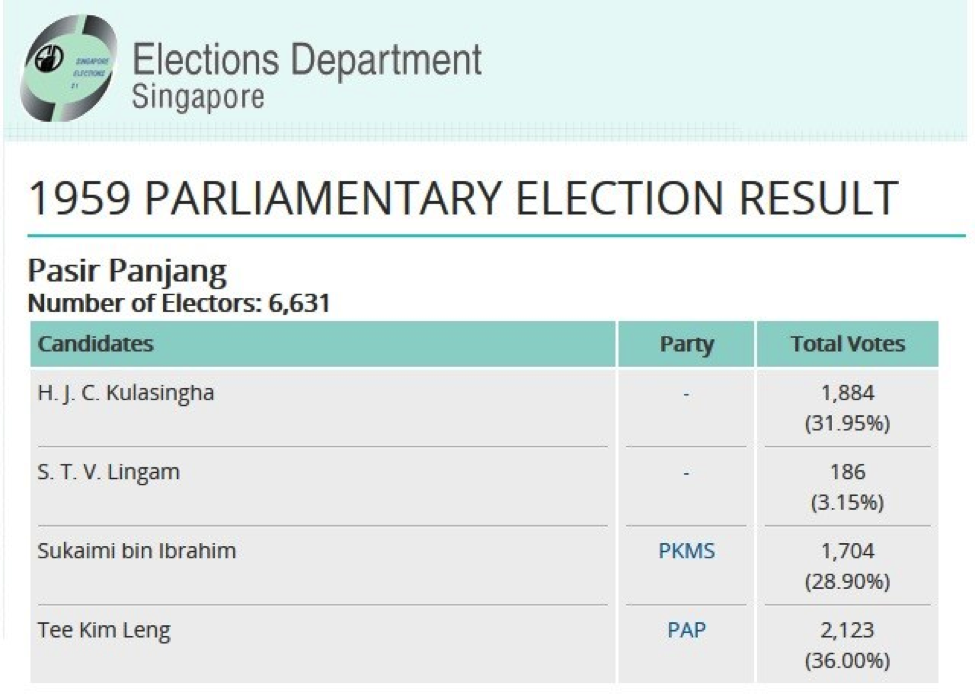
    For instance, during GE1959, 64 percent of valid votes by Pasir Panjang residents were split among three defeated minority candidates, while the PAP’s Tee Kim Leng obtained 36 percent (see image below). Clearly, there was no unfair disadvantage attributable to race.

    Pic1

    From 1959 (when the PAP first assumed power) until 1984, there were 77 victories by Chinese candidates in multiracial electoral contests. Seventy three of those wins went to the PAP. If Singapore’s ruling party insists that racial bias exists among many voters, it should clarify which of its candidates did not win on merit but through voters’ racialism.

    Another important statistic involves minorities defeating Chinese candidates. There were 49 such victories, or 38.9 percent of all 126 pre-GRC multiracial electoral contests, evidence that a candidate’s ethnicity plays little or no part in a voter’s decision at the polls.

    The PAP won 117 of those 126 multiracial tilts, proving that whenever voters were asked to make a choice between candidates of different races, they almost always chose the PAP and did so regardless of ethnicity. This is known as voting along political lines.

    Why the Downward Trend in Minority Representation?

    The preference of most Singaporean voters for the PAP, whatever its candidate’s race, has resulted in this phenomenon – a near-perfect correlation between the proportion of minority representation in parliament and the proportion of minority candidates on the PAP slate. This phenomenon is the reason for the drop in minority representation from 1959 to 1984.

    TABLE B

    Year of general election Proportion of minority candidates in PAP slate Proportion of minority representation in Parliament Number of minority PAP candidates Number of minority MPs in Parliament Total number of MPs in Parliament
    1959 33.33% 35.29% 17 18 51
    1963 33.33% 31.37% 17 16 51
    1968 29.31% 29.31% 17 17 58
    1972 24.62% 24.62% 16 16 65
    1976 24.64% 24.64% 17 17 69
    1980 24.00% 24.00% 18 18 75
    1984 18.99% 20.25% 15 16 79

    Table B shows that the lower the proportion of minorities in the PAP slate of candidates, the smaller the proportion of minority representation in parliament.

    Back in the 1980s, the PAP government should have noticed this trend before jumping to a vastly different conclusion about voter behavior and changing the law to accommodate its GRC scheme.

    The almost 100 percent correlation is not surprising. This is exactly what one would expect when voters choose their parliamentary representative based on political affiliation, not race, in a situation where one party enjoys overwhelming dominance.

    Elections Under the GRC System

    The pre-GRC trend of Singaporeans voting along political lines continued after GRCs became a fixture on Singapore’s political landscape. Almost every elected seat since 1988 has been filled by a PAP parliamentarian – 562 out of a total of 585.

    Just like during the pre-GRC era, the proportion of minority representation under the GRC system is almost wholly dependent on the proportion of minority candidates on the PAP slate.

    This period saw 28 GRC battles involving an unequal number of minority candidates between the two competing parties. If voters were racially biased, they would choose the party with fewer minority candidates, but there were as many as eight victories (28.57 percent) for the party fielding more minorities.

    One of those eight wins is a good example of why race is not an issue in Singaporean politics requiring affirmative action such as the GRC scheme.

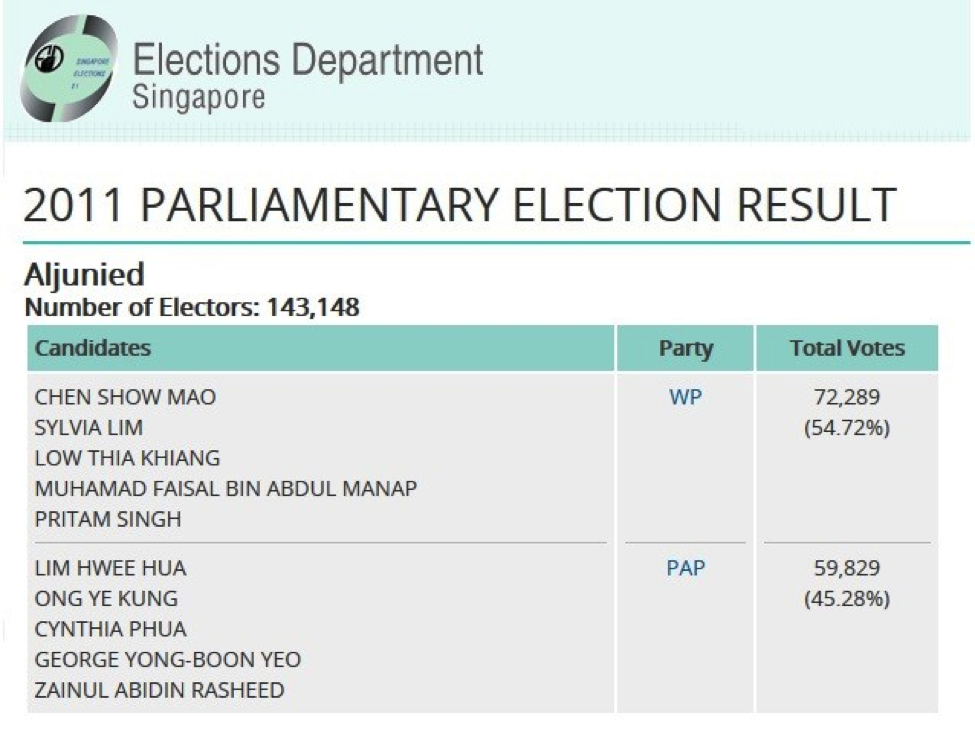
    If the PAP theory of racial bias among voters was valid, why did Aljunied residents vote for a party fielding more minority candidates (see image below), especially since they (Pritam Singh and Muhamad Faisal) had no previous parliamentary experience, unlike their opponent Zainul Abidin Rasheed?

    Pic2

    One may argue that the 2011 Workers’ Party victory in Aljunied does not necessarily mean racial bias didn’t exist. Rather, this argument might go, there was just too much voter dissatisfaction with the ruling party at that time, causing the tide to turn against the PAP.

    But if so, then it means that Aljunied residents’ political concerns trumped any racial bias they might have had, meaning that any racialism among voters was not able to sway the outcome of an election contest.

    Multiracial Single-Seat Contests During the GRC Era

    Not every minority MP entered parliament through a GRC.

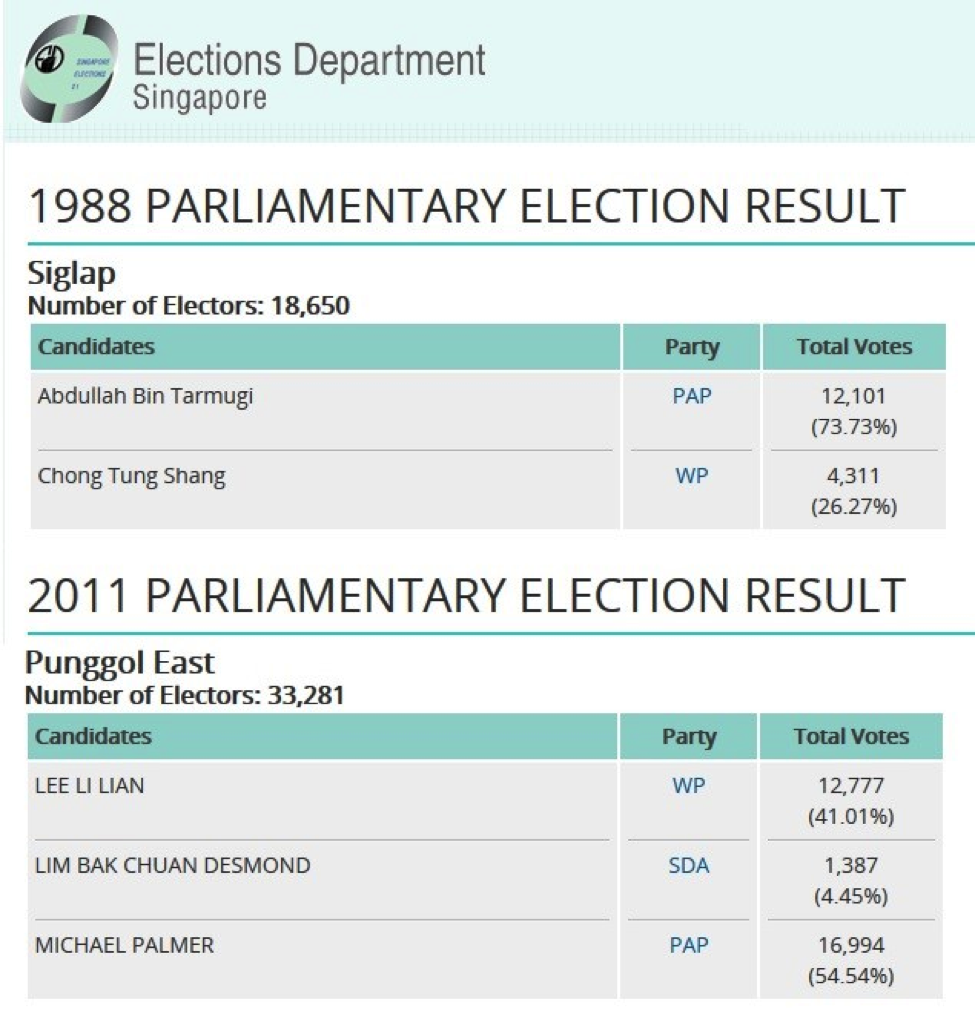
    Even when the PAP decided to have one of its minority candidates contest in a single-seat constituency, voters still sent that candidate into parliament instead of picking the opposing candidate from the ethnic Chinese majority (see image below). This clearly demonstrates that race plays no significant part in voters’ decisions.

    Pic3

    Of course, there were 28 single-seat victories by Chinese candidates against their minority opponents. But one can easily argue that those results simply reflect the clout that the PAP enjoys in Singapore’s political arena. If the PAP disagrees with that argument, it should reveal to Singaporeans which of its 28 victories had nothing to do with merit.

    From whichever angle you look at the Republic’s election data, it’s impossible to arrive at any convincing conclusion that Singaporeans vote along racial lines.

    So Many Questions, But No Satisfactory Answers

    The PAP says it fears inadequate minority representation in parliament, but what is adequate? If “adequate” means proportional parliamentary representation based on Singapore’s demographics, should there also be affirmative action to bring about “adequate” minority presence in the country’s employment, educational and sporting sectors?

    If it is deemed impractical or unnecessary to expect every Singaporean corporation, school or sports team to adhere to a racial quota, why should the GRC scheme be allowed to continue, especially when the very problem the scheme was created to overcome does not even exist?

    Michael Y.P. Ang is an independent Singaporean journalist. In 1999, he was among the core group of journalists who helped launch Channel NewsAsia, where he covered sport, entertainment, crime, and the 2001 Singapore General Election. He comments on Singapore’s sporting issues, often through a sociopolitical angle, on his Facebook page Michael Ang Sports.


    Source: http://thediplomat.com

  • Help! Ada Hantu In Our Hotel Room

    Help! Ada Hantu In Our Hotel Room

    Stomper Siti noticed something out of the ordinary in a photograph she took with her some of her companions at a hotel in Singapore on Feb 13.

    According to the Stomper, after the photograph was taken, she noticed that there was a reflection of a ghostly white figure in a window at the top left hand corner of the image.

    Said Siti with regards to what happened:

    “We saw the figure two days after we took the photograph.

    “The image was a selfie, no one was taking the photo for us.

    “We were freaked out by what we saw.”


    Source: http://singaporeseen.stomp.com.sg

  • 8 Fakta Dan Mitos Mengenai Durian

    8 Fakta Dan Mitos Mengenai Durian

    Musim durian dijangka kembali sekali lagi ke Singapura tidak lama lagi.

    Dengan jenis seperti Musang King atau Mao Shan Wang terus menjadi buruan, kami bawa anda melihat sekilas fakta dan mitos berhubung raja buah itu, seperti ditukil dari laman healthxchange.com.sg.

    FAKTA TENTANG DURIAN

    1) Durian kaya dengan zat

    Ini tentunya khabar gembira bagi anda yang gemar makan durian. Durian kaya dengan kalium, serabut diet, zat besi, vitamin C dan vitamin B kompleks.

    Buah yang juga dikenali sebagai raja buah itu sangat baik untuk meningkatkan kekuatan otot dan tekanan darah.

    Bukan itu sahaja, durian juga baik untuk melancarkan buang air besar dan kesihatan kulit. Ia juga mendukung sistem saraf, meningkatkan kekebalan tubuh dan meningkatkan penghasilan sel darah merah.

    2) Durian boleh menyebabkan berat badan anda naik

    Ini adalah salah satu fakta pahit yang perlu anda terima, terutama bagi penggemar durian. Secara purata, durian seberat 1 kilogram mengandungi hampir 1,350 kalori. Memakan satu durian sahaja bermakna anda sudah mengambil 68 peratus daripada 2,000 kalori yang disarankan setiap hari bagi seorang dewasa. Bahkan, seulas durian (sekitar 40 gram) mempunyai 54 kalori.

    3) Pesakit kencing manis perlu kurangkan pemakanan durian

    Boleh dikatakan, buah durian tidak begitu sesuai untuk pesakit kencing manis. Ini kerana durian mempunyai kandungan gula yang tinggi. Ia mengandung gula sederhana seperti sukrosa, fruktosa, dan glukosa.

    4) Durian berikan tenaga serta-merta

    Oleh kerana kandungan karbohidrat yang tinggi, durian boleh membantu untuk meningkatkan tahap tenaga yang rendah dengan pantas di kalangan individu sihat. Kandungan kalium yang tinggi dalam durian juga membantu mengurangkan kelelahan, sekaligus menghilangkan tekanan dan rasa cemas

    MITOS TENTANG DURIAN

    1) Durian kaya dengan kolestrol

    Ramai yang menyangka durian mengandungi kolesterol. Namun hakikatnya, buah ini memiliki kandungan lemak monotaktepu yang baik untuk jantung. Selain itu, durian boleh membantu mengurangkan kadar kolestrol LDL yang tidak baik untuk anda.

    2) Manggis perlu dimakan bersama durian untuk kurangkan panas badan

    Menurut tradisi orang Cina, oleh kerana manggis buah pendingin, ia dapat mengurangkan kesan “kehangatan” durian. Namun, tiada kajian saintifik yang membuktikan hal ini.

    3) Makan durian dan minum arak pada masa yang sama boleh membawa kematian

    Sekali lagi, tiada bukti saintifik yang menunjukkan kombinasi ini dapat membawa maut. Makan durian dan minum arak mungkin hanya menyebabkan perut kembung, gangguan pencernaan dan rasa tidak selesa pada hati.

    Ini kerana hati harus bekerja lebih keras untuk memetabolismekan kedua-dua lemak dan gula dalam durian dan arak, terutama jika ia diambil secara berlebihan.

    4) Makan durian boleh meningkatkan libido atau nafsu berahi

    Fakta ini mungkin sedikit mengecewakan. Buah durian boleh menyebabkan suhu badan meningkat, namun ini tidaklah menjadikan buah itu satu afrodisiak.

    Kesimpulannya, menurut laman healthxchange, para pakar pemakanan memberi pesanan bahawa durian itu buah yang kaya dengan zat.

    Jika dimakan secara sederhana, ia boleh membekalkan tubuh dengan mineral, vitamin dan lemak yang baik untuk kesihatan.

    Menurut healthxchange, sudah cukup untuk makan dua hingga tiga ulas durian sekaligus. Sayangnya, ramai yang sukar mengawal diri sehingga makan durian melebihi yang sepatutnya.

    Source: http://berita.mediacorp.sg