Throwing out socio-political blogger Alex Au Wai Pang’s appeal against his conviction for contempt of court, the Court of Appeal issued strong words against his attempt to pass off the content in his offending blog post as fair criticism.
By using insinuations, rather than express statements, to allege that hearing dates for two challenges against laws criminalising homosexuality had been manipulated, Au’s blog posting on Oct 2, 2013 was an “even more insidious” attack on the judiciary’s independence, the court ruled, in its judgment released yesterday.
“It was carefully crafted so as to take the form of insinuations that were just as effective as (if not more effective than) overt or express statements. There was, in addition to the very nature and tenor of the article itself, a total absence of a rational basis on the part of (Au) when he wrote the article, and it follows that the article clearly did not constitute fair criticism,” the three-judge court said.
“This insidious attack on the independence as well as impartiality of the judiciary goes to the very heart of what the (indeed, any) judiciary stands for and clearly undermines public confidence in the administration of justice.”
Au had appealed against an S$8,000 fine for the blog post titled 377 wheels come off Supreme Court’s best-laid plans, which alleged that the Supreme Court’s “strange calendaring” had allowed a gay couple’s constitutionality challenge against Section 377A to be heard first, although they had launched the bid after a similar contest by Mr Tan Eng Hong, 51, who was caught having oral sex with a man in a public toilet.
This, Au alleged, was because Chief Justice Sundaresh Menon wanted to be on the three-judge Court of Appeal to hear the constitutional challenge against Section 377A. CJ Menon could not do this otherwise because of conflict of interest, as he was Attorney-General when Tan’s criminal case was heard in court.
In arguing against the conviction for contempt of court, Au said he had not engaged in mere descriptive reporting in the article. Instead, it was based on what he called logical deductions arising from a set of objective facts.
But his argument was dismissed by Judge of Appeal Andrew Phang, who delivered the judgment on behalf of the three-court judge. From a “plain reading” of the title of the article, “the implication — or rather, insinuation — is that there was something untoward or even sinister in the alleged deliberate scheduling” of the cases, said the court, which comprised Judge of Appeal Chao Hick Tin and Justice Tay Yong Kwang.
“Put simply, why would the ‘wheels’ need to come off a perfectly functioning vehicle which was presumably headed in the correct direction to begin with?” the judges wrote.
Au also did not have “even a shadow of objective facts upon which to premise what he claims is fair criticism”, they added, referring to the blogger’s argument that his article was based on conversations with several unnamed sources. “The alleged sources – or, rather, their rank absence – bear this out. They were nothing more than general as well as vague references.”
Justice Phang noted that this was not simply a case of Au getting his version of events incorrect or off the mark, as he had claimed. Neither was it a case of Au being misled by these so-called sources,” he added.
“It should also be noted that in his affidavit, Au even attempted to rely on ‘sources’ that post-dated the publication of the article. His efforts in this regard – viewed in their totality – come across as disingenuous. It is clear that the Article did not constitute fair criticism,” the judge added.
Singapore’s High Court on Thursday fined a prominent dissident blogger $8,000 for “scandalising” the city-state’s judiciary in an online commentary.
Alex Au, 62, was punished over an October 5, 2013 post insinuating that hearing dates on a constitutional challenge to an old law criminalising gay sex between men had been rigged.
Au, also a gay-rights activist, apologised to the court and paid the fine. He would have been jailed for one day if he failed or refused to pay the fine.
“I have instructed my attorneys to file an appeal,” Au told reporters.
In an earlier ruling, the High Court said Au was “guilty of scandalising contempt” for publishing the article on his blog site.
Contempt of court carries a possible jail sentence, a fine or both. There is no maximum penalty specified under the law.
Au is well-known in Singapore for his commentaries critical of the long-ruling People’s Action Party (PAP).
He has also called for the repeal of the controversial Section 377A of the penal code, which criminalises sex between men.
First introduced by British colonial administrators in 1938, the law is not actively enforced by authorities.
But the government says it has to remain on the books because most Singaporeans are conservative and do not accept homosexuality.
Singapore’s highest court, the Court of Appeal, in October upheld rulings by lower courts that it was up to parliament to repeal the Section 377A.
The government has taken a strong stand against attacks on the integrity of the judiciary, saying they undermine public confidence in the institution.
In 2010, British author Alan Shadrake was given a six-week jail term for publishing a book critical of the administration of the death penalty, which was ruled an insult to the judiciary.
Blogger Alex Au Wai Pang was on Thursday (Jan 22) found guilty of scandalising contempt over a blogpost in which he discussed challenges of the constitutionality of Section 377A.
However, High Court judge Belinda Ang found that a second post by Au was not in contempt of court.
The Attorney-General’s Chambers (AGC) took action against Au, 61, over two articles on his Yawning Bread blog in October 2013, arguing that the articles were not fair criticism and risked undermining public confidence in judiciary. The AGC also charged that the articles were baseless attacks against the authority of court and crossed the legal line.
Justice Ang found that Au’s first article, 377 Wheels Come Off Supreme Court’s Best Laid Plans, had imputed judicial partiality and impropriety on the part of the Chief Justice, and risked undermining public confidence in the administration of justice in Singapore.
However, she ruled that the AGC failed to prove beyond reasonable doubt the charge of scandalising contempt on the second post titled Church Sacks Employee and Sues Government – on one ground right, on another ground wrong.
In this post, Au wrote that he did not have high hopes that former Robinson & Co employee Lawrence Wee’s application for a court declaration that Article 12 of the Constitution prohibits discrimination on the basis of sexual orientation, “mostly because my confidence in the Singapore judiciary is as limp as a flag on a windless day”.
Justice Ang disagreed with the prosecution that Au’s graphic description of his lack of confidence in the judiciary “stems from the judiciary’s inadequacies, incompetence and/or partiality against cases which relate to issues of sexual orientation”.
Sentencing for Au’s conviction in relation to the first article will proceed at a later date.
Alex Au, a blogger at Yawningbread and founder of a Singapore gay rights group, People Like Us.
When the story first broke, what struck me most was the focus on lesbians. It is far more common in anti-LGBT speech for the reference to be either directed at gay males or framed with reference to gay male sex, at least in Singapore and the West. But coming from a lecturer in Malay Studies, I wasn’t surprised.
On 20 February, Syed Muhd Khairudin Aljunied made a post on Facebook in which he lambasted “liberal Islam” and its support for lesbianism, describing them not only as “wrongful ideologies” — a matter of opinion, perhaps — but also as “diseases” and “cancers”. The latter may have stepped into hate speech.
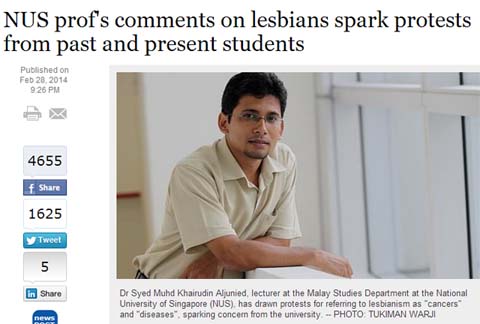
As the story in the Straits Times (headline shown above) shows, it generated protests and several petitions.
Now, before I go further, it is important to look at what Khairudin actually said. An anonymous comment led me to the Rilek1Corner site which had a screengrab (see thumbnail at left). His Facebook post seems to have been an answer to a question by an unnamed person, concerning a “new development” in which liberal Islam may be affirming unorthodox sexual identities. In his answer, Khairudin suggested giving advice, going to “proper religious classes”, and seeking help from counsellors. He urged using the “power of technology” to alert groups and movements about spreading these “wrongful ideologies”.
The recommendation may sound reasonable, even if we disagree with his view. Nevertheless, the dehumanising tone he used to describe lesbians — and for that matter, adherents of “liberal Islam” too — is what made the post stand out.
I have on several occasions argued that homophobia is deeply linked to insecurity stemming from a loss of male privilege. You get clues to this when you read some of the things Pope Benedict XVI used to say, speaking of both “radical feminism” and “homosexual lifestyles” in virtually the same breath, and how both have undermined “family life”. Traditionalists’ conception of a happily ordered family is one where the husband is the dominant member, and where the sexes had clearly demarcated roles. Feminism, which argued for equality and autonomy for women, was a serious threat. The gay rights movement sprang from this, making the point that true autonomy includes autonomy in sexual orientation and gender identity.
It is not easy to see this linkage between feminism and gay rights when one looks at the speech of the US-based Christian Right, and that may be why we forget that there is a link. This, in my view, is because in the US, it has become socially impossible to speak openly against equality for women. Thus, even as the Christian Right goes ballistic over gays and lesbians, they know it won’t be politick to attack heterosexual women as well.
However, this does not mean they don’t engage in side actions that try to limit women’s autonomy. The same people also tend to support tighter restrictions on abortion. But they have cleverly packaged it as a “right to life” issue, not as an “attack women’s right to control their bodies” issue, which in reality it is.
Islam is much less reticent about speaking out against equality and autonomy for women. I used to joke that Muslim clerics aren’t as prominent in attacking the LGBT movement as the Christian Right because they were too busy trying to control women. Things may be changing now, not because they are any more accepting of equality for women, but because the LGBT issue has made enough progress that we can’t be ignored any longer.
But it is probably no coincidence that the religions that feel most threatened by this “deadly mix” of feminism and gay rights, and are more explicit about linking the two, are the ones that still segregate men and women, either in prayer halls or in clerical roles. Gender distinctions are not just important in Islam and Roman Catholicism, they are part of the teaching. It is much easier for them to speak out against both feminism and gay rights simultaneously than it is for conservative Protestants, who have already conceded the point on women’s equality (even if they have not internalised it).
This dual threat perception comes together to explain why the question that Khairudin had to answer focussed on lesbians. Lesbians represent both a refusal to be subordinate to men and a challenge to heteronormativity. They are the “worst of the worst”.
* * * * *
In the wake of the news reports, I asked around if anyone knew Khairudin or had heard him speak on previous occasions. One friend gave me a particularly interesting answer, painting a negative picture of the man. She had attended one (or maybe more than one — I didn’t clarify with her) lecture by him and came away with the impression that he was insufferably sexist. She remembered how the notion of male privilege and dominance held up many of the ideas he propounded.
The other strong impression she came away with was his condescension towards Malays. She said, “His opening remarks was something along the lines of ‘I want to stress that while my field is Malay Studies, I myself am not Malay, but Arab’. Why was it necessary to stress that? He then added, ‘However, I married a Malay wife,’ and saying how much he ‘loved’ Malays.”
My friend got quite agitated just retelling this to me. I don’t blame her. It sounds awfully like people who say, “I have nothing against gays, in fact some of my best friends are gay, but . . . “
It’s a bit ironic then that a group called Fellowship of Muslim Students Association (FMSA), responding to petitions being circulated, described in a statement it issued,
Dr Syed Khairudin is an icon of the Malay/Muslim community in the field of academic achievement. He continues to play a contributing role to the Malay/Muslim community and the mainstream society.
Another thing you’d note from the FMSA statement is its reference to a “Neo-Sodom-Gomorrah community”, presumably newly coined by them. However, as playwright Alfian Sa’at pointed out,
They do use the term LGBT as well, which clearly shows that the coinage is a silly and childish attempt at testing the limits of provocative and inflammatory speech.
Which brings me back to the question of hate speech.
* * * * *
There is at least one petition calling on the university authorities to sanction Khairudin for committing hate speech. Khairudin’s defenders argue that if the university did so, it would be a violation of academic freedom.
Where is the line between academic freedom and hate speech? It may be hard to draw, for indeed there is value in allowing space for counter-mainstream, even offensive ideas. But a necessary test may be whether the idea being espoused is intellectually grounded: What is the basis for the idea? How sound is it?
This test may be easier to apply in some disciplines than others. It is, for example, quite clear that advocating the “truth” of creationism can seek no protection from academic freedom, but arguing the moral value of large-scale genetic engineering of humans — well, that may not be so clear-cut.
But lost in the debate about whether Khairudin was exercising his academic freedom is this: Was his Facebook posting on a matter that was within his area of expertise? It is doubtful. From what little I know, his area is that of Malay Studies, which I would think is quite distinct from Islamic Studies. He was pronouncing on religion, particularly on liberal Islam. I am sure there are scholars out there with much deeper knowledge about Islamic perspectives.
This is important. A professor of monetary theory can have no special claim to be an expert on transgender identities.
If on balance his passing judgement on liberal Islam and lesbians wasn’t within Khairudin’s area of expertise, then the greater laxity that one might give for academic freedom will not apply. He was in fact just exercising his right to free speech, the same right that you and I have. That speech will need to be tested on the same basis as anyone else’s speech for hate content. So the question comes back to this: Is labelling a class of people a “disease” and “cancer” something that would cross the line? Suppose one said that the migration of dark-complexioned people from such and such a place to Singapore was a “cancer” — would that be OK? Suppose one said that a new religion making inroads and gaining adherents was a “disease” infecting Singapore society, would that be acceptable?
POST-SCRIPT
In Straits Times’ Breaking News,
The National University of Singapore (NUS) professor who drew criticism last week for referring to lesbianism as “cancers” has been counselled by the university.
In an e-mail to all faculty members, staff and students on Wednesday, NUS provost Tan Eng Chye said he had counselled Associate Professor Syed Muhd Khairudin Aljunied, who acknowledged that his original post “reflected poor judgment in the tone and choice of words”.
Prof Tan, who is also NUS deputy president of academic affairs, said Dr Khairudin’s comments “contained provocative, inappropriate and offensive language”.
– Straits Times, 5 March 2014, NUS professor “counselled” by university for Facebook posting on lesbianism, by Pearl Lee
In a Clarification Statement which I found on Rilek1Corner (the source was Khairudin’s Facebook page) he wrote that he has not removed the original post, except the words “cancer” and “social diseases”. He also wrote that “My position as a Muslim about LGBT remains clear and is in line with the view of Muslims scholars”, and that “There is no disagreement in Islam on the prohibition of homosexuality.” Although Khairudin stressed that this was his personal view, the sense one gets from the foregoing is an attempt to invoke his religion for justification and defence.