Tag: Basuki Tjahaja Purnama

  • Jakarta Election Results A Victory For Prejudice Over Pluralism?

    Jakarta Election Results A Victory For Prejudice Over Pluralism?

    The long, divisive campaign for governorship of Indonesia’s capital city Jakarta is finally over, with unofficial results showing a decisive victory for the challenger Anies Baswedan over the controversial incumbent governor Basuki Tjahaja Purnama (popularly known as Ahok).The Conversation

    The election was the most politically significant regional election in Indonesia’s history because it wasn’t just about choosing the chief executive for the city’s 10 million citizens.

    Rather, it became a referendum on the future of Indonesia’s ethno-religious diversity and tolerance after unwanted intervention by a number of radical Islamist groups, most notably the Islamic Defenders Front (FPI).

    The blasphemy campaign against Ahok

    These groups accused Ahok, a Chinese Indonesian who is Christian, of blaspheming last September by mocking a Qur’anic verse that allegedly calls for Muslims to reject non-Muslims as their leaders. Ahok criticised unnamed religious clerics (ulama) for using verse 51 of the Surah Al-Maidah that advises Muslims to avoid aligning with Christian and Jews.

    FPI and its allies managed to obtain a religious ruling (fatwa) from the Indonesian Ulama Council (MUI) declaring that Ahok was guilty of committing blasphemy against Islam. They then sponsored a number of anti-Ahok rallies in Jakarta, the largest of which, held in November 2016, attracted approximately 2.5 million protesters.

    Under pressure from these groups, the Indonesian government opened an investigation against Ahok and tried him for blasphemy. The trial was adjourned a week before the election.

    Anies, a very astute politician, quickly capitalised on anti-Ahok accusations, by seeking and receiving an endorsement from Habib Rizieq Shihab, FPI’s supreme leader. He also started to portray himself as an “Islamic candidate” to win the support of Jakarta’s Muslims, who comprise 85% of registered voters.

    The strategy seems to have worked, as an Indo Barometer poll in February indicated more than half of Jakarta’s voters would not vote for Ahok because they believed he had committed a blasphemous act against Islam.

    They reached this conclusion despite a number of Islamic scholars saying that the Qur’anic verse in question must be seen in the context of warfare between Muslims and non-Muslims during the early Islamic period. And that it had nothing to do with how Muslims should choose their leader.

    The race between the two contenders was very tight, as indicated by a reputable Saiful Mujani Research and Consulting (SMRC) poll, which showed Anies leading Ahok with a margin of 1% (47.9% vs 46.9%), with up to 5.2% of voters still undecided.

    The campaign took an ugly turn when an elderly woman, who had voted for Ahok during the first round and subsequently died, was allegedly denied a Muslim burial. And an Islamist activist made a Facebook post stating it would be religiously permissible for any women voting for Ahok during the run-off election to be gang-raped.

    Police had to tear down a number of banners placed in mosques across Jakarta discouraging their members to vote for Ahok during the runoff.

    Implications of the election results

    The election has serious implications for the future of Indonesian politics. Anies’ victory means he is in a stronger position to mount a challenge against President Joko Widodo in 2019, as a candidate of the Great Indonesia Movement Party (Gerindra), or with another opposition party.

    A young, telegenic politician who has widely touted his Islamic credentials, Anies is perceived by Jokowi as a more formidable opponent than “old guard” elite figures, such as retired General Prabowo Subianto and former president Susilo Bambang Yudhoyono, who are both widely expected to be contenders during the 2019 presidential election.

    But more importantly, Anies’ victory is another sign of the growing Islamisation of Indonesian politics, which has been on the rise since the country made its democratic transition in 1998.

    This phenomena can be seen throughout Indonesian society, from the promotion of Islamist prayer groups (pengajian) and study circles (halaqah) in public university campuses throughout the country; the proliferation of Indonesian women wearing Islamic veils (hijab); and the rapid increase in local regulations restricting alcohol consumption and the rights of religious minorities.

    There seems to be an ideological and political convergence between Islamist groups such as FPI (an association of approximately 100,000 hardline Islamists with close ties to the Indonesian security apparatus) and Hizbut Tahrir Indonesia. This latter is known for its advocacy for a global caliphate.

    Members of both groups are developing a close relationship with the conservative elements of the Nahdlatul Ulama NU) and Muhammadiyah, Indonesia’s two largest Muslim organisations with generally moderate political leanings. They claim membership by 60 million and 30 million people respectively.

    The MUI fatwa against Ahok was signed by Maaruf Amin, who, apart from being the council’s general chairman, is also NU’s supreme leader (rais aam).

    The groups have also cooperated to demand the implementation of shari’a regulations (perda shari’a) by local governments throughout Indonesia. And there are now 442 such regulations in place in over 100 cities and districts.

    These regulations require women to wear hijab in public, prohibit the consumption of alcohol and prostitution, and declare a number of Islamic minority sects, such as Ahmadis and Shiites, to be illegal within their respective localities. The groups have also encouraged acts of violence against both minorities over the past decade or so.

    Rising Islamism and the renewed prejudice against ethnic and religious minorities pose a danger to the pluralist outlook enshrined in Indonesia’s official founding principles, which are collectively known as Pancasila. Made from the Sanskrit word for “five”, panca, and the Javanese for “principles”, sila, Pancasila states: “The one God system (monotheism), just and civilised humanity, the unity of Indonesia, democracy and social justice for all.”

    These principles have underpinned equality for all Indonesia’s ethnic and religious groups since the country’s founding in 1945. Indonesian founding fathers who created Pancasila meant to give equal political and economic opportunities to all Indonesians irrespective of their ethnic and religious background.

    Unlike Indonesia’s neighbour Malaysia, Pancasila grants no special status to Muslims and instead gives official religions status to a number of religions (Islam, Christianity, Hinduism, Buddhism, and Confucianism). It gives them equal legal recognition, and grants their members full religious freedom. Most significantly, adherents of all religions are free to run for and occupy any public office.

    By creating these accusations against Ahok, the Islamists have refused to recognise the legal rights of Indonesia’s ethnic and religious minorities to run for public office. Ahok’s loss means that Indonesia’s ethno-religious diversity is the biggest casualty of this highly polarising election.

    Alexander R Arifianto, Research Fellow, Indonesia Programme, S. Rajaratnam School of International Studies, Nanyang Technological University


    Source: www.theindependent.sg

  • Muslim Jakarta Governor Candidate Ahead In Election, Early Count Shows

    Muslim Jakarta Governor Candidate Ahead In Election, Early Count Shows

    Former Indonesian education minister, Anies Baswedan, was slightly ahead of Jakarta’s incumbent Christian governor in the race to lead the Indonesian capital, unofficial early counting by a private pollster showed on Wednesday.

    Baswedan had secured 51.93 per cent of the votes, just ahead of Basuki Tjahaja Purnama, known as “Ahok”, on 48.07 per cent, based on a quick sample count of around 5 per cent of the vote by Indikator Politik.

    A candidate needs a simple majority to win. The national elections commission will announce official results in early May.

    The Jakarta poll has been overshadowed by religious tensions, with mass Islamist-led protests against Purnama, and is being widely seen as a proxy battle for the presidential election in 2019.

    Purnama is backed by President Joko Widodo’s ruling party. Baswedan is supported by a conservative retired general, Prabowo Subianto, who lost to Widodo in a 2014 presidential vote and may challenge him again.

    But the election is also viewed as a test for Indonesia’s young democracy and record of religious tolerance, with both sides raising concerns about intimidation and voter fraud.

    The campaign featured mass rallies led by a hardline Islamist movement, which has strengthened in recent years in a country long dominated by a moderate form of Islam.

    Police said 15 people were detained following reports of disturbances at several polling stations in the city of 10 million people, after what the Jakarta Post this week dubbed “the dirtiest, most polarising and most divisive” election campaign the nation had ever seen.

    “Political differences should not break our unity,” President Joko Widodo said in a statement after casting his ballot at a central Jakarta polling station. “We are all brothers and sisters. Whoever is elected, we must accept.”

    LIGHT SECURITY

    “Don’t let any cheating happen, because the future of Jakarta is determined by the election today,” Purnama, 50, told reporters after voting with his family in North Jakarta.

    His rival, Baswedan, 47, said as he voted in the south of the city that the election was being closely watched at home and abroad, so it was important to avoid an atmosphere of tension.

    Polls closed at 1pm (0600 GMT) with 7 million people eligible to vote. Security appeared light at several polling stations, though police said 66,000 personnel were deployed across the city.

    Police in neighbouring provinces on Java island searched private cars and public buses heading for Jakarta on Tuesday to look for sharp objects and explosives.

    Jakarta police spokesman Argo Yuwono said police had stopped and searched vehicle heading for Jakarta on Tuesday to ensure “no movement of masses toward the capital”.

    Religious tensions have been an undercurrent in the campaign, with Purnama on trial for blasphemy over comments he made last year that many took to be insulting to Islam.

    Hundreds of thousands of Muslims took to the streets late last year to call for his sacking and to urge voters not to elect a non-Muslim leader. One person died and more than 100 were injured after one protest turned violent.

    Police fear Islamic leaders could incite a fresh bout of unrest if Purnama wins the election.

    CONTESTING THE RESULTS

    Purnama faces up to five years in jail if convicted of blasphemy. His trial will resume on Thursday, when prosecutors will submit a sentence request.

    “We are worried things could be hotter if the results are quite close,” said Isabella Hariyono, a 30-year-old voter in North Jakarta. “We hope things don’t heat up. The police and military are ready but we never know.”

    Private pollsters, approved by the national elections commission, are expected to announce an unofficial tabulation of a sample of votes, known as “quick counts”, within a few hours of polls closing. The elections commission is expected to announce official results by the first week of May.

    The loser can contest the results in the Constitutional Court, which could prolong political uncertainty for weeks.

    Citigroup said in an investor note that, despite the potential for renewed protests if Purnama won, it was maintaining a Jakarta stock index target of 6,150 by the end of 2017, representing an 8 per cent upside.

    “As long as there are no security issues, the election outcome should not significantly stall the reform programme of the national government, in our view,” it said.


    Rilek1Corner

    Source: http://www.channelnewsasia.com

  • Marvel To Discipline Indonesian Marvel-Gold Artist For Hidden Political, Religious Reference

    Marvel To Discipline Indonesian Marvel-Gold Artist For Hidden Political, Religious Reference

    Marvel Comics is planning to take disciplinary action against an Indonesian artist who sneaked several controversial references into his artwork for the first issue of X-Men Gold, according to reports citing a statement by the comics giant.

    X-Men Gold #1, which was published on Wednesday (Apr 5), was illustrated by Indonesian artist Ardian Syaf.

    His artwork allegedly contained several hidden religious references and sparked an outcry by comic book fans on social media.

    In one scene, Jewish mutant Kitty Pryde is seen standing in front of a crowd of humans. Her head is adjacent to a sign saying “Jewelry”, which some took to be a reference to her heritage.

    In the same panel, there is a building with the numbers “212” on it – a reference to a mass rally by Indonesian Muslims on Dec 2 last year against Jakarta’s Christian Chinese governor Basuki “Ahok” Tjahaja Purnama. Ahok is on trial for blasphemy over accusations that he insulted the Islamic holy book, the Quran.

    Another scene in the issue shows Colossus wearing a t-shirt with “QS 5:51” on it, a reference to a verse in the Quran used by some in Indonesia to support their view that non-Muslims should not lead the government.

    Ardian shared artwork for the issue on his Facebook page on Thursday, in a post that has since been taken down. By Sunday evening, the post had drawn almost 200 comments.

    Many criticised him for the alleged political messages. “The X-Men message at its core is integration, not division,” Facebook user Zauri Severino Junior wrote.

    “It’s shameful to see (an) Indonesian artist make a fool of himself worldwide just because of his impaired religious views and racism,” another commenter, Nuri Agustiani Setiawan, wrote.

    In a statement published by ComicBook on Saturday, Marvel said the artwork “was inserted without knowledge behind its reported meanings”.

    “These implied references do not reflect the views of the writer, editors or anyone else at Marvel and are in direct opposition of the inclusiveness of Marvel Comics and what the X-Men have stood for since their creation,” the statement said.

    Marvel added that disciplinary action would be taken against Syaf, but did not give further details.

    It added that the artwork would be removed from subsequent printings, digital versions, and trade paperbacks.

    In a Facebook post on Tuesday (Apr 11), Syaf said his career was “over now”.

    He added: “It’s the consequence (of) what I did, and I take it. Please no more mockery, debate, no more hate. I hope all in peace.”


    Source: www.channelnewsasia.com

  • Jakarta Anti-Governor Protest: Cars Burnt, 1 Dead And Many Injured

    Jakarta Anti-Governor Protest: Cars Burnt, 1 Dead And Many Injured

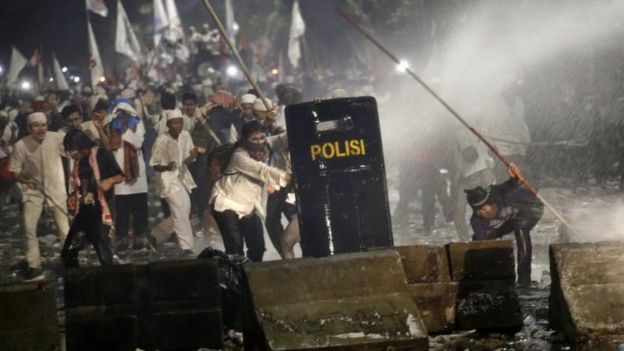
    Indonesian police have used tear gas and water cannon to subdue protesters as thousands of hard-line Muslims marched against Jakarta’s governor.

    Basuki Tjahaja Purnama, a Christian, is the first ethnic Chinese to hold the governor’s post in the capital of majority Muslim Indonesia.

    The demonstrators accuse him of having insulted Islam’s holy book, the Koran, and want him to be prosecuted.

    Clashes broke out between police and protesters who refused to disperse.

    One elderly man died, the Associated Press reports, citing police. Several other people, including police officers, have been injured.

    Protesters had earlier marched upon the presidential palace.

    Police had been braced for the possibility of religious and racial tensions erupting at the rally, which an estimated 50,000 people attended.

    It had mostly been peaceful but groups of angry demonstrators clashed with police after nightfall and set vehicles alight.

    In 1998, a wave of anti-Chinese sentiment led to mobs looting and burning Chinese-owned shops and houses. Ethnic Chinese make up about 1% of Indonesia’s population of 250 million people.

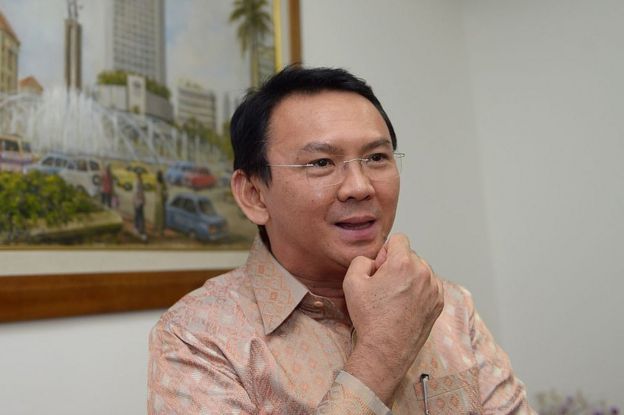
    Basuki Tjahaja Purnama, known by his nickname Ahok, speaks to journalists at his office in Jakarta in 2014
    Protesters are sprayed with water from a police water cannon truck during a clash outside the presidential palace in Jakarta, Indonesia, Friday, Nov. 4, 2016

    The protest was held to demand that Mr Purnama be prosecuted for blasphemy over comments he made in September that were seen as criticising a Koranic verse.

    He said that Islamic groups using a passage of the Koran to urge people not to support him were deceiving voters, who will go to the polls in February.

    The verse is interpreted by some as prohibiting Muslims from living under the leadership of a non-Muslim.

    Mr Purnama has since apologised but formal complaints were lodged against him by Islamic groups for defamation. He is now being investigated by police.

    Who is Governor Ahok?

    Some protesters at Friday’s rally carried signs calling for the governor’s death, the BBC’s Rebecca Henschke in Jakarta says.

    Representatives met with Vice-President Yusuf Kalla, who promised that the investigation into Mr Purnama would be completed within two weeks.

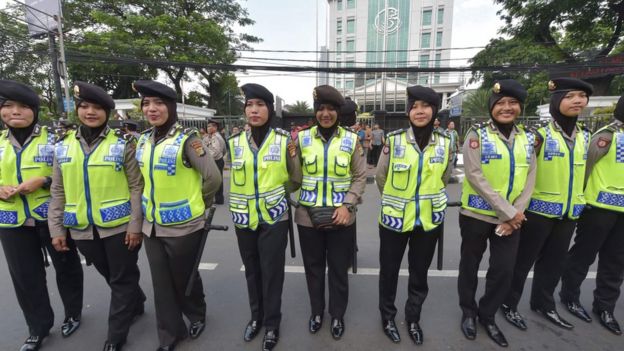
    Indonesian policewomen stand guard as Muslims march towards the presidential palace during a protest against Jakarta governor Basuki Tjahaja Purnama also known as Ahok over an alleged blasphemy in Jakarta on November 4, 2016

    There have long been tensions around Mr Purnama political role.

    In 2014, he was the deputy governor under Joko Widodo. When Mr Widodo was elected president the main group behind the current protest – Islamic Defenders Front (FPI) – did not want Mr Purnama to succeed him.

    They argued that a Christian should not govern a Muslim-majority city. The campaign against him has since taken on anti-Chinese overtones, though the FPI said the rally was not about the governor being from a minority group.

    Jakarta police said there were “provocative statements and images” on social media urging people to take violent action against Mr Purnama, including calls to kill him.

    Despite being seen as brash and outspoken, the governor is popular among many in the capital and has been praised for his effectiveness.

    Muslims in Indonesia are largely moderate and the country’s largest Islamic organisation, Nahdlatul Ulama, had advised its 40 million members not to take part in the protest.


    Source: www.bbc.com