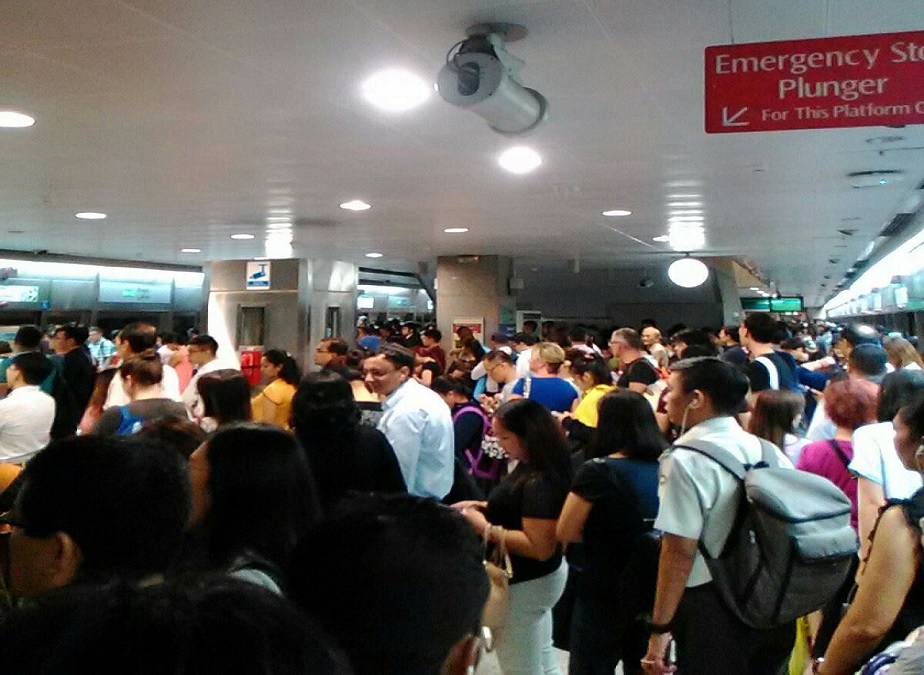
Whenever the MRT breaks down, all else fail too. Just take a look at Workers’ Party’s NMP Gerald Giam’s experience who was charged $49 for an Uber ride during the MRT breakdown that occurred yesterday. Any of you experienced exorbitant Uber/Grab fares as well? And Minister Khaw still has the cheek to say that the media is “unfairly magnifying” the problem of train breakdowns? #bull #bodohpehkambing
***
My experience yesterday evening on the MRT and this morning due to Downtown Line’s “signalling problem” (fare: $49). Is the media still “unfairly magnifying” the problem of train breakdowns, Mr Khaw?
“Raise fares to improve train service”, says the title of the letter to the Straits Times forum page on Wednesday.
Mr Jonathan Toh Joo Khai, the writer, pointed at the Public Transport Council (PTC), which regulates public transport fares, as the “root cause of SMRT’s frequent train breakdowns.”
“The fare hikes are miserly compared with the rate of inflation,” Mr Toh said.
He then rattled off a litany of “financial indicators” of the SMRT which, he said, “had been falling for five straight years.”
“Unlike other companies, SMRT cannot shed its money-losing train business,” Mr Toh said. “Yet, it is yet expected to improve reliability even as the PTC moderates fare hikes to meet the demands of commuters, some of whom even want a freeze to fare hikes until reliability improves.”
“How is that possible?” he asked.
He argued that “train fares in Singapore are low relative to gross domestic product per capita.”
Mr Toh thus called for fares to be increased, and that discounts be given to those in need.
“The rest who happily use our latest flashy iPhones and Samsungs to kill time on the trains can surely afford a fare hike,” he concluded.
The public transport operators (PTOs) make yearly application, usually towards the end of the year, for “fares review”, which the PTC will consider and decide on several months later, usually around March.
Mr Toh’s call is not new and is the latest in the last two years or so from various quarters who have also also called for higher fares for buses.
In January 204, for example, this report appeared in the TODAY newspaper:
TODAY, Jan 2014
“Rather than complain about both poor service and fare increases, perhaps it is time for a shift in commuters’ thinking towards paying even more, so that we get the transport services we deserve in a world-class city,” the writer said.
About four months later, the former chairman of the PTC, Gerard Ee, echoed the same sentiments.
Straits Times, May 2014
“At the end of the day, buses and trains are about transporting a lot of people from Point A to B as affordably as possible,” Mr Ee said. “So by that very nature, they are going to be crowded. They’re not designed for comfort.
“If you treasure your time and treasure your comfort, you pay a premium – there are premium bus services. If you value your time and comfort even more, buy a car. And then ultimately, get a chauffeur. You have to decide for yourself what it is you want.”
Straits Times, Jan 2014
But in January 2014, the PTC itself delinked the relationship between fare hikes and better service, particularly breakdowns of the system.
The PTC’s remarks were in response to public sentiments that fares should not go up when trains are still breaking down.
“[The] Public Transport Council (PTC) has said that the two issues should be kept separate,” the Straits Times reported.
Nonetheless, Prime Minister Lee Hsien Loong said in September last year that progress and improvements have been made, and that “there are not so many breakdowns as before.”
But just three months later, the TODAY newspaper reported that the “number of major MRT delays had hit a] four-year high.”
Sept 2014
There were 12 “major delays” in the first nine months of 2014 alone, the newspaper reported. This was more than the 11 for the entire year in 2011, the previous record number of delays.
And on Thursday, 30 July 2015, the Straits Times reported that there have already been “five major delays in Q1, nearly half last year’s total.”
Straits Times, 30 July 2015
“[There] were five service delays lasting more than 30 minutes between January and March this year,” the Straits Times said.
This included a disruption in February where a breakdown in the line between Yew Tee and Kranji station lasted for four hours and 38 minutes.
And earlier in July, the entire train system was shut-down for several hours due to a train fault, affecting 250,000 commuters.
Would all these problems disappear with the simple solution of increasing fares?
One would be hard-pressed to argue for such a simplistic expectation.
Yet, the truth is that much public funds have been poured into the transport system, billions in fact, and billions more have been earmarked for the same in the next decade.
And are the PTOs making losses?
If they were, there would be no justification for them to double the salary of their chief executive officer, as SMRT did this year, raising its CEO pay from S$1.2m in 2013, to $2.25m to $2.5m in 2015. (See here: “SMRT CEO paid $2.2m to $2.5m – a multifold jump in three years?“.
In an opinion piece in the Straits Times on Thursday, 09 July, the newspaper’s Senior Transport Correspondent, Christopher Tan, says “apologies from the operator, regulator or the Government” over Tuesday’s island-wide MRT shut-down “are beginning to sound glib and hollow.”
However, Mr Tan also suggested that “the Government should step in to help beef up resources required for SMRT to make things right quickly.”
Do you think it is prudent for the Government to pour in even more resources into SMRT, resources which ultimately will have to come from commuters and taxpayers?
We were having family dinner when my dad received notification that he is activated. Without further ado, he put down his dinner and report within 30 minutes to the assigned station. He did not grumble about how he had to work again. The previous time when he was activated, he came back to us and shared with us how he could understand the feelings of the passengers who were shouting and pushing him and his coworkers. He stood and said sorry at least 100 times to everyone who was trapped. He is just a maintenance guy in SMRT.
But, there was no negativity in him despite being shouted at, at the efficiency of the company, at the long standing hours or at anything. He came back to announce that he was glad that it’s settled.
So, before we throw our frustrations and ill mannerism to any of the ground staff, please remember that they are just doing their best to get lives moving. They apologized on behalf of SMRT, not themselves. And most importantly, they have families waiting for them back home, or the unfinished dinner to eat too. A little empathy goes a long way to consider the various stakeholders invoked in this whole process. And I am sure we can do this!
And for now, my family and I are waiting for my dad to come home safely.
I was caught in the massive breakdown of the North-South and East-West Line (NSEWL) of the MRT yesterday evening as I was heading to a meeting at the WP HQ in Jalan Besar. When I reached Dover station at about 7.05pm, the eastbound train was already at the platform but with all its cabin lights off. I got onto the train anyway, but waited almost 5 minutes before it finally moved off. The westbound train on the opposite track was similarly stalled. My train stopped midway to the next station and all its lights went out again. This pattern was to repeat itself several more times over the next 25 minutes. When I reached Outram Park station at about 7.35pm, the lights in the train went out a final time and we were told to detrain as it was no longer in service.
The PA system announcements at the station informed us that train service on the entire NSEWL had been suspended and free shuttle buses were available. So I exited the station thinking I could hop onto one of the buses. Big mistake! The street level was packed with people and there were no buses to be seen and no directional signs to guide the stranded commuters. Someone asked me where the buses were. I told him honestly that I had no idea.
Knowing that it would be pointless to attempt taking a cab, I headed back down to the station, against the flow of the crowd, hoping to get in again and take the North-East Line (NEL). But all the fare gates were closed and I was told by an SMRT staff that I had to exit and walk around the station to get into the NEL entrance. I finally boarded the NEL and arrived at my meeting almost half an hour late.
I consider myself fortunate that I was able to hop onto the NEL. The guy sitting next to me on the East-West Line train (before it stopped at Outram) said that he was heading to his home in Simei. I think he, like hundreds of thousands of other commuters, probably got home much later than usual.
This 3.5 hour service disruption, which happened simultaneously on the two busiest MRT lines during the Tuesday evening rush hour, was probably the most serious service disruption ever. I had flashbacks to November 2011, when I had another close shave — I just missed getting on one of the trains from City Hall station that was to eventually stall in the middle of the tunnel.
According to SMRT and LTA, the outage was due to a power fault. Preliminary investigations found that a faulty train could have caused the power to trip. I find it astonishing that a fault with a single train could cause power to be cut to trains at all 58 stations on the NSEWL. Is there so little redundancy in the system? Or are all the circuits strung together in series like a cheap set of Christmas tree lights?
As of the time of this writing, it is still unclear if the MRT service will be available in time for the Wednesday morning rush hour. SMRT has already advised commuters to make alternative travel plans. Both the Minister for Transport and LTA have come out to apologise for the breakdown and demanded that the faults be investigated and rectified. That is little comfort for the quarter-of-a-million or so commuters who suffered this massive inconvenience and frustration.
The Commission of Inquiry (COI) into the November 2011 MRT disruptions had identified maintenance (or lack thereof) as a key cause of the multiple breakdowns then. Now, almost 4 years later, with a new CEO at the helm who promised to focus more on engineering and maintenance capabilities, we seem to be back to square one. What can we expect moving forward? Another COI?