
The Singapore Cabinet comprises the PM, 2 DPMs and 15 ministers. 5 of them, or slightly more than a quarter, had been generals/equivalent in the military before becoming politicians.
Another country with many high ranking military officers in the government is North Korea. Myanmar which used to parachute generals into top positions in the government have recently begun a cabinet reshuffle to replace ministerial positions held by the military with scholars. It appears Singapore has regressed – the number of ex generals increased after the last election (ex general George Yeo replaced by Chan Chun Sing and Tan Chuan Jin).
Military men do not make good leaders in the government for the simple fact that they are used to giving orders. They are not listeners but control freaks. This is evident in Singapore where the mainstream media, grassroots organisations and government bodies continue to be controlled by the PAP.
Our leader, PM Lee, is himself an ex general, the youngest in Singapore’s history. That PM Lee does not listen is obvious from his ‘solutions’ to our chronic problems ie.
– Overcrowding/increased cost of living – increase the population to 6.9 million under PAP’s PWP.
– CPF retirement shortfall – sell HDB homes and downgrade with assistance from HDB.
– CPF and statutory board failure – edit government web pages and continue to conceal data from the public.
– High cost of public housing – change the Resale Price Index to make prices look lower.
– Rat infestation – HDB, town council and NEA not responsible but blame feeding of stray dogs.
– Foreigners displacing Singaporean employees – employ more foreigners because Singaporeans are overpriced and foreigners help to create jobs for us.
etc.
Ten years under ex-general PM Lee’s leadership, Singaporeans have only experienced policy failure after failure. Instead of addressing them, the PAP only masks its failure with the implementation of the PGP, dishing out more grants, shoves its own ‘right’ version of Singapore’s history down our throat, attempts to control online media, silence the CPF ‘noises’ at Hong Lim Park, etc.
What’s worse about our system is that ALL the generals DO NOT have any combat experience. These paper generals have been fast-tracked because of their stellar academic results and nothing else. What are their real achievements? Transformation of the army by throwing tax dollars at costly state-of-the-art weapons? Introducing pixelised uniforms which have been ditched by the US army? It’s a waste of tax dollars to have about 20 to 30? paper generals on a little red dot.
SAF/President’s scholars are destined for top jobs in the military since day one. These scholars are ‘untouchable’ and their superiors are acutely aware of their limitations. They simply are not able to understand what the rank and file/ordinary citizens go through.
The 5 (ex) paper generals in our cabinet are:
1 (Major General) Chan Chun Sing
Chan is a PAP MP of Tanjong Pagar GRC which was a walkover in the 2011 election. As such, the popularity or unpopularity of Chan is unknown. Chan has not even spoken at an election rally but from this video, you can be certain he will be a flop without the GRC system.
Chan has not worked a single day in the private sector and his understanding of local issues is suspect. He served in the army from 1987 to 2011 and was (coincidentally) promoted to army chief during his last year in the army.
Chan was promoted to Brigadier General (BG) in June 2007. Three short years later, he was promoted to Major General (MG) without accomplishing anything significant. He stayed on as the chief of army and ‘retired’ after only 1 year of service/OJT, wasting precious tax dollars. If Chan had already decided to go into politics, he should have allowed others who would have stayed on to contribute to the army. Or was Chan promoted to look better in politics? Combat experience – zero.
2 (Brigadier General) Tan Chuan Jin
Like Chan, Tan also served in the army from 1987 to 2011. Among all the newbie ministers, Tan was the most respected. But from Tan’s handling of the CPF issue and the MOM’s reluctance to address the flawed immigration policy, Tan’s credibility has taken a beating. Tan’s fast-tracked career in the military has disconnected him from ordinary citizens. He has yet to realise PAP’s policy failure and prefers to continue with tweaks.
3 (Rear Admiral) Lui Tuck Yew
As an SAF scholar, Lui was fast-tracked to top navy position within 20 years, including his taxpayers-funded studies of course. He was also the CEO of HDB in 2005.
4 (Rear Admiral) Teo Chee Hean
Like scholar Lui, Teo’s military career saw him promoted to head the navy within 20 years.
5 (Brigadier General) Lee Hsien Loong
Lee joined the SAF in 1971 and rose through the ranks to become the youngest BG in 1983 within a mere 13 years. Excluding the 5 years of studies funded by taxpayers, Lee achieved his miraculous promotion within 8 years. According to Dr Michael Barr, Lee “graduated in 1980 …by this stage he had risen to the rank of Major .. despite having only served for about three years on operational duty”.
The interesting thing is Lee’s final years in the army where he had received a promotion every year from 1981 to 1983 without a single day in combat!
In other democratic countries, it takes ‘forever’ to be promoted when one is already holding a very high ranking position. Guess our generals are not known as ‘paper generals’ for nothing.
Lee’s phenomenal rise in the SAF?
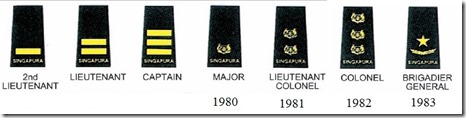
With a military career as smooth as silk, it is not that PM Lee doesn’t want to understand the reality of mere mortals like us but he really can’t.
The table (below) is a summary of our paper generals.
| NAME | ENLIST | RESIGN | YEARS | RANK |
| LEE HSIEN LOONG | 1971 | 1984 | 13 | BRIGADIER GEN |
| TEO CHEE HEAN | 1972 | 1992 | 20 | REAR ADMIRAL |
| LUI TUCK YEW | 1983 | 2003 | 20 | REAR ADMIRAL |
| CHAN CHUN SING | 1987 | 2011 | 24 | MAJOR GEN |
| TAN CHUAN JIN | 1987 | 2011 | 24 | BRIGADIER GEN |
* Lee Hsien Loong holds the world record for attaining the rank of BG in the shortest time, without any combat experience, in a democratic country. Our military is designed by scholars, for scholars. Every Tom, Dick and Harry scholar will become a general so long as he toes PAP’s line.
PM Lee and DPM Teo were both born with a silver spoon in the mouth. One shouldn’t expect them to understand the struggles of ordinary/low wage citizens and PAP’s flawed policies confirm their disconnect.
Real leaders should never be fast-tracked to top positions based on academic results. Currently, all paper generals are not really elected because of our unique GRC system designed to perpetuate PAP’s power.
Running a government requires a consultative approach while it’s a top-down approach in the military. After years of a top-down approach, it becomes impossible to teach old dogs new tricks. Paper general George Yeo has already paid the price for not listening. Paper generals are failed politicians as is evidenced by their refusal to engage in a meaningful manner with their ‘wayangs’.
Without a doubt, generals are army-trained and best left in the military. If paper generals can run our country, pigs should be able to fly.
Source: http://likedatosocanmeh.wordpress.com


