Tag: Chee Soon Juan

  • Chee Soon Juan: Marsiling-Yew Tee GRC By-Election Needed

    Chee Soon Juan: Marsiling-Yew Tee GRC By-Election Needed

    It is bad enough that the PAP has reserved the Presidential Election and that Mdm Halimah Yacob has become the President without a contest. At the same time, Mdm Halimah has left the Marsiling-Yew Tee GRC short of an MP and without a minority representative. Then the PAP says that there is no need for a by-election to fill her seat. This is an abuse of power. The PAP sees itself bigger than Singapore and continues to do as it pleases. Such unchecked control endangers the future of this nation.

    This is why the SDP has initiated legal action to ask the court to rule on the matter of a by-election when an MP vacates his/her seat.
    http://yoursdp.org/…/sdp_files_lawsuit_agai…/2017-09-13-6194 But such action entails financial costs and no one party has the means to shoulder such an expense by itself.

    We, therefore, call on all Singaporeans to contribute to this cause. Please do your part and financially support the effort to stop the PAP from continuing its abuse of power. If everyone does a little, our load will lighten and the role of holding the PAP accountable made more effective. So please donate as well as help us spread this message far and wide. Remember, we’re all in this together. You can do so online, through bank transfers or cheques. Please click here: http://yoursdp.org/index/donate/0-12


    Source: Chee Soon Juan

  • By-Election In Marsiling-Yew Tee GRC

    By-Election In Marsiling-Yew Tee GRC

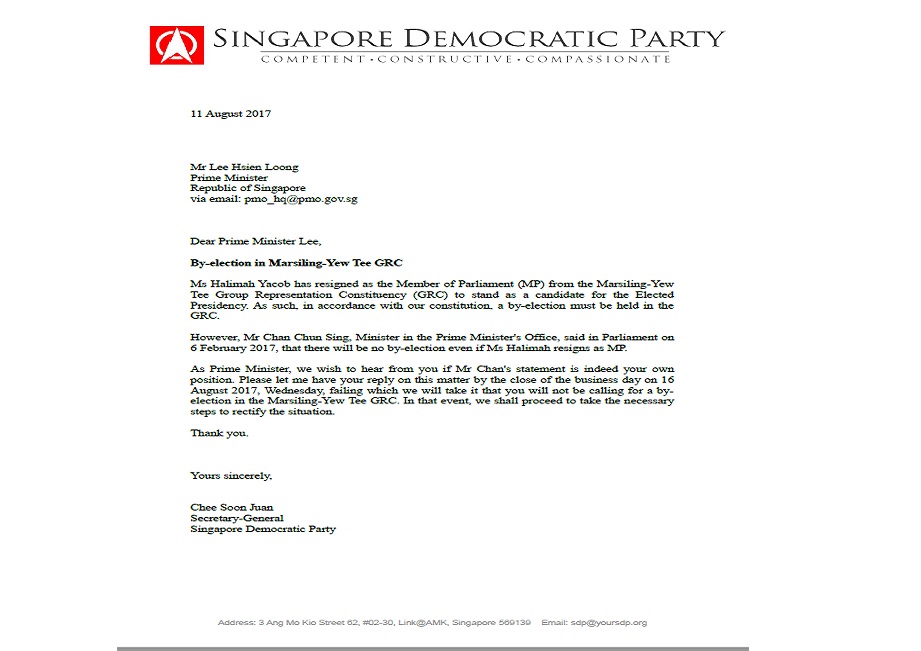
    The Secretary-General of Singapore’s Democratic Party, Chee Soon Juan has written a letter addressed to Prime Minister Lee Hsien Loong to question him whether a by-election will be held at Marsiling-Yew Tee GRC, following Halimah Yacob’s resignation.The full letter is attached below.

  • SDP: 21 Reasons Why Tharman’s Call For Confidence In Lee Hsien Loong’s Team Is Misplaced

    SDP: 21 Reasons Why Tharman’s Call For Confidence In Lee Hsien Loong’s Team Is Misplaced

    In his Facebook post, DPM Tharman Shanmugaratnam called on Singaporeans to “have confidence” in the present system of governance, adding, “You can count on PM Lee Hsien Loong and all of us in his team for that.”

    To have confidence in the government, Singaporeans need transparency. So before the DPM asks for trust in Mr Lee Hsien Loong’s team, the PAP must first account for and explain:

    1. Price hikes
    Why the Government announced a slew of price hikes, including a drastic 30% increase in water fees, only after the 2015 general elections and at a time of economic uncertainty for the people.

    2. Asset enhancement
    Then PM Goh Chok Tong’s assurance in 1992 that HDB prices will “continue to rise” only to be told in 2017 by National Development Minister Lawrence Wong that prices will “come down” until the flats are eventually returned to HDB.

    3. AGO report
    The Auditor-General’s 2016 report that PAP Government lacked “principles of good governance and financial controls” which resulted in a large number of instances where there was a “breakdown in the controls.” This included the construction of a rubbish centre for $880,000.

    4. GIC losses in UBS
    The GIC’s loss of nearly $6 billion this year in its investment in UBS despite the SDP’s repeated warnings about the problems with the Swiss bank, and the subsequent refusal of the Government to account for the loss.

    5. Elected Presidency
    The sudden decision to change the rules – and the contorted reasoning for the change – to restrict candidacy for the EP after Dr Tony Tan nearly lost the election in 2015.

    6. Hep-C outbreak
    Health Minister Gan Kim Yong’s refusal to release correspondence such as emails, memos, minutes of meetings between officials at MOH and SGH over the Hepatitis C outbreak in 2015 as well as the refusal to openly identify the officers who were at fault and the penalties meted out to them.

    7. Cracks in new MRT trains
    The failure to inform the public of cracks in brand new MRT trains and the secretive nature of the way the trains were shipped back to China for repairs.

    8. Deteriorating infrastructure
    The Government’s inability to deal with constant breakdown of MRT services, HDB lift mishaps (which have caused death and injury), falling slabs of HDB blocks, and flooding of our roads whenever it rains heavily.

    9. Productivity decline
    The stagnant productivity levels despite the more than $20 billion the PAP Government has thrown at the problem. The situation has deteriorated to the point where PM Lee now admits that our economy has “maxed out” after easy gains in recent years.

    10. Future economy
    The lack of direction and rehash of old ideas from the Committee on the Future Economy despite the involvement of five ministers and one full year of work.

    11. Online gambling
    The introduction of online gambling despite widespread public objection.

    12. Foreign labour
    The continued influx of foreign workers despite falling job vacancies and increasing unemployment among Singaporeans.

    13. China relations
    The mishandling of relations with China leading to Mr Lee Hsien Loong’s exclusion from the OBOR summit in Beijing.

    14. Zika and TB
    The explosion of Zika infections and the increase in new cases of active TB in Singapore in 2016.

    15. Money laundering
    The discovery of money laundering in our financial system last year despite SDP’s warning since 2008 that Singapore was becoming a haven for tax evaders and money launderers.

    16. Neptune Orient Lines
    Mr Ng Yat Chung’s appointment as CEO of SPH despite his running aground the NOL (losing $1.5 billion in the process) and which resulted in the company being sold to the French CMA CGM in 2016. The new owners turned NOL’s fortunes around registering a US$26m-profit in less than one year.

    17. Keppel and SembMarine
    The deep financial troubles of Temasek-owned Keppel Corp and Sembcorp Marine amidst charges of corruption against the companies in Brazil following the bust in the oil-rig industry.

    18. Shortage of engineers
    How, after more than 50 years of uninterrupted PAP rule, Singapore now finds itself short of engineers, a situation which “poses a national risk”.

    19. Ailing retail
    The shuttering of retail shops and empty shopping centres. This is epitomised by a dying Orchard Road.

    20. Closing of JCs
    The controversial closing down of neighbourhood Junior Colleges in which MOE provided dubious reasons.

    21. GIC/Temasek non-transparency
    The non-transparent manner in which the GIC and Temasek Holdings are managed and the related issue of the retention of CPF funds through the Minimum Sum Scheme.

    This list does not, of course, include the allegations of impropriety by Dr Lee Wei Ling and Mr Lee Hsien Yang against PM Lee and his team which necessitates even more accountability. Mr Tharman’s call for confidence in the current administration is desperately  misplaced.


    Source: http://yoursdp.org

  • Chee Soon Juan: Goh’s Folly – Commodification Of Public Housing

    Chee Soon Juan: Goh’s Folly – Commodification Of Public Housing

    IT IS SAID that a politician thinks of the next elections but it takes a real leader to think of the next generation.

    And so it is with Mr Goh Chok Tong who may, having bolstered the PAP’s grip in politics through his asset enhancement and HDB upgrading schemes, lay claim to being a brilliant politician but, through these same policies, demonstrated utter failure as a leader.

    In 1991, under pressure to deliver a good result to secure his mandate as the new prime minister after taking over from Lee Kuan Yew, Mr Goh introduced the asset enhancement programme which, for all intents and purposes, cajoled (or threatened, as some saw it) Singaporeans into voting for his party in return for enhancing the prices of their HDB flats.

    The plan worked brilliantly, securing for the prime minister and his party mates a healthy victory. But it also started the pernicious mentality among Singaporeans that one’s flat was a commodity whose price stood to appreciate markedly over a short span of time.

    As a consequence, few thought little of shelling out huge sums of money, mainly by using their retirement funds, to finance HDB purchases. The motivation was that one could monetise the asset and realise robust capital gains at a later stage.

    Such a trend had two unfortunate effects: The first was that using CPF savings to service HDB mortgages would leave many financially wanting in their retirement years.

    The second is that as prices rose, young entrants into the public housing market would find it prohibitive to start a home. As a result, many young couples put off having children as their finances come under pressure.

    The propaganda, pushed by a media that act more like cheerleaders than vehicles for thoughtful deliberation, compounded the public’s exuberance for asset enhancement. Duly stoked, homeowners devised ways of using their flats to turn a profit.

    Some have even resorted to buying older flats at high prices with the view to reaping the benefits of redevelopment through the Selective En bloc Redevelopment Scheme (SERS).

    (The SERS selects older blocks of flats for demolition and replaces them with new ones. Displaced occupants stand to gain from a fresh 99-year lease of their new flats and are, in some cases, compensated financially or given subsidised prices for their new flats.)

    Related article: SDP proposes Non-Open Market flats

    This prompted the National Development Minister to step in and point out that SERS, as the name suggests, is selective – extremely selective, in fact – of blocks earmarked for redevelopment; only four percent have come under the scheme since it was launched in 1995.

    In addition, the Minister reminded, when the 99-year lease is up, a flat would have to be returned to the state. In other words, it becomes worthless.

    How does this square with Mr Goh Chok Tong’s vaunted promise to enhance one’s asset in return for voting for the PAP?

    A cynical ploy

    It was the height of irresponsibility to make a promise that the government is ill-equipped to deliver. For one thing, property prices are not determined by fiat. Much of it relies on the state of the economy. With an increasing number of workers being retrenched (or if they remain employed, having their wages frozen) and the young finding it more difficult to find jobs, how are Singaporeans going to afford bigger and more expensive flats or, for that matter, even their first one? And if they can’t, how is value of HDB property going to go up?

    With the global economy showing little appetite for the kind of exploitative trade seen over the past few decades, Singapore’s economic fortunes have dimmed considerably. The inexorable march of automation also means that more and more Singaporeans will be out of jobs, replaced by robots. Add to these China’s determination to by-pass Singapore (a staunch US ally) as a trading centre in order to secure its own shipping interests, our economic future looks shaky.

    In the face of such uncertainty, how is the PAP going to make good on its asset enhancement promise? It was, to begin with, unrealistic to expect prices to appreciate indefinitely. Yet, Mr Goh and company chose to ignore the pitfalls in a cynical bid to buttress its political hegemony.

    The policy also has ramifications at the macro level. With a significant portion of income tied up in property, consumer spending and other forms of domestic investment are necessarily curtailed. Investments in higher education or to start-up businesses are also reduced. All these have serious implications for our economy as we move ahead.

    In the final analysis, housing – in particular public housing – should not be a tradeable commodity. It is our home in which we bring up our children, that roof over our heads when ill-winds blow. It should never have been turned into a commercial entity.

    ​Therein lies Goh Chok Tong’s ultimate folly.


    Source:www.cheesoonjuan.com
  • Chee Soon Juan: Rising Charges Heavy Burden On Citizens In Time Of Economic Uncertainty

    Chee Soon Juan: Rising Charges Heavy Burden On Citizens In Time Of Economic Uncertainty

    The PAP has done it again. The govt announced this week that ERP charges at 4 gantries (2 at PIE and 2 at CTE) will be increased. Another ERP will be activated along the KPE. Then today, PAP Town Councils announced that S&CC will be increased in June.

    We’ve said repeatedly that when you give PAP a blank cheque, they’ll happily cash it after the elections. What’s more, it’s coming at a time when retrenchments are piling up and wages are under pressure because our economy isn’t doing well..


    Source: Chee Soon Juan 徐顺全