Tag: COE

  • Commentary: Vote Wisely In The Next Election

    Commentary: Vote Wisely In The Next Election

    The train collision marked a new low for SMRT and our Nation. Louder comes the call for heads to roll from the very top. What is at the root of the SMRT failures?

    SMRT is a corporation (private) that is owned by the Government. Supposedly, this model of corporatizing public services serve to benefit all stake holders. We hear this idealistic scenario again recently in Parliament, when Mr Khaw Boon Wan made the same points in response to questions. But have all stakeholders benefited as claimed or only their select few?

    A private corporation exist for profit while a public service exists to serve the public. So there is a fundamental problem to begin with when the Government decides to run public services like a business. Try as you will but you cannot have the cake and eat it too.

    After more than 50 years of running the country like a business against all wisdoms cautioning the dangers of profiting off public services, Singaporeans are witnessing the inevitable happen. The so-called efficiency comes at a huge expense to the public. When public officers meant to serve public interest failed their fiduciary duties as the structure of check and balances are compromised by colluding conflict of interests producing a public/private self-serving mess that we now inherited.

    When the next election comes, we must correct this by voting our rights to take back this Nation and stop their failed projects (HDB, COE, ERP, CPF, 6.9 Million people, etc.) on their tracks.


    Source: Damanhuri Bin Abas

  • Towing Company Boss: Ferrying Scrapped Cars On Lorry’s Back Is Normal, ‘Perfectly Legal’

    Towing Company Boss: Ferrying Scrapped Cars On Lorry’s Back Is Normal, ‘Perfectly Legal’

    The 60-year-old owner of a towing company which became famous after one of its cargo lorry was spotted ferrying a Peugeot car on its back, says that the company had been using the same practise for over 20 years, and that ‘It’s perfectly legal.’

    He also demonstrated how to load the car onto the back of the lorry, and said that the company has transported over thousands of scrapped vehicles using the method, reports Shin Min Daily News via Lianhe Zaobao.

    A photo of one of its vehicle in action was snapped by a netizen last Saturday (Mar 11).

    In the photo, the front wheels of the Peugeot car were openly dangling outside the back of the lorry, and the licence plate was also shaky and looked really to fall out at anytime, prompting many to ask whether such practices infringe on safety regulations.

    The owner of the company who was driving the lorry at that time, upon realising that someone had taken a picture of his lorry, contacted Shin Min Daily News to clarify that the car on the back was on its way to the junkyard to be scrapped.

    He also told reporters that the company had never been told to stop or gotten any fines for using the same way to transport the scrapped vehicles in the past 20 years.

    In fact, he said that there had never been any complaints.

    He explained that the weight, size and dimensions of the car transported were within the stated regulations, and that its center of gravity was still within the lorry itself:

    “After I saw my lorry on the news, I went online to check, and found that compared to other lorry models and cars, there were no breach of safety rules.”

    According to the data he showed, the heaviest a lorry can weight is about 3350kg, and an empty lorry itself weights 1760kg, which meant that he could ferry another 1500kg of goods on its back.

    An employee also used a forklift to demonstrate the lifting of the vehicle onto a lorry’s back, while the owner added that they would further secure the car with ropes before moving on the roads.

    Automobile Importer and Exporter Association president Neo Tiam Tin said that as long as the weight and length did not exceed the stated limit, it would be legal to transport the vehicle in said manner.

    He also told reporters that every vehicle’s weight limit and initial empty weight differs, but as long as the accumulated weight did not exceed the limits, it would not be an issue.

    He estimated the weight of a car to be around 1000kg.

    As for the front of the car which was dangling outside the lorry, he said that the owner could tie a red cloth at the bark of the lorry to signal to other drivers the potential hazard.

    According to traffic regulations, if a transported objected extends more than 1.8metres from the back of vehicle, or 40 percent of vehicle’s length, it would require a permit.

    Mr Neo revealed that using small lorries to ferry scrapped vehicles was a common practice which had been adopted for the past 10 to 20 years.


    Source: www.stomp.com.sg


  • Cars Too Expensive, Singaporeans Rent Cars By Becoming Uber Driver

    Cars Too Expensive, Singaporeans Rent Cars By Becoming Uber Driver

    In one of the most expensive countries in the world to own a car, Peter Chiu is finding a novel way to pay for one.

    The 58-year-old retired policeman rents a car in Singapore, drives three to four hours a day for Uber Technologies Inc. to cover its cost, and has a shiny Honda Vezel the rest of the time for his personal use. Hiring a vehicle to work for Uber is becoming a more common sight in the city-state, where Chiu’s SUV costs more than a BMW M3 luxury sports sedan does in New York.

    “Buying a car in Singapore is so expensive,” said Chiu. “If you want to drive around to cover expenses, that is quite easy. And any extra money you get, that’s more income for you.”

    New technologies are not only disrupting traditional industries in Singapore — a trend that Prime Minister Lee Hsien Loong said will force the economy to transform — but also changing consumers’ behavior as they try to cope with rising costs and unemployment at a six-year high.

    “Uber is another avenue for employment,” said Brian Tan, an economist with Nomura Holdings Inc. in Singapore. “It makes the labor market more efficient, because it provides you with an alternative career. You don’t need a special license for that.”

    A Honda Vezel like Chiu’s typically sells for more than S$100,000 ($71,000) in Singapore, almost four times the price in the U.S. On top of taxes, car owners in the city state are forced to buy permits — called Certificates of Entitlement — which are limited in supply and auctioned by the government to help curb road congestion and pollution. At the most recent offering this week, the permit cost S$50,789 for the smallest vehicles.

    Rental Surge

    Chiu drives six days a week for Uber, just enough to cover the S$500 weekly cost of his vehicle, which he rents from Lion City Rentals, a local subsidiary of the car-hailing company. He doesn’t mind the part-time work or the traffic in a country that’s smaller than Rhode Island in the U.S.

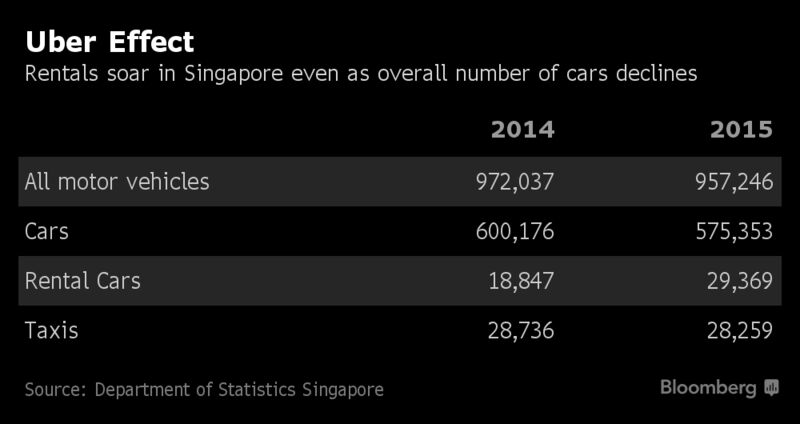
    Between 2014 — the year after Uber began operating in Singapore — and 2015, the number of rental cars in the country soared more than 50 percent to 29,369, surpassing the number of taxis on the road, according to official data. Even so, the total vehicle population decreased by 1.5 percent.

    Simon, a 45-year-old former property agent who preferred to give his first name only, rents a Toyota Corolla and drives for Uber four hours a day at most. A slump in home sales since the government began imposing measures to rein in prices has pushed many in the industry to seek other sources of income, including ferrying commuters around the island for Uber.

    Simon said his main job now is making “alternative investments” and the Uber gig allows him to have a car of his own to use on weekends, when he makes trips about 20 kilometers (12 miles) across the border to Malaysia with his wife and two kids. The journey has an added cost-saving advantage: he buys gas for his car in Malaysia, where it’s cheaper.

    Uber is using auto rentals and financing to attract and retain drivers around the world, as are rivals such as GrabTaxi Holdings Pte in Singapore and Lyft Inc. in the U.S. While for many drivers, earning an income may be the main reason they turn to the ride-hailing companies, in Singapore, having the car may be just as important.

    “It makes a lot of sense to rent a car,” said Tang Kin Yee, 53, whose main job is in commercial photography and advertising. Business was slow last year and he started driving for Uber to supplement his income.

    He now rents a Honda Vezel and is thinking about driving for Uber full time.


    Source: www.bloomberg.com

  • Motorcycle COE Remains Above $6000 After Latest Bidding Excercise

    Motorcycle COE Remains Above $6000 After Latest Bidding Excercise

    Certificate of Entitlement (COE) premiums for cars fell in the latest bidding exercise on Thursday (May 18), while all other categories saw a marginal increase.

    The premiums for big and small cars went down by 3.63 and 1.81 per cent respectively. Premiums for small cars (up to 1,600cc and 97kW) fell S$869 to S$47,020, while premiums for big cars (above 1,600cc and 97kW) went down by S$1,854 to S$49,156.

    Meanwhile, premiums for goods vehicles and buses saw the largest increase  — up by 1.65 per cent compared to the previous bidding exercise on May 5. Premiums in Category C was at S$43,002, up from S$42,302.

    In the open category, premiums went up by 1.43 per cent to S$49,700. This is a S$700 increase from the last bidding exercise.

    As for motorcycles, premiums went up by just S$1 — to S$6,303 — compared to the last bidding exercise.


    Source: www.todayonline.com

  • Lenders Bypassing Car Loan Curbs

    Lenders Bypassing Car Loan Curbs

    The motor industry has found ways to get around car loan curbs – a development that is keeping vehicle demand and certificate of entitlement prices buoyant.

    Checks revealed that used car dealers, parallel importers and credit companies offer financing that is effectively 80 per cent to 90 per cent of a car’s purchase price, with repayment of up to 10 years.

    This exceeds the Monetary Authority of Singapore’s (MAS) 2013 curb, which restricts loan quantums to not more than 60 per cent of the purchase price and a repayment period of up to five years.

    The curb is breached by offering one or more of the following:

    • Overtrade – a practice of offering a buyer substantially more for his trade-in vehicle. This is practised mostly by authorised agents.

    • Disguised leases – in a lease agreement, the car is registered under the lessor’s name, and the monthly rental is substantially higher than instalments in a hire-purchase. But dealers are readily offering “leases” that allow the car to be registered under the end-user’s name and with relatively low monthly payments via a buyback offset.

    • Invoice inflation – if a car costs $170,000, the seller will inflate it to, say, $270,000, so as to secure an 80 per cent loan from the bank.

    • Balloon scheme – a seller subtracts the car’s scrap value from the instalment calculation, resulting in lower monthly payments. At the fifth year, the consumer “scraps” the car to settle the outstanding amount, or refinances the car.

    All the schemes come with higher interest rates, but consumers who cannot afford to fork out a hefty down payment under the MAS ruling have been snapping them up.

    An MAS spokesman said: “As part of MAS’ supervision of financial institutions (FIs), we check on their compliance with the rules. If an FI breaches the rules, MAS will not hesitate to take regulatory action.”

    The MAS, however, would not say if any lender has actually been taken to task for any of these schemes. It added that it expects lenders “to take reasonable steps to ascertain the veracity of the purchase prices of cars quoted in loan applications”.

    Mr Ron Lim, general manager of Nissan agent Tan Chong Motor, said the various schemes that bypass the loan curb show that “there is a lot of grey areas”.

    “We hope MAS can enforce it better,” he added. “Then we can have a more level playing field.”

    A businessman who bought a used Bentley Flying Spur recently told The Straits Times that the invoice for the car – which was selling for $400,000 – was inflated to $700,000. Mr Y.Z. Liu, 66, said: “It was blatant cheating. If the car was indeed $700,000, then the first owner should be compensated.”

    Mr Michael Lim, president of the Singapore Vehicle Traders Association, said the association of used car dealers and parallel importers has been appealing to the Finance Ministry for the loan limit to be raised.

    He played down the high financing deals and said: “Most of these are rental and leasing packages.”

    However, classified ads in The Straits Times and car portal sgCarMart are rife with offers of “low down payment”, “80 per cent loan” and repayment over 10 years.

    One credit company, Century Tokyo Leasing, has been advertising a balloon scheme that promises a monthly instalment of about $800 for a Honda Vezel – nearly 40 per cent lower than the $1,250 required for a normal hire-purchase deal.

    Mr Anthony Lim, a veteran car financier, said: “These companies are flush with foreign funds and they are eager to do business here. But… if a loan contract is in breach of the law, it is not binding. So the lender may have no recourse if the borrower decides to stop paying.”


    Source: www.straitstimes.com