Tag: democracy

  • Why Singapore Is The World’s Most Successful Society

    Why Singapore Is The World’s Most Successful Society

    Singapore turns 50 on Aug. 9, 2015. Is Singapore the most successful society since human history began? Or, to put it differently, did Singapore improve the living standards of its people faster and more comprehensively than any other society?

    The only way to answer these questions is with empirical data. The most basic needs of any human being are food, shelter, health, education and employment. Did Singapore improve the delivery of those basic needs faster than any other society?

    When Singapore was expelled from Malaysia in 1965 and thrust into an unwanted independence, it was a typical Third World country. Its per capita income of $500 was the same as Ghana’s then. It was not desperately poor, but it had malnutrition. I know this personally as I was put on a special feeding program when I joined school in the first grade, drinking milk from a pail with a ladle shared by other children.

    Table 1: Comparison of real GDP per capita gdpchart
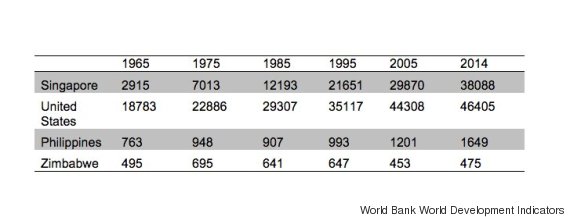
    *Using constant 2005 USD

    This malnutrition disappeared quickly. Singapore’s per capita income has shot from $500 to $55,000 today, the largest increase any newly independent nation has enjoyed. This spectacular economic success story of Singapore is clearly amazing. Yet, when I was Singapore’s ambassador to the UN in the 1980s, the then head of UNICEF, the American James Grant, used to chide me for speaking about it.

    Table 2: Percent increase in real GDP from year listed to 2014 gdpchart2
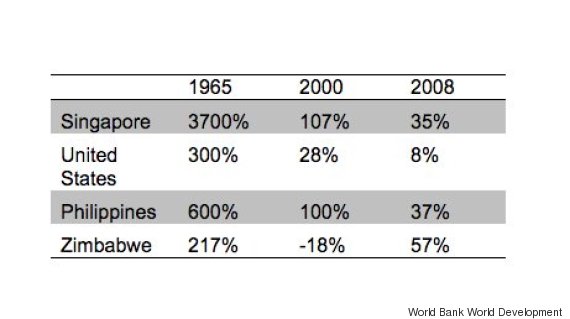
    *Using constant 2005 USD

    He told me that Singapore’s success in another area was even more spectacular. We had reduced our infant mortality faster than any other society, going down from 35 per 1,000 live births in 1965 to 10.90 in 1985. James Grant was right. Babies are the most vulnerable members of any society. When they live instead of dying, they reflect an improving social ecosystem that keeps them alive.

    The babies who lived in Singapore went on to enjoy one of the best education systems in the world. The OECD ranked 15-year-old Singaporean children number one in the world in a recent global ranking of “Universal Basic Skills” in mathematics and science. Singapore students also topped the OECD PISA problem solving test in 2012.

    There are many other areas where Singapore’s social standards top the charts. From the Singapore with slums that I grew up in, we now have the highest home ownership of any country in the world, with 90 percent of residents living in homes they own. Even amongst households in the lowest 20 percent of incomes, over 80 percent own their own homes. Rapidly rising salaries and strong compulsory saving schemes, through the Central Provident Fund, led to this incredibly high home ownership.

    So why did Singapore succeed so comprehensively? The simple answer is exceptional leadership. Many in the world have heard of Mr. Lee Kuan Yew, the founding prime minister who passed away in March this year. Far fewer have heard of Dr. Goh Keng Swee, the architect of Singapore’s economic miracle, and Mr. S. Rajaratnam,Singapore’s philosopher par excellence.

    Together, they made a great team.

    This exceptional team also implemented three exceptional policies: Meritocracy, Pragmatism and Honesty. Indeed, I share this “secret” MPH formula with every foreign student at the Lee Kuan Yew School, and I assure them that if they implement it, their country will succeed as well as Singapore. Meritocracy means a country picks its best citizens, not the relatives of the ruling class, to run a country. Pragmatism means that a country does not try to reinvent the wheel. As Dr. Goh Keng Swee would say to me, “Kishore, no matter what problem Singapore encounters, somebody, somewhere, has solved it. Let us copy the solution and adapt it to Singapore.” Copying best practices is something any country can do. However, implementing “Honesty” is the hardest thing to do. Corruption is the single biggest reason why most Third World countries have failed. The greatest strength of Singapore’s founding fathers was that they were ruthlessly honest. It also helped that they were exceptionally shrewd and cunning.

    Still, Singapore has its fair share of detractors. Its political system was widely viewed as being an “enlightened dictatorship,” even though free elections have been held every five years. Its media is widely perceived to be controlled by the government and Singapore is ranked number 153 out of 180 by Reporters Without Borders in 2015 on the Press Freedom Index. Many human rights organizations criticize it. Freedom House ranks Singapore as “partially free.”

    Undoubtedly, some of these criticisms have some validity. Yet, the Singapore population is one of the best educated populations and, hence, globally mobile. They could vote with their feet if Singapore were a stifling “un-free” society. Most choose to stay. Equally importantly, some of the most talented people in the world, including Americans and Europeans, are giving up their citizenship to become Singapore citizens. Maybe they have noticed something that the Western media has not noticed: Singapore is one of the best places to be born in and to live in. Quite amazingly, a society destined to fail in 1965 has become one of the world’s greatest success stories.


    Source: www.huffingtonpost.com

  • Can Singapore Save Democracy?

    Can Singapore Save Democracy?

    Next Sunday, Singapore celebrates the 50th anniversary of its independence. There’s much to celebrate — for some at least. The city-state is indeed “exceptional” (as its leaders like to say) as a global hub for finance, trade, travel, and shipping. Its mix of languages, which include English and Mandarin, has made it the perfect gateway to an economically resurgent Asia.

    At the same time, inequality is rising. A Malay minority continues to lag behind Chinese and Indians. Antediluvian laws against gay sex and chewing gum remain in place.

    Most damagingly, Singapore has a democratic deficit. The same partyhas ruled it for 50 years. The media is compliant. Politicians have long used defamation suits to bully dissenters and even intimidate the foreign press.

    But it is complacent, and even dishonest, to judge the place without also asking what democracy really means today — and what it could mean for a small city-state like Singapore. The moral high ground should not be so easily accessible to citizens of present-day democracies.

    Democracy has not been much in evidence in the workings of the European Union’s technocrats, or indeed among the radicals of Syriza. Feckless wars, special-interest lobbyists, and political dysfunction have made the U.S. resemble late Byzantium rather than the small-town civic haven witnessed by Tocqueville. The runaway candidacy of Donald Trump exposes a growing constituency for demagogues in the world’s oldest democracy.

    India, routinely described as the world’s “largest democracy,” has been undergoing its own disturbing mutations. During the decades that Lee Kuan Yew pulled Singapore out of economic backwaters, many in the Indian middle class longed for a leader like him: an authoritarian technocrat who could make big decisions about economic development without going through parliamentary democracy’s messy and arduous processes of deliberation, debate and consensus.

    After flirting with one authoritarian prime minister (Indira Gandhi) and two technocrat-type successors (Rajiv Gandhi and Manmohan Singh), middle-class Indians may have found their ideal leader in Narendra Modi, who concentrates power at the top while shopping fantasies of squeaky-clean smart cities and bullet trains.

    Modi is unlikely to match Lee Kuan Yew’s achievements as an economic modernizer. In prosecuting his opponents, however, he has already surpassed the Singapore patriarch.

    Lee deployed stern libel laws against his detractors; he did not resort to large-scale subversion of Singapore’s genuinely meritocratic and honest bureaucracy. The ongoing campaign against Teesta Setalvad, one of Modi’s most resilient critics, has revealed yet again that the Hindu nationalist right won’t balk at undermining India’s very few sacrosanct institutions while settling political scores.

    Any criticism of Singapore’s democratic deficit should begin by acknowledging that there’s hardly any resemblance between the original idea of democracy and its current incarnations in India, Europe and the United States.

    In its classical Athenian form, democracy was a political regime where the equality of citizens was taken deeply seriously. The idea of citizenship itself was restrictive: It excluded women and slaves. But citizens in the Athenian city-state enjoyed a degree of control over their lives and protection from harm that their modern counterparts can only dream of.

    The demos, the people, held actual power in the absence of such mediating institutions as a professional bureaucracy, executive, and legislature. By contrast, today’s democratic states concentrate too much power in a few institutions and individuals.

    The “traditional” media, mostly owned by corporate interests allied with political elites, and prone to sensationalism, was always a poor substitute for the Athenian assembly of free citizens that facilitated open discussion and debate. Social media seems more suited to self-promotion and slander than democratic symposium. As for routine elections, they increasingly validate Rousseau’s sneer that the English were free once every seven years.

    Rule by and for the people seems to have been replaced in many formal democracies with rule by and for the rich and powerful. It’s clear now, after decades of rhetoric about democracy, that its original ideal — a community where human beings live together without holding power over another — can only be realized, imperfectly if at all, in small states.

    Here, Singapore has a huge advantage over centralized and dysfunctional democracies. It’s actually a functional city-state with a relatively small (5.5 million) and highly literate population, and it has no enemies.

    Astute management appears to have assured Singapore’s economic future. It can weather the shocks that make both haves and have-nots elsewhere crave the sweeping broom of authoritarianism.

    The conditions certainly exist for Singapore to move from being a showcase of efficient authoritarianism to an exemplar of that much-invoked but nearly extinct thing: democracy. Its insecure leaders may feel no sense of urgency to change the status quo. But it’s never too late for a 50-year-old nation-state to grow up.

    This column does not necessarily reflect the opinion of the editorial board or Bloomberg LP and its owners.

    Source: www.bloombergview.com

  • The Singapore Exception

    The Singapore Exception

    AT 50, ACCORDING to George Orwell, everyone has the face he deserves. Singapore, which on August 9th marks its 50th anniversary as an independent country, can be proud of its youthful vigour. The view from the infinity pool on the roof of Marina Bay Sands, a three-towered hotel, casino and convention centre, is futuristic. A forest of skyscrapers glints in the sunlight, temples to globalisation bearing the names of some of its prophets—HSBC, UBS, Allianz, Citi. They tower over busy streets where, mostly, traffic flows smoothly. Below is the Marina Barrage, keeping the sea out of a reservoir built at the end of the Singapore River, which winds its way through what is left of the old colonial city centre. Into the distance stretch clusters of high-rise blocks, where most Singaporeans live. The sea teems with tankers, ferries and container ships. To the west is one of Asia’s busiest container ports and a huge refinery and petrochemical complex; on Singapore’s eastern tip, perhaps the world’s most efficient airport. But the vista remains surprisingly green. The government’s boast of making this “a city in a garden” does not seem so fanciful.

    Singapore is, to use a word its leaders favour, an “exceptional” place: the world’s only fully functioning city-state; a truly global hub for commerce, finance, shipping and travel; and the only one among the world’s richest countries never to have changed its ruling party. At a May Day rally this year, its prime minister, Lee Hsien Loong, asserted that “to survive you have to be exceptional.” This special report will examine different aspects of Singaporean exceptionalism and ask whether its survival really is under threat. It will argue that Singapore is well placed to thrive, but that in its second half-century it will face threats very different from those it confronted at its unplanned, accidental birth 50 years ago. They will require very different responses. The biggest danger Singapore faces may be complacency—the belief that policies that have proved so successful for so long can help it negotiate a new world.

    In 1965 Singapore was forced to leave a short-lived federation with Malaysia, the country to its north, to which it is joined by a causeway and a bridge. Lee Kuan Yew, Lee Hsien Loong’s father, who became Singapore’s prime minister on its winning self-government from Britain in 1959, had always seen its future as part of Malaysia, leading his country into a federation with its neighbour in 1963. He had to lead it out again when Singapore was expelled in 1965. By then he had become convinced that Chinese-majority Singapore would always be at a disadvantage in a Malay-dominated polity.

    Mr Lee’s death in March this year, aged 91, drew tributes from around the world. But Mr Lee would have been prouder of the reaction in Singapore itself. Tens of thousands queued for hours in sultry heat or pouring rain to file past his casket in tribute. The turnout hinted at another miracle: that Singapore, a country that was never meant to be, made up of racially diverse immigrants—a Chinese majority (about 74%) with substantial minorities of Malays (13%) and Indians (9%)—had acquired a national identity. The crowds were not just mourning Mr Lee; they were celebrating an improbable patriotism.

    Lee Kuan Yew himself defined the Singapore exception. As prime minister until 1990, he built a political system in his image. In line with his maxim that “poetry is a luxury we cannot afford,” it was ruthlessly pragmatic, enabling him to rule almost as a (mostly) benevolent dictator. The colonial-era Internal Security Act helped crush opposition from the 1960s on. Parliament has been more of an echo-chamber than a check on executive power. No opposition candidate won a seat until 1981. The domestic press toes the government line; defamation suits have intimidated and sometimes bankrupted opposition politicians and hit the bottom line of the foreign press (including The Economist).

    Singapore, it is sometimes joked, is “Asia-lite”, at the geographical heart of the continent but without the chaos, the dirt, the undrinkable tap water and the gridlocked traffic. It has also been a “democracy-lite”, with all the forms of democratic competition but shorn of the unruly hubbub—and without the substance. Part of the “Singapore exception” is a system of one-party rule legitimised at the polls and, 56 years after Mr Lee’s People’s Action Party (PAP) took power, facing little immediate threat of losing it. The system has many defenders at home and abroad. Singapore has very little crime and virtually no official corruption. It ranks towards the top on most “human-development” indicators such as life expectancy, infant mortality and income per person. Its leaders hold themselves to high standards. But it is debatable whether the system Mr Lee built can survive in its present form.

    It faces two separate challenges. One is the lack of checks and balances in the shape of a strong political opposition. Under the influence of the incorruptible Lees and their colleagues, government remains clean, efficient and imaginative; but to ensure it stays that way, substantive democracy may be the best hope. Second, confidence in the PAP, as the most recent election in 2011 showed, has waned somewhat. The party has been damaged by two of its own successes. One is in education, where its much-admired schools, colleges and universities have produced a generation of highly educated, comfortably off global citizens who do not have much tolerance for the PAP’s mother-knows-best style of governance. In a jubilant annual rally to campaign for lesbian, gay, bisexual and transgender (LGBT) rights on June 13th, a crowd estimated at 28,000 showed its amused contempt for the illiberal social conservatism the PAP has enforced. Younger Singaporeans also chafe at censorship and are no longer so scared of the consequences of opposing the PAP.

    The PAP’s second success that has turned against it is a big rise in life expectancy, now among the world’s longest. This has swelled the numbers of the elderly, some of whom now feel that the PAP has broken a central promise it had made to them: that in return for being obliged to save a large part of their earnings, they would enjoy a carefree retirement. And it is not just old people who have begun to question PAP policies. Many Singaporeans are uncomfortable with a rapid influx of immigrants. These worries point to Singapore’s two biggest, and linked, problems: a shortage of space and a rapidly ageing population.


    Source: www.economist.com

  • The Lee Kuan Yew Conundrum

    The Lee Kuan Yew Conundrum

    Washington, D.C., is fast becoming an acronym for “Dysfunctional Capital.” Singapore, in contrast, has become the poster child for “the concept of good governance,” to quote the Financial Times’s obituary for the country’s longtime leader, Lee Kuan Yew, who was laid to rest on Sunday. For Americans in particular, this contrast presents a conundrum. On the one hand, Americans hold as a self-evident truth that their democracy is the best form of government. On the other hand, they see mounting evidence daily of Washington’s gridlock, corruption, and theatrical distractions, which makes their system seem incapable of addressing the country’s real challenges.

    In assessing the quality of national governance, international rankings often focus on three related baskets of indicators: first, a nation’s level of democracy and civic participation, and the degree to which citizens exercise political rights; second, the effectiveness of its government in facing issues, making policy choices, executing policy, and preventing corruption; and third, its performance in producing the results people want, including rising incomes, health, and safety.

    Let’s start with performance, since it is easiest to measure. As a Russian proverb declares, it is better to be healthy, wealthy, and safe than sick, poor, and insecure. Who can disagree? On these criteria, how has Singapore performed over the course of its first five decades versus the United States; or the Philippines (which the U.S. has been tutoring in democracy-building for a century); or Zimbabwe (an African analogue that declared independence from the United Kingdom just a few years after Singapore, and where dictator Robert Mugabe has been as dominant a national force as Lee Kuan Yew has been in Singapore)?


    Real GDP per Capita by Country: 1965-2013

    The table uses constant 2005 U.S. dollars. (World Bank)

    As the table above shows, over the past 50 years, real per-capita GDP in Singapore grew 12-fold. In current dollars, the average Singaporean’s income grew from $500 a year in 1965 to $55,000 today. Over that same period, real per-capita GDP in the United States and the Philippines doubled, and Zimbabwe’s actually dropped. When comparing the United States and Singapore, it is important to note that Singapore was essentially catching up to America. But what about economic performance in the 21st century? Over the past decade and a half, U.S. GDP has grown an average of less than 2 percent a year—while Singapore’s averaged nearly 6 percent. In the World Economic Forum’s latest Global Competitiveness Index, Singapore was ranked second overall, behind only Switzerland (the United States came in third). For the past seven years, Singapore has also been ranked the best place in the world to do business by the Economist Intelligence Unit.

    As for its healthcare services, Singapore’s infant-mortality rate has fallen from 27.3 deaths per 1,000 births in 1965 to only 2.2 in 2013. A child born in the United States has three times the chance of dying in infancy of one in Singapore. In the Philippines, 23 out of every 1,000 children born die in infancy. In Zimbabwe, 55. In 2012, Bloomberg Rankings judged Singapore the world’shealthiest country based on the full array of health metrics; the United States ranked 33rd, the Philippines 86th, and Zimbabwe 116th. Singapore also has one of the lowest crime rates in the world. A citizen is 24 times more likely to be murdered in the United States than in Singapore. And in 2012, less than 1 percent of Singaporeans reported that they struggled to afford food or shelter, by far the lowest percentage in the world.

    The second basket in assessing governance focuses on what experts call the effectiveness of the governmental process itself. Each year, the World Bank produces Governance Indicators metrics on government effectiveness, regulatory quality, rule of law, and control of corruption. Singapore leads the United States by a significant margin on each of these measures and is not even on the same level with the Philippines and Zimbabwe. Singapore’s widest lead over both the United States and comparable nations comes in the prevention of corruption and graft. Singapore scores in the top 10 while the United States ranks 20 countries lower on the list, with the Philippines and Zimbabwe in the bottom third. According to the 2014 Gallup World Poll, 85 percent of Americans see “widespread” corruption in their government, while only 8 percent of Singaporeans believe their government is corrupt.

    On democratic participation and personal liberties, Freedom House produces an annual report. In its 2014 ranking, the United States was among the freest countries in the world. Singapore scored in the bottom half, behind South Korea and the Philippines. It lost points mainly for Lee Kuan Yew’s People’s Action Party’s tight management of the political process. According to its report, “Singapore is not an electoral democracy. … Opposition campaigns have typically been hamstrung by a ban on political films and television programs, the threat of libel suits, strict regulations on political associations, and the PAP’s influence on the media and the courts.”

    The contrast between Singapore’s ranking in the first two categories, and the third, reminds us of a fundamental question of political philosophy: What is government for? Contemporary Western Europeans and Americans tend to answer that question by emphasizing political rights. But for Lee Kuan Yew, “the ultimate test of the value of a political system is whether it helps that society establish conditions that improve the standard of living for the majority of its people.” As one of his fellow Singaporeans, Calvin Cheng, wrote this past week in The Independent, “Freedom is being able to walk on the streets unmolested in the wee hours in the morning, to be able to leave one’s door open and not fear that one would be burgled. Freedom is the woman who can ride buses and trains alone; freedom is not having to avoid certain subway stations after night falls.” Lee Kuan Yew always insisted that the proof is in the pudding: rising incomes for the broad middle class, health, security, economic opportunity.

    To Western ears, the claim that an autocratic state can govern more effectively than a democratic one sounds heretical. History offers few examples of benevolent dictatorships that delivered the goods—or stayed benevolent for long. But in the case of Singapore, it is hard to deny that the nation Lee built has for five decades produced more wealth per capita, more health, and more security for ordinary citizens than any of his competitors.

    Thus Lee Kuan Yew leaves students and practitioners of government with a challenge. If Churchill was right in his judgment that democracy is the worst form of government except for all the others, what about Singapore?


    Source: www.theatlantic.com

  • Malaysia’s Federal Court Upholds 5 Year Prison Sentence Handed Down To Anwar Ibrahim By The Court Of Appeal

    Malaysia’s Federal Court Upholds 5 Year Prison Sentence Handed Down To Anwar Ibrahim By The Court Of Appeal

    PUTRAJAYA: The Federal Court has upheld the Court of Appeal’s five-year prison sentence on Datuk Seri Anwar Ibrahim for sodomising former aide Mohd Saiful Bukhari Azlan.

    The apex court earlier on Tuesday upheld the Mar 7, 2014 decision against the Opposition leader.

    Anwar, 67, was sentenced to five years’ jail for sodomising his former aide Mohd Saiful Bukhari, 30, at the Desa Damansara condominium in Bukit Damansara on June 26, 2008.

    Anwar had filed 35 grounds in his petition of appeal asking the Federal Court to overturn the Court of Appeal’s ruling.


    Source: www.thestar.com.my