Tag: economy

  • Singaporeans The Unhappiest Employees Out Of 7 Asian Markets

    Singaporeans The Unhappiest Employees Out Of 7 Asian Markets

    Singaporeans are the unhappiest employees out of of seven Asian markets, according to JobStreet.com’s Job Happiness Index released on Thursday (29 September).

    Out of the 67,764 participants from Singapore, Malaysia, the Philippines, Indonesia, Thailand, Hong Kong and Vietnam surveyed in June, the 3,398 Singaporean respondents averaged a 5.09 score out of the highest – and happiest – score of 10.

    Workers in the Philippines were found to be the happiest, with an average score of 6.25. The average scores of the remaining markets were (in ascending order of happiness): Malaysia (5.22); Vietnam (5.48); Hong Kong (5.56); Thailand (5.74) and Indonesia (6.16).

    Singaporeans were also the most pessimistic about their prospects in their existing jobs. Sentiment ratings and future outlooks about their jobs saw them scoring an average of 4.93, the unhappiest score among the surveyed markets.

    Among the Singaporean respondents, those in the C-suites (i.e. top corporate executives) were found to be the unhappiest with an average score of 4.4, while fresh graduates were the happiest employees with an average score of 5.3. Those working in the sciences, hotels and restaurants, as well as human resources were found to be the happiest employees.

    Lack of management competency was the top reason cited by Singaporean respondents for being unhappy at work. The second biggest factor was the lack of promotions and career development, followed by poor training and development programmes.

    Rising unemployment and a slower economy were not factored in the survey, although these factors have a dampening effect, said Chook Yuh Yng, country manager of JobsStreet.com Singapore.

    “The number of job seekers is outnumbering vacancies by 100 to 93 for the first time in four years. On the other end of the spectrum, the happiest employees in the Philippines are enjoying stronger economic and job growth,” she said.

    Singaporean respondents cited convenient work location, having good colleagues and company reputation as key factors underpinning job happiness. They also recommended getting a new job (30 per cent), a higher salary (19 per cent) and receiving recognition from one’s company (9 per cent) as ways to increase job happiness.


    Source: https://sg.finance.yahoo.com

  • Singapore Economy ‘In For A Tough Period’: Tharman

    Singapore Economy ‘In For A Tough Period’: Tharman

    The Singapore economy is “in for a tough period that will last for a while”, said Deputy Prime Minister Tharman Shanmugaratnam on Wednesday (Sep 28).

    Speaking to reporters at the launch of the Wong Fong Industries headquarters in Joo Koon, Mr Tharman noted that for 2016, “we’ve had some growth at the start but the second half will be weaker; in the lower half of the 1 per cent to 2 per cent range”.

    Private sector economists surveyed by the Monetary Authority of Singapore have said they expect Singapore’s economy to grow by 1.8 per cent this year.

    “First, structurally, we are now in the new mode of growth. We can’t keep growing by increasing manpower. We have to get productivity up. But even if things go well in Singapore, structurally we are talking about normal growth being 2 to 3 per cent – which is relatively good if we go by the standards of most developed economies,” said Mr Tharman.

    “We are currently growing below the normal growth and that’s because of the cyclical winds that are affecting us. It’s partly because of the general slowdown of the global economy, partly because of the restructuring in China, but it’s also some sector-specific factors,” he said, adding that Singapore has to prepare for growth “below 2 per cent for a couple of years”.

    GOVT’S PRIORITY TO HELP SMEs INNOVATE: THARMAN

    “Now is the time for SMEs to retool during these tough times … We also have to monitor our unemployment to ensure it doesn’t become structural. We want to quickly match displaced workers with jobs, help people get back in as soon as possible. We will work with private placement providers, give incentives to match people to jobs,” he said.

    Mr Tharman said it remains the Government’s priority to help innovation-minded SMEs: “We want to help SMEs to commercialise their capabilities beyond Singapore to take advantage of the growing regional opportunities.”

    Wong Fong Industries in particular, is looking to take electric vehicles right to the cutting edge with Singapore’s first electric supercar that it is developing with Williams Advanced Engineering.

    In recent years, the transport engineering firm has shifted gears to be more innovation-driven, moving into higher value areas such as military, specialised vehicles and electric vehicles.

    “The first 50 years is about survival and profits, but going forward we feel innovation and research and development will be key,” said Mr Eric Lew, executive director, Wong Fong Industries.

    The firm’s new S$30 million corporate headquarters is twice the size of its previous office and houses its new Wong Fong Research and Innovation Centre.

    “With this new headquarters, we have expanded our service capability, we have expanded our Wong Fong Academy capacity and our research and development facilities. With that we are able to double the activities in the group,” said Mr Lew.

    At the launch event, Mr Tharman also called for closer partnerships between research institutes and local firms, which would help focus R&D resources towards commercialisation.


    Source: ChannelNewsAsia

  • Sounding The Alarm: The PAP Needs To Face Up To Economic Reality

    Sounding The Alarm: The PAP Needs To Face Up To Economic Reality

    In his Lunar New Year message this year, Prime Minister Lee Hsien Loong referred to the global economic distress, saying: “The Government is watching the situation closely. We do not expect a severe downturn, like the Global Financial Crisis in 2008.”

    Finance Minister Mr Heng Swee Keat, likewise, played down the looming crisis, going so far as to say that Singapore’s externally oriented industries will experience a “subdued performance” and, even then, only for the short term, reflecting “modest growth” in the global economy.

    A cursory review of the analyses coming out from the global business sector paints a picture quite different. Granted some of these reports are speculative and alarmist but there is a considerable amount of data pointing to a more severe, even alarming, picture.

    China’s weakening economy, slumping oil prices, collapse of the commodities market, and signs of an economic slowdown in the United States are all contributing to an ominous outlook ahead.

    The Baltic Dry Index, which measures the transportation cost of raw materials, has dropped to a record low and falling – the lower the index, the slower the global trade. In fact, demand has been so bad that ships are being scrapped faster than they’re built.

    William White, the Swiss-based chairman of the OECD’s review committee and former chief economist of the Bank for International Settlements (BIS) warns that the current situation is worsethan what it was in 2007.

    White, who had warned about the 2008 crisis before it happened, blames the situation on high debt levels. The debts, incurred through easy credit since the last crisis, have “reached such levels in every part of the world that they have become a potent cause for mischief.”

    Much of this debt has been incurred by the corporate sector in Asia with Singapore leading the charge. As a percentage of GDP, Singapore has the highest private debt among emerging markets.

    This has led analysts to wonder out loud whether these corporate debts are serviceable in light of the economic downturn. Law firms in Singapore are even warning that rising bond defaults are looking ominously like those in the crises of 2008 and 1998. Bad loans in the country reached a six-year high in 2015 with our economy facing “escalating risk on multiple fronts”.

    All this has an negative knock-on effect for the rest of the economy. Our non-oil domestic exports fell nearly 10 percent in January this year – its third consecutive month of contraction. The oil-industry is doing even worse with petrochemical exports plunging 18.3 percent.

    This has resulted in lay-offs; announcements of retrenchments from banks, IT firms, oil-companies, news portals, etc have become the staple in our daily news.

    The downturn has inevitably caused much pain in the property sector. Dozens of real estate agencies have gone bust with thousands of property agents leaving the industry. A glut of undersold condominium projects with many more coming on in the pipeline have depressed housing prices.

    Homeowners are also feeling the brunt of the crisis. Nearly 80 percent more financially distressed homeowners in Singapore are putting up their properties for auction. (This development is not surprising given that Singapore has one of the highest level of household borrowing relative to GDP in Asia.)

    Bad as the housing market is, business is even worse for commercial properties. There is already excess capacity in prime office space with millions more square feet of new supply coming into the market this year. Rental, having fallen 15 percent in 2015, is expected to nosedive by a further 10 to 20 percent in 2016.

    Clearly, with the way things are going, the economy is not, according to Finance Minister Heng, just “subdued”. It is time the government faces up to the increasingly dire situation here and, to the extent that its actions do not continue to dig a deeper economic hole, start taking steps to put things right.


    Source:www.cheesoonjuan.com

  • Employment Growth In First 3 Quarters Of 2015 Lowest In 6 Years

    Employment Growth In First 3 Quarters Of 2015 Lowest In 6 Years

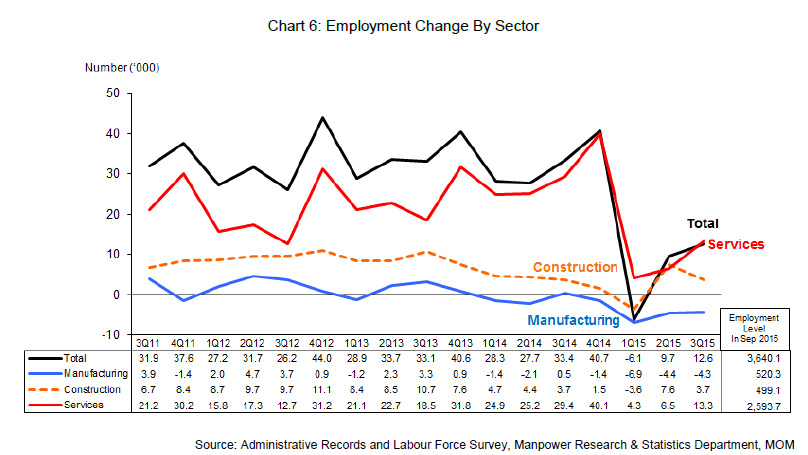
    Jobs growth in Singapore remained low in the third quarter of 2015, with unemployment rising slightly for residents and citizens, according to figures released in the Ministry of Manpower’s (MOM) latest Labour Market Report.

    From July to September this year, total employment grew by 12,600, which is higher than the preceding quarter’s growth of 9,700 but significantly lower than the increase of 33,400 from the corresponding period last year.

    According to MOM, the cumulative employment growth for the first three quarters of this year was 16,200, which is the lowest growth since 2009.

    The employment gains were driven by increases in the services sector, with the wholesale and retail trade, real estate services, construction and manufacturing sectors all cutting back on employment.

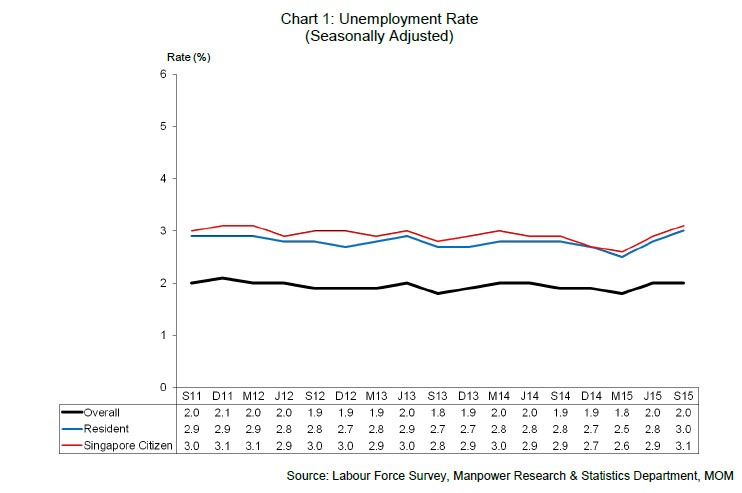
    Overall unemployment remained low at 2.0 per cent, but rose slightly for the second consecutive quarter to 3.0 per cent for residents and 3.1 per cent for citizens.

    More workers were laid off in the third quarter, with 3,460 losing their jobs. This is higher than the 3,250 laid off in the second quarter of 2015.

    A significant majority, or seven out of ten, residents laid off in the quarter were from the professionals, managers, executives and technicians (PMET) group, according to MOM.

    Even though there were still more vacancies than people looking for work, the ratio has moderated with the number of seasonally-adjusted vacancies declining over the quarter by 11 per cent.

    This has brought down the job openings to job seekers ratio to 116 openings per 100 seekers, which is comparable to the level in Jun 2013.

    An estimated 56,700 residents, comprising 51,100 Singaporeans, were unemployed in Sep 2015, up from 52,700 residents unemployment in Sep 2014, MOM said.

    Responding to the figures, Ms Jaya Dass, country director for HR services provider Randstad Singapore, said that the government’s focus on increasing productivity and transitioning to a more service and quality-based economy is making Singapore less manpower-reliant. “These initiatives, coupled with the slowdown in core sectors like manufacturing and construction, have contributed to slower employment growth,” she said.

    However, she added that initiatives to deepen the skills of Singaporean workers, such as SkillsFuture, will provide better career opportunities in the coming year.


    Source: http://business.asiaone.com

  • F1 And SIA: A Match Made In Heaven?

    F1 And SIA: A Match Made In Heaven?

    Now into its second year of the sponsorship deal between Singapore Airlines (SIA) and the Formula One Grand Prix, the national carrier said it is reaping the returns in both commercial and intangible terms.

    Industry observers added that financially, the deal is estimated to have more than paid off the investment. SIA said its involvement is not just about advertising its name, it is about bringing the sport to the community.

    But being the national carrier, SIA also benefits from higher ticket sales as fans from the region fly into Singapore to enjoy the only night race on the F1 calendar.

    According to observers, while sponsorships tend to be a more integral part of business in the West, the landscape is less developed in Asia. So as one of the early movers, some said SIA is likely to have higher returns on investment.

    Details of the sponsorship are kept confidential, and there are no numbers from SIA on how the F1 tie-up helps its bottomline.

    But one industry watcher estimates that it is likely to have paid off financially.

    Mr Jochen Wirtz, Professor of Marketing at NUS Business School, said: “Just from a financial point of view, a breakeven would be somewhere between 10,000 to 20,000 tickets. And if you look at the numbers, there are about 85,000 visitors to F1, of which about 40,000 fly in from other countries.

    “That means for SIA to break even, they have to capture about 25 to 50 per cent of this incremental travel, and I think that is not an unreasonable number. So just on short-term financials, I think there is a good possibility for Singapore Airlines to break even.”

    Mr Wirtz said this does not include the intangible benefits to SIA, such as marketing exposure and greater brand recognition globally.

    SIA itself recognises that the partnership helps to enhance its brand image and international exposure.

    Said Mr Sheldon Hee, vice president of marketing communications and development at Singapore Airlines: “The global economy goes through its cycles. And for us, building on a platform like the Formula One, the Singapore race is an opportunity for us to position Singapore and Singapore Airlines in the minds of consumers, be it now or be it in a couple of years when they can travel again.

    “There will be opportunities for us to capture some of this interest, and hopefully bring them via Singapore or into Singapore on Singapore Airlines.”

    SIA recently announced that it would extend its sponsorship of the Grand Prix event until 2017.


    Source: www.channelnewsasia.com