Tag: elitist

  • Netizens Angry Over NTU’s Elitist Email

    Netizens Angry Over NTU’s Elitist Email

    An e-mail sent out by Nanyang Technological University’s (NTU) School of Humanities and Social Sciences (HSS) to its final-year students has raised the ire of a number of undergraduates and netizens.

    Last Wednesday, Mr Joel Chong, a final-year student at the HSS, uploaded a screen-shot of the e-mail, which asked for inspirational stories from its undergraduates.

    Besides stories from prodigies, outstanding undergraduates with multiple job offers awaiting them, and those who have overcome great odds, the school also asked for stories from “graduating VIP students from an important or well-known family, sons or daughters of politicians, professors, celebrities etc”.

    That line has angered a number of netizens, and Mr Chong’s post has since garnered more than 400 likes and over 700 shares.

    Speaking to The New Paper yesterday, Mr Jonathan Ang, 23, a third-year student at HSS, said: “Why does it even matter what your surname is? That group shouldn’t even be there at all, it’s not about phrasing but the subject matter itself that is wrong.”

    Miss Emi Morihata, 21, a third-year student at NTU’s Wee Kim Wee School of Communications and Information, was also disappointed with the HSS.

    “Their view of ‘inspirational stories’ is so superficial.

    “The fact that they are setting these narrow-minded measurements as indicators of an eligible candidate already shows that they are just doing it for the sake of publicity to showcase the school.

    “Graduation is a celebration of the students who have worked hard through the years. If they really want to highlight these hardworking people who overcame challenges during their academic life, such indicators won’t be on the e-mail in the first place.”

    Responding to Mr Chong’s Facebook post last week, a spokesman for NTU felt he had been unfair in singling out the particular line, causing “the spirit and meaning of our open request for nominations” to be “misinterpreted and distorted”.

    Responding to queries from TNP yesterday, an NTU spokesman said: “We understand the concerns raised and it was never our intention to focus on only individuals of certain backgrounds.

    “The highlighted line could have been better phrased.

    “Convocation is a celebration of our students’ achievements and knowledge, and as always, we will be as inclusive as possible and portray this by featuring stories of students from all walks of life.”

    Sociologist Tan Ern Ser felt the line in the e-mail suggested elitism.

    “In a meritocratic society, we celebrate achieved status – that is, achieved through individual merit, ability and diligence – rather than social background, which is not within our control.

    “Highlighting a person’s social background is not only elitist but also contrary to our core values.

    “Perhaps, the ones who penned those requirements have good reasons for doing so, and I am sure many would like to know what those reasons are,” he said.


    Source: www.tnp.sg


  • Deconstructing Arguments Of Young Singaporean Elitist

    Deconstructing Arguments Of Young Singaporean Elitist

    ‘Elitism’ can be good for society

    It’s very interesting to me whenever a teenager thinks that he has something important or meaningful to say about society. I used to blog about social issues as a teenager myself, and it wasn’t too long ago– so I like to think that I relate to the civic-minded young ones. [1]

    The first and most important thing we need to remember about young teenage thinkers is that they’re most probably dependent on their parents.

    This does not automatically discredit their perspective, but it does shape it tremendously. [2]

    Or, to look at it from another point of view, there’s a lot about society you simply don’t know about until you start paying for the roof over your head and the water coming out of your taps.

    How does this play out in Russell’s argument?

    He claims that “equity is better than equality”, but he has no proposal for actually increasing the net amount of equity in Singapore.

    So all he’s really saying is that the status quo works well for him, and he’d like things to be kept that way, thank you very much.

    Which is quite rational from his perspective. Why should commoners get access to the privilege that HE inherited?

    (Actually there’s a good reason: because it’s a step towards increasing the net amount of equity in Singapore. But he avoids talking about this, probably because he’s a teenager who isn’t actually accountable for anything yet.)

    Let me go through Russell’s argument, bit by bit:

    In recent years, we seem to have collectively confused equity with equality.

    Well, maybe. Let’s see.

    Equality is making everyone stoop down to the lowest common denominator of society – everyone does the same thing and all are given equal probabilities.

    Straw man! We’re conflating equality of opportunity here with a sort of imposed collectivism. Imposed collectivism typically leads to the shittiest kind of equality, AKA “we’re all equally miserable”.

    Also, “Making everyone stoop down to the lowest common denominator” implies some sort of Down to the Countrysidemovement. Like we’re deliberately weighing people down so that they can’t be excellent (see: Vonnegut’s Harrison Bergeron).

    Vonnegut’s story demonstrates “making everybody stoop down”, where people are literally policed and maimed. Giving the disenfranchised access to education is a totally different thing.

    Equity entails everyone doing what their abilities allow them to do, and everyone being given equal opportunities to succeed; only the most outstanding grab those opportunities.

    That’s the end goal that pretty much everybody agrees is a good thing.

    The challenge is that we often disagree about how to get there.

    If we take a modern society and reduce it back to an agrarian one, where everyone puts in equal effort, we achieve equality but not equity – because we are taking people with the capability to be, for instance, lawyers and doctors, and making them do the same menial tasks as everyone else.

    What is up with the “reduce modern society back to an agrarian one” motif?

    Also, what are these horrible menial tasks that everybody does except lawyers and doctors? Washing their own underwear? The horror.

    It is a natural consequence that students from affluent backgrounds get into better schools because their parents are likely more well-heeled and can afford better-quality education for them.

    Oh man, that’s not even half of it. Parents from affluent backgrounds also are likely to read more, read to their kids more, have more thoughtful conversations at the dinner table, have better connections and so forth. Check out this great comic: On a plate
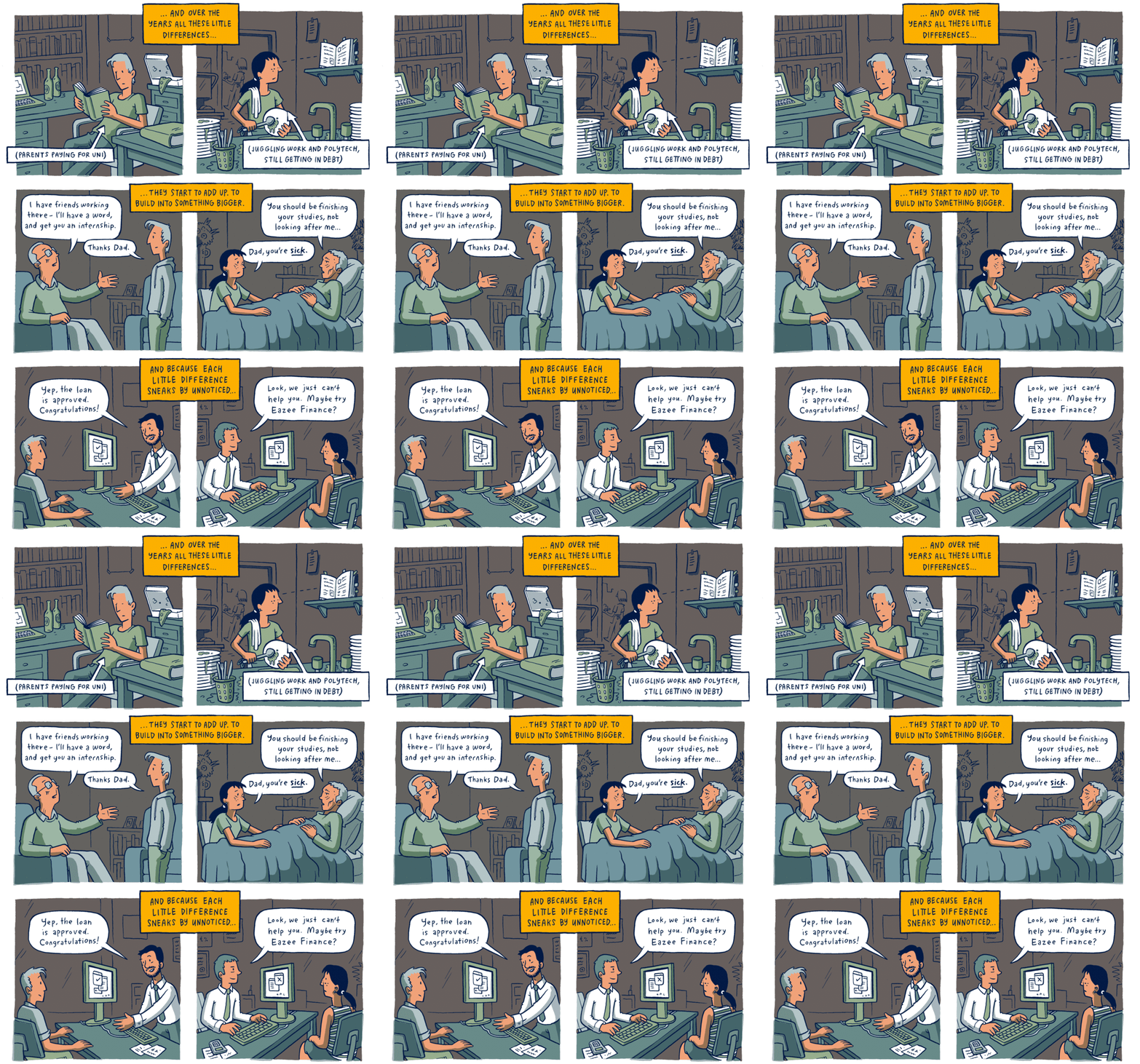
    differences

    There is no point aiming for equality for the sake of equality, and giving up equity.

    Ah, but you see, the point is to GAIN equity by reducing inequality. The point is to GAIN more high-quality doctors and lawyers from the people who don’t currently have access to opportunities.

    Did you seriously think that the Principal of RI is saying “let’s give up equity for the sake of equality”? Equity bad, equality good?

    […] when we stream students according to their abilities, it is only natural that students whose families can afford better quality education make it to better institutions.

    Try to avoid “it is only natural” statements, because they’re actually non-arguments. It’s only natural for a 17-year-old to write things like this. It’s only natural for people to desire and persue equality.

    Everything is only natural, ergo it’s redundant to talk about it.

    A natural consequence that stratifies society does have its own purpose for the well-educated, critical minds to mingle together to build Singapore up to greater heights.

    Don’t pretend that “natural phenomena” has noble intentions. It only seems to because it serves your interests.

    The idea that a country will be brought to greater heights by a circlejerking elite is a romantic one, but it’s BS.

    Intelligence is an asset; and we cannot allow ourselves to prioritise equality over intelligence and equity.

    Again, the idea that equality takes precedence over equity here is utterly mislaid.

    The fundamental point that you’re missing is that addressing inequality is a necessary step towards creating more equity. We don’t need to send doctors and lawyers to the countryside. We need to give rural children the opportunity to read and write.

    RI is often touted as a factory for future leaders – why would we want to draw resources away from the nurturing of our future leaders, or worse still, level the playing field?

    Oh, that’s a pretty simple one. Because leaders aren’t made better by throwing more resources at them, or by putting them on a pedestal.

    Leaders need perspective. Leaders need empathy. Leaders need to see the big picture. Leaders need to mingle with everybody, not just the equity-laden, menial-task-avoiding elites. Leaders are nurtured in difficulty and struggle, not with silver spoons.

    You see, Russell, you fundamentally misunderstand the pursuit of maximizing equity for a society, and you fundamentally misunderstand leadership.

    We should relook the way we go off the well-trodden path, and ensure that we do not shake up the status quo just for the sake of doing so.

    The status quo will get shaken whether you like it or not. What you should actually relook, though, are the assumptions in your own thinking.

    Here are a couple of quotes worth ruminating on:

    Elizabeth Warren: “There is nobody in this country who got rich on their own. Nobody. You built a factory out there – good for you. But I want to be clear. You moved your goods to market on roads the rest of us paid for. You hired workers the rest of us paid to educate. You were safe in your factory because of police forces and fire forces that the rest of us paid for. You didn’t have to worry that marauding bands would come and seize everything at your factory… Now look. You built a factory and it turned into something terrific or a great idea – God bless! Keep a hunk of it. But part of the underlying social contract is you take a hunk of that and pay forward for the next kid who comes along.”

    Lee Kuan Yew: “The successful have forgotten that without the peace and stability that made their education, their job or their business opportunities possible, they would never have made it. But having made it, they think they made it on their own. Some students from the top schools like Raffles Institution or Hwa Chong, they go abroad and they think that they had done it on their own. They don’t owe the government or society anything. They are bright chaps, but how did they make it? Because we kept a balance in society. With peace, stability, we built up our education system and enabled the brightest to rise to the top.”

    _____

    [1] If you’re bored enough to dig into my archives, you’ll find that I too was a presumptuous little twit who thought he had a valuable perspective that the world ought to know about. What changed? I moved out, bought a flat, and pay my own bills. Lol.

    Incidentally, I think it’s very important to remember that news sites are uniquely incentivized to publish incendiary letters. If a letter published on straitstimes.com sparks outrage, that means a lot of traffic for straitstimes.com. It’s not hard to imagine the editors sorting through the letters and laughing amongst themselves, saying, “Wah, this one damn jialat, publish this one!”

    [2] One of the easiest ways to “win aguments” as a teenager is to just use bigger words and talk longer than everybody else. (You’ve got all the time in the world, and no bills to pay.)

    People will eventually find it too tedious to engage with you, and their disengagement means you’re the one left standing. Hooray, you win!

    ____

    Update: Got a great comment about this on Facebook:

    “I think your argument could be summarised into a “equity good not equals equality bad” essay rather than a slightly tedious point-counterpoint.

    Also, the only part I slightly disagree with is precisely the part you quoted above. I think you’re both arguing on a false dichotomy. More resources do to a certain extent allow for the development of better leaders. It can pay for programmes that stretch the capabilities and capacities of participants beyond what normal programmes allow. It can also create opportunities for experiences that are beyond a smaller budget. The problem is that those things are easy to programme, but what we’re missing is the perspective and empathy that you’ve rightly pointed out. We need to be doing more of that, which doesn’t necessarily mean we have to scrap the other good developmental programmes that are already in place.”


    Source: www.visakanv.com

  • ITE Graduate Looked Down By Interviewer Because Of Poor Qualifications

    ITE Graduate Looked Down By Interviewer Because Of Poor Qualifications

    Dear All Singapore Stuff,

    I’m going to share my thoughts regarding an interview with a certain company for the position of Test Technician and after the interview, I left feeling horrible, depressed and really upset. The interviewer was rude and unprofessional. I found this job opening through jobstreet.

    First of all, I waited for almost an hour before the interview commenced because the HR recruitment specialist had an appointment and forgot about the interview. How convenient. That is unprofessional and they should have told me beforehand. The interviewer didn’t introduce his name, what his position was or which department here was from. So we’ll call him Mr Nice guy.

    So Mr Nice guy asked me regarding my last drawn salary, from two previous companies. He asked “why is your salary low?”. I explained that I worked only for a few days during the course of the employment and probably that’s the reason why it’s not that high. Mr Nice guy wasn’t satisfied with my answer and raised his voice and said “NO NO YOU’RE NOT ANSWERING MY QUESTION”. At this point of time, I felt that this interview had gone sideways. Mr Nice guy critiqued how could I possibly work with the company if I couldn’t answer a simple question.

    In the first place, is this question even relevant? You employ someone based on merit and skills, not on previous pay and I did give an answer. I’m sorry if you are not satisfied with my answer.

    Mr Nice guy proceeded with the interview and I answered as best as I could, in a polite manner even though I felt like walking out the door. He was rude throughout the interview and asked me questions that are not related to the job scope. All the while he behaved in a condescending manner and constantly undermined my credibility. Mr Nice Guy kept hinting that the company is looking for “highly educated people” He seem to have a prejudice against ITE graduates like me.

    The ad that they posted is misleading to future applicants on what are the required qualifications. I have met the necessary requirements. I have a Nitec in the relevant course and I have the relevant experience. The interviewer looked down on me just because I was an ITE graduate. He also continously undermined my capabilities throughout the interview and he was hinting that ITE graduates have no place in the company.

    Education is very important in Singapore. But it is wrong to stereotype someone just based on his/her qualifications. Even if you are from ITE, it doesn’t make you less of a person. What does it matter if you have a PhD but you’re an asshole. Is someone deemed highly educated just based on his qualifications? Everyone should be treated equally regardless of their education. There should be no prejudice against people who has less education than you. What’s important is the attitude of someone and I believe that is what you should look for in an employee.

    Mr Nice guy concluded the interview by bluntly saying that according to him, I had failed the interview because of my attitude and I wouldn’t ever get a good job in Singapore and that the way I answered his first question was unreasonable and unprofessional.

    I believe he was the one who was rude and treated me with no respect. If i wanted to be interrogated I would’ve just gone to a police station. Where did he learn his interviewing skills from? He was rude and inconsiderate from the start and he didn’t even know that he was rude. He spoiled my day with his attitude. I dont have any background in human resource but i doubt that that is a how an interview should be held.

    I have lodged a report with TAFEP and am currently awaiting a personal apology from the interviewer itself for being rude to me. I hope other people don’t go through what I have been through.

    PS: Interviewer is a foreigner. At first I didn’t want to mention it for fear of readers having clouded judgements but due to recent cases, i thought this factor should be taken into consideration.

    Disgruntled Applicant
    A.S.S. Contributor


    Source: www.allsingaporestuff.com

  • Wealthiest 1% Globally Will Possess More Than Half Of Total Global Wealth In 2016

    Wealthiest 1% Globally Will Possess More Than Half Of Total Global Wealth In 2016

    The very rich are getting very richer.

    The wealthiest 1% of the world’s population will own more than half of total global wealth next year, according to projections released Monday by Oxfam International, the antipoverty advocacy group.

    And the richest 80 people in the world alone now possess more combined riches than do the poorest half of the world’s population, Oxfam reported, citing Credit Suisse CSGN.VX +1.23% and Forbes data.

    “Global wealth is becoming increasing(ly) concentrated among a small wealthy elite,” the Oxfam report said.

    In 2010, it would have taken the combined riches of the 388 top billionaires to equal the combined assets of the bottom 50% of the planet. But the billionaires’ assets have appreciated so quickly since then, and the total value of the poor’s resources has dropped so precipitously, that last year it took just the top 80 billionaires to equal the wealth of the bottom 3.5 billion people on the planet, Oxfam said.

    The wealthiest 80 people have a combined net worth of $1.9 trillion, up from $1.3 trillion in 2010, with the bulk of their fortunes coming from the financial, pharmaceutical and health care industries. More than a billion people live on less than $1.25 a day, Oxfam said.

    The richest 20% of the population together hold 94.5% of the world’s wealth, Oxfam said. The poorest 80% of the world’s population share just 5.5%.

    “It is time our leaders took on the powerful vested interests that stand in the way of a fairer and more prosperous world,” Winnie Byanyima, Oxfam’s executive director, said in a written statement accompanying the report.


    Source:http://blogs.wsj.com