Tag: extremist

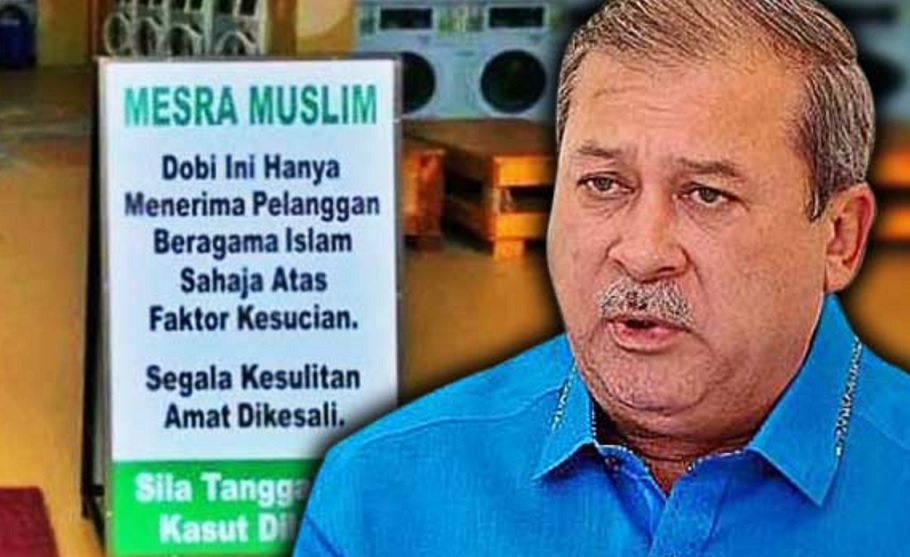
  • Sultan Johor Response To Muar’s Muslim-Only Laundrette: ‘Nonsense, This Is Not A Taliban State’

    Sultan Johor Response To Muar’s Muslim-Only Laundrette: ‘Nonsense, This Is Not A Taliban State’

    Johor ruler Sultan Ibrahim Sultan Iskandar has ordered the Muslim-only laundrette in Muar to stop its controversial policy or risk being shut down.

    “I cannot accept this nonsense. This is Johor, which belongs to Bangsa Johor and it belongs to all races and faiths. This is a progressive, modern and moderate state.

    “This is not a Taliban state and as the head of Islam in Johor, I find this action to be totally unacceptable as this is extremist in nature,” the visibly upset Johor ruler said, as quoted by The Star.

    He has since ordered the state Islamic religious affairs committee chairperson Abdul Mutalip Abd Rahim, the religious council and the district council to investigate the matter.

    The ruler also confirmed that he had spoken to the state’s mufti, Mohd Tahrir Samsudin, as well as state executive councillor for religion Abd Mutalip Abd Rahim over the matter.

    “I want the owner to apologise to me and the people of Johor. He has made Johoreans very angry and embarrassed because this is not the Johor we want.

    “The owner has gone against the vision of a united, harmonious, moderate and tolerant Johor. If he still insists on carrying on the Muslim-only practice, he can leave Johor.

    “I suggest he set up shop in Afghanistan. His thinking is sick and goes against everything that Johor stands for.”

    Confirming that he and his family members were “deeply appalled” by the action of the laundrette owner, the Johor ruler said it would lead to more narrow-minded actions in the name of Islam if such actions were not stopped.

    On the owner who, in the wake of the controversy, has since put up a new sign to say it was “Muslim-friendly”, the sultan said: “Don’t try to be clever. It’s still the same. The owner needs to have his brains cleaned up.

    “I want to put a stop to such extremism. Extremism has no place in my state. We take pride in being Bangsa Johor and I want to know where the owner of this launderette learn his Islam?

    “Islam teaches the faithful to be tolerant and respect other people and faiths,” he said at Istana Bukit Serene yesterday.

    Pointing out how mosques in Johor were open to non-Muslims as long as they were properly dressed, the sultan said he could not imagine non-Muslims being banned from entering mosques, saying he was concerned over rising religious extremism.

    “I wonder where this launderette owner washes his clothes when he is overseas? Is he saying only the clothes of Muslims are clean and those of non-Muslims are unclean? That’s what he means, I believe.

    “From now on, I am directing the state executive council and all the councils to insist that any business owners who carry out such blatant discriminatory practices should have their licences revoked. Don’t mess around with your narrow-minded religious prejudices.”

    He said he could not keep quiet on the issue, as if this was allowed to go unnoticed, “then next we will have taxis for only Muslims or non-Muslims”.

    He added that he also did not want other races to carry out similar actions.

    Pictures of the Muar laundrette went viral last week, when it was reported that a sign on the premises reminded customers that only Muslims were allowed to use its laundry machines.

    Johor prince Tunku Idris Sultan Ibrahim had expressed shock over the laundrette’s policy while several others, including Perlis mufti Mohd Asri Zainul Abidin and prominent banker Nazir Razak, criticised the move.

    The operator of the laundrette, however, denied being a racist and insisted that he only wants to ensure that cleanliness be maintained at all times


    Source: www.malaysiakini.com

  • RRG Counsellors Saved Two Secondary Schoolboys From Further Radicalisation

    RRG Counsellors Saved Two Secondary Schoolboys From Further Radicalisation

    One developed an interest in global affairs involving Muslims and became convinced of the need to migrate to an Islamic caliphate. Another penned pro-Islamic State (IS) slogans in his school books that were discovered by his father.

    In both cases, which involved secondary schoolboys, relatives and friends became concerned enough to alert the Religious Rehabilitation Group (RRG). The boys met with RRG counsellors, who explained religious concepts and the IS’ violent ideology to them.

    A third case was of a wife who noticed her husband becoming more vocal about a much stricter form of Islam, holding the exclusivist view that loyalty could only be given to God and Muslims. She confided in her relative, who approached RRG for advice. The wife spoke a few times over the phone with a counsellor on how she could advise her husband not to hold such extreme religious views.

    Sharing these cases on Friday (June 23) of people who had approached the RRG, the group’s vice-chairman Mohamed Ali urged the public to tap its helpline, mobile app and resource and counselling centre at Khadijah Mosque on Geylang Road, if they suspect their loved ones are close to being radicalised.

    The three cases are the only instances of voluntary reporting that RRG has encountered since 2014 – the year its resource centre opened – and that its counsellors “saved” from going further down the path of radicalisation, said Ustaz Mohamed.

    Because they were detected early, they did not need to be reported to the Ministry of Home Affairs or dealt with under the law, he said. “They are not those who were ready to use violence, but they believed that violence is justified.”

    Ustaz Mohamed declined to reveal when RRG was alerted to each case or the backgrounds of the individuals. The secondary schoolboys felt they benefited from the sessions with RRG counsellors and realised the danger of supporting IS, he said.

    In the third case, counsellors had no contact with the husband. But through speaking with the counsellors, the wife learnt more about how extremists promote their ideologies “under the cloak of religion”, said the RRG.

    Loved ones must be “first agents” and seek information such as what websites their children, relatives or friends have browsed, and for how long, said Ustaz Mohamed.

    Cases are not reported to the MHA unless individuals persist in the belief that violence is legitimate even after counselling. “RRG works with MHA, not for MHA,” he said.


    On whether the three individuals might have ended up detained under the Internal Security Act (ISA), were they not reported early to the RRG, Ustaz Mohamed said the answer was not straightforward.

    This is because there are other channels available, such as local mosques or the Islamic Religious Council of Singapore. “But logically we understand that when someone is radicalised and nothing is being done, that process of radicalisation can go further and it could lead to violence. It could lead to him wanting to use violence,” he said.

    The authorities have stepped up calls for family members and the community to report those who are potentially radicalised. They said the time between radicalisation and committing violence could be very short and that terror attacks would divide communities, playing into the hands of terrorist groups.


    Source: www.todayonline.com

  • Netizen: MHA Should Release Female Radical From ISA Detention, Counsel Her

    Netizen: MHA Should Release Female Radical From ISA Detention, Counsel Her

    I dont agree with the ARREST….she needed counselling and advise not arrest..

    she did not say she wants to bomb singapore…

    i hope MHA…reconsider her arrest and release her.

    BY THE WAY..ARW TGE PHOTO BELOW ..HER PHOTO ?


    Source: Mohammed Bashir Ismail Khan

  • Perak Woman Buys Toys Set For Son, Shocked To Find Terrorist Figures

    Perak Woman Buys Toys Set For Son, Shocked To Find Terrorist Figures

    A woman who bought a building blocks toy set for her son here was shocked to discover that it contained elements that are offensive to Muslims.

    40-year-old Mahnun Mat Isa, a teacher, said she was surprised to find the word ”Allah” and ”Muhammad” on a banner held by a ”terrorist-like” character in the game set.

    “What’s more shocking is that the terrorist character (is wearing) an (Islamic turban),” she said

    Mahnun had bought the toy set at a shop in Taiping and the product was made in China.

    “I came to know about it when my son, who was playing with the toy, showed me the ‘terrorist’ character holding a banner which displayed the words ‘Allah’ and ‘Muhammad’,” she told reporters here yesterday.

    Mahnun said she immediately lodged a police report and informed the Perak Islamic Religious Council (Maipk) in Parit Buntar on May 25.

    Kerian police chief Supt Omar Bakhtiar Yaacob confirmed receiving a report from the teacher


    Source: www.nst.com.my

  • Defeat Of Rebels Could Spell More Trouble For Southeast Asia

    Defeat Of Rebels Could Spell More Trouble For Southeast Asia

    Like the stirring of a hornet’s nest — as an expert here put it — the imminent defeat of Islamist militants in the southern Philippine city of Marawi could pose a bigger problem further down the road, terrorism analysts said yesterday.

    What was previously largely contained in the Philippines could escalate into a security nightmare for the region if the militants regroup in other areas near the Sulu Sea such as eastern Malaysia, and parts of Indonesia, said S Rajaratnam School of International Studies (RSIS) research fellow Graham Ong-Webb.

    Dr Rohan Gunaratna, who heads RSIS’ International Centre for Political Violence and Terrorism Research, also warned that if “regional governments fail to contain the threat, (the problem) will spill over into Singapore”.

    The Philippine military said yesterday it was close to retaking Marawi, which was held for a seventh day by the militants. More than 100 people have been killed, most of them militants, according to the military, and most of the city’s residents have fled.

    Last month, Home Affairs and Law Minister K Shanmugam underscored the growing terrorist threat in Singapore’s backyard, and warned that the southern Philippines, which is less than a four-hour flight away from Singapore, was becoming a sanctuary for returning fighters from the Middle East and from where attacks could be launched on South-east Asia.

    Speaking at an international exhibition on homeland security held here, Mr Shanmugam noted that, with the Islamic State (IS) losing ground in Iraq and Syria, the “potential locus of the threat” could move closer to home.

    Similarly, there could be unintended fallout from the efforts of the Philippine authorities to drive the militants, who consist of both local and foreign fighters from Indonesia, Malaysia and Singapore, out of their country.

    Dr Graham Ong-Webb noted that if the militants were “pushed to a corner”, they could flee the Philippines, and “find pockets elsewhere” to re-establish themselves. Using an analogy of a hornet’s nest, he pointed out that when the nest is provoked, the hornets “either attack, or … surrender, die fighting, or … fly to another location to rebuild their nest”.

    Given its size, Indonesia, for example, could potentially provide hideouts for fleeing militants to reorganise and hit back, with the help of traditional insurgents which could morph into terrorist groups “if they find it to be in their interest”.

    “It is difficult (for Indonesia) to consolidate internal security, and there (could be) pockets of insecurity, or lawlessness,” said Dr Ong-Webb.

    Assoc Prof Kumar Ramakrishna, head of Policy Studies and coordinator of the National Security Studies Programme at RSIS, noted that West and Central Java, as well as Central Sulawesi, may be “fertile socioeconomic and political ground for IS ideology to take root”. He also cited southern Thailand, where there is an ongoing insurgency. While the Thai-Muslim separatists have been “not that interested” in broader agendas such as those perpetuated by Al Qaeda or Jemaah Islamiyah, the insurgency in southern Thailand could provide a source of weapons for IS cells in Malaysia, Assoc Prof Kumar said.

    Assoc Prof Kumar said the Mindanao region “has arguably been a weak link for decades”. The fighting in Marawi, which is located on the southern Philippine island of Mindanao, confirmed Mr Shanmugam’s concerns, he added.

    The analysts reiterated that Singapore is a prime target for terrorists, and the fierce fighting that broke out in Marawi showed that Singapore should not take security for granted.

    “Singapore is a symbol of financial and economic success, any successful attack on Singapore by terrorists would be deemed a terrorists’ jackpot,” said Assoc Prof Antonio Rappa, who heads the Management and Security Studies programme at the Singapore University of Social Sciences. Last week, a suicide bombing at a Jakarta bus station killed at least three policemen and injured 12 others. The IS has claimed responsibility for the attack.

    Each successful attack in the region would embolden the terrorists, said Assoc Prof Rappa. “The weak links lie outside Singapore’s borders. In the neighbouring states, there is often a lack of sufficient public education and a high amount of security complacency,” he said.

    Lauding the establishment of the SGSecure movement, Dr Gunaratna said Singapore “should work to create competencies in the region to fight the threat”, and beef up defences against IS’ online propaganda. “The Government of Singapore needs to play a greater role to build the offshore counter terrorism operational capabilities,” he said.


    Source: www.todayonline.com