Tag: fasting

  • Bangladeshi Foreign Workers Steadfast Observing Ramadan Despite Gruelling Schedules

    Bangladeshi Foreign Workers Steadfast Observing Ramadan Despite Gruelling Schedules

    On the last night of Terawih Prayers before Ramadan comes to an end for our Muslim friends, I had the privilege to witness and photograph how the men who built our houses practise their faith.

    Many of the construction workers in Singapore are Bangladeshi, and many Bangladeshi are Muslim, so I’ve always wondered how they continued to be faithful during the Holy Month despite their punishing and gruelling working lives here in Singapore.

    Last night (4th July 2016) I photographed these Muslim workers saying their Terawih Prayers outside their dormitory in Tuas, where space is so limited within the dorms that they have had to bring their faith out onto the roadside.

    *Please feel free to share this*

    040716


    Source: Darren Soh I Photographer

  • Terrorist Launched Suicide Bomb Attack At Nabawi Mosque

    Terrorist Launched Suicide Bomb Attack At Nabawi Mosque

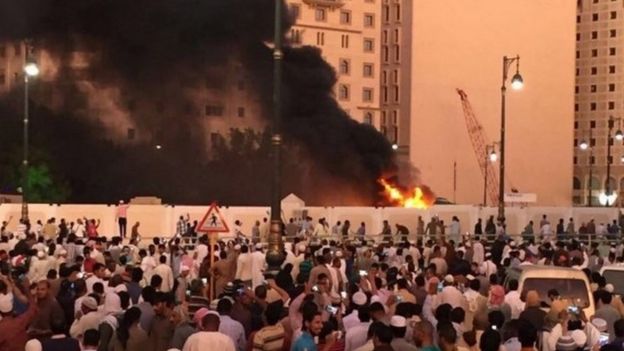
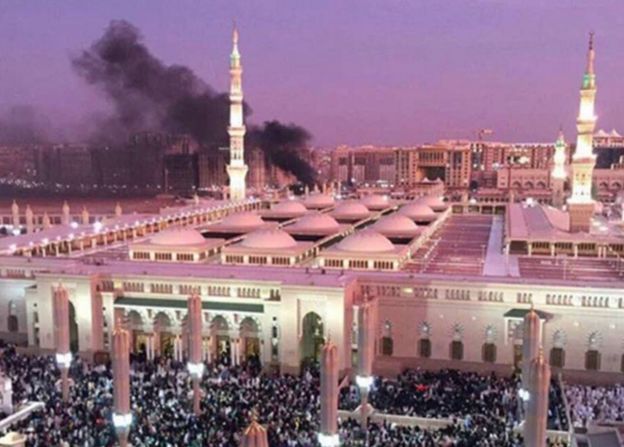
    A suicide bomber has killed four security officers and injured five others near one of Islam’s holiest sites in the Saudi city of Medina, according to the interior ministry.

    The bomber detonated his explosives after being stopped outside the Prophet’s Mosque, a statement said.

    The mosque is the burial place of the Prophet Muhammad and Medina the second-holiest city in Islam after Mecca.

    Blasts also struck two other Saudi cities on Monday.

    That the attack happened in Medina at such a place is likely to leave Muslims around the world aghast, BBC World Service’s Middle East editor, Alan Johnston, says.

    Suspicion is likely to fall on so-called Islamic State (IS), he adds.

    Bomb blast site in Medina, 4 July

    Al-Arabiya gave a different account of the incident, saying the bomber had targeted the security officers by pretending he wanted to break his Ramadan fast with them.

    Qari Ziyaad Patel, 36, from South Africa, who was in the mosque, told the Associated Press news agency people had at first thought it was the sound of the cannon fire that marks the breaking of fast.

    The ground shook, he said, adding: “The vibrations were very strong. It sounded like a building imploded.”

    Smoke rises behind the Prophet's Mosque in Medina

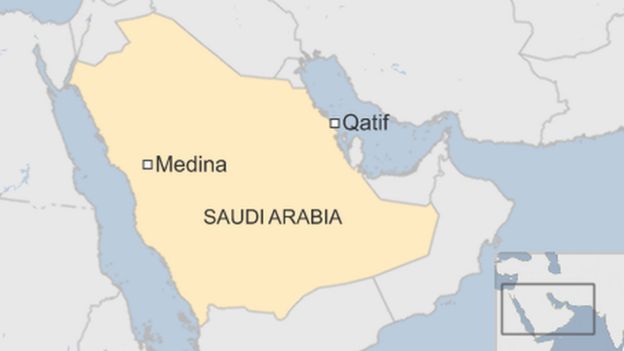
    Earlier, at least one explosion rocked Qatif, an eastern city which is home to many minority Shia Muslims.

    The blast appeared to target a Shia mosque. The attacker was killed but no other casualties were reported.

    A suspected suicide bomber also died after detonating a device near the US consulate in the city of Jeddah. Two security officers were slightly injured as they tackled the man, but no-one else was hurt.

    No-one has yet said they were behind any of the attacks.

    They come with the holy month of Ramadan drawing to a close and ahead of the Eid al-Fitr holiday.

    Saudi Arabia has been the target of attacks by IS over the past two years.

    In June, the interior ministry said there had been 26 “terror attacks” in the kingdom in that time.

    Map of Saudi Arabia

    A series of deadly attacks worldwide were either claimed by, or blamed on, IS over the past week:


    Source: www.bbc.com

  • What If You Are Not Forced To Fast?

    What If You Are Not Forced To Fast?

    In a country where fasting during Ramadan is a given among Muslims, many forget that the ritual is not as universal among adherents worldwide.

    After all, 99 per cent of Malaysian Muslims observe fasting, according to a Pew Research Center Forum on Religion and Public Life survey of more than 38,000 Muslims in 39 countries, released in 2012.

    The survey found that fasting is generally observed by most Muslims in Southeast Asia, South Asia, the Middle East, North Africa, and Sub-Saharan Africa. In such countries, observance is 85 per cent and above, except for an outlier — the Democratic Republic of the Congo, where only 69 per cent Muslims fast.

    But it is a different story in Central Asia and Southern-Eastern Europe.

    While more than 84 per cent fast in Turkey and Tajikistan, just half of the Muslims fast in Uzbekistan and Kyrgyzstan. Just 43 per cent observe it in Azerbaijan, and a mere 30 per cent of Muslims fast in Kazakhstan.

    While most Muslims in Kosovo and Bosnia-Herzegovina fast (76 per cent and 75 per cent respectively), it is not so in Russia (56 per cent) and Albania (44 per cent).

    There is a sizeable portion of Muslim populations in the latter area. Seven in 10 of Kazakhstan citizens are Muslims. More than half of Albanians are too, compared to the second biggest religion there (Christianity, at 10 per cent).

    Despite that, Muslims elsewhere are always ignored in conversations about Islam — either by Muslims themselves, or in critical discourse from the West. Although the cradle of Islam is in the Middle East, we take for granted the diversity of Muslims and how the religion is practised differently by different groups of people.

    Free ‘iftar’ meals are laid out before Muslims arrive to break their fast during the holy month of Ramadan at Masjid India in Kuala Lumpur on June 7, 2016. — Picture by Yusof Mat Isa

    Despite that, it might seem surprising that fasting is actually the second most observed ritual in the five pillars of Islam. Around 93 per cent of Muslims worldwide fast, following 97 per cent who declare their faith in the oneness of Allah and Prophet Muhammad being the last messenger.

    (The fact that three per cent of Muslims do not even believe in the Declaration of Faith might shock some; while some might argue those are not even technically Muslims.)

    Compared to that, only 77 per cent give zakat, or alms; just 63 per cent perform the five daily prayers; and a mere nine per cent perform the hajj to Mecca — which is itself only mandated for those who can afford it.

    It should be noted here that Muslims in Central Asia and Southern-Eastern Europe also find religion less important in their lives. Only 15 per cent of Albanian Muslims believe religion is “very important”, and just 18 per cent in Kazakhstan. Except in Turkey, Muslims in those countries who place such importance in religion do not reach even half of the population.

    What does this really say about fasting? That perhaps compelling Muslims to fast does not correlate with Muslims voluntarily doing so.

    There were two countries where 100 per cent of Muslims surveyed observe fasting. Guess where?

    It was in Thailand, where Muslims are minorities concentrated in the southern provinces. And Cameroon, a Christian-majority country.

    Would making fasting mandatory for Muslims in Central Asia and Southern-Eastern Europe by decree of the state increase the level of observance there? Unlikely, considering the minor role religion plays there.

    Whereas in Malaysia, fasting is enforced by state religious authorities. Skipping it is considered a punishable crime.

    In the Federal Territories, Muslims caught openly eating, drinking, or smoking during Ramadan can be fined not more than RM1,000 or jailed not more than six months or both for first offence, under Section 15 regarding “not respecting Ramadan”, in its Shariah Criminal Offences Act 1997.

    Other states also have almost the same provisions in their respective Shariah Criminal Offences Acts.

    In some states, the offence also covers those who sell food, drinks etc. for immediate consumption by Muslims during Ramadan. The seller is also liable to face the same punishment.

    In theory, this would be impossible to implement fairly, considering that the Shariah laws are supposed to apply only to Muslims. In theory, of course.

    However, with Islam as entrenched here, this practically means that a restaurant — although itself has no religion — would usually refuse service to Muslims outright during fasting hours, completely ignoring that there are many valid reasons for skipping fast: illness, menstruation, travelling, just for instance.

    It has been years since fasting was made mandatory for Muslims here. And still, not 100 per cent of Muslims observe it.

    And yet, considerable resource is being devoted to this exercise that some may even consider almost impossible (Thailand and Cameroon, notwithstanding). Add to that, skipping fasting is yet another “crime” in the Shariah laws where nobody is a victim.

    Malaysia is already pandering to Muslims during Ramadan — office hours end an hour early so Muslims can afford to return home for breaking fast, only for most of them in the Klang Valley to be stuck in unusually bad traffic jams during the daily evening commute.

    If not observing fasting is no longer a crime, would the level of those fasting tumble from 99 per cent? Perhaps it would. But then again, perhaps it would not, as 93 per cent of Muslims here already consider religion to be very dear to their lives.

    This summer, some Muslims would be subjected to long hours of fasting in certain countries, especially in the West. There are tales of those who only have five hours between breaking fast and resuming fasting. Some of those Muslims still steadfastly observe their fast.

    Canadian MP Mark Holland’s vow to fast in solidarity with Muslims was applauded by many Muslims. Some even prayed for Holland to one day see the light and embrace Islam.

    Just like Holland, and many more who choose to fast despite gruelling conditions, they do so not out of coercion, not because they are afraid of getting caught.

    It is only then that one can witness a Muslim who is sincere with his/her faith. As long as fasting is forced, ending up a burden on Muslims nationwide, such a thing is rarely possible.

    * This is the personal opinion of the columnist, Zurairi AR.


    Source: www.themalaymailonline.com

  • Big Box Durian Fest – If You’re Muslim, You Have 45 Minutes To Eat The Durians

    Big Box Durian Fest – If You’re Muslim, You Have 45 Minutes To Eat The Durians

    Some Muslims customers are unhappy with Big Box, a mall in Jurong East, for organising a “Durian Fest EAT ALL YOU CAN!” event during the fasting month.

    Saying that the durian fest they held last year was a huge success, Big Box invited its customers to another durian feast via a Facebook post on June 15. The durian fest is held this weekend (18 and 19 June) and customers can pay $38 to attend a session from 3 – 5pm, or another from 6 – 8pm. Alternatively, they could pay $68 to attend both sessions in a day.

    Some Muslim customers are unhappy because the mall is having the durian fest during the fasting month of Ramadan. Big Box, tried to explain that was why they were having two sessions. But some Facebook users said that since the fast typically ends past 7pm, they will have very little time to eat the durians, and so it is not fair.

    1Big Box apologised to such customers and said that it will be mindful of this when it organizes its next durian fest.


    Source: The Independent – Singapore

  • 100 Year Old Grandpa Still Fasts During Ramadan

    100 Year Old Grandpa Still Fasts During Ramadan

    He will be celebrating his 100th birthday in two weeks, which makes him one of the oldest Singaporeans around.

    But with the month of Ramadan starting today, Mr Othman Nasir will not be having his usual birthday celebrations on June 20 because he will be fasting.

    He told The New Paper that he wants to observe Ramadan because he is still capable of fulfilling his obligations as a Muslim.

    His daughter, Madam Norlela Othman, 44, who is the youngest of his 10 children, said her father often fasts throughout Ramadan despite his advanced age.

    Mr Othman, who was born in Batu Pahat in Johor, moved to Singapore in 1939 to serve in the British army.

    His time spent in the army is what made him a disciplined and responsible man and father, said Madam Norlela.

    Speaking from Mr Othman’s four-room flat in Tampines, where he has lived since 1984, the mother of four daughters said: “He was a strict father when we were growing up, especially with his words.”

    It is this discipline that may have contributed to his longevity.

    He eats plenty of vegetables and fruits. When he eats meat, it is mostly fish.

    He also leads a relatively stress-free life, spending his free time reading the Quran.

    Mr Othman still looks healthy at his age. Other than gout, he has no major illnesses.

    His memory remains good although his hearing has weakened and his speech has slowed down considerably.

    He used to be able to walk with the help of a walker, but has been using a wheelchair since a fall last year.

    “If I were to tell my life story, it would be too long,” Mr Othman told TNP in Malay, with a chuckle.

    After leaving the army, Mr Othman worked as a messenger.

    He was then at a security company for 25 years before retiring in 1997.

    Mr Othman has only vague memories of kampung life in Malaysia and Singapore, but he said he prefers life in Singapore today – everything is easier here.

    His domestic helper, who wanted to be known only as Ms Setyani, has looked after him for eight years.

    “Every two weeks or so, we take him out to get some fresh air,” said the 32-year-old Indonesian.

    HARI RAYA CLOTHES

    Madam Norlela, who works as an airline ticketing officer, said her father often asks to be taken to Geylang Serai and Beach Road, to places he remembers fondly.

    “He used to take his children to Geylang during Ramadan to look for Hari Raya clothes” she added.

    “And his old army quarters was at Beach Road.”

    When asked about the birthday celebrations, Madam Norlela said she has nothing planned, but it is likely that her siblings and their families will break fast together with Mr Othman on that day.

    The last day of Ramadan will be on July 5 in Singapore, the day before Hari Raya Puasa.


    Source: www.tnp.sg