Tag: freedom

  • Global Survey: Most Will Trade Freedom For Security

    Global Survey: Most Will Trade Freedom For Security

    Most people think that violent terrorism is a major challenge facing their societies and they support tough measures to counter the problem at the expense of some civil liberties, according to a global survey on public perceptions towards violent terrorism commissioned by the Center for Strategic and International Studies (CSIS), based in Washington.

    According to the findings released earlier this week — derived from 8,000 respondents in eight countries — one in two people feel that their governments have not taken adequate steps to address violent extremism.

    The survey was conducted in August this year and involved participants from China, Egypt, France, India, Indonesia, Turkey, the United Kingdom, and the United States.

    Around 25 per cent of the respondents from Turkey and France felt that violent terrorism is the most important issue facing their countries. Overall, around two-thirds of those polled see violent extremism as a major problem in their country.

    “In everywhere except China, at least 75 per cent of those surveyed expect a terrorist attack in the next year,” said CSIS in a report of the survey findings.

    “On a more alarming note, a majority in every country believes that it is likely that violent extremist groups will acquire and use weapons of mass destruction in their lifetime.”

    The majority of respondents in Turkey, France and the US feel their own governments have not taken adequate steps to contain and prevent violent extremism.

    In late June, a gun and bomb attack on Istanbul’s Ataturk airport killed more than 40 people and injured more than 230. Yesterday, a Turkish official said police in the capital had fatally shot a suspected Islamic State (IS) group militant who was planning a suicide bombing.

    France has also been hit hard by violent terrorism, with 230 deaths and about 700 injuries as a result of attacks said to be carried out by IS.

    Both France and Turkey are both sources of a relatively high number of foreign militants fighting in Iraq and Syria, with an estimated 700 French citizens and 500 Turks fighting under the IS flag.

    Just last month, an Afghan-born American sowed terror across Manhattan and New Jersey, wounding 29 people before he was arrested — the latest in a spate of lone-wolf attacks to rock the US.

    Despite widespread anxiety about the terrorist threat, 73 per cent of respondents in the CSIS survey believe that violent extremism can be eradicated.

    When asked about potential measures to counter violent extremism, 90 per cent were in favour of requiring all citizens and visitors to have identification cards.

    A similar percentage also supported asking Internet companies to do an even better job of shutting down all content from violent extremist groups, while 71 per cent favoured allowing government agencies to monitor all phone records, email and social media for contacts with terrorists.

    Close to 90 per cent of the sample was also supportive of asking Muslim leaders to declare definitively that Islam does not in any way condone violent extremism or the creation of a caliphate. More than 80 per cent of those surveyed also said that immigrants who have not passed rigorous screenings and background checks for connections to extremism should be barred from entering their countries.

    On Monday, Iraqi forces, supported by a US-led international coalition, launched a major offensive on the city of Mosul, the IS’ last major stronghold in Iraq.

    The US expects IS to use crude chemical weapons as it tries to repel the offensive, although experts say the group’s technical ability to develop such weapons is highly limited.


    Source: www.todayonline.com

  • Martyn See’s 12 Tips For Political And Human Rights Activists In Singapore

    Martyn See’s 12 Tips For Political And Human Rights Activists In Singapore

    My 12 tips for Political and Human Rights Activists in Singapore.

    1. Read the law thoroughly, particularly the ones that the PAP will use to trip you up, namely Sedition Act, the new Contempt of Court law, Public Order Act (holding a public indoor forum featuring a foreign speaker is illegal), defamation laws, Films Act, MDA Licensing Scheme, Cooling-off Day regulations, Penal Code.

    2. Being an activist is a good way to filter your friends. If certain people start avoiding you, then you know they are not worthy friends anyway.

    3. Family members and close friends will try to dissuade you. They are usually the biggest fearmongers in your life. Listen politely but always follow your own conscience.

    4. Bear your own responsibility for your speech and action. Never implicate others.

    5. Live your life as you normally would. If you labour under the (imaginary) fear of being under constant surveillance, you already short-changed yourself and the people around you.

    6. Campaigning should be fun and energizing. If it becomes a begrudging chore or bore, take a break and recharge.

    7. Yes, there are government moles within the opposition ranks and in civil society. They usually have friendly and pleasant personalities. They are likely to stay in the background and will not be too strident in their political views, but will offer to photograph, video or take notes. Most people unwittingly allow them into their organisation because they are short of manpower. But do challenge these dodgy types to display a public commitment to the cause. Otherwise, keep them out of the inner loop.

    8. From time to time, organise leisure activities with fellow activists from other fields. Watch the tension, friction and squabbles dissipate, like magic.

    9. If you haven’t had run-ins with censorship or the police, the government probably does not take you seriously.

    10. Be thoroughly prepared for your home to be raided by the police one day, to face arrest, and most of all, to spend time in prison. To be at peace with such a prospect frees you up to speak your mind fearlessly and to make decisions without regret.

    11. Draw inspiration from the ones who have suffered and sacrificed so much before us. For example, whenever I think of what Chia Thye Poh, Said Zahari, Lim Hock Siew and their families had to go through, my own worries become embarrassingly trivial.

    12. Forget about the results and the rewards. These things are out of your control. Do the work because your conscience is pricking you and is keeping you awake at night.

    —————————————

    Your guide to dealing with police interrogations.

    http://singaporerebel.blogspot.sg/…/activists-speak-about-t…

    ——————————–

    Good night, and good luck.


    Source: Martyn See

  • Why Singapore Is The World’s Most Successful Society

    Why Singapore Is The World’s Most Successful Society

    Singapore turns 50 on Aug. 9, 2015. Is Singapore the most successful society since human history began? Or, to put it differently, did Singapore improve the living standards of its people faster and more comprehensively than any other society?

    The only way to answer these questions is with empirical data. The most basic needs of any human being are food, shelter, health, education and employment. Did Singapore improve the delivery of those basic needs faster than any other society?

    When Singapore was expelled from Malaysia in 1965 and thrust into an unwanted independence, it was a typical Third World country. Its per capita income of $500 was the same as Ghana’s then. It was not desperately poor, but it had malnutrition. I know this personally as I was put on a special feeding program when I joined school in the first grade, drinking milk from a pail with a ladle shared by other children.

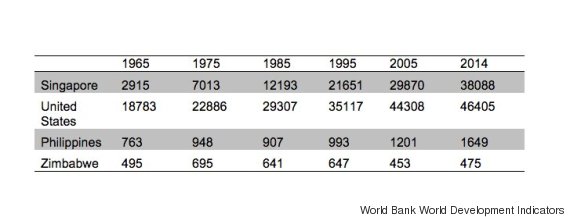
    Table 1: Comparison of real GDP per capita gdpchart

    *Using constant 2005 USD

    This malnutrition disappeared quickly. Singapore’s per capita income has shot from $500 to $55,000 today, the largest increase any newly independent nation has enjoyed. This spectacular economic success story of Singapore is clearly amazing. Yet, when I was Singapore’s ambassador to the UN in the 1980s, the then head of UNICEF, the American James Grant, used to chide me for speaking about it.

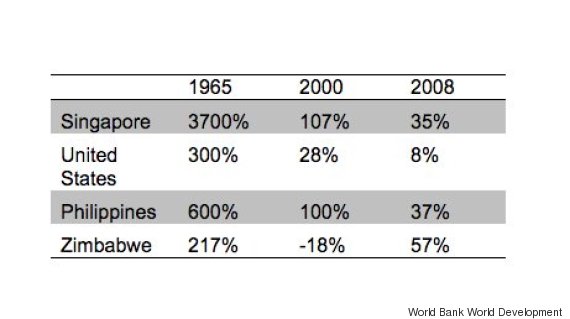
    Table 2: Percent increase in real GDP from year listed to 2014 gdpchart2

    *Using constant 2005 USD

    He told me that Singapore’s success in another area was even more spectacular. We had reduced our infant mortality faster than any other society, going down from 35 per 1,000 live births in 1965 to 10.90 in 1985. James Grant was right. Babies are the most vulnerable members of any society. When they live instead of dying, they reflect an improving social ecosystem that keeps them alive.

    The babies who lived in Singapore went on to enjoy one of the best education systems in the world. The OECD ranked 15-year-old Singaporean children number one in the world in a recent global ranking of “Universal Basic Skills” in mathematics and science. Singapore students also topped the OECD PISA problem solving test in 2012.

    There are many other areas where Singapore’s social standards top the charts. From the Singapore with slums that I grew up in, we now have the highest home ownership of any country in the world, with 90 percent of residents living in homes they own. Even amongst households in the lowest 20 percent of incomes, over 80 percent own their own homes. Rapidly rising salaries and strong compulsory saving schemes, through the Central Provident Fund, led to this incredibly high home ownership.

    So why did Singapore succeed so comprehensively? The simple answer is exceptional leadership. Many in the world have heard of Mr. Lee Kuan Yew, the founding prime minister who passed away in March this year. Far fewer have heard of Dr. Goh Keng Swee, the architect of Singapore’s economic miracle, and Mr. S. Rajaratnam,Singapore’s philosopher par excellence.

    Together, they made a great team.

    This exceptional team also implemented three exceptional policies: Meritocracy, Pragmatism and Honesty. Indeed, I share this “secret” MPH formula with every foreign student at the Lee Kuan Yew School, and I assure them that if they implement it, their country will succeed as well as Singapore. Meritocracy means a country picks its best citizens, not the relatives of the ruling class, to run a country. Pragmatism means that a country does not try to reinvent the wheel. As Dr. Goh Keng Swee would say to me, “Kishore, no matter what problem Singapore encounters, somebody, somewhere, has solved it. Let us copy the solution and adapt it to Singapore.” Copying best practices is something any country can do. However, implementing “Honesty” is the hardest thing to do. Corruption is the single biggest reason why most Third World countries have failed. The greatest strength of Singapore’s founding fathers was that they were ruthlessly honest. It also helped that they were exceptionally shrewd and cunning.

    Still, Singapore has its fair share of detractors. Its political system was widely viewed as being an “enlightened dictatorship,” even though free elections have been held every five years. Its media is widely perceived to be controlled by the government and Singapore is ranked number 153 out of 180 by Reporters Without Borders in 2015 on the Press Freedom Index. Many human rights organizations criticize it. Freedom House ranks Singapore as “partially free.”

    Undoubtedly, some of these criticisms have some validity. Yet, the Singapore population is one of the best educated populations and, hence, globally mobile. They could vote with their feet if Singapore were a stifling “un-free” society. Most choose to stay. Equally importantly, some of the most talented people in the world, including Americans and Europeans, are giving up their citizenship to become Singapore citizens. Maybe they have noticed something that the Western media has not noticed: Singapore is one of the best places to be born in and to live in. Quite amazingly, a society destined to fail in 1965 has become one of the world’s greatest success stories.


    Source: www.huffingtonpost.com

  • Singapore Has Always Been Fundamentally Secular

    Singapore Has Always Been Fundamentally Secular

    I disagree with the writer’s views in the letter “Don’t let secular fundamentalism be the norm” (May 15). I think Singapore is fundamentally secular.

    While I agree that some Singaporeans cannot help it if their religious beliefs colour their contribution to public discourse, the writer is confusing “is” with “ought”. Public discourse should be as secular as possible because to engage in it is to consider the interests of all Singaporeans, and not all believe in the tenets of any one religion.

    Consequently, any laws or policies influenced by the tenets of any one religion are liable to be divisive and not representative of the views and interests of all Singaporeans. Thus, since independence, Singapore has pursued a secular approach.

    The late Mr Lee Kuan Yew even remarked that religious leaders should “take off (their) clerical robes” before taking on anything political. This is because our founders recognised the partiality and potential divisiveness of religion in public discourse.

    Secular fundamentalism has always been the norm: It is simply a steadfast, fundamental adherence to secularism in public discourse. To do away with it is to do away with a core principle on which Singapore is founded.


    *This article was written by Benjamin Seet Chong Eng, in Voices, Today, on 18 May 2015.

    Source: www.todayonline.com

  • Vincent Wijeysingha: In persecuting Amos Yee, Singapore Has Lost Its Humanity

    Vincent Wijeysingha: In persecuting Amos Yee, Singapore Has Lost Its Humanity

    I wrote the following last weekend but did not publish it until now because Amos Yee’s case was still sub judice:

    I avoided making any public comment on the Amos Yee case because parties associated with the PAP would seize upon anything to suggest that some eminence grise was behind his video, that Amos was being exploited for some perverse political enterprise. This accusation is regularly leveled at opponents of the PAP. When five SMRT drivers were in jail following the bus drivers’ strike in 2012, the authorities showed them a photo of me and asked if they recognised me. No doubt someone was most anxious to divert the story from that of labour discrimination to one of political manipulation so as to absolve the SMRT and, therefore, the government, from any culpability.

    However, tonight, as I contemplate the conclusion of the trial and await the judge’s verdict next Tuesday, I have one or two things I feel I must say even if only the ISD pays attention! In all of my forty-five years, I have never been so disgusted, so ashamed to be a Singaporean as I have in these last 6 weeks watching the state torment and bludgeon a teenage boy who had, in its opinion, the temerity to utter sentiments that, if the truth be told, many, many people were feeling in the wake of Lee Kuan Yew’s death. I need not rehearse the points made by Amos in his fateful video post but I’d wager there are many who did not share the public mourning and did agree with Amos that the man who was being so lamented had a tremendously dark side which resulted in terrible outcomes for the people whom he made his enemies and that, therefore, his passing from the political stage was welcomed. I am one of them: I welcome his passing from the loathsome, crepuscular political stage he engendered.

    I was so profoundly disgusted to watch the state use all the means at its disposal to throw a bulwark against this boy for fear that the sacrosanct memory of the departed prime minister might be tarnished. Can anyone be blamed for entertaining the suspicion that the real reason they treated him thus was not because of his obscenity or his harassment or his sedition but plainly and simply to safeguard the former prime minister whose posthumous reputation will be so useful to the PAP’s vote share at election time?

    Not content to put the fear of, well, god, into him, the public authorities arrested him in his grandparents’ home, handcuffed him and hauled him away, remanded without adult protection for days before they put him in front of a judge. And as if to compound or underline the government’s bellicosity, the state-run media published downright untrue headlines about the case.

    I was disgusted and ashamed to watch a child handcuffed and shackled in my name, and wearing a nauseatingly ugly prison uniform while surrounded by any number of policemen. This treatment has continued every time Amos has been brought to court and no public body or official thought it apposite to enter an objection. Each time I read that Amos was so shackled, I wonder what threat the public authorities believe this skinny sixteen year old poses to public safety. Well, let me tell them there is none. This boy is not violent; he is neither a danger to himself nor to others. He only offended by his words. There was no reason whatsoever to treat him the way the police did. And speaking as a social worker who has worked for many years with children, I am so very deeply concerned at the long-term damage this experience will do to him.

    To watch the state deal with a gifted child on the threshold of a lustrous adulthood, the government utters a fundamental untruth when it says that people are our only resource. In fact, its only resource is its own reputation, however beleaguered it currently is. And to extend it, it would bully a child.

    There is no public official today who can be proud of himself for the treatment dealt this boy well before he was convicted of any offence. Even the shameful spectacle of the public prosecutor bargaining for a reduction in Amos’ bail conditions if he would submit to psychological assessment had nothing whatsoever to do with the purpose of bail, which is to compel subsequent attendance in court. Amos is not a flight risk. Therefore the suspicion that the state intended to make life as difficult for him as possible cannot have escaped the mind of anyone who has paid attention to the case.

    That the state considered the utterances of this boy to endanger the reputation of a two thousand year old institution and the memory of a world renowned statesman, widely considered the father of his nation, was testament not so much to the virulence of his words but to the scandalous wickedness of the state which punishes a young boy for daring to offend the memory of the PAP’s founder and jeopardise his electoral utility.

    I am nauseated by how the justice system has treated this boy. And every parent, every social worker, every teacher, should be equally scandalised. To me, not a lawyer, this is a repudiation of the sacred confidence we vest in our courts. Tonight, the state stands indicted before the court of natural justice.

    I sincerely and earnestly hope the PAP will suffer for so doing come election time.

    Why has no public body raised its voice in defence of this boy? Why did the Director of Social Welfare, whom we charge to safeguard vulnerable children, not assume her statutory duty and inquire into his well-being. Why did she not make appropriate inquiries when he disclosed parental abuse? She cannot pretend to be ignorant because the entire nation was aware of how he was abused at home and in public. Until this moment no social worker has called for this young man to be protected rather than attacked and assaulted. As a social worker I am so thoroughly ashamed of the members of my profession, of social work teachers at SIM and NUS, of the Singapore Association of Social Workers, who have refused, in craven cowardice, to raise their voices in defence of a child whose “crime” was to say something that some, and only some, considered objectionable.

    That stranger who hit Amos outside the State Courts encapsulated and summed up the state’s attitude to Amos. And it is this: that if you challenge the status quo, the received wisdom, the reputation of those with power, you will be hammered and bludgeoned. His entitlement to punch Amos was an entitlement he believed conferred upon him: he watched how the state dealt with Amos and felt himself justified in replicating it. And the state has confirmed this view by keeping his identity private while splashing Amos’ identity all over our media, both print and broadcast. As if to quantify and codify the prevailing temper, that so-called journalist, Bertha Henson, cheered from her cowardly sideline when Amos was assaulted. That malevolent woman, together with everyone who approved of the unprovoked assault on Amos, has forfeited her right to be regarded any more as a human being because she has connived in the abuse of a child. To harm a child is inhuman; to cheer when it is done is anti-human.

    The state which has played out this sorry saga must hang its head in shame. Amos Yee was not just assaulted on the piazza of the State Courts, he was assaulted by Singapore itself. It is no longer, nor can it be, a return to business as usual. Because our community and our government have today descended to the depths of depravity where children are beaten in public, where the system closes an eye as we shackle and handcuff them, where journalists cheer as children are assaulted, where newspapers write misleading headlines.

    All in the name of protecting a dead politician whose enormous reputation and, indeed, many misdeeds, have neither need for nor right to protection.

    Vincent Wijeysingha

    Vincent is a lecturer at SIM University.


    Source: www.tremeritus.com