Tag: Front Pembela Islam

  • Indonesia Police Arrests 3rd Woman In Foiled Bomb Attack On The Presidential Palace

    Indonesia Police Arrests 3rd Woman In Foiled Bomb Attack On The Presidential Palace

    JAKARTA — Indonesian police early on Thursday (Dec 15) nabbed a woman believed to have instructed a female would-be suicide bomber to launch a foiled attack on the Presidential Palace, as a senior Indonesian Cabinet Minister declared that the government is not losing the fight against radicalism.

    National police spokesperson Senior Commander Martinus Sitompul said they nabbed the female suspect, Tutin Sugiarti, 37, at a rented home in a village near Tasikmalaya city in West Java at 4.30am (local time).

    “She has given motivation to Novi to jihad (martyr),” he was quoted as saying in Antara news portal.

    Sugiarti is believed to have played a part in recruiting Dian Yuli Novi, 27, who was arrested on Saturday in Bekasi, West Java. Novi had intended to use a 3kg homemade pressure-cooker bomb for a suicide attack at the palace during the change of guard ceremony on Sunday.

    Sugiarti’s husband Hendra Gunawan, 39, was also arrested but it is not clear if he was involved in the terror plot, the authorities said.

    Sugiarti is the third woman arrested over the planned Sunday attack inspired by the Islamic State (IS), after Novi and Arida Putri Maharani, 25, were arrested by the police counter-terrorism squad over the weekend.

    Novi, who was among a group of seven people arrested, had worked in Singapore as a nanny, while Indonesian reports said Maharani facilitated the use of funds in the making of the bomb. Novi’s arrest came minutes after two men who delivered the bomb were ambushed by the counter-terrorism squad in

    East Jakarta. Another bomb maker was later caught in Central Jakarta.

    Maharani was arrested on Sunday in Sunda, a town in Solo. She is believed to be the wife of one of the two men and was also being prepared as a suicide bomber.

    Authorities said the group was controlled by a new terrorist cell based in Solo. The cell, police said, was set up by Bahrun Naim, an Indonesian militant who is in the Middle East fighting alongside IS militants.

    Naim is the mastermind of a terror attack in Jakarta in January, a July suicide attack on a police station in Solo, Central Java, and more recently, a plot to attack Singapore’s Marina Bay by launching a rocket from Batam.

    Meanwhile, senior Indonesian Cabinet Minister Luhut Binsar Pandjaitan, who is close to President Joko Widodo, said the government needs to reinforce Indonesia’s founding ideology, Pancasila, which included national unity and social justice among its five principles.

    He said it has been neglected since the fall of former President Suharto in 1998 ushered in democratic rule.

    “We are not losing control (against radicalism),” he declared.

    Massive protests demanding the arrest of Jakarta governor Basuki “Ahok” Tjahaja Purnama, who is on trial for alleged blasphemy, have affected the image of Indonesia as practising a moderate form of Islam and shaken the secular government.

    The blasphemy controversy has also given a national stage to the Islamic Defenders Front, previously known as a morals vigilante group with members involved in protection rackets.

    Its leader, Rizieq Shihab, told a Dec 2 protest in Jakarta that Indonesia would be peaceful if there was no blasphemy and other problems such as gays.

    Mr Pandjaitan said the government has Mr Shihab in its sights.

    “We have quite detailed data about him. We’ll see what happens. We know what we are going to do,” he said. “The President is very brave to do whatever is necessary for the benefit of this country. No hesitation at all.”


    Source: www.todayonline.com

  • Jakarta Anti-Governor Protest: Cars Burnt, 1 Dead And Many Injured

    Jakarta Anti-Governor Protest: Cars Burnt, 1 Dead And Many Injured

    Indonesian police have used tear gas and water cannon to subdue protesters as thousands of hard-line Muslims marched against Jakarta’s governor.

    Basuki Tjahaja Purnama, a Christian, is the first ethnic Chinese to hold the governor’s post in the capital of majority Muslim Indonesia.

    The demonstrators accuse him of having insulted Islam’s holy book, the Koran, and want him to be prosecuted.

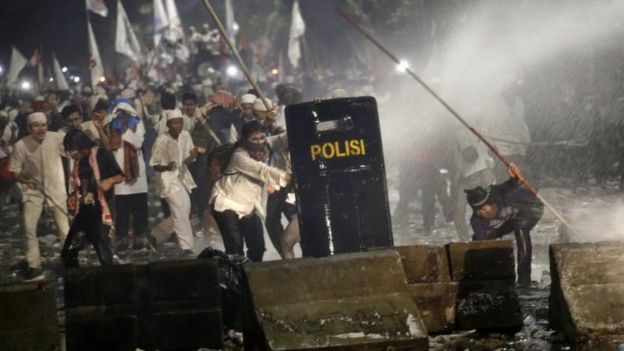
    Clashes broke out between police and protesters who refused to disperse.

    One elderly man died, the Associated Press reports, citing police. Several other people, including police officers, have been injured.

    Protesters had earlier marched upon the presidential palace.

    Police had been braced for the possibility of religious and racial tensions erupting at the rally, which an estimated 50,000 people attended.

    It had mostly been peaceful but groups of angry demonstrators clashed with police after nightfall and set vehicles alight.

    In 1998, a wave of anti-Chinese sentiment led to mobs looting and burning Chinese-owned shops and houses. Ethnic Chinese make up about 1% of Indonesia’s population of 250 million people.

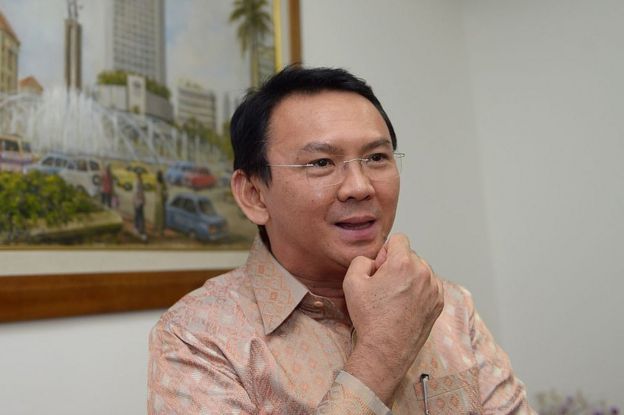
    Basuki Tjahaja Purnama, known by his nickname Ahok, speaks to journalists at his office in Jakarta in 2014
    Protesters are sprayed with water from a police water cannon truck during a clash outside the presidential palace in Jakarta, Indonesia, Friday, Nov. 4, 2016

    The protest was held to demand that Mr Purnama be prosecuted for blasphemy over comments he made in September that were seen as criticising a Koranic verse.

    He said that Islamic groups using a passage of the Koran to urge people not to support him were deceiving voters, who will go to the polls in February.

    The verse is interpreted by some as prohibiting Muslims from living under the leadership of a non-Muslim.

    Mr Purnama has since apologised but formal complaints were lodged against him by Islamic groups for defamation. He is now being investigated by police.

    Who is Governor Ahok?

    Some protesters at Friday’s rally carried signs calling for the governor’s death, the BBC’s Rebecca Henschke in Jakarta says.

    Representatives met with Vice-President Yusuf Kalla, who promised that the investigation into Mr Purnama would be completed within two weeks.

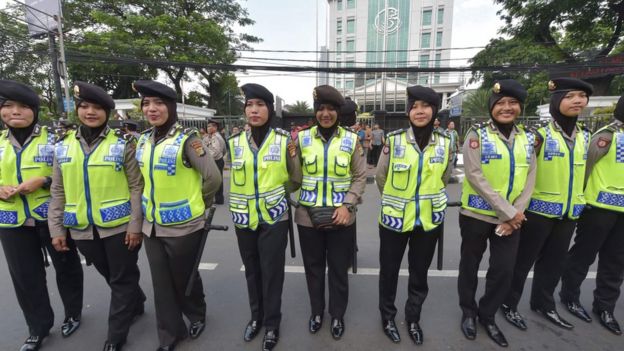
    Indonesian policewomen stand guard as Muslims march towards the presidential palace during a protest against Jakarta governor Basuki Tjahaja Purnama also known as Ahok over an alleged blasphemy in Jakarta on November 4, 2016

    There have long been tensions around Mr Purnama political role.

    In 2014, he was the deputy governor under Joko Widodo. When Mr Widodo was elected president the main group behind the current protest – Islamic Defenders Front (FPI) – did not want Mr Purnama to succeed him.

    They argued that a Christian should not govern a Muslim-majority city. The campaign against him has since taken on anti-Chinese overtones, though the FPI said the rally was not about the governor being from a minority group.

    Jakarta police said there were “provocative statements and images” on social media urging people to take violent action against Mr Purnama, including calls to kill him.

    Despite being seen as brash and outspoken, the governor is popular among many in the capital and has been praised for his effectiveness.

    Muslims in Indonesia are largely moderate and the country’s largest Islamic organisation, Nahdlatul Ulama, had advised its 40 million members not to take part in the protest.


    Source: www.bbc.com

  • Challenges ahead for moderate Islam

    The Nahdatul Ulama and Muhamadiyah organisations will probably remain on their paths as modernist Muslim movements that address the challenges of modern Indonesia.

    INDONESIAN POLLS: Can the state forestall the proliferation of new radical groups that chip at the country’s plural and democratic culture?

    AS Indonesia heads to the polls next month, a range of political actors and parties have come to the fore to defend the country’s image and standing internationally, and to emphasise yet again the pressing need for Indonesia to defend its tolerant culture and beliefs.

    More than a decade ago, it was feared that Indonesia would have been swept towards a rising tide of exclusive communitarian thinking that seemed poised to spread across that vast country.

    Groups like the Laskar Jihad were waging what they regarded as a holy war against infidels, and Indonesia was hard-pressed to defend its reputation as a bastion of moderate Islamic thought and praxis.

    Yet, despite the fears of many, Indonesia has been able to maintain its own cultural-historical course, and it remains a country where normative religiosity has not been overwhelmed by the culture of violence.

    This is largely due to the important role played by the country’s mainstream Muslim organisations, notably the Nahdatul Ulama (NU) and the Muhamadiyah.

    Today, as we watch the election campaign intensify, it is interesting to note how groups like the NU and Muhama-diyah remain steadfast in their stand against all forms of religious communitarianism and intolerance.

    Take for instance the party-political TV ad for the Partai Kebangkitan Bangsa (PKB, National Awakening Party), which is the party-political offshoot of the NU.

    The PKB’s ad features prominent leaders of the party reminding the viewers that Indonesia is not “like other Muslim countries”, and that Indonesian Islam has evolved along its own trajectory and has its own local character.

    This is in keeping with the position taken by successive generations of the NU’s leadership, who have argued tirelessly that Southeast Asian Islam has to adapt to the realities of pluralism and diversity that is the norm in our part of the world.

    It reminds us of the slogan coined by the late leader of the NU, Abdurrahman Wahid, who spoke of Indonesian Islam as being warna-warni: complex and with many hues. Today, that legacy of pluralism and diversity is being defended still by the NU and its party, the PKB.

    The same can be said of the Muhamadiyah, that has been a reformist Islamic movement from the outset, and which has laid great emphasis on modern education, the sciences and a pragmatic approach to dealing with the question of diversity in culture and society.

    Both the NU and Muhamadiyah have created a vast network of think tanks, publishing houses, intellectual and activist circles, etc. to consolidate their hold on the country’s Muslims and to disseminate ideas related to their vision of a modern, dynamic Islam.

    Via bodies such as the LKiS research unit and publishing house and circles like the Jaringan Islam Muda Muhamadiyah (JIMM), the two mass movements have been defending Indonesian pluralism and diversity for decades.

    But Indonesia today is a very different country than what it was two decades ago, and gone are the days where the NU and Muhamadiyah could propagate their brand of religious and philosophical thinking without being challenged.

    In short, their view is no longer hegemonic and pervasive as it once was, and the reason for this lies in the erosion of state power as well as the opening up of public domains.

    Since 1998, the once-invincible Indonesian state, that was centralised with power in the hands of the political-military elite, has been challenged by new political actors and agents across the country. The demand for more decentralisation of power has led to the emergence of competing power-bases and sites of discussion, and also opened the way for the rise of many smaller, yet vocal and demanding Islamist groups across the country.

    Today, Indonesia’s Islamic arena is still dominated by the NU and Muhamadiyah, but it is being contested by groups as diverse as the Front Pembela Islam (FPI), the Hizb’ut Tahrir Indonesia (HTI) and even quasi-state bodies like the Majlis Ulama Indonesia (MUI) that has been busy issuing judgments on things as diverse as yoga and Facebook. As these new actors and agents enter the contested discursive arena, new debates are emerging and new concerns being raised.

    Here lies the concern of many Indonesia watchers who wish to see Indonesia remain a peaceful and diverse country, for these new groups present a different, if somewhat homogenous and monolithic vision of what Indonesia should be.

    Though they are small in number, their reach is greater thanks to the manner in which they have managed to capture the imagination of the young, poor, disenfranchised and the media. It is worrisome indeed when small groups of hardliners are given so much attention in the media, and when it is clear that such radical clusters have learned the art of media manipulation themselves. Over the past few years, these are the groups that have captured the headlines for their attacks on intellectuals, minorities and even other schools of Muslim thought.

    As long as the public arena remains an open one where any new actor can enter and enunciate a different — sometimes provocative — stand on issues, groups like these will continue to thrive. The NU and Muhamadiyah may be able to command the loyalty and support of more than 70 million Indonesians, but it has to be remembered that in predominantly Muslim Indonesia today, there are around 200 million Muslim minds to win over.

    So the question arises: Can Indonesia retain its reputation as the bastion of Muslim tolerance, pluralism and diversity?

    The answer lies as much in mathematics as it does in ethics, for in the final analysis it is numbers that count. The NU and Muhamadiyah can, and probably, will remain on their appointed paths as modernist Muslim movements that address the challenges of modern Indonesia.

    But if the state does not prevent or forestall the proliferation of the new radical groups that continue to chip at the country’s plural and democratic culture, this bastion, too, might fall in the future.

    With these factors in mind, the coming elections in Indonesia will serve as a useful barometer of public sentiment and Muslim sensibilities, and so once again, I state the obvious: Indonesia’s coming elections are important not only for that country, but for the region and the Muslim world as well.

    Written by Farish Noor

    Source: New Straits Times