An Ang Mo Kio GRC resident found a political flyer promoting PAP candidate Intan on his car’s windshield this morning at the carpark next to 542b serangoon north Ave 3.
The resident called his area’s Residents’ Committee (RC) up to question if this is legal but the RC members denied responsibility and claimed they are under the People’s Association (PA) and not under the PAP. The RC members then referred him to contact the PAP but added that the PAP candidate Intan will not have time to talk to him.
PAP candidate for AMK GRC Intan has also ignored his messages over Facebook.
1. Priority given to foreigners with Singaporean spouse and children for citizenship
WP believes that the best way to integrate immigrants is through the family unit and not through importing foreign labour who have no roots in Singapore. Singaporeans with a non-citizen spouse often face disruptions to their family life which creates stress and anxiety for the child when they have to separate from one parent who is on a short-term visit pass. Giving foreign spouses priority for citizenship after 5 years on the long-term visit pass will help alleviate the situation for this group of people.
WP also suggests that other than foreign spouses, only permanent residents with at least 5 years of uninterrupted residencey should be eligle for citizenship.
2. Mandatory unemployment insurance
WP proposes a employment security fund which requires both employers and employees to share a 0.1% contribution of the basic salary towards the scheme. In the event on voluntary unemployment, the fund will pay out 40% of your last drawn salary up to a monthly salary cap of the prevailing median wage for the next 6 months.
3. Holistic and equitable education system
WP proposes a 10 year through-train program where high stakes exams will be dropped and children will only take their first exam at 16 years of age. This will allow them to learn at their own pace and develop other skills and interests. Class sizes will also be reduced for teachers to dedicate more time and attention on each individual student. The government will also put in $10K into the CDA account of all parents instead of the current dollar-for-dollar matching practise.
4. Making public housing more affordable
WP proposes that the prices of HDB to be de-linked from land cost which means that BTO flats prices will be reduced drastically. They suggest that the price of BTO flats be 25% of the median monthly household income of applicants serving a 20 year loan after a 10% downpayment. There will also be discounts for lower income applicants of 2 and 3 room flats.
WP also suggests that ethnic quotas for housing to be removed so that Singaporeans have the freedom to choose their homes regardless of race, language or religion.
5. Abolish the ISA and CLTP Act
WP believes that there should be more trust-building and due process in our criminal justice system. They call for the abolishment of Criminal Law Temporary Provision and the Internal Security Act, both of which provides for detention without trial. CLTP is targeted at drug lords, ah long san and criminal gang leaders while ISA is for terrorist cases and spies. To tackle the problem of terrorism, a dedicated anti-terrorism law should be enabled so that the authorities can make swift arrests and detain suspects without trial.
Minister for the Environment and Water Resources Vivian Balakrishnan likened Singaporeans’ relationship with the People’s Action Party (PAP), forged 50 years ago, to a marriage.
“Relationships have ups and downs. Sometimes, you even need to fight.
“The point… is, a relationship is not a one-night stand. It’s not just finding the mostINTERESTING, the most entertaining partner, but about someone who you are going to spend another 50 years or more (with),” he said.
His PAP team is contesting the Holland-Bukit TimahGROUPrepresentation constituency (GRC) against a Singapore Democratic Party (SDP) team led by party chief Dr Chee Soon Juan.
Dr Balakrishnan said at a rally at Commonwealth Avenue last night that the PAP hadEARNED the trust of Singaporeans through the long relationship.
But along the way in this “marriage”, a third party will try to barge in.
“Let’s be honest. There will always be opportunities.
“How do third parties come in? They come in when they sense the relationship is not close… not strong or when there are issues that are not yet resolved,” he said.
The opposition, he said, will campaign on the basis of the politics of anger, envy, jealousy and class division.
“But actually what they are trying to do is barge into our home.”
The relationship isn’t always glamorous.
“Many opposition politicians look down on PAP politicians for spending so much time on the ground, for knocking on your doors humbly, for looking at drains,CHASING rat burrows, getting rid of mosquitoes,” he said.
But the PAP does it so people will know the party is there for them, Dr Balakrishnan said.
“We do all these things because of a relationship. Because I want you to know that I’m there for you. That I will look after you, protect your children, that I’llINVEST (in) and build your neighbourhoods,” he said.
He said the party has built a relationship based on trust.
‘IT’S ABOUT TRUST’
“People knew whether we did the popular or unpopular thing… we did it with you, for you and for Singapore. It’s not just a slogan. It’s really about trust,” he said.
And that includes designing a system unique to Singapore to help those who need it most.
Describing Singapore as having one of the fastest ageing population, coupled with one of the fastest shrinking population, he said the Government had to consider a model that would best serve the differentGROUPS.
For example, the welfare state model from Western countries provides universal benefits but at the cost of highTAXES.
Such a systemWORKS if the population and its people’s wages are growing, and if the middle class are able to afford the high tax rates, he said.
But when a population is ageing and is expected to shrink in theFUTURE, the system will fail, he said, adding that Japan was one such example.
Singapore, on the other hand, works on its own model, built on the basis of personal and family responsibility, savings, living within our means, having insurance and subsidies targeted for the needy.
“The value of our Singapore model, which is unique, is that we can make sure the people who need help receive help, we don’t run out ofMONEY and the reserves are not raided.
“For the Pioneer Generation, $8 billion put aside, we didn’t pass the bill to the children. We took it straightaway (from the) present budget, settled andACCOUNTED for,” he said.
The point… is, a relationship is not a one-night stand. It’s not just finding the mostINTERESTING, the most entertaining partner, but about someone who you are going to spend another 50 years or more (with).
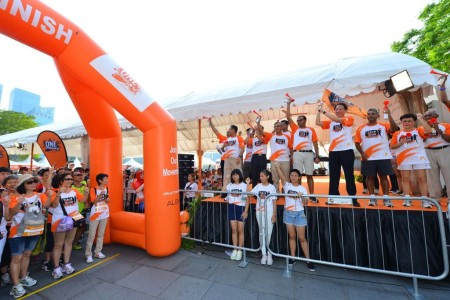
At the sidelines of the Orange Ribbon Run 2015 that marked 50 years of racial harmony in Singapore, Chairman of OnePeople.sg, Dr Janil Puthucheary shared with Popspoken that he feels racial harmony in Singapore is “really quite exceptional” but “is not something to be taken for granted”. A whopping 7,000 people participated in the third edition of the Orange Ribbon Run – an event organized by OnePeople,sg, a national body that promotes multiracialism in Singapore. The event saw the support of Team Singapore athletes including former Olympian, Mr. C. Kunalan, SEA Games 2015 athletes and players from the Football Association of Singapore.
When we probed further on how racial harmony could be promoted, Dr Janil replied, “There’s no one single approach… We organise different types of dialogues, debates and discussions about the issues of racial harmony, religious harmony and moving beyond this, tolerance and trust is our mission. So we are talking about it. We are talking about it, and we are encouraging people to think about it and to believe that this is something worth fighting for, worth standing for.”
On how rising racial tensions in neighbouring Malaysia affecting Singapore, Dr Janil noted, “Well, you know, our political structure in Singapore is such that we can’t play racial politics. That was something that was set up in 1965, very deliberately. And I think it’s something most Singaporeans – almost, I believe, all Singaporeans – believe it’s a strength that we have in our nation. That people are not going to get support if they try to feed into racial anxieties, if they try to stir up racial tensions, and it amounts to some degree of agitation.” He believes that our political structure is mature enough to move away from a model of having to “appeal to, engage with, and serve the broad middle ground of most Singaporeans, if not all Singaporeans.”
We all share a common humanity: DPM Teo
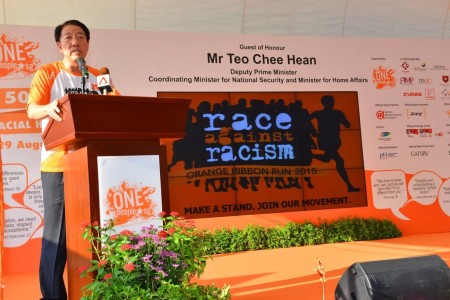
Mr Teo Chee Hean, Deputy Prime Minister (DPM) and Coordinating Minister for National Security and Minister for Home Affairs graced the event.In his speech, heCREDITED the government for progress made in the sphere of racial harmony.
He touched upon the government’s success of deliberate policy making (e.g. bilingualism, common education system, integrated housing, fairness in the workplace etc), which has succesfully resulted in cohesively integrating people from different backgrounds.
DPM Teo also rallied the crowd to open their hearts and minds, and come together as one people. He believes that reaching out to another to understand someone better, will definitely bring people closer together. At the same time, he cautioned against people with their own “agendas” who try to “accentuate” differences.
Everyone sharing a ‘common humanity’,was to him, something worthwhile to celebrate. It is hence imperative for us to think about how we can enlarge the existing areas we have in common “and not allow anyone who wants to accentuate differences to succeed in dividing us,” said DPM Teo.
The People’s Action Party (PAP) has often said that it believes multi-party democracy would be bad for Singapore.
This is an untenable position.
In the past 150 years, several societies, primarily in the West, have flourished and developed under systems of multi-party democracy. To argue categorically that Singaporeans should not vote in an alternative party because it will hurt us, is an argument that would hold no water with many.
ST ILLUSTRATION: MIEL
Conversely, the opposition has argued that single-party dominance would be bad for the future of Singapore, and diverse voices are needed to bring us forward. This argument, being the mirror image of the PAP’s, is just as faulty. First, Singapore made the greatest leaps in development and quality of life during PAP’s complete political dominance under Mr Lee Kuan Yew. Second, in the global arena, one-party China beats multi-party democracy India on mostINDICATORS of human and economic development.
The fact of the matter is that the truth lies somewhere in between. There are multi-party democracies that work, and there are those that are paralysed by competitive politics. There are single-partyGOVERNMENTS that are ridden by corruption and who cause misery to their people, and there are competent ones that are able to implement visionary long-term policies without being blocked at every juncture.
The bestFORM of government is, at the end of the day, the one that works.
As Singaporeans go to the polls on Friday, dogma and ideology should not hinder us from making the right decision.
The overarching issue in the campaigning hitherto – which encompasses all others such as immigration, cost of living, healthcare, education and so forth – is whether the electorate should vote in more opposition into Parliament as alternative voices, and as a check on the PAP.
And, bearing in mind the preceding arguments, the answer is clear: we should do so, only if the Opposition is good. Having Opposition for the sake of opposing voices would be exactly the kind of dogma we seek to avoid.
But what, then, makes a good Opposition?
ESTATE MANAGERS OR LEGISLATORS?
Crucial to this question is what a Member of Parliament (MP) is meant to do, another debate that has been ongoing. And again the debate has been framed in a simplisticBINARY fashion thus far: should MPs be town council managers or parliamentary legislators?
The answer is obviously both.
First, an MP needs to show that he has the ability and integrity to manage a town council well. A town council is set up as a microcosm of the issues that a country at large faces. At the heart of it is the allocation of financial and other resources to maintain housing estates, upgrade them, disburse grants to needier constituents and manage other day-to-day operations of the constituency.
It is boring and mundane, but absolutely vital to keep a town running. Likewise, it is also these nitty-gritties that keep a country running, not grand speeches and rhetoric.
And that is why the town council issue, as confusing and grating as it may be for laymen, is so important.
If you can’t run a town, how can you run a country?
QUALITY OVER QUANTITY
Second, as many have rightly pointed out, MPs must also perform in Parliament. However, the debate on this has also been simplistic.
Several websites have compiled lists of the number of times MPs have spoken and have asked voters to make a judgment based on that. The Workers’ Party has also pointed to its parliamentary record of asking the most questions over the highest number of sittings.
This is valuing quantity over quality.
It is not the number of parliamentary questions one files but the impact one makes on the legislative agenda that counts. It is what one says that is important, not the number of times one speaks up.
A case in point is former Nominated Member of Parliament Walter Woon, who, by getting the Maintenance of Parents ActPASSED, arguably made even more impact in the history of Parliament than most PAP backbenchers.
If the Workers’ Party retains or increases its presence in Parliament, I hope its MPs will file full motions to debate matters of national importance they have championed during campaigning, such as minimum wage and the nationalisation of public transport, instead of filing hundreds of parliamentary questions that nobody remembers. Or, worse, engaging in fiery speeches that, in the end, results only in minor policy tweaks to the ruling party’s, is not only counterproductive but makes a mockery of being an Opposition MP.
This Polling Day, Singapore is at a crossroad. Many of us are not against the establishment of a good, credible Opposition that can contribute to nation-building. What we do not want is a fixation on numbers, that we have to have more Opposition MPs regardless of who they are and what they stand for. Such dogma would only be detrimental to Singapore.