Tag: GE2015

  • Tommy Koh: 10 Reflections On GE2015

    Tommy Koh: 10 Reflections On GE2015

    On Cooling-off Day, a good friend invited me to lunch with a group of eminent Singaporeans. I decided to use them as a focus group and asked them to predict whether the PAP’s popular vote would go up or down.

    The majority said it would go down. I asked them whether the PAP would lose any more seats to the opposition. The majority predicted that the PAP would lose one group representation constituency (GRC) and one single-member constituency (SMC).

    Like the pundits and the bookies, my friends at lunch were wrong in their prognosis. The following are 10 of my reflections on the People’s Action Party’s surprising and extraordinary victory.

    SG50

    First, 2015 is not an ordinary year. It is our Golden Jubilee year. Singaporeans from all walks of life, and of different political persuasions, are very proud of what we have achieved in the past 50 years.

    ST ILLUSTRATION: MIEL


    The SG50 Steering Committee has adopted a low-key, bottoms-up and people-centric approach to the year-long celebrations. The positive mood was boosted by the excellent performance of our athletes at the SEA Games, and by the conferment of World Heritage status on our beloved Botanic Gardens by Unesco.

    Anyone who attended the National Day Parade would have been inspired by the pride, patriotism and unity of the occasion. I am sure that SG50 increased the popularity of the PAP at the polls.

    THE LEE KUAN YEW FACTOR

    Second, I think that the Lee Kuan Yew factor played a part in the electoral success of the PAP. Mr Lee’s passing triggered a spontaneous outpouring of love and respect for him by Singaporeans. The people of Singapore acknowledged that the success of Singapore was due, in large part, to the vision, courage and determination of Mr Lee and the other founding fathers.

    I am sure that some of the goodwill for Mr Lee was transferred to the political party that he founded and led. The combination of the first and second factors made 2015 an exceptionally good year for the PAP. Tactically, Prime Minister Lee Hsien Loong was right to hold the election this year, instead of next year.

    FEAR OF A FREAK ELECTION

    Third, the opposition made a big mistake in contesting all 89 seats in Parliament. Although many of the candidates, from parties other than the Workers’ Party (WP) and the Singapore Democratic Party (SDP), had no prospect of winning, the fact that all seats were contested made it possible for the PAP to warn against a freak election.

    The bottom line is that, while the electorate wants a credible, constructive and responsible opposition in Parliament, it also wants the PAP to continue to form the government. If the opposition had been wiser, it would have refrained from contesting 45 of the 89 seats so that, on Nomination Day, the PAP would have won enough seats to form the government. In such a scenario, the electorate would have been more at ease in voting for good opposition candidates.

    THE SILVER VOTE

    Fourth, since 2011, the Government has done several very significant things to win the hearts and minds of senior citizens. The Pioneer Generation Package, MediShield Life, and the Silver Support Scheme have been very well received. The belated recognition of the pioneers and their contributions to Singapore has touched the hearts of many older Singaporeans.

    The SG50 Steering Committee has adopted a low-key, bottoms-up and people-centric approach to the year-long celebrations… I am sure that SG50 increased the popularity of the PAP at the polls.

    My hypothesis is that the majority of the half a million voters, over the age of 65, would have voted for the PAP.

    REMEDYING THE PAIN POINTS

    Fifth, the PAP has brought relief to three of the pain points that emerged in the 2011 General Election. These are housing, immigration and transport. National Development Minister Khaw Boon Wan has increased the supply of public housing, and cooled the overheated property market.

    The Government has also reduced the intake of foreign workers. Transport Minister Lui Tuck Yew worked very hard on both the bus system and the MRT system. He has brought relief to the bus system. The problem of the frequent breakdown of our train system has, however, not yet been solved, in spite of his best efforts.

    On the three pain points, the PAP has brought relief to two-and-a-half of them. The electorate, which is fair-minded, has therefore decided to reward the PAP for having listened to its concerns and for responding to them.

    THE CHALLENGE OF INEQUALITY

    Sixth, the PAP has also responded to the growing concerns about inequality in Singapore. It has introduced schemes like Workfare and the Progressive Wage Model.

    It has opened two schools for students who failed their Primary School Leaving Examination, or PSLE. It has upgraded the quality of technical and vocational education offered by our Institute of Technical Education. It has introduced a new educational initiative called SkillsFuture, based on the successful apprenticeship system in Germany and Switzerland. It has expanded its support for early education.

    It has also reassured the public that social mobility is well, and stronger, in Singapore than in Europe and America. Therefore, although Singapore continues to be a very unequal society, and life is hard for the bottom 30 per cent of our population, the Government was given credit by the electorate for the many initiatives it has taken to address the problem.

    CREDIBILITY OF THE WORKERS’ PARTY

    Seventh, the ascendance of the WP was seriously affected by the PAP’s allegation that it had mismanaged the Aljunied-Hougang-Punggol East Town Council, and that it had exposed an integrity issue.

    Although the WP rebutted the PAP’s allegation and had, in turn, accused the PAP of bullying and using the town council system to impede the progress of the opposition, the exchange left some voters in doubt about the competence and integrity of the WP. This factor could have explained the loss of Punggol East, the drop in the support for the WP in Hougang and Aljunied GRC, and its failure to capture East Coast GRC and Fengshan SMC.

    Going forward, it is important for the WP to clear its name, and to restore the electorate’s faith in its competence and integrity.

    PAP’S ELECTORAL STRATEGY

    Eighth, the PAP did a better job managing the electoral campaign this year than in 2011.

    PAP organising secretary Ng Eng Hen proved to be a capable campaign manager. Although the PAP was outgunned by the opposition in the staging of rallies, it devoted more manpower and resources to door-to-door campaigning and retail diplomacy. The party also decided to capitalise on the popularity of PM Lee by putting up his poster in every constituency.

    It was like a referendum on him, and it could have backfired. Fortunately for the PAP, the strategy seemed to have paid off.

    AN INSECURE WORLD

    Ninth, the sentiments of the electorate have always been affected by the external environment. The 2001 GE is a case in point.

    Following the Sept 11 terrorist attacks in the United States, the electorate rallied to the PAP, which has a good track record of keeping peace at home, and a strong defence against any external threat. In that election, the PAP’s popular vote was 75.3 per cent.

    In this election, the PAP’s narrative about the terrorist threat from ISIS and the uncertain global economy worked to its advantage.

    VOICE OF REASON

    Tenth, I am glad that the PAP leader whose team scored the highest popular vote of 79 per cent was Deputy Prime Minister and Finance Minister Tharman Shanmugaratnam. He was always calm and measured.

    He never uttered an insult or a threat.

    Instead, he explained the PAP’s policies and rebutted the alternatives put forward by the opposition in a clear and rational way. He was intellectually brilliant but came across as humble and open-minded.

    I hope other politicians would seek to emulate him.

    • The writer is a Special Adviser at the Institute of Policy Studies, Lee Kuan Yew School of Public Policy, National University of Singapore.


    Source: www.straitstimes.com

  • PAP Voter: I Did Not Vote PAP Out Of Fear

    PAP Voter: I Did Not Vote PAP Out Of Fear

    To the oppies,

    I did not vote for PAP out of fear. I voted for PAP because your ideas did not take into account of global trends.

    I did not vote for PAP thinking they can resolve the problems of the world, I do expect them to make the transition more painless for Singaporeans.

    If Foreign Talent is to get the job, at least allocate enough money for Singaporeans to upgrade their skills so that they can remain competitive.

    I did not vote for PAP because I liked them, I voted for PAP because I think for now they can do the job best. The rest just talk (and anyone can do that).

    In fact, I feel that Worker’s Party fashion sense seems to be better. At least there are some colours. White shirts easy to get dirty, hard to maintain.

    I am aware that our government may have lost some money in some investment, but I think that is part of the game of investment.

    As long as the investment is not lost through dishonesty but through inevitable global / market / business trends, I am fine.

    I don’t think I deserve to receive any part of the reserves, I am just wondering why do the oppies feel so dignified and justified that they deserve our reserves.

    The reserves (through our fixed asset) should be used for the betterment of our country, provide infrastructural framework for our learning, leisure & work.

    I feel very amused that the oppies say that the whole country is against 6.9 million white paper, but I am very happy with the white paper.

    There are people who say I am happy with the white paper because I am a businessman and will benefit by having more customers in the country.

    Actually that is true as well, but what is more true is that with more population, it will drive business cost down, and some business will provide services / products affordably to the less well off segment.

    With no big population to support businesses, no businesses can afford to help the poor. The oppies are understanding this so so wrong.

    It is true that higher population will drive certain segment’s goods prices up, but it will also drive certain products and services’ prices down as well.

    Higher population is good for the poor.

    The oppies, think again of those people voting for the white uniformed PAP. It is not because we are upper class and want to maintain our edge over the poorer half of the population.

    We are voting for PAP because it will take care of the whole country. The oppies need to polish up their plans.

    And don’t get me started on the CPF problem. Yes, it is true that the government is increasing the age to withdraw CPF, and there is a logical reason to it, we are living longer.

    Also, as a funding guy, I have seen millions of dollars or hundreds of thousands at one shot. Most people in the working class has never held 100-200k in their hands before, what do you think would happen when they hold that amount of money?

    The money would be squandered. Cheated by some younger women / men. The country is doing you a favour by safeguarding for you.

    If you know how to handle the finance, the minimum sum of 100+ K is not going to make a difference to your lifestyle. If you do not know how to handle finance, then the 100+ K is better off safeguarded by the government of Singapore.

    Thanks.

    Yours Loyally,

    Source: Raymond Ng

  • Quad Research – We Predicted GE2015 Outcome

    Quad Research – We Predicted GE2015 Outcome

    This article originally appeared on Vulcan Post

    At the end of a battle when all is won and lost, and some forsaken along the way, there will always be someone who will come out and say, I told you so. The battle in question here is the recent GeneralSwinging Votes Elections 2015, and the I told you so isthe power of research.

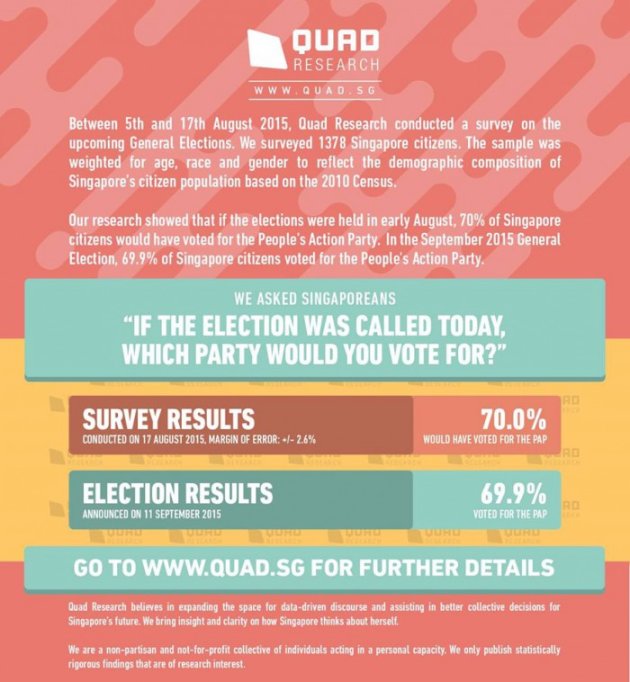
    I mean, there’s going to be a vast difference between the armchair critic and hard, solid facts obtained by the most honourable and also time-consuming method: actual cold hard field research — somethingQuad Research champions. Regular political pundits were generally unable to pick up on the vote swing and pre-election predictions were all proven wrong with the results. But it was Quad who somehow, from the skirmish, had the evidence to show that this was the expected result of the elections.

    Image Credit: Quad.sg

    Quad Research believes in expanding the space for data-driven discourse, and assisting in better collective decisions for Singapore’s future. According to them, they are a non-partisan and not-for-profit collective of individuals acting in a personal capacity who only publish “statistically rigorous findings that are of research interest.”

    So between August 5 and August 17 — a good month before election fever began, Quad Research conducted a survey on the upcoming General Elections to measure Singaporeans’ perceptions on the issues that matter to them and how this affects their political choices.

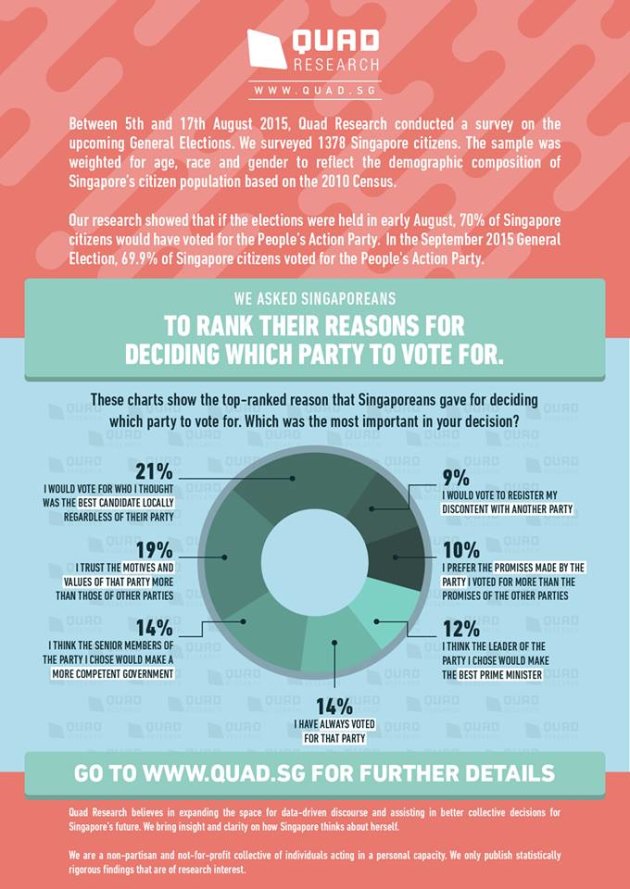
    Among their findings in election and party matters, they discovered that:

    • Opposition supporters might be likely to vote for other opposition parties if their preferred party was absent
    • Best local candidate‘ (in each SMC/GRC) mattered most in candidate choice, especially for opposition supporters
    • PAP voters are more concerned with party loyalty and government quality
    • PAP supporters’ voting motivations tend to mirror Conservative voters, while Opposition supporters’ motivations tend to mirror Labour voters

    Image Credit: Quad.sg

    Moving on from party talk, Quad also found that while a slight majority of Singaporeans think that Singapore is meritocratic, there may be evidence that social mobility is slowing in the country, especially for those in the lower and middle classes. Interesting.

    What else is interesting is that Singaporeans perceive our rate of unemployment to be higher than it actually is. How many of you thought it was at least 20%? Real talk — it’s only 2.6%.

    If you’re up for some lunchtime reading, power up with some factual knowledge via Quad Research. You might even find yourself somewhere in the statistics. Happy reading!

    Source: https://sg.news.yahoo.com

  • Lee Li Lian: Why I Rejected NCMP Role

    Lee Li Lian: Why I Rejected NCMP Role

    I was in Parliament this afternoon to clear my cupboard. This particular book was especially memorable. I delivered my maiden speech on this and although there were butterflies in my stomach, I was glad that I was able to speak up on this topic.

    I went to the library to thank the staff who were always so patient with each and everyone of us smile emoticon I had to once again explain my decision not to take up the NCMP role. I hope residents of PE can understand my decision. I would like to thank ELD for the NCMP appointment, however I will not be accepting it.

    Thank you to everyone who has encouraged me on and have shared your disappointment with this decision. I wish to explain my reasons:

    1. Respecting the electoral process and the voters’ choice.
    I’ve done my part in Parliament in the 2.5 years. Residents have seen the issues that I have raised in this period,and we have shared my parliamentary work as part of our door-to-door outreach during GE2015 to every household except Rivervale Crest (Condominium) which we have no access to.

    Majority of the voters in Punggol East decided to not give me the mandate after 2.5 years, and we must respect this. The NCMP role is better suited for an aspiring MP who has no such experience and should take this up to show how he/ she can contribute in Parliament.

    2. Being Fair
    In 2013, after I was elected. I resigned from my job to become a full time MP. The reason for doing so was to be fair to both my residents and employer with my commitment of time. If I were to take on the NCMP role, the commitment in Parliament is quite similar to a full fledged MP.

    However, unlike for an MP, it is not possible to be a full time NCMP. It will not be fair to my future employer to take leave from work every month. During budget debates, for example, you need to be away from work for at least 2 weeks.

    3. WP has many good candidates.
    Hopefully with my decision, Parliament can allow one more from East Coast GRC to be appointed as NCMP. This gives a chance to our other aspiring MPs to show the people what they can do in terms of speaking up for them.

    In addition, I would like to spend some time now with my family, who has supported me throughout this journey but have also missed my presence in their lives. I had my first child while being an MP, and while I do not have any regrets, I did miss out on key moments in her life as I walked the ground in Punggol East.

    Although I did not take up the seat, I will continue to contribute to society and to Singapore. I will continue to keep in touch with PE residents. I have made many friends there, including those that wept for me. I will also continue to support and make my contributions to the Workers’ Party.

    I left Parliament with a heavy heart and the hazy weather reflects my feelings. It has been a fantastic 2.5 years.

    The election is over and results are final. Let us move on as a country and may all new MPs enjoy the process as much as I did.


    Source: Lee Li Lian 李丽连

  • Workers’ Party: Daniel Goh Will Take Up NCMP Position Vacated By Lee Li Lian

    Workers’ Party: Daniel Goh Will Take Up NCMP Position Vacated By Lee Li Lian

    The Workers’ Party’s Central Executive Council (CEC) met on 15 September 2015 to discuss the Non-constituency Member of Parliament (NCMP) seats offered to our candidates for General Election 2015.

    As six Workers’ Party candidates have been elected to Parliament in General Election 2015, the law allows for the three candidates who received the highest votes amongst the unelected candidates from Opposition political parties to be declared elected as NCMPs. These three candidates are Ms Lee Li Lian who contested in Punggol East SMC, Mr Dennis Tan Lip Fong who contested in Fengshan SMC, and one candidate from the team which contested in East Coast GRC.

    The CEC concurred with Ms Lee Li Lian’s decision not to accept the NCMP position and with Mr Dennis Tan’s decision to accept the NCMP position.

    The CEC decided to nominate Mr Leon Perera from the East Coast GRC team to take up the NCMP position and, should Parliament resolve to fill the vacated NCMP seat left by Ms Lee, that Associate Professor Daniel Goh Pei Siong would fill that seat.

    THE WORKERS’ PARTY
    16 September 2015


    Source: http://www.wp.sg