Tag: GRCs

  • Flashback 1988: Definition of Malay Was Debated In Parliament (In The Context Of GRC System)

    Flashback 1988: Definition of Malay Was Debated In Parliament (In The Context Of GRC System)

    The issue on the definition of Malay was debated earlier in Parliament (in the context of the GRC system) back in 1988.

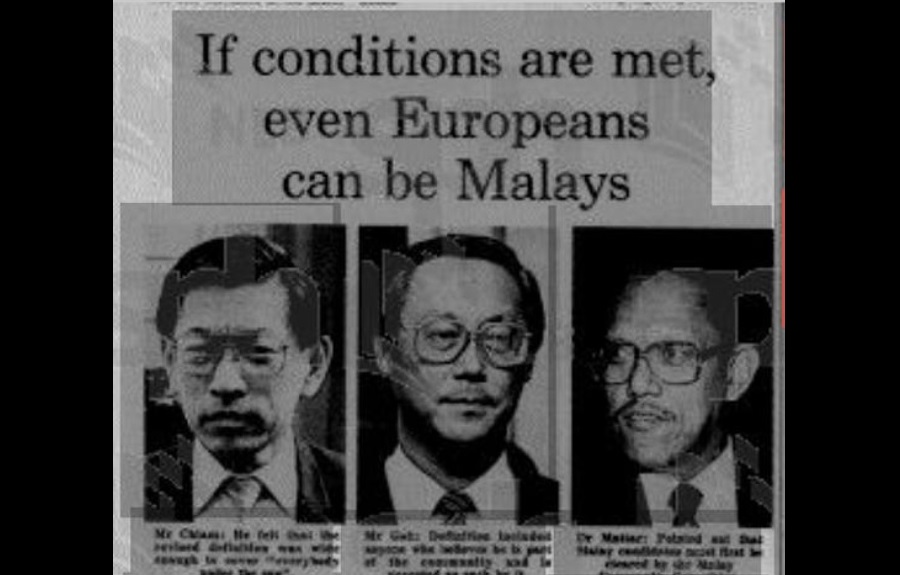
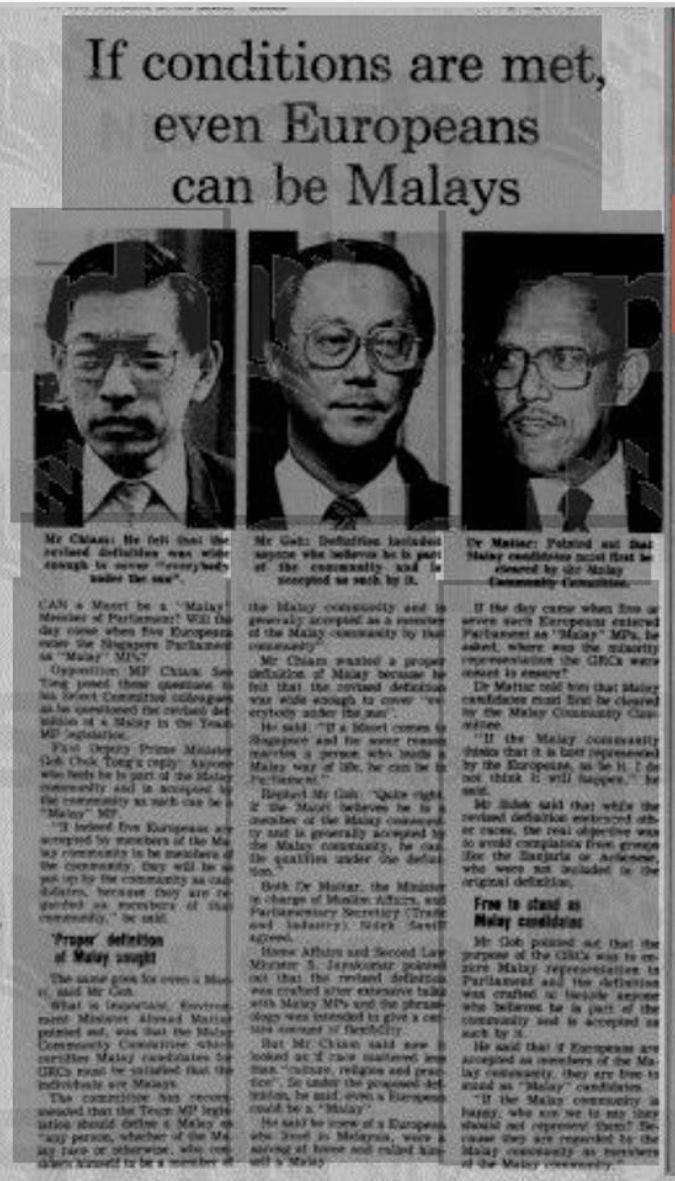
    It was an exchange involving Goh Chok Tong, Chiam See Tong and Ahmad Mattar.


    Part of the excerpt read;

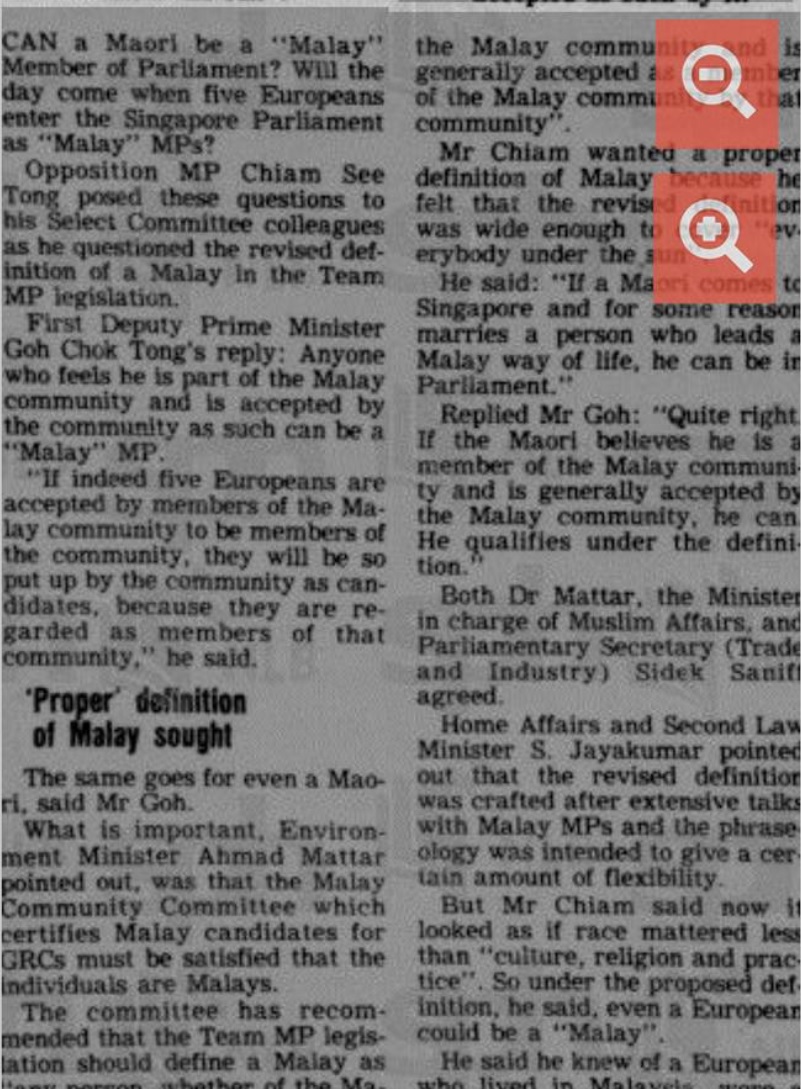
    Can a Maori be a “Malay” Member of Parliament? Will the day come when five Europeans enter the Singapore Parliament as “Malay” MPs?

    Opposition MP Chiam See Tong posed these questions to his Select Committee colleagues as he questioned the revised definition of a Malay in the Team MP legislation.

    First Deputy Prime Minister Goh Chok Tong’s reply: Anyone who feels he is part of the Malay community and is accepted by the community as such can be a “Malay” MP.

    “If indeed five Europeans are accepted by members of the Malay community to be members of the community, they will be so put up by the community as candidates, because they are regarded as members of that community,” he said.

    The same goes for even a Maori, said Mr Goh.


    In another part;

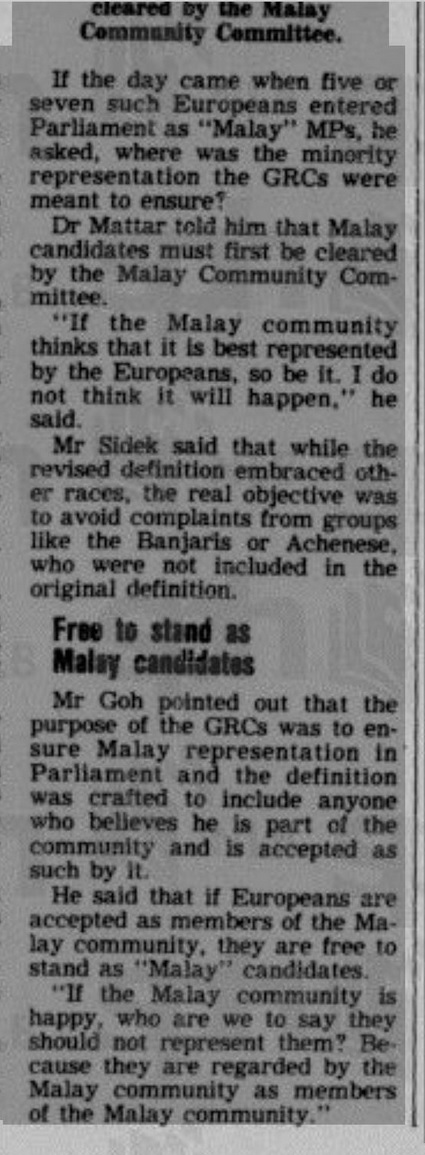
    If the day came when five or seven such Europeans entered Parliament as “Malay” MPs, he asked, where was the minority representation the GRCs were meant to ensure?

    Dr Mattar told him that Malay candidates must first be cleared by the Malay Community Committee.

    “If the Malay community thinks that it is best represented by the Europeans, so be it. I do not think it will happen,” he said.

    Mr Sidek said that while the revised definition embraced other races, the real objectives was to avoid complaints from groups like the Banjaris or Achenese, who were not included in the original definition.


    Also;

    Mr Goh pointed out that the purpose of the GRCs was to ensure Malay representation in Parliament and the definition was crafted to include anyone who believes he is part of the community and is accepted as such by it.

    He said that if Europeans are accepted as members of the Malay community, they are free to stand as “Malay” candidates.

    “If the Malay community is happy, who are we to say they should not represent them? Because they are regarded by the Malay community as members of the Malay community.”


    Source: Abdul Rohim Sarip
  • Electoral Boundaries Report: Two New GRCs But Moulmein-Kallang Carved Up

    Electoral Boundaries Report: Two New GRCs But Moulmein-Kallang Carved Up

    Of the 16 Group Representation Constituencies recommended by the Electoral Boundaries Review Committee (EBRC), two did not exist in the 2011 General Election, while Moulmein-Kallang GRC will be dropped in the upcoming GE.

    According to the report released on Friday (Jul 24), the new GRCs are Marsiling-Yew Tee, a four-member GRC mainly carved out of what used to be Sembawang and Chua Chu Kang GRCs, and Jalan Besar, a GRC which has re-emerged after being dissolved ahead of the 2011 polls.

    Moulmein-Kallang GRC – which currently includes two Cabinet Ministers, Dr Yaacob Ibrahim and Mr Lui Tuck Yew, as well as Ms Denise Phua and Mr Edwin Tong – has been dissolved, with the area now forming parts of Holland-Bukit Timah, Bishan-Toa Payoh, Tanjong Pagar and Jalan Besar GRCs.

    Prime Minister Lee Hsien Loong had previous requested that the “average size of the GRCs be reduced to below five”. Accordingly, there are now 8 five-member GRCs from 11 previously, with Chua Chu Kang, East Coast and West Coast all now four-member GRCs. The number of four-member GRCs increased this year to 6 from 2 in 2011.

    Ang Mo Kio and Pasir Ris-Punggol remain the only 2 six-member GRCs. Both have more voters each than in 2011, with Ang Mo Kio still the largest constituency by population with 187,652 voters, up from 178,933 before.

    The total number of voters has increased from 2,349,091 in 2011 to 2,460,977 currently.


    Source: www.channelnewsasia.com

  • Lee Hsien Loong: Electoral Boundaries Committe Formed Two Months Ago

    Lee Hsien Loong: Electoral Boundaries Committe Formed Two Months Ago

    The committee that reviews electoral boundaries was formed two months ago, a sign that the general election is round the corner.

    Prime Minister Lee Hsien Loong announced the formation of the Electoral Boundaries Review Committee on Monday, in response to questions in Parliament.

    The forming of the committee, which redraws constituency boundaries ahead of a general election, is the first formal step towards calling a GE.

    Leading up to the polls in 2006 and 2011, the committee had taken four months to do its work before issuing its report.

    While there is no fixed date for the election to be called after the report is submitted, it has taken as short as one day and as long as one month and 26 days in the past.

    Mr Lee told the House that he had asked the Committee in its review to consider the population shifts and housing developments since the last boundary delineation exercise.

    He also asked them to consider having smaller group representation constituencies, so as to reduce the average size of such constituencies to below five members, and have at least 12 single member constituencies. There are currently 15 group representation constituencies and 12 single-seat constituencies.

    “As per past practice, the Committee is chaired by the Secretary to Prime Minister. It is now in the midst of its deliberations and will make its recommendations to me when it is ready,” said Mr Lee.

    He was responding to questions from People’s Action Party MP Arthur Fong (West Coast GRC) and Non-Constituency MP Yee Jenn Jong of the Workers’ Party on whether the committee has been formed.

    Mr Lee added that he could not promise a minimum period between the publication of the report and the calling of a general election, which Mr Yee had asked for.

    The reason is that “it depends very much on the exigencies of the situation, and … on when elections become necessary,” said the Prime Minister.

    The committee’s work is to split or shrink group representation constituencies, and absorb or create more single-member constituencies, based largely on population shifts.

    It is appointed by the Prime Minister and is usually made up of five civil servants.

    Mr Yee had asked if the committee’s members can be drawn from various political parties as well, as it was done before Singapore became independent.

    Mr Lee said the committee has, for many years, comprised civil servants with experience and domain knowledge.

    This allows them to make considered decisions on how to divide up the constituencies, taking into account population shifts and housing developments in Singapore, and prevents “complete upheaval” each time the boundaries are redrawn, he added.

    “As for bringing political parties in, I’m not sure that’s an entirely good idea,” he said, adding that this is the practice in the United States.

    In America, members of the House of Representatives decide on the demarcation of electoral boundaries, said Mr Lee, and “what happens is they carve it up among themselves”.

    “It’s a political deal. I think that’s not a good arrangement. I think it’s best we leave this to the civil servants to work at,” he added.

    Furthermore, Mr Lee said that he would leave the committee to decide whether it would open its meeting minutes to the public, as Mr Yee had requested.

    But he added: “I don’t believe that it is helpful to have every twist and turn in the minutes reported and published. I think the committee’s report is the final word.”

    After the committee’s report is released, Parliament is dissolved and the writ of election issued. Nomination Day – which must take place no earlier than five days and no later than one month after the writ is issued – then signals the start of the campaign period, leading up to Polling Day.

    This process took between two and seven months in the past GEs.


    Source: www.straitstimes.com

deneme bonusu