Tag: GST

  • Case Of Overcharging At Yong Tau Foo Stall In Nu Central’s Foodcourt, Kuala Lumpur

    Case Of Overcharging At Yong Tau Foo Stall In Nu Central’s Foodcourt, Kuala Lumpur

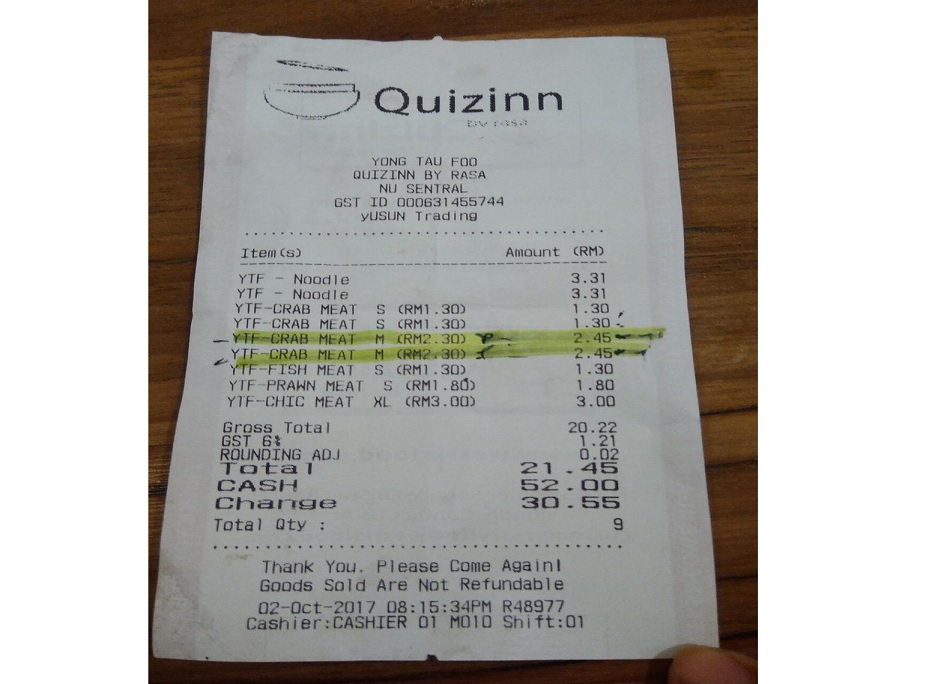
    BERHATI-HATI MAKAN DI FOOD COURT NU SENTRAL.

    Lepas settle pos barang dkt pejabat pos di brickfields.. Ank² nak dinner yg ringan² je..

    So aku bwk lah anak² pergi makan dkt food court Quizinn dkt Nu Sentral sbb dah dekat n sebelah je. Lagipun ada mcm² pilihan dkt situ.

    Masuk ni dah 2-3x makan dkt sini..sbb anak2 suka mkn dkt yong tau foo. Makan pun stakat mee, crab stick, fish ball n prawn je. Selebihnya hirup sup panas². Sebelum ni.. wlaupun diaorg bg resit siyes..aku tak pernah check. Ye lah.. Mknan cam tu kan ada standard harga dia.

    Tapi harini sbb ada 2-3 orang depan aku tu..mknan diaorg tak siap rebus lagi n turn aku kena bayar. Sementara nk tunggu turn aku siap..aku belek² lah resit tu..

    Ehh..harga actual tu tak sama. Aku pun tanya lah dkt budak² cashier tu..

    Aku: “Kenapa harga ni (yg warna kuning) tak sama harga?”

    Cashier: Owh..harga ni dh include GST.

    Aku: GST?? Knp nak charge gst dkt atas ni? Bwh ni dh ada gst.

    Cashier : Smua harga dkt resit sama kak. Dia siap print 2-3 resit lain tunjuk bukti. Mmg harga actual tak sama.

    Aku: Oooo..skrg smua customer u kasi tipu lah? Sy bkn bodoh tau u mau tipu. Sy pn org meniaga jgk. Mgkin org lain tak perasan u buat mcm ni.

    Cashier: itu harga dh betul. Ikut system gst.

    Aku pun ambik mknan dh siap.. Aku hantar dkt ank². Pastu aku citer dgn asben n terangkan balik apa budak cashier tu ckp dkt aku. Kedai ni penipu. N mostly orang melayu kita bnyk mkn dkt sini.

    So.. Asben aku tengok resit n trus pergi tanya balik dkt cashier tu. Aku tak pergi pun. sbb sakit hati dgn jawapan bodoh diaorg tu. Lagi bagus cara ank² makan.

    Asben aku tanya.. Ini harga apasal xde sama? Dia cakap lain pulak. Katanya yg sebelah tu harga lama.. Yg kanan tu harga baru. Asben aku ckp korg jangan nak main² harga pulak. Tetiba harga baru lama.

    Cashier siap cakap..takpe lah bang, boleh complain dkt management. Saya dh complain bnyak kali dah pasal POS system harga ni tapi takde tindakan. Maknanya selama ni diaorg meniaga diaorg mmg buat krja² cenggini lah. Bodoh²kan cust.

    Asben pergi dkt ofis management n complain. Management siap ckp..takde pun budak kedai tu complain apa² pasal system harga mcm ni.

    Last² budak dekat management pergi balik kedai tu n masuk jmpa cashier n cashier pulangkan rm5.20.. Asben aku ckp apesal refund bnyk.. Katanya Management suruh pulangkan duit yg 2 item tu.

    Isu dia bukan lah aku berkira yg sen² tu. Tapi benda tak betul..cakap dgn aku lain pastu cakap ngn asben aku lain. Mmg lah aku marah klu peniaga tipu org mcm ni. Berapa ramai dh diaorg ni kencing pengguna dgn alasan GST.

    Ini baru 1 kedai. Belum kedai² lain yg ada dkt situ. Katanya management yg set POS system tu. Itu lantak korang lah nak salahkan sesama sendiri. Bukan hal kitaorg pn. Itu pun belum tentu ID GST tu betul. Silap haribulan rekaan sendiri.

    Yang aku tahu habis dah tanggungjawab aku bila aku kongsi dgn kawan² lain supaya check resit setiap kali buat pembelian. Sbb aku kesian jugak dkt pekerja² yg dalam Nu Sentral tu mostly malays n diaorg yg slalu dan kerap makan dkt food court tu.


    Source: Ezza Fie

  • Malaysia’s GST Takes Effect: Less Savings, Still Worth The Trip

    Malaysia’s GST Takes Effect: Less Savings, Still Worth The Trip

    Singaporeans who frequently shop in Malaysia say they will continue to do so, even though prices of many goods could go up after the new goods and services tax (GST) kicks in today.

    This is because the strong Singapore dollar makes shopping across the Causeway at least 30 per cent cheaper than in Singapore, they said. The new GST is 6 per cent.

    Popular items that Singaporeans cart back include groceries such as instant noodles and soft drinks, baby items such as diapers, and household essentials like shampoo and toilet rolls.

    Yesterday, Malaysians thronged malls and supermarkets, such as the one at Aeon Bukit Indah in Johor Baru, to stock up on essentials such as paper towels, diapers and detergent.

    According to a poster at the entrance of the supermarket, essential items such as rice, palm oil and white bread are exempted from the new GST.

    Singaporean Lim Peng Soon, 61, is not too concerned about the new tax.

    He drives to Johor Baru from his Woodlands home once a week to pick up household items and groceries, such as eggs.

    “I know about the tax, but I will continue to buy things in Johor. It will still be cheaper than in Singapore,” said Mr Lim, who is self-employed. “Generally, I save at least 30 per cent buying things in Malaysia.”

    For accounts manager Viki Foo, 39, her trips to Kuala Lumpur once every three months will continue.

    She stocks up on baby formula for her 21/2-year-old son.

    “I’ll still save quite a fair bit, especially with the good exchange rate,” she said. Yesterday, $1 could buy RM2.69, compared with RM2.59 a year ago.

    When it comes to buying big-ticket items such as laptops, however, Ms Foo said she will be more “cautious” as it may cost at least $100 more with the new tax.

    For some Singaporeans, the new GST means fewer trips. Administrator Jennifer Goei, 57, has stopped visiting Johor since the Chinese New Year.

    The recent hikes in vehicular fees and tolls have put her off making such trips altogether. “And now, there’s this 6 per cent GST,” she said.


    Source: www.straitstimes.com

  • MPs Question Fiscal Sustainability Of Budget Schemes

    MPs Question Fiscal Sustainability Of Budget Schemes

    About a week after the Republic unveiled a Budget that was hailed by various quarters for its generosity and far-sightedness, several Members of Parliament (MPs) yesterday raised concerns about the Government’s fiscal sustainability, given that the projected spike in social spending coincides with a moderating economy.

    An ageing population would also mean less revenue that could be derived from taxes, they added, stressing that the Republic’s healthy reserves should not be taken for granted.

    In all, 25 MPs rose to speak during the first day of the Budget debate. Apart from concerns about fiscal sustainability, MPs generally welcomed Budget measures such as the SkillsFuture initiatives and the Silver Support Scheme, and offered suggestions on the implementation of the new programmes. They also highlighted the continuing struggle among businesses to raise productivity, but stressed the need to stay the course.

    The introduction of more social safety nets and other measures to mitigate social inequality prompted Workers’ Party chairman Sylvia Lim to observe a “leftwards” shift.

    In particular, she said the Silver Support Scheme — which gives cash payouts to needy elderly — came as a surprise to most. “It embodies what the People’s Action Party government has always eschewed — having any form of rights-based, ‘defined benefits’ welfare scheme,” Ms Lim said. “Up to now, government assistance schemes were usually temporary and subject to continuous means-testing and conditions, with applicants needing to fill up forms and provide documentary proof of illness and family income.”

    She added: “This Budget explicitly talks about strengthening social safety nets. This suggests a shift to the left, a direction which I believe is right … A shift left does not necessarily undermine economic performance, but could well enhance it.”

    Holland-Bukit Timah GRC MP Liang Eng Hwa said the Budget signalled a further shift to the left, but this was possible only because “over the past 50 years, we have built a stronger and more sustainable financial position through careful budgeting and sheer discipline”.

    Still, Nominated MP (NMP) Chia Yong Yong urged prudence, quipping: “If we lean too much to the left, we will not have much left.”

    Deputy Prime Minister and Finance Minister Tharman Shanmugaratnam announced during the Budget statement last Monday that Temasek Holdings will be included in the Net Investment Returns (NIR) framework — joining GIC and the Monetary Authority of Singapore — so part of its projected long-term returns can be spent. Personal income taxes for the top 5 per cent income earners will also be raised. With these moves, the MPs felt the Republic has seemingly exhausted ways to boost its coffers, without raising taxes for the masses.

    West Coast GRC MP Foo Mee Har noted that this year’s budgeted expenditure was 19 per cent higher than that in the previous year.

    “While it is assuring to know that these expenditures can be provided for from current reserves accumulated since 2011, it appears that we have come to rely more and more on past reserves to fund our spending, and have now resorted to including Temasek in the NIR framework to make ends meet,” she said. “How will we know when we have gone too far, when we have crossed the line in fiscal prudence — that tried-and-tested principle that has seen Singapore through many economic crises?”

    Distributing a table showing figures from the Ministry of Finance, Bishan-Toa Payoh GRC MP Hri Kumar Nair pointed out that if Singapore had not been drawing from its reserves via net investment income contributions, it would have run up “large deficits for a number of years”.

    Noting that government expenditure will continue to rise, he warned: “We are running out of levers to pull. After Temasek, there is no next.”

    He added: “Increasing taxes on the top 5 or even 10 per cent will get you only so far, and there will be considerable pressure on the Government not to raise taxes for everyone else … There will no doubt be calls on the Government to raise the NIR contribution beyond 50 per cent, but that means leaving behind less for our children, so where do we go from there?”

    Mr Liang suggested that the Government regularly review the country’s fiscal sustainability, with additional scrutiny and oversight on spending programmes that last longer than 10 years.

    With the economy moderating, NMP Randolph Tan said, ultimately, the fiscal strength to fund more social programmes would have to come from strong economic growth. “Singapore has to be cautious and prepare for the possibility that — unlike resource-rich and larger economies —slower growth may not turn out to be the idyllic experience we imagine,” he said. “By simultaneously drawing on surpluses, proposing a deficit and announcing a surprise rise in taxes on the wealthiest, this Budget gives us a glimpse of the stark realities we face.”

    The Budget debate continues today.


    Source: www.todayonline.com

  • Experts: GST Set To Increase To Pay For Social Spending

    Experts: GST Set To Increase To Pay For Social Spending

    While the Government has raised income tax rates for top earners in Singapore for a more progressive tax system, taxes paid by a broader swathe of Singaporeans, such as the Goods and Services Tax (GST), will probably go up in the coming years to pay for social spending, said tax experts and economists.

    The GST could go up after next year to 9 or 10 per cent, in line with the Asia-Pacific average. Other taxes the Government could raise include consumption taxes, stamp duties and property taxes, they said.

    On Tuesday, Finance Minister Tharman Shanmugaratnam had dispelled the notion that the Government had adopted a “Robin Hood” strategy for this year’s Budget by taxing the rich more to give to the poor. He said the bulk of the spending is for the common interest and not one particular group.

    “This is our society… We need to take collective responsibility,” said Mr Tharman, who is also Deputy Prime Minister, on a televised forum on Channel 5.

    PricewaterhouseCoopers tax partner Koh Soo How said Mr Tharman’s words signal a continued shift towards a “broad-based” system that reaps revenue from indirect taxes such as the GST. Noting the Government had committed not to raise the GST for five years during the 2011 General Election, he said any hike would probably take place in 2016 or 2017.

    On the other hand, Ernst & Young Solutions head of tax Chung-Sim Siew Moon does not expect a hike in the GST before 2020. “The minister has indicated that the revenue measures that have been put in place will be sufficient for the increased planning needs until the end of the decade,” she noted.

    The GST contributes the second largest share, after corporate income taxes, to Singapore’s total operating revenue, contributing about 16.5 per cent in Financial Year 2014.

    Taxes such as the GST, which are collected from the domestic population, can be raised without affecting Singapore’s international standing in terms of tax competitiveness, Mr Koh said. He noted that many countries, including the United Kingdom, Malaysia and countries in the European Union, are also gradually increasing tax revenue from indirect taxes. Indirect taxes include consumption taxes such as duties on alcohol, tobacco and petrol.

    Mr Koh added: “Tools such as GST vouchers are in place for the Government to make adjustments to alleviate the burden on low-income taxpayers.”

    KPMG Singapore head of tax Tay Hong Beng also pointed out that consumers have a degree of choice as to whether to consume and pay consumption taxes.

    Experts also expected the current income tax rates to hold. Noting that only about 30 per cent of all Singapore residents pay income tax, Mr Tay said increasing the tax burden on a minority of taxpayers “might not be the fairest way forward”.

    “Taking the concept of ‘collective responsibility’ further, the best option remains to grow the Singapore economy. A growing economy directly increases the takings from taxation without the need for excessively high tax rates,” he said.

    Mr Koh from PwC pointed out that raising the top marginal rate of personal income tax beyond the 22 per cent announced during Monday’s Budget statement may hurt Singapore’s competitiveness.

    In line with the global shift from direct to indirect taxation, Mr Tharman on Monday also announced an increase in petrol duties. Duties on tobacco, alcohol and gambling were also raised last year, with alcohol taking the steepest hike of 25 per cent.

    Nanyang Technological University economist and Assistant Professor Walter Theseira said taxpayers can expect to pay more in the medium and long term, with higher-income earners contributing a larger share. The proceeds can fund social initiatives to help the unemployed, and support medical expenses and retirement provisions for middle- and lower-income groups.

    “It is fair that we all are asked to pay a bit more to fund them, although of course in general the more fortunate amongst us should contribute a larger share,” said Asst Prof Theseira.


    Source: www.channelnewsasia.com

  • Former Customs Officer Handed 5-Year Imprisonment Sentence For Corruption

    Former Customs Officer Handed 5-Year Imprisonment Sentence For Corruption

    A former Singapore Customs officer on Thursday (Feb 5) was sentenced to five years’ jail and ordered to pay a penalty of S$673,084.80 for corruption and abetting four Indian nationals to fraudulently claim Goods and Services Tax (GST) tourist refunds.

    Of the amount, S$11,400 was for corruption offences and S$661,684.80 was a penalty of three times the amount of GST defrauded.

    Mohamed Yusof Bin Abdul Rahman, 67, pleaded guilty to seven corruption charges, while another 26 charges were taken into consideration.

    He also pleaded guilty to 25 GST tax evasion charges, and 78 similar charges were taken into consideration. The offences were committed between January 2013 and January 2014.

    As a customs officer, Yusof’s main duty was to process GST refund claims made by tourists leaving Singapore, at Changi International Airport.

    In late 2013, the Inland Revenue Authority of Singapore noticed suspicious claims made by foreigners via the Electronic Tourist Refund Scheme (eTRS).

    Investigations revealed that Yusof helped approve fraudulent GST refund claims of four Indian nationals amounting to S$493,858.67. The claims were approved even though the jewellery produced did not match the description on the receipts.

    In return, Yusuf received bribes in cash totalling S$11,400.

    The prosecution called this the “most elaborate, sophisticated and pre-meditated GST fraud case since the introduction of the GST electronic tourist refund scheme in August 2012.”

    Last year, the four Indian nationals were sentenced to jail terms of between 36 and 48 months, and ordered to pay penalties amounting to three times the tax defrauded.

    The case of another accomplice, 50-year-old Lim Pheck Aun, has not been dealt with yet.

    At the time of the offences, the sales executive at Soon Huat Goldsmith is believed to have accepted bribes, in return for generating eTRS tickets to those who were not the actual buyers of jewellery.


    Source: www.channelnewasia.com