Tag: human rights

  • Aung San Suu Kyi On Official Visit To Singapore

    Aung San Suu Kyi On Official Visit To Singapore

    Myanmar State Counsellor Aung San Suu Kyi will make an official visit to Singapore from Nov 30 to Dec 2, announced Singapore’s Ministry of Foreign Affairs (MFA) on Tuesday (Nov 29).

    Ms Suu Kyi will be here at the invitation of Prime Minister Lee Hsien Loong who will host an official welcome ceremony and a dinner for her at the Istana on Wednesday.

    Both leaders will be guests-of-honour on Thursday at the opening ceremony of a three-month exhibition of Myanmar artefacts called “Cities and Kings: Ancient Treasures from Myanmar” at the Asian Civilisations Museum.

    Ms Suu Kyi, who is also foreign minister, will call on Acting President J Y Pillay.

    Emeritus Senior Minister Goh Chok Tong and Deputy Prime Minister Teo Chee Hean will host her to meals separately and the Nobel laureate will have breakfast at a hawker centre with Foreign Minister Vivian Balakrishnan.

    Also on her agenda is IE Singapore’s Global Conversations dialogue with Singapore businesses, said MFA.

    In 2015, Myanmar was Singapore’s 28th largest trading partner, with total trade at S$3.57 billion.

    For Myanmar, Singapore was its third largest trading partner after China and Thailand. As of end-October this year, Singapore was the second largest investor in Myanmar with cumulative investment at US$15.6 billion, after China (US$18.5 billion).

    During her three-day visit, Ms Suu Kyi will get an orchid named in her honour at the Singapore Botanic Gardens. She will also receive a briefing by the Corrupt Practices Investigation Bureau, said MFA.

    Ms Suu Kyi last visited Singapore in 2013 when she was Myanmar’s opposition leader.

    During this official visit, she will be accompanied by Union Minister for Commerce U Than Myint, Minister of State for Foreign Affairs U Kyaw Tin, and officials from the Ministry of National Planning and Finance, President’s Office, and Ministry of Foreign Affairs.


    Source: www.channelnewsasia.com

  • United Nations: Myanmar Seeking Ethnic Cleansing Of Rohingyas

    United Nations: Myanmar Seeking Ethnic Cleansing Of Rohingyas

    Myanmar is seeking the ethnic cleansing of the Muslim Rohingya minority from its territory, a senior UN official has told the BBC.

    Armed forces have been killing Rohingya in Rakhine state, forcing many to flee to neighbouring Bangladesh, says John McKissick of the UN refugee agency.

    The government of Myanmar, also known as Burma, has been conducting counter-insurgency operations since coordinated attacks on border guards in October.

    It denies reports of atrocities.

    Burmese officials say Rohingyas are setting fire to their own houses in northern Rakhine state. The BBC cannot visit the area to verify what is occurring there as journalists and aid workers have been barred.

    The Rohingya, who number about one million, are seen by many of Myanmar’s Buddhist majority as illegal migrants from Bangladesh.

    ‘Collective punishment’

    Although Bangladesh’s official policy is not to allow in illegal entrants across the border, the foreign ministry has confirmed that thousands of Rohingyas have already sought refuge in Bangladesh. Thousands more are reportedly gathering on the border.

    Efforts to resolve the issue must focus on “the root cause” inside Myanmar, Mr McKissick, head of the UN refugee agency UNHCR in the Bangladeshi border town of Cox’s Bazar told BBC Bengali’s Akbar Hossain.

    He said the Myanmar military and Border Guard Police had “engaged in collective punishment of the Rohingya minority” after the murders of nine border guards on 9 October which some politicians blamed on a Rohingya militant group.

    Security forces have been “killing men, shooting them, slaughtering children, raping women, burning and looting houses, forcing these people to cross the river” into Bangladesh, Mr McKissick said.

    “Now it’s very difficult for the Bangladeshi government to say the border is open because this would further encourage the government of Myanmar to continue the atrocities and push them out until they have achieved their ultimate goal of ethnic cleansing of the Muslim minority in Myanmar,” he said.

    On Wednesday, the Bangladesh foreign ministry summoned Myanmar’s ambassador to express “deep concern” over the military operation in northern Rakhine state.

    It said “desperate people” were crossing the border seeking safety and shelter and asked Myanmar to “ensure the integrity of its border”.

    Authorities in Bangladesh have been detaining and repatriating hundreds of fleeing Rohingya.

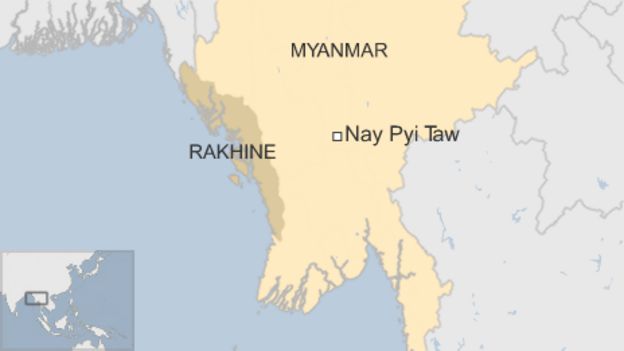
    Map showing Maungdaw's location in Rakhine State© BBC Map showing Maungdaw’s location in Rakhine State

    Earlier this week, Human Rights Watch released satellite images which it said showed that more than 1,000 homes had been razed in Rohingya villages over the past six weeks.

    What is happening in Rakhine state?

    A massive security operation was launched last month after nine police officers were killed in co-ordinated attacks on border posts in Maungdaw.

    Some government officials blamed a militant Rohingya group for the attacks. Security forces then sealed off access to Maungdaw district and launched a counter-insurgency operation.

    Rohingya activists say more than 100 people have been killed and hundreds arrested amid the crackdown.

    Soldiers have also been accused of serious human rights abuses, including torture, rape and executions, which the government has flatly denied.

    It says militants have attacked helicopter gunships providing air support to troops.

    Who are the Rohingya?

    The estimated one million Muslim Rohingya are seen by many in mainly Buddhist Myanmar as illegal migrants from Bangladesh. They are denied citizenship by the government despite many having lived there for generations.

    Communal violence in Rakhine state in 2012 left scores dead and displaced more than 100,000 people, with many Rohingya still remaining in decrepit camps.

    They face widespread discrimination and mistreatment.

    Is the government to blame?

    Myanmar held its first openly contested election in 25 years last November, with Nobel Laureate Aung San Suu Kyi’s National League for Democracy winning a landslide victory.

    Though she is barred from the presidency due to a constitutional rule, Ms Suu Kyi, who serves as State Counsellor, is seen as de-facto leader.

    But her government, led as it is by a former human rights icon, has faced international criticism over the dire situation in Rakhine state.

    Rights groups have questioned why journalists and aid workers are not being allowed to enter northern Rakhine.

    Presidential spokesman Zaw Htay says the international media is misreporting what is going on.


    Source: www.msn.com

  • Gang Rape, Torture Claims As Rohingyas Flee Myanmar

    Gang Rape, Torture Claims As Rohingyas Flee Myanmar

    TEKNAF, Bangladesh: Horrifying stories of gang rape, torture and murder are emerging from among the thousands of desperate Rohingya migrants who have pushed into Bangladesh in the past few days to escape unfolding chaos in Myanmar.

    Up to 30,000 of the impoverished ethnic group have fled their homes, the United Nations says, after troops poured into the narrow strip where they live earlier this month.

    Bangladesh has resisted urgent international appeals to open its border to avert a humanitarian crisis, instead telling Myanmar it must do more to prevent the stateless Muslim minority from entering.

    The scale of human suffering was becoming clear Thursday, as desperate people like Mohammad Ayaz told how troops attacked his village and killed his pregnant wife.

    Cradling his two-year-old son, he said military men killed at least 300 men in the village market and gang-raped dozens of women before setting fire to around 300 houses, Muslim-owned shops and the mosque where he served as imam.

    “They shot dead my wife, Jannatun Naim. She was 25 and seven months pregnant. I took refuge at a canal with my two-year-old son, who was hit by a rifle butt,” Ayaz told AFP, pointing to a cut on the boy’s forehead.

    Ayaz sold his watch and shoes to pay for the journey and has taken shelter along with at least 200 of his neighbours at a camp for unregistered Rohingya refugees.

    ‘DEEP CONCERN’

    Many of those seeking shelter in Bangladesh say they have walked for days and used rickety boats to cross into the neighbouring country, where hundreds of thousands of registered Rohingya refugees have been living for decades.

    The Rohingya are loathed by many in majority Buddhist Myanmar who see them as illegal immigrants and call them “Bengali”, even though many have lived in Myanmar for generations.

    Most live in impoverished western Rakhine state, but are denied citizenship and smothered by restrictions on movement and work.

    As the crisis deepened, Bangladesh said late Wednesday it had summoned the Myanmar ambassador to express “deep concern”.

    “Despite our border guards’ sincere effort to prevent the influx, thousands of distressed Myanmar citizens including women, children and elderly people continue to cross (the) border into Bangladesh,” it said. “Thousands more have been reported to be gathering at the border crossing.”

    TORTURE AND RAPE

    Since the latest violence flared up, Bangladesh’s secular government has been under intense pressure to open its border to prevent a humanitarian disaster.

    Instead, Bangladesh border guards have intensified patrols and coast guards have deployed extra ships. Officials say they have stopped around a thousand Rohingya at the border since Monday.

    Farmer Deen Mohammad was among the thousands who evaded the patrols, sneaking into the Bangladeshi border town of Teknaf four days ago with his wife, two of their children and three other families.

    “They (Myanmar’s military) took my two boys, aged nine and 12 when they entered my village. I don’t know what happened to them,” Mohammad, 50, told AFP. “They took women in rooms and then locked them from inside. Up to 50 women and girls of our village were tortured and raped.”

    Mohammad said houses in his village were burned, echoing similar testimony from other recent arrivals.

    Human Rights Watch said Monday it had identified more than 1,000 houses in Rohingya villages that had been razed in northwestern Myanmar using satellite images.

    The Myanmar military has denied burning villages and even blamed the Rohingya themselves.

    Jannat Ara said she fled with neighbours after her father was arrested and her 17-year-old sister disappeared, she believes raped and killed by the army.

    “We heard that they tortured her to death. I don’t know what happened to my mother,” said Ara, who entered Bangladesh on Tuesday.

    Rohingya community leaders said hundreds of families had taken shelter in camps in the Bangladeshi border towns of Teknaf and Ukhia, many hiding for fear they would be sent them back to Myanmar.

    Police on Wednesday detained 70 Rohingya, including women and children, who they say they will send back across the border.

    “They handcuffed even young girls and children and then took them away with a view to pushing them back to Myanmar,” said one community leader who asked not to be named, adding they faced “certain death” if made to return.


    Source: www.channelnewsaia.com

  • Mohamed Jufrie Mahmood: Why Does Singapore Continue To Do Business With Myanmar Despite The Gross Human Rights Violations On Rohingyas?

    Mohamed Jufrie Mahmood: Why Does Singapore Continue To Do Business With Myanmar Despite The Gross Human Rights Violations On Rohingyas?

    Just like their persecuted brothers in Mindanao, southern Thailand and elsewhere in the world, the Rohingyas are finally making moves to protect themselves.

    myanmar-fighting-back

    The question now is, will Singapore continue supplying arms to those who are persecuting and murdering them.

    The bigger question is, why did Singapore even start to work closely with and supply arms to the generals knowing very well that the arms would be used against the local population since the country was and is still not under any form of external military threat?

    Are we doing it for the money?


    Source: Mohamed Jufrie Mahmood

  • Myanmar Army Fires On Rohingya Villages In Rakhine Region

    Myanmar Army Fires On Rohingya Villages In Rakhine Region

    State media say two soldiers and six attackers died in clashes after an ambush on troops, which led to air support being called in.

    There are reports of villages burning in the northern region of Rakhine.

    Photos released by Human Rights Watch seem to show charred villages, with the group reporting 430 burnt buildings.

    The satellite photos were taken between 22 October and 10 November, following reports of fighting and civilians fleeing last month.

    rohingya-1

    Rohingya activists say the government is trying systematically to drive the Muslim minority from their villages.

    rohingya-2

    Attacking the Rohingya is a popular move for the military, the BBC’s Jonah Fisher reports from Myanmar’s largest city, Yangon.

    They are disliked by many, if not most, Burmese who consider them illegal immigrants from Bangladesh, our correspondent says.

    Media barred

    The latest outbreak in fighting was triggered by an attack on three police checkpoints just over a month ago.

    The Burmese government is not allowing independent journalists into Rakhine, so it is impossible to verify claims about the scale of the fighting.

    According to the latest official statement on Saturday, troops were ambushed and then clashed several times with armed men, presumably Rohingya Muslims, equipped with guns, knives and spears.

    At one point, when faced by about 500 men, the soldiers called in air support and two helicopter gunships fired on the Rohingya village.

    BBC map

    Casualty figures vary widely, our correspondent says.

    Brad Adams, the Asia director for Human Rights Watch, said the new photos showed “widespread destruction” that was “greater than we first thought”.

    “Burmese authorities should promptly establish a UN-assisted investigation as a first step toward ensuring justice and security for the victims,” he said.

    The government – led by Aung San Suu Kyi – talks of “clearance operations” as part of the search for the attackers.


    Source: www.bbc.co.uk