Tag: immigrants

  • Malaysia Mass Graves: Villagers Tell Of Immigrants Emerging From Secret Camps

    Malaysia Mass Graves: Villagers Tell Of Immigrants Emerging From Secret Camps

    The residents of Wang Kelian sensed something was amiss when a number of people stumbled on to their streets, weak and injured, and began to beg for food and water.

    “They would walk into my shop, with injuries covering their hands and feet. Some were just too weak to even speak properly,” said Lyza Ibrahim, who runs a food stall in the town on the northern Malaysian border with Thailand.

    “One asked me, ‘[Is this] Malaysia?’ Then he pointed in the other direction, said ‘Thailand’ and shook his head to signal that he was not wanted there.”

    Wang Kelian is an unassuming settlement but it has been thrust into the global spotlight this week after the discovery in nearby jungle of dozens of secret camps used by people smugglers and nearly 140 grave sites.

    Police say some of those graves contain multiple bodies – raising the terrible prospect of hundreds of unexplained deaths. On Tuesday Malaysian authorities began the grim task of exhumation.

    Some of the campsites included wooden pens, some with barbed wire and guarded by sentry posts. In one pen, police found several parts of a decomposed body.
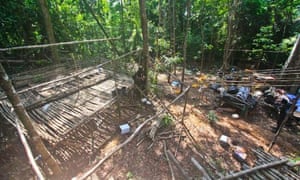
    A picture from Royal Malaysian Police shows an abandoned human trafficking camp where graves were found nearby, close to the border with Thailand at Wang Kelian, Malaysia.

    The camps appear to be part of a complex of bases stretching into Thailand on what had been a well-established route smuggling mostly Rohingya people from Burma and Bangladesh.

    But the trade has been in chaos since early May, when Thai authorities launched a crackdown after the discovery of mass graves on their side of the border.

    Thousands of migrants headed for Thailand started landing elsewhere in south-east Asia. And as the smugglers fled their jungle hideouts, migrants were spotted in Wang Kelian.

    Ibrahim said she had seen several migrants, whom she believed to be Rohingya, and heard stories about many others, including that they would go to a nearby mosque to ask for help.

    Others echoed her story. Another woman said she had spotted a Bangladeshi migrant wandering in the area and knocking on her neighbour’s door.

    “It is very sad. We have been hearing these stories, but we can’t do much,” said the woman, who declined to give her name. “We could only offer food, clean clothes, but we have to call the police and they will be taken away by the police after that.”

    Malaysian officials acknowledged the camps had been around for some time but defended themselves against criticism that no action was taken earlier. Authorities had previously vehemently denied there were any such sites in the country.

    “We have been building up intelligence and information,” the national police chief, Khalid Abu Bakar, told reporters on Monday, vowing tough action against any Malaysians involved.

    But anti-trafficking groups said the latest discovery came as little surprise and would cast an even harsher spotlight on Malaysia, which was listed as ‘tier three’ by the US State Department’s annual human-trafficking report, the worst ranking for countries which are failing to stop the trade.

    “There were stories about these camps that went back nearly 10 years,” Matthew Friedman, the former chief of the UN inter-agency project on human trafficking, told the Guardian. He now heads the Mekong Club, which campaigns against slavery in Asia. “We passed the information on to the local authorities, but there was no follow-up.”

    Bags with human remains at Wang Kelian, Perlis, Malaysia

    A report in 2009 by the US Senate committee on foreign relations found that “a few thousand” Burmese migrants had become victims of extortion and trafficking once they were deported across Malaysia’s border with Thailand.

    In addition, it said there were questions about the “level of participation” of government officials in Malaysia and Thailand.

    Villager Mahyuddin Ahmad said he has seen migrants in Wang Kelian for the past two years but more had been spotted in the past month – the largest group being about 10 people, including women and children.

    The 55-year-old businessman, who said he had given food such as instant noodles and clothes to migrants, added: “It is a common sight here. We didn’t suspect anything because we thought they just come from Thailand.

    “So we are really shocked to hear what the police revealed yesterday about the grave sites and jungle camps.”


    Source: www.theguardian.com

  • Malay Grassroots Organisations To Roll Out 10 Porridge Distribution Projects During Upcoming Ramadan

    Malay Grassroots Organisations To Roll Out 10 Porridge Distribution Projects During Upcoming Ramadan

    Malay grassroots organisations will work with immigrant associations to roll out 10 porridge distribution projects during the Muslim fasting month of Ramadan this year, said Minister of State for Health Lam Pin Min on Saturday.

    Calling the projects meaningful, Dr Lam said it will not only help promote the spirit of giving and helping the needy, but will also allow new immigrants to assimilate by interacting with Singaporeans and learning the significance of local ethnic and cultural practices.

    He made the remarks at a talk about integration, organised by the People’s Association (PA).

    Speaking to more than 1,000 people including grassroots leaders, representatives of immigrant associations and students at the ITE College Central, Dr Lam urged Singaporeans and new citizens alike to work with the Government on social integration.

    He said: “Integration is a two-way process…while new citizens need to learn and accept the Singapore way of life so as to integrate better into our society, local Singaporeans must also put in effort to encourage and welcome new citizens to step forward and be active members of the community.”

    And because Singapore must continue to attract new immigrants so as to survive, given its ageing population and low birth rates, social integration thus becomes critical, he added, as he noted the role of the PA in promoting integration.

    Part of its efforts this year is the Happy Project 50 initiative – a series of 50 community service programmes jointly created by grassroots organisations and immigrant associations, of which the 10 porridge distribution projects come under.


    Source: www.straitstimes.com

  • Muslims Form Human Shield Around Oslo Synagogue

    Muslims Form Human Shield Around Oslo Synagogue

    REUTERS – More than 1,000 Muslims formed a human shield around Oslo’s synagogue on Saturday, offering symbolic protection for the city’s Jewish community and condemning an attack on a synagogue in neighboring Denmark last weekend.

    Chanting “No to anti-Semitism, no to Islamophobia,” Norway’s Muslims formed what they called a ring of peace a week after Omar Abdel Hamid El-Hussein, a Danish-born son of Palestinian immigrants, killed two people at a synagogue and an event promoting free speech in Copenhagen last weekend.

    “Humanity is one and we are here to demonstrate that,” Zeeshan Abdullah, one of the protest’s organizers told a crowd of Muslim immigrants and ethnic Norwegians who filled the small street around Oslo’s only functioning synagogue.

    “There are many more peace mongers than warmongers,” Abdullah said as organizers and Jewish community leaders stood side by side. “There’s still hope for humanity, for peace and love, across religious differences and backgrounds.”

    Norway’s Jewish community is one of Europe’s smallest, numbering around 1000, and the Muslim population, which has been growing steadily through immigration, is 150,000 to 200,000. Norway has a population of about 5.2 million.

    The debate over immigration in the country came to the forefront in 2011 when Anders Behring Breivik killed 77 people and accused the government and the then-ruling Labour party of facilitating Muslim immigration and adulterating pure Norwegian blood.

    Support for immigration has been rising steadily since those attacks, however, and an opinion poll late last year found that 77 percent of people thought immigrants made an important contribution to Norwegian society.


    Source: www.haaretz.com