Tag: independence

  • Myanmar Army Fires On Rohingya Villages In Rakhine Region

    Myanmar Army Fires On Rohingya Villages In Rakhine Region

    State media say two soldiers and six attackers died in clashes after an ambush on troops, which led to air support being called in.

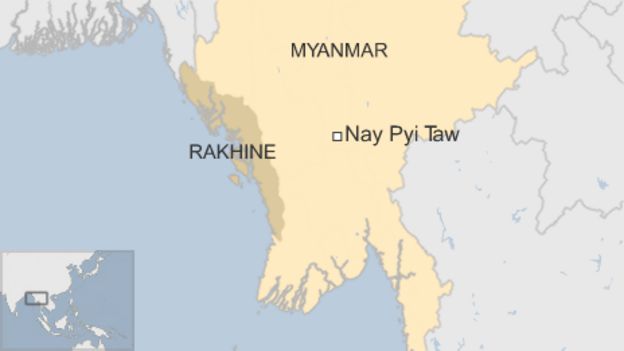
    There are reports of villages burning in the northern region of Rakhine.

    Photos released by Human Rights Watch seem to show charred villages, with the group reporting 430 burnt buildings.

    The satellite photos were taken between 22 October and 10 November, following reports of fighting and civilians fleeing last month.

    rohingya-1

    Rohingya activists say the government is trying systematically to drive the Muslim minority from their villages.

    rohingya-2

    Attacking the Rohingya is a popular move for the military, the BBC’s Jonah Fisher reports from Myanmar’s largest city, Yangon.

    They are disliked by many, if not most, Burmese who consider them illegal immigrants from Bangladesh, our correspondent says.

    Media barred

    The latest outbreak in fighting was triggered by an attack on three police checkpoints just over a month ago.

    The Burmese government is not allowing independent journalists into Rakhine, so it is impossible to verify claims about the scale of the fighting.

    According to the latest official statement on Saturday, troops were ambushed and then clashed several times with armed men, presumably Rohingya Muslims, equipped with guns, knives and spears.

    At one point, when faced by about 500 men, the soldiers called in air support and two helicopter gunships fired on the Rohingya village.

    BBC map

    Casualty figures vary widely, our correspondent says.

    Brad Adams, the Asia director for Human Rights Watch, said the new photos showed “widespread destruction” that was “greater than we first thought”.

    “Burmese authorities should promptly establish a UN-assisted investigation as a first step toward ensuring justice and security for the victims,” he said.

    The government – led by Aung San Suu Kyi – talks of “clearance operations” as part of the search for the attackers.


    Source: www.bbc.co.uk

  • Separation 1965: The Tunku’s ‘Agonised Decision’

    Separation 1965: The Tunku’s ‘Agonised Decision’

    Did Singapore ask to leave Malaysia of its own accord or was it forced out against its will?

    Fifty years after Singapore’s separation from Malaysia, the question is still moot. This review of the events leading to the separation seeks to throw light on the conundrum.

    Singapore separated from Malaysia on Aug 9, 1965, by a constitutional fiat that formalised an agreed settlement between the state of Singapore and the federal government.

    The act of separation was effected by the Malaysian Parliament adopting an Amendment to the Malaysian Constitution and ratifying an Agreement on Separation signed by the governments of Singapore and Kuala Lumpur. It was put into action by a Proclamation of Independence of Singapore by then Prime Minister Lee Kuan Yew that was read over Radio Singapore.

    That agreement was negotiated by leading members of the two governments to bring about an amicable solution to an increasingly bitter and intractable conflict between their ruling parties.

    However, it was then Malaysian Prime Minister Tunku Abdul Rahman who initiated the move to “hive off” Singapore from Malaysia.

    As he explained at a press conference after the passage of the Separation Act: “It was my idea that Singapore should leave the federation and be independent. The differences between the state government of Singapore and the central government of Malaysia had become so acrimonious that I decided that it was best that Singapore went its own way. Otherwise, there was no hope for peace.”

    This confirms that Singapore was forced to leave Malaysia at the Tunku’s behest. It was not Singapore that sought to secede or initiated the negotiation to separate from Malaysia, as some scholars seek to argue.

    Indeed, in the months leading to its constitutional eviction, Singapore had been warned by Malaysian leaders against seeking secession or a partition of Malaysia between the former states of Malaya and the new states – Singapore, Sarawak and Sabah, as well as Penang.

    That partition had been proposed by Singapore as an alternative constitutional arrangement for a looser confederation. The proposal had developed from the call made by political parties grouped in the Malaysian Solidarity Convention for a “Malaysian Malaysia” that would ensure equality among all the states and ethnic groups in the country.

    This dual demand infuriated the ruling Alliance in Malaysia, especially the dominant Umno. Sections of the ruling parties called for strong retaliation against Singapore’s ruling People’s Action Party (PAP), which they accused of treason for seeking secession. Some “ultra nationalists” called for the arrest of Mr Lee and even imposing direct central rule on Singapore.

    As the conflict of words raged and Malay passions were roused, Malaysia’s senior leaders feared that violence might break out, leading to racial clashes across the whole country.

    Tunku’s surgical solution

    It was against this deteriorating political situation that the Tunku began to consider a surgical solution to this intractable problem, to cut the Gordian knot, as it were.

    The Tunku had left for London in mid-June for a Commonwealth Prime Ministers’ Conference.

    I interviewed him on behalf of Radio Television Singapore (RTS) before his departure at the Paya Lebar International Airport, but he declined to say anything about the altercations between Malaysian politicians and Singapore leaders.

    In London, the Tunku was hospitalised with shingles and he thought long and hard about the problems with Singapore. His conclusion: “There would be no end to the bickering with Singapore except perhaps if Mr Lee Kuan Yew is made prime minister in the real sense of the word.”

    Indeed, the Tunku asked Minister Lim Kim San, who had gone to London with him, to tell Mr Lee (“your PM”) that “he can attend the next Prime Ministers’ Conference on his own”.

    That was the first indication by the Tunku that he would give Singapore independence, Mr Lim later said, although he missed the implication of the Tunku’s cryptic remark at the time.

    The Tunku wrote to his deputy, Tun Abdul Razak, telling him how he felt about the relations with Singapore and to talk things over with Mr Lee. Tun Razak met Mr Lee on June 29, but found it impossible to reach any meeting of minds. In Mr Lee’s recounting of the meeting in his memoirs The Singapore Story, Tun Razak went back on his previous agreement to consider a looser arrangement for Singapore and insisted on total capitulation in political activity, defence, foreign affairs, security and finance.

    However, as recounted by Dr Goh Keng Swee, when he met Tun Razak and Dr Ismail (Abdul Rahman), the Home Affairs Minister, in Kuala Lumpur on July 13, Dr Goh proposed that Singapore leave Malaysia to become an independent state. This proposal jived with the Tunku’s idea for Singapore to leave the federation.

    At a second meeting on July 20, Dr Goh told Tun Razak and Dr Ismail that Mr Lee was in favour of secession of Singapore and it should be done quickly, by Aug 9 when Parliament was to reconvene.

    On his return from London on Aug 5, the Tunku was asked by pressmen at the airport, including me, if he would be meeting Mr Lee to discuss the political differences raging between the two sides.

    His reply was non-committal, almost nonchalant, saying he would meet Mr Lee if there was anything to discuss. Little did we know that serious talks between Tun Razak, Dr Ismail and Dr Goh were going on in Kuala Lumpur, with Mr Lee in the Cameron Highlands consulted, on the total hiving off of Singapore from Malaysia.

    Tun Razak gave a full report to the Tunku on his return home. After Tun Razak and Dr Ismail had negotiated the terms of separation with Dr Goh and Mr E.W. Barker, the Tunku held an emergency meeting of his core Cabinet members on Aug 6, and approved the draft Bills to amend the Constitution and get Singapore to withdraw from the federation.

    On Aug 7, the Tunku said, the “big shots” of the PAP (meaning Mr Lee), called at his residency and signed the Separation Agreement, while other members of the Singapore Cabinet signed it in Singapore or at Singapore House in KL.

    Even at the last minute, Mr Lee asked the Tunku if he really wanted to break up Malaysia, which they had spent years to bring about. Would it not be wiser to go back to their original plan for a looser federation or confederation?

    But the Tunku demurred. “There is no other way out. I have made up my mind. You go your way and we go our own way,” Mr Lee recalled him saying.

    Secrecy had to be of the essence on both sides of the Causeway for fear of opponents of the separation reacting with violence to the agreement.

    Special Parliament session

    The first inkling we in RTS had that something was happening was the departure of several ministers from Singapore to KL on Aug 7. I was instructed to fly to KL on Aug 8 to cover the special session of Parliament on Aug 9, a Monday.

    I was joined in KL by fellow reporters Lim Kit Siang and Fuad Salim. In Parliament, we found only Mr Devan Nair, PAP MP for Bungsar, present. Some of the Singapore MPs were at Singapore House. Mr Nair and I listened to the Tunku’s speech moving the Separation of Singapore Bill on a certificate of urgency, via the in-house sound system in his office.

    When the session was adjourned, we learnt the Bill had been passed without opposition, although Umno Secretary-General Syed Jaafar Albar had left the chamber before the vote and expressed his disagreement with the separation. He, like the other ultras, wanted to maintain Malay rule over Singapore, forcibly if need be.

    When Separation was announced by the Tunku over Radio Television Malaya and the Proclamation of Singapore’s Independence read over Radio Singapore at 10am, Singaporeans received the news with a mixture of relief, regret and foreboding, although some quarters in Chinatown let off firecrackers in celebration.

    And when Mr Lee went on Radio Television Singapore to explain the circumstances leading to the separation, it was clear that he had been forced to accept Singapore’s eviction from Malaysia.

    It was, he said, a moment of anguish for him, having devoted his whole life to bringing about a united Malaysia, whose people were bound by ties of kinship, geography and history.

    He and Dr Goh had negotiated the terms of Separation to ensure that Singapore would be truly independent while continuing to have access to the water supply from Johor for its survival.

    And Singapore would be on its own for all its multiracial population, living in peaceful amity with the rest of Malaysia. Thus did Singapore achieve independence while avoiding a forcible integration in a Malaysia riven by interracial tension and hostility from a communal political system.

    That is the “coup” that Mr Lee and his PAP colleagues carried out for the people of Singapore, to achieve an independent and sovereign Singapore.

    However, it was the Tunku who played the decisive role in this saga.

    It was his agonised decision to let Singapore go that tipped the scales in favour of separation. Otherwise, the fracas between the state and central governments could well have become more intense and impossible to resolve, with no way out but an inevitable forceful denouement, that is, the arrest of Mr Lee and his senior lieutenants and the imposition of direct federal rule by the central government on Singapore.

    The Tunku was magnanimous in telling Mr Lee to leave Malaysia. If there is one person that Singapore should thank for its independence, it is Tunku Abdul Rahman Putra, the first prime minister of Malaysia.


    •The writer, Mushahid Ali, a senior fellow at the S. Rajaratnam School of International Studies, Nanyang Technological University, was a reporter with Radio Television Singapore from 1963 to 1966 and later with the Ministry of Foreign Affairs from 1970 to 2001.


    Source: www.straitstimes.com

  • Yusof Ishak Chose To Stay, Thereby Convincing Other Malays

    Yusof Ishak Chose To Stay, Thereby Convincing Other Malays

    Post-Separation in August 1965, Mr Yusof Ishak’s steadfast loyalty to Singapore convinced many other Malays to stay instead of migrating across the Causeway where they would be part of the majority community.

    As this fledgling nation’s first president, Mr Yusof, who was born in Malaysia, strived to build up people’s faith in Singapore as a multiracial nation.

    The man and his ideals are the focus of a new 120-page monograph titled Yusof Ishak: Singapore’s First President by Iseas fellow Norshahril Saat.

    “Had he left for Malaysia, like many other Malay elites at that time, many other Malays would have followed suit on seeing that their Yang di-Pertuan Negara no longer trusted the Singapore system,” wrote Dr Norshahril.

    In the book, he also seeks to debunk the myth that Mr Yusof, who started Malay newspaper Utusan Melayu, was a “Malay chauvinist”.

    Dr Norshahril explained that Mr Yusof “was not struggling for Malays because he was a Malay”. “He just wanted equality.”

    Former president S R Nathan, who wrote the foreward, said he suggested the book be written so that young Singaporeans could learn more about their country’s history and its pioneers.

    The monograph is not for sale as of now, but there are plans to distribute it to schools here.

    Minister-in-charge of Muslim Affairs Yaacob Ibrahim, who was interviewed for the book, told reporters yesterday that it could help younger generations understand how pioneers like Mr Yusof struggled to build a nation.

    Second Minister for Home Affairs and Foreign Affairs Masagos Zulkifli said Mr Yusof was “the first among many significant Malay leaders who conveyed the message that this country is a country that belongs to everyone”.


    Source: www.straitstimes.com

  • Remembering The First National Day Parade In 1966

    Remembering The First National Day Parade In 1966

    Hours before the Ministers and VIPs arrived at 9am, the marching contingents stood in neat rows under the morning sun at the Padang.

    Some 23,000 took part in the National Day Parade in 1966, just a year after Singapore’s independence.

    For Mr Chia Hearn Meng of the People’s Defence Force, whose memories were mentioned by Defence Minister Ng Eng Hen on his Facebook page, the day started at 2am, when he collected and cleaned his rifle from the armoury.

    The students had to assemble at 5am, and they were still practising on the Padang before the parade started.

    For many, marching was something new, and they had spent months making sure their steps were synchronised. Some participants, tired and hungry, collapsed on the Padang as they waited in the sun.

    Here are snippets from the 1966 Parade from four people who were there:

    “Marching practices were chaotic, because many only spoke dialects.”

    Mr Chia Hearn Meng, then a 29-year-old construction supervisor, heeded the call to join the People’s Defence Force (PDF) after he saw how racial riots rent the nation.

    He was assigned to the 3rd PDF, which was stationed at Pearl’s Hill.

    “There were many labourers and cleaners; we were all grouped together,” he told The Straits Times. “Marching practices were chaotic, because many of the workers only spoke dialects.

    “When the NCO gave commands in Malay and sometimes English, they would shout for the instructions to be given in Cantonese or Hokkien.”

    Just learning how to march took them many months, due to the difficulties of communication.

    “Some cannot differentiate kiri (left in Malay) and kanan (right in Malay),” he said. “When they turn they will face each other.”

    Each weekend, they would rehearse in the hot sun wearing thick uniforms, steel helmets and heavy leather boots.

    “In the old days, the uniform was very thick and we had to swing our arms upright. My armpits had bruises!” he recalled.

    Mr Chia, now 78, took part in five parades, and he remembers the routine clearly:

    At 2am, they collected their Mark 4 rifles and blank bullets from Pearl’s Hill, then cleaned and checked them, he said.

    After that they fell in and waited for the army clerk to lead them to Beach Road where the contingents assembled. At 6am, they marched to the Padang.

    “It took us about an hour, and we would wait from 7am till the VIPs arrived,” he said.

    After the march past at the City Hall, they continued to High Street, South Bridge Road, Chinatown, Tanjong Pagar, Neil Road, Outram Park and Queenstown, he said.

    Along the way, people jammed the streets and cheered.

    “It would be pretty awesome if I can march alongside my son and my grandson in this year’s parade. That will make three generations of soldiers serving Singapore,” said Mr Chia.

    “We slept in school classrooms the night before”

    The night of August 8, 1966, the boys from the St Gabriel’s Secondary School brass band slept in their classrooms to make sure they would not be late for the Parade.

    They had to assemble at the Merdeka Bridge at 5am.

    “We disturbed each other, and didn’t get much sleep,” said Mr Bernard Chiang, who played the baritone.

    Then 15 years old, Mr Chiang and his friends were excited to be performing for the inaugural National Day.

    They had trained hard – with sessions of three to four hours at least twice a week- to perfect their marching and their music.

    “We sacrificed many hours practising foot drills and our formations to sharpen our precision and synchrony in marching and playing the instruments,” he wrote in an email to The Straits Times.

    It was tough because they had just set up the school band a year before, and there was a lot to learn.

    After assembling at Merdeka Bridge, they marched down to the Padang.

    “While we were positioned at the Padang,we still had to go through few rounds of practices to ensure that the parade was ready and perfect,” he wrote.

    That was when some participants started to collapse and they were carried away on stretchers, he said.

    “It was probably due to long hours of standing under the hot sun, lack of sleep, dehydration and no proper breakfast,” he said, adding that this was the first NDP and they were better prepared for later parades.

    Still, this was nothing compared to the torrential downpour in 1968, he recalled.

    “The instrument was frozen and waterlogged, we couldn’t blow it,” he said. The dyes on their uniforms ran in the rain.

    They marched a longer route that year too, all the way to Queenstown.

    “Our uniforms got wet, and we marched till they dried in the sun, then they got wet again from our sweat,” he laughed.

    He was quick to add that they were proud to be pioneers in the NDP, and the camaraderie forged then has stayed with them for a lifetime. He still meets up with his band mates, the 64-year-old florist said.

    “We had no cameras, no phones back then to take videos!”

    Mr Ramadas Palanisamy, now 85, was nominated to represent the former Woodbridge Hospital in the nurses’ contingent.

    The nursing officer, then 36, joined dozens of others from local hospitals including Singapore General Hospital, Tan Tock Seng Hospital, and the now-defunct Toa Payoh Hospital.

    “I was very happy and excited to be nominated,” he said, being one of only two representatives from Woodbridge.

    The training took about three months, and an army officer taught them how to march at first, he said. Later, one of the nursing staff took over.

    On the day of the Parade, they had to “go early in the morning and stand there”, he said. All the nurses were neatly turned out in their freshly-ironed uniforms and white shoes.

    “Everybody was in a joyous mood, and it went fantastically,” he recalled fondly. “The only thing was, I couldn’t watch the parades. We had no cameras, no phones back then to take videos!”

    He took part in the Parade from 1966 to 1968, but when he was nominated again in 1969, he decided to let others have a chance, he said.

    “I saw Lee Kuan Yew and the cabinet ministers sitting on the City Hall steps”

    Mr S. Sivakolunthu, 78, was with the first People’s Defence Force, but he was “on loan” to the Tamil Teachers’ Union for the 1966 National Day Parade.

    The teacher, who taught Tamil and English, was a volunteer soldier for three years. He marched in the PDF contingents in the 1967 and 1968 parades.

    For the 1966 parade, the lance corporal helped to train about 70 Tamil teachers at Monk’s Hill Secondary School every Saturday, he said.

    “I had six months of training with the PDF,and it was tough, but I could do the marching,” he said. “There were teachers in uniformed groups, and they helped too.”

    He recalls leading the contingent of teachers in their march past the City Hall.

    “I saw Lee Kuan Yew and the cabinet ministers sitting on the City Hall steps,” he said.

    The retiree, who is still active in community work, said he has watched the National Day Parade on television every year since.


    Source: www.straitstimes.com

  • More Booking Tours On Long National Day Weekend

    More Booking Tours On Long National Day Weekend

    Following the announcement of a long National Day weekend from Aug 7 to 10, tour agencies said they are seeing a spike in bookings.

    According to some agencies, there has been a 30 per cent increase in tour bookings for the extended National Day weekend, with some saying trips to nearby countries such as Thailand and Hong Kong are almost fully booked.

    Numbers are expected to increase further, said the agencies, and companies have also approached the agencies for corporate bookings to reward staff.

    BOOKINGS IN LOCAL HOTELS UP

    However, not all are heading overseas, with local hotels reporting an increase in bookings for the weekend. Some hotels said that about 90 per cent of their rooms with a view of the parade have already been reserved, while others have introduced special packages to celebrate the nation’s Golden Jubilee.

    “If they have done a 3-day booking, we’re obviously going to contact them again and offer the package over the four days because it is not fair that they didn’t know, so this is the government generosity of adding an extra day, which is terrific,” said Antoine Chahwan, Regional Vice President, Four Seasons Hotel. “To celebrate Singapore’s 50, I’m sure a lot of people will stay in Singapore to be part of this great celebrations.”

    Previously, Speaker of Parliament Halimah Yacob urged Singaporeans to remain in the country during the long weekend to celebrate the nation’s 50th birthday instead of travelling overseas.


    Source: www.channelnewsasia.com

deneme bonusu