Tag: Islam

  • Unchartered Waters: Meet The Australian Royal Navy’s Trailblazing Muslim Captain Mona Shindy

    Unchartered Waters: Meet The Australian Royal Navy’s Trailblazing Muslim Captain Mona Shindy

    When Captain Mona Shindy climbed aboard HMAS Canberra to test missiles in the Pacific, a locker had to be converted into a sleeping quarters to accommodate her.

    Never before had an active Australian warship carried women. But aged 23 and launching what would become a 26-year career with the Navy, this was just the first hurdle of a trailblazer.

    Already she had a University degree in the blokey domain of engineering. Weapons engineer. And if this were not unusual enough, Captain Shindy happens to be Muslim, and for most of her career in the navy, has been a mother.

    Australian Navy Captain Mona Shindy


    On board HMAS Canberra Captain Shindy and her two female room-mates were like celebrities, and not all of it was positive publicity.

    “We were an absolute novelty and people knew our every movement, what we got up to and where we were. Overall the experience was a positive experience but there certainly were times that were quite challenging,” Captain Shindy says.

    “Most female engineers in any work environment _ you really do have to work that little bit harder initially to prove your worth, to demonstrate your competence to really be accepted fully as valued member and a real contributor to the team.”

    Then came the challenge of Ramadan, and explaining as a young sublieutenant that she was fasting and would appreciate a meal being put aside for her.

    The response was along the lines of: “You’ll eat with everyone else, or you just won’t.” Which left her “the middle of the ocean with a few cans of tuna”.

    Once the right ranking officer was made aware of the problem, a solution was soon found.

    Anger was never an option.

    “My first reaction is to empathise, rather than get angry, and to try and be part of the solution and work on the education piece, through engagement and interaction and just being professional about what I do and delivering professional outcomes and results. In the end, people respect that.”

    It’s an attitude that has delivered her to the pinnacle of her career, recognised this week when she was named NSW Telstra Business Woman of the Year. As Director Littoral Warfare and Maritime Support, Captain Shindy advises the Government on the best way to spend billions of dollars on replacement tankers, ships, patrol boats — almost everything except submarines.

    She was previously charged with turning around the Fast Frigate System Program Office, from an inefficient organisation with adversarial stakeholder relationships, to a collaborative culture with performance-based contracts. And she shaved 30 per cent in costs from a $130 million budget.

    “People were happy at the end of the tenure, ships were leaving the wharf on time with all the maintenance done, when initially they weren’t.”

    Soon after her first tour of duty on HMAS Canberra, Captain Shindy married and had a daughter, now 20 and a son, 18, who finished his HSC on Wednesday. Their happy accident followed a decade later in the form of another daughter, now 11.

    Captain Mona Shindy at Garden Island Navy Base in Sydney. Picture: Toby Zerna


    The job has required service on ships for two-year durations, with time away ranging from two to six months.

    “But six months in anyone’s language for a mother with two young children and a young family, is a very significant sacrifice.

    “I’m not going to dress it up. It was tough.”

    It could not have happened without an extended family backing her up. Crucial were her mother — “who in many ways acted as a pseudo mother for my children sometimes when I was away” — and husband, who has taken many career breaks.


    “For me, the only thing that made it easier is knowing that those kids had just as much love and support from those that were with them than I could have given them myself.”

    Her family migrated from Egypt when she was three.

    “The moment my parents migrated to Australia, they were determined to feel as Australian as anyone else.” She holds the position of Chief of Navy’s Strategic Adviser on Islamic Cultural Affairs, for which she was awarded the Conspicuous Service Cross in this year’s Australia Day honours for her work bridging cultural divides.

    It is her aim to encourage more Muslims to join the defence force — around 100 of the 45000 defence force personnel identify as Muslim, 27 of them in the Navy.

    “There’s lots of Australian Muslims who feel very hurt … by previous military campaigns that our defence forces have been on that have I guess resulted in discomfort and difficulty …. where those campaigns have occurred that have caused ramifications for a lot of innocent people.”

    She says terrorist attacks which have hijacked aspects of religious teachings to justify those behaviours have created “fear and uncertainty for others who are non-Muslims”.

    “For some people that gets looked at as the whole Muslim community,” Captain Shindy says. Some young Muslim see this in black and white “us and them” terms.

    “They don’t have the maturity necessarily to see the greys and to understand that this is not everyone that has those views about you. That erodes confidence for those kids.”

    There’s lots of Australian Muslims who feel very hurt … by previous military campaigns that our defence forces have been on

    Her message to them is this: “You can be a proud Australian that loves everything about this great nation and still love your roots and love where you came from and straddle both worlds and both communities. That’s how I live my life and I like to help other people find their way in living those two things.”

    And she can cite her own experience, including active service at the start of the 2003 Iraq War.

    “It’s always tough, when you go anywhere, whether that’s Iraq. They were difficult times, they were interesting times I think for the whole nation.

    “We are an instrument of our democratically elected government and I think that’s something that is very much accepted, understood and part of the contract that I personally have with my organisation. That’s my role, that’s what I signed up to do.”


    Source:www.dailytelegraph.com.au

  • Does “No Pork, No Lard” Means The Food Is Halal?

    Does “No Pork, No Lard” Means The Food Is Halal?

    This is the translated version of the original Malay article published in Berita Harian (Singapore) on 27 October 2013.

    To access the original Malay version, please clickhere.

    I would like to thank bro. Muhammad Azril bin Muhammad Yusof for his help in translating the article.

    May Allah reward him with His best reward.

    —————————

    Question

    Can Muslims patronize shops or food suppliers that have no halal certificates but instead display labels showing “No Pork , No Lard “?

    Answers

    Consuming halal food is obligatory on all Muslims (The Quran, 2:168 and 172) .

    However, Islamic scholars differ in their opinions about what constitutes halal (permissible) and haram (non-permissible).

    For example, some scholars view that there is no restriction when it comes to eating amphibious animals, while some scholars only permits fish as the only permissible seafood that can be eaten, different from the view held by the Syafiite – the dominant school of jurisprudence among Malays and in this region.

    Thus, there exist varying opinions and flexibility when considering whether a food is halal in Islam, even though the principle is the same.

    But in the context of Singapore and due to limited space allowed for this article, let’s address this issue to only the Syafiite school (practiced) here.

    Based on the criteria set by MUIS with regards to halal food, everything is permissible except the following foods:

    • Pig and all parts of its body
    • Dog and all parts of its body
    • Carcass (of an animal that is halal to consume but was not slaughtered in according to Islamic requirements)
    • Animals with fangs, such as bear, lion and monkey
    • Birds of prey that have talons such as hawks and eagles
    • Animals that are forbidden by religion to be killed such as ants and bees
    • Animals that are decreed by religion to be killed such as a snake, scorpion, and rat
    • Filthy animals like flies and most insects
    • Animals that live in two worlds, such as a toad
    • Blood
    • Alcohol and all other intoxicating food and drinks
    • Impurities
    • Plants that are poisonous or harmful to health

    Therefore, any food that contains contents of prohibited substances mentioned above is considered non-halal, or in other words, is haram to be consumed.

    A simple way for the public to ensure that a food is halal is by looking at the logo or halal certificates issued by MUIS or other reputable overseas Islamic institutions.

    You can ask for help from MUIS halal department with regard to this should there be any doubt about a certificate or the halal logo from other Islamic institutions abroad.

    It should be made clear that any food that does not meet the above criteria are not permissible to be consumed altogether although the providers, vendors, store operators and chefs are Muslims.

    Instead, a food is halal if it meets all the criteria as stated above even though the providers, vendors, store operators and chefs are non-Muslims.

    For foods that do not have logos or halal certifications, there are two options that can be considered.

    Firstly, we can assume a food to be halal after a reasonable assessment has been made by reading the list of its contents or observing the site where the food is handled and there seems to be nothing or any evidence that makes the food forbidden to be eaten.

    This is based on Islamic legal maxim that says, “Everything (related to non-ritual) is permissible until proven otherwise”, which is based on these hadiths (the Prophet’s traditions):

    “Verily Allah the Almighty has prescribed the obligatory deeds, so do not neglect them; He has set certain limits, so do not go beyond them; He has forbidden certain things, so do not indulge in them; and He has said nothing about certain things, as an act of mercy to you, not out of forgetfulness, so do not go enquiring into these.” (Narrated by Al-Daruqutni)

    “What Allah has made lawful in His Book is halal and what He has forbidden is haram, and that concerning which He is silent is allowed as His favor. So accept from Allah His favor, for Allah is not forgetful of anything. He then recited, ‘And thy Lord is not forgetful.’ (19:64)” (Narrated by Al-Hakim and Al-Bazzar)

    Leave the food on the basis of being cautious, especially if there is an uncomfortable feeling or doubt about it, according to the hadith, “Leave what makes you doubtful for what does not.” (Narrated by AlTurmuzi)

    Especially if there are many other options that are clearly permissible and not suspicious in nature.

    This is the safest choice, though it is not a must in all circumstances.

    Although there are shops with notice board displaying the word “No PORK, No LARD”, here are some notes that needs to be known.

    “No Pork, No Lard” is not an absolute assurance that the food is halal as the criteria for a food to be halal are as mentioned above, and not only dependent on the absence of pig elements in it.

    The food may not be permissible as the animal may not have been slaughtered according to Islamic requirements.

    It may also contain ingredients from alcohol or impurities.

    It would be more accurate to point out that food with the status “No Pork , No Lard” is the same as foods with no logos or halal certificates as mentioned above, and the same principle needs to be applied  to decide whether the food can be eaten or not .

    Should be reminded that God created man, full of diversity, both in terms of knowledge, personality and others.

    This leads to differences, among other things, in the level of conservatism.

    Some have high conservatism and some are low that shape choices in life, including food choices.

    Because of the diversity in human behaviors, we find there are some who are only comfortable eating at places that display halal certificates or, are operated by Muslims only, while some are more open and flexible .

    Some are inclined to stick to the principles of being cautious and play safe, while there are others who follow the maxim, “Everything (related to non-ritual) is permissible until proven otherwise”.

    There are those who want to examine in detail before deciding if something is halal and there are some who accepts whatever is visible to their eyes.

    When factoring the differences in opinions among other schools of thoughts with regards to food, more and more young people are exposed to views from other schools of Islamic jurisprudence with regards to this matter and the increasing number of Muslims from other countries that follows differing schools of Islamic jurisprudence in, surely the consideration of a food being deemed as halal has become increasingly varied.

    In this case, managing different viewpoints of what constitutes halal food has become important to avoid misunderstandings that could create negative reactions, which is not favored by religion.

    Advices that can be considered are:

    Do not be quick to judge something as haram or accuse those who choose food that has no certificate, or not displaying halal logo, or a “No Pork, No Lard” signage as beng in the wrong, unless we clearly know and have proof that the food is haram.

    It is important to understand that it is the responsibility of the accuser to provide proof when they declare that the food is haram because the original rule on the matter is it is halal until proven otherwise.

    Being prudence (wara’) is encouraged, but it cannot be forced on to others.

    Ask questions and get clarification before reprimanding or judging because that person may have information that we do not know or he may have a different viewpoint on the matter.

    If we cannot or could not be bothered to ask questions and seek clarifications, and have no solid evidence that the food is haram, we should respect a person’s food choice and be respectful about it as commanded in The Quran, 49:12.

    We can offer a better choice, one that is safer or share our views of our food choices, but in a wise manner, not by being judgmental or harsh, and we should leave it to the one concerned to either accept it or not.

    Do not equate people who eat foods that are not clearly stated as halal to be the same as eating food that is clearly haram such as pork or alcohol because both these types are not equal, in fact and Islamic ruling.

    Muhammad Haniff Hassan is a Research Fellow at the School of International Studies S. Rajaratnam (NTU, Singapore ). He graduated in sharia and law (UKM, Malaysia) and international studies (NTU).


    Source: http://haniff.sg

  • UK Academics Boycott Universities In Israel To Fight For Palestinians’ Rights

    UK Academics Boycott Universities In Israel To Fight For Palestinians’ Rights

    More than 300 academics from dozens of British universities have pledged to boycott Israeli academic institutions in protest at what they call intolerable human rights violations against the Palestinian people.

    The declaration, by 343 professors and lecturers, is printed in a full-page advertisement carried in Tuesday’s Guardian, with the title: “A commitment by UK scholars to the rights of Palestinians.”

    The pledge says the signatories, from a variety of universities in England and Wales, will not accept invitations to visit Israeli academic institutions, act as referees for them, or take part in events organised or funded by them. They will, however, still work with individual Israeli academics, it adds.

    The advert says the signatories are “deeply disturbed by Israel’s illegal occupation of Palestinian land, the intolerable human rights violations that it inflicts on all sections of the Palestinian people, and its apparent determination to resist any feasible settlement”.

    In a statement on behalf of the organisers of the boycott, Prof Jonathan Rosenhead, of the London School of Economics, said Israel’s universities were “at the heart of Israel’s violations of international law and oppression of the Palestinian people”.

    He said: “These signatures were all collected despite the pressures that can be put on people not to criticise the state of Israel. Now that the invitation to join the commitment is in the public domain, we anticipate many more to join us.”

    The initiative brought immediate criticism from the British and Israeli governments. The British ambassador to Israel, David Quarrey, said he was “deeply committed” to promoting academic and scientific ties. He added: “As David Cameron has said, the UK government will never allow those who want to boycott Israel to shut down 60 years worth of vibrant exchange and partnership that does so much to make both our countries stronger.”

    The Israeli embassy in London published a scathing response to the ad, saying: “Boycott movements only aim to sow hatred and alienation between the sides, rather than promoting coexistence.

    “The only path to advancing peace between Israelis and Palestinians passes through the negotiation room. Israel has called time and again for the renewal of talks immediately, without any preconditions. Those who call for a boycott against Israel during a month which saw 45 stabbing attacks – in which more than 100 Israelis were wounded, and 10 were murdered – blatantly ignore the lives of Israelis, and the conditions necessary for peace.”

    The advert was also condemned by Richard Verber, senior vice-president of the Board of Deputies of British Jews. He told Jewish News: “We would ask why these academics are singling out Israel in such a discriminatory fashion. At a time of immense, often barbaric, upheaval in other parts of the Middle East, Israel remains a beacon of academic excellence and progressive thinking.

    “In the complex conflict between Israel and the Palestinians, boycotting either side will lead to zero progress. Their energy would be much better spent encouraging academic dialogue and relations between like-minded Israelis and Palestinians who believe in a brighter future.”

    The advert comes less than a week after a group of writers, academics, MPs and others, among them JK Rowling, Simon Schama and Zoë Wanamaker, wrote to the Guardian to criticise the idea of such boycotts. The letter followed a pledge in February by hundreds of artists and musicians to instigate a cultural boycott of Israel due to the country’s “unrelenting attack on [Palestinian] land, their livelihood, their right to political existence”.

    The counter-letter called boycotts singling out Israel “divisive and discriminatory”. It said: “We will be seeking to inform and encourage dialogue about Israel and the Palestinians in the wider cultural and creative community. While we may not all share the same views on the policies of the Israeli government, we all share a desire for peaceful coexistence.”


    Source: www.theguardian.com

  • Workers’ Party: Set Up Committee To Address Persistent Perceptions Of Racial Discrimination

    Workers’ Party: Set Up Committee To Address Persistent Perceptions Of Racial Discrimination

    The Workers’ Party welcomes the signing of the International Convention on the Elimination of All Forms of Racial Discrimination (ICERD) on October 19, 2015 and its expected ratification in 2017. The Workers’ Party strongly believes in the aspirations laid out in the National Pledge, and Singaporeans should continually better the realisation that we are “one united people, regardless of race, language, or religion.” Acceding to and ratifying ICERD is an important step towards our national vision.

    All societies have room to improve on the treatment of racial minorities. Singapore is no different. Even as we celebrate the achievements of our multiracialism, Singaporeans should be mindful of areas where we can do more. It is important for a multiracial society like Singapore to ensure that racial minorities recognise that they can always be confident of a safe, inclusive environment where they are accorded the human dignity each and every person rightly deserves.

    A specific area that Singapore can work on as a society is to examine structural factors and institutional practices that may reinforce persistent perceptions of discrimination among racial minorities in Singapore. We are mindful that conditions fuelling such perceptions might not have been purposefully established or maintained. This makes it all the more important for Singaporeans to examine what we can all do to live up to the spirit of our National Pledge and the ICERD in eliminating all forms of racial discrimination and preserving our national pillar of multiracialism.

    The Suara Musyawarah Committee Report on the concerns and aspirations of Malay-Muslim Singaporeans, published in July 2013, highlighted persistent perceptions of discrimination that would be, in the long run, unhealthy for our racial harmony. In May 2014, Member of Parliament for Aljunied GRC Muhamad Faisal Abdul Manap proposed the formation of a committee made up of government representatives, Members of Parliament and community leaders to address these perceptions of discrimination among Malay-Muslims.

    In light of the signing of the ICERD, the Workers’ Party believes the formation and functioning of a multiracial committee is the best way forward to study and address persistent perceptions of discrimination among all minority communities. If the committee finds these perceptions to have some basis in institutional practices, then the findings will inform the Government to take the necessary action to rectify these practices. If these perceptions are found to have no basis, then the findings will allow the Government to work with affected communities to correct the perceptions. The committee will also serve as a useful national platform for inter-cultural conversations to promote mutual understanding and respect.

    Singapore has made significant strides in multiracial integration and countering racial discrimination over the decades. Such steps are especially important for a highly diverse and multiracial society where physical space is limited and population density is rising. These conditions also mean that Singaporeans should constantly look to work on success in addressing racial discrimination and perceptions of discrimination, while conscientiously seeking to address shortcomings to strengthen our multiracialism.

    Links:
    The International Convention on the Elimination of All Forms of Racial Discrimination
    The Suara Musyawarah Committee’s Report
    Transcript of Mr Muhamad Faisal’s speech and debate in Parliament on 26 May 2014

    Dr Daniel Goh 
    Chair, Media Team
    The Workers’ Party

    27 October 2015


    Source: www.wp.sg

  • Indonesia Introduces Strict Anti-Gay Law, Gay Sex Punishable With 100 Strokes Of Cane

    Indonesia Introduces Strict Anti-Gay Law, Gay Sex Punishable With 100 Strokes Of Cane

    Strict laws against homosexuality have come into effect in the conservative Indonesian province of Aceh.

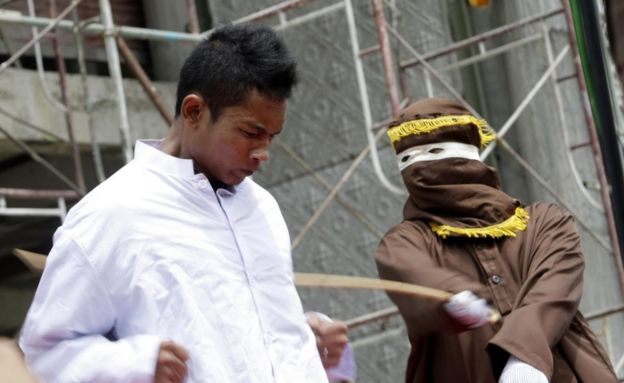
    Gay sex between Muslim men or women, both locals and foreigners, can now be punished with 100 strokes of the cane.

    The law, passed in 2014 but only now being enforced, has faced opposition by rights groups.

    The strictly Muslim province has become increasingly conservative in recent years and is the only one in Indonesia allowed to implement Sharia law.

    Under the new laws, adultery also carries a possible penalty of 100 strokes. Those who accuse someone of adultery without proof could themselves face 80 lashes.

    A man is caned for violating Sharia law

    “The law is to safeguard human dignity. It is to protect Aceh’s Muslims from committing immoral acts,” provincial Sharia chief Syahrizal Abbas told the AFP news agency.

    But Ismail Hasani, from human rights group the Setara Institute for Democracy and Peace, criticised the law as “cruel, inhumane and against the constitution”.

    Gay sex is not illegal in the rest of Indonesia.

    Aceh has allowed brought in its own laws ever since reaching an agreement with the national government in 2001 to end a separatist movement.

    The province has recently seen a deterioration in relations between the Muslim majority and smaller religious groups such as Christians.

    Churches have been destroyed in violent protests in recent weeks or have been demolished by local authorities who said they lacked proper permits.


    Source: www.bbc.co.uk

deneme bonusu