Tag: Islamic Defenders’ Front

  • In Indonesia, MUI Fatwa Seeks To Keep Santa Hats Off Muslims

    In Indonesia, MUI Fatwa Seeks To Keep Santa Hats Off Muslims

    JAKARTA — Apit Abdullah does not believe in Santa Claus.

    That is not surprising, considering that he is 18 years old. But Apit, a Muslim, was wearing a red Santa hat at the cafe where he works, inside the largest upscale shopping mall in Jakarta, the Indonesian capital.

    “It’s showing respect for the holiday,” he said of his Christmas-themed hat as he cleaned a window. “It’s no problem.”

    Others, however, are trying to make it one.

    This month, the Indonesian Ulema Council, the country’s largest body of Islamic clerics, issued a religious edict barring Muslims from wearing Christmas-themed clothing, specifically those working in shopping malls, department stores and restaurants.

    The council’s edict, known as a fatwa, is not legally binding, but it is nonetheless adding to growing political, ethnic and religious tensions prompted by the prosecution of Jakarta’s popular governor, who is Christian and ethnic Chinese, for blasphemy.

    Analysts as well as supporters of the governor, Mr Basuki Tjahaja Purnama, said that the case against him was orchestrated by opposition political parties to sideline him before a hotly contested election scheduled for February. The blasphemy accusations set off street protests in Jakarta in recent weeks that drew hundreds of thousands of conservative Islamists demanding that Basuki be jailed or killed.

    Although Indonesia is the world’s most populous Muslim-majority nation, it has a secular government and influential Christian, Hindu and Buddhist minorities. Christmas decorations, including trees, Santa statues and light displays, are common at shopping malls and hotels across the country each December.

    On Sunday (Dec 18), members of the Islamic Defenders Front, a hard-line group with a long history of violence against religious minorities, conducted sweeps on stores in Surabaya, the capital of East Java province and Indonesia’s second-largest city, to check that Muslims were not wearing Christmas-themed clothing.

    Analysts said they fear the edict could provoke religiously motivated violence.

    “The Islamists are pushing boundaries and gaining ground,” said Mr Rainer Heufers, executive director of the Centre for Indonesian Policy Studies, a nongovernmental think tank.

    While the Indonesian National Police said that they would not enforce the religious order, officers made no effort to arrest the Islamists who visited stores in Surabaya, and in fact escorted them to prevent clashes with non-Muslims. There were no reports of altercations or anyone being injured, but there were accounts that the Islamists sought to intimidate shop managers and workers into obeying the edict.

    On Wednesday, police killed three people suspected of terrorism in a firefight on the outskirts of Jakarta. They arrested three others armed with explosives who were believed to be planning suicide bombings on Christian targets on Christmas, further heightening tensions.

    The arrests and supposed plots have prompted foreign embassies, including that of the United States, to issue security warnings to their citizens living in or travelling through Indonesia.

    The Indonesian Ulema Council has defended its edict against Muslim workers wearing Santa hats, fake reindeer antlers and other Christmas-style clothing, saying it was “based on feedback from Muslim congregations”. The feedback asserted that Muslim shop workers were being compelled to wear clothing associated with Christianity, according to Mr Ma’ruf Amin, the council’s chairman.

    Many Indonesians, however, think the edict may be politically and racially motivated. Some note that in October, the council issued an edict forbidding Muslims from voting for non-Muslim candidates such as Mr Basuki.

    The governor is on trial over comments he made during a speech to fishermen in late September, when he lightheartedly cited the Quran and said it would be perfectly acceptable for Muslim voters to choose a Christian in the February election.

    “Recently we’ve seen politics mixed with religion, which is very dangerous,” Ms Alia Syarifiah, 28, a marketing professional, said as she waited for her order at a doughnut shop at a mall in central Jakarta. “People are thinking harmful thoughts.”

    Ms Alia, who is Muslim, was wearing a Christmas-style red dress in preparation for a holiday office party with her Christian colleagues. “I’m dressed up for Christmastime, but I don’t celebrate Christmas,’’ she said. “It’s about showing respect.”

    Her server, Ms Fharas Basmallah, 19, a Muslim who was wearing a Santa hat, said that she did not particularly like it but was asked by her employer at the doughnut shop to wear it.

    “I’m not pro-hard-line,” she said. “Lately, these mass Muslim organisations are getting more strict. Maybe they want to turn Indonesia into an Islamic state.”

    For decades, some political parties and hard-line Muslim groups have pushed to turn Indonesia into an Islamic nation like Saudi Arabia or Iran. The most recent push, analysts say, started after the country began moving toward democracy and decentralisation after the ouster of Suharto, the authoritarian president, in 1998.

    Autonomous provincial, district and city governments have over the past decade passed hundreds of bylaws inspired by Islamic law, or Shariah. The majority of the regulations single out women — enforcing dress and morality codes — while others are aimed at religious minorities or gay, lesbian and transgender Indonesians.

    There is also anecdotal evidence of “creeping Islamisation” in Indonesia, which recognises six official religions and whose national motto is “Unity in Diversity”. An increasing number of women, particularly younger ones, wear the traditional Islamic head scarf, or hijab, researchers say, and there has been an explosion of religiously oriented television talk shows and Quran study groups.

    Analysts say the edict against Muslims wearing Christmas-themed clothing is another example of the conservative agenda of Indonesian Islamist groups.

    “They’ve seen a new space that they’ve got and are trying to push forward,” Mr Heufers said. “Unfortunately, it’s a very smart move.”

    Mr Azyumardi Azra, a prominent Islamic scholar and a member of the advisory board to the leadership of the Indonesian Ulema Council, said he did not believe the council was seeking to make the country an Islamic nation.

    “The problem is the MUI leadership has no workable coordination and strategy to deal with sensitive issues related to the pluralist Indonesian nation,” he said, referring to the council by its Indonesian acronym.

    “The MUI is very prone to infiltration by the radicals, who are taking advantage of its position,” he said.

    For Ms Lia Ramhawati, 36, who sells perfume at an upscale department store in central Jakarta, the uproar over Christmas clothes is much ado about nothing.

    Although she and her colleagues have never been asked by management to wear Christmas attire, Ms Lia, who is Muslim, said she would have no problem doing so.

    “If the bosses tell us, we really don’t have a choice,” she said. “But I don’t care. It’s just about showing respect for Christians.”


    Source: www.todayonline.com

  • Indonesia Police Arrests 3rd Woman In Foiled Bomb Attack On The Presidential Palace

    Indonesia Police Arrests 3rd Woman In Foiled Bomb Attack On The Presidential Palace

    JAKARTA — Indonesian police early on Thursday (Dec 15) nabbed a woman believed to have instructed a female would-be suicide bomber to launch a foiled attack on the Presidential Palace, as a senior Indonesian Cabinet Minister declared that the government is not losing the fight against radicalism.

    National police spokesperson Senior Commander Martinus Sitompul said they nabbed the female suspect, Tutin Sugiarti, 37, at a rented home in a village near Tasikmalaya city in West Java at 4.30am (local time).

    “She has given motivation to Novi to jihad (martyr),” he was quoted as saying in Antara news portal.

    Sugiarti is believed to have played a part in recruiting Dian Yuli Novi, 27, who was arrested on Saturday in Bekasi, West Java. Novi had intended to use a 3kg homemade pressure-cooker bomb for a suicide attack at the palace during the change of guard ceremony on Sunday.

    Sugiarti’s husband Hendra Gunawan, 39, was also arrested but it is not clear if he was involved in the terror plot, the authorities said.

    Sugiarti is the third woman arrested over the planned Sunday attack inspired by the Islamic State (IS), after Novi and Arida Putri Maharani, 25, were arrested by the police counter-terrorism squad over the weekend.

    Novi, who was among a group of seven people arrested, had worked in Singapore as a nanny, while Indonesian reports said Maharani facilitated the use of funds in the making of the bomb. Novi’s arrest came minutes after two men who delivered the bomb were ambushed by the counter-terrorism squad in

    East Jakarta. Another bomb maker was later caught in Central Jakarta.

    Maharani was arrested on Sunday in Sunda, a town in Solo. She is believed to be the wife of one of the two men and was also being prepared as a suicide bomber.

    Authorities said the group was controlled by a new terrorist cell based in Solo. The cell, police said, was set up by Bahrun Naim, an Indonesian militant who is in the Middle East fighting alongside IS militants.

    Naim is the mastermind of a terror attack in Jakarta in January, a July suicide attack on a police station in Solo, Central Java, and more recently, a plot to attack Singapore’s Marina Bay by launching a rocket from Batam.

    Meanwhile, senior Indonesian Cabinet Minister Luhut Binsar Pandjaitan, who is close to President Joko Widodo, said the government needs to reinforce Indonesia’s founding ideology, Pancasila, which included national unity and social justice among its five principles.

    He said it has been neglected since the fall of former President Suharto in 1998 ushered in democratic rule.

    “We are not losing control (against radicalism),” he declared.

    Massive protests demanding the arrest of Jakarta governor Basuki “Ahok” Tjahaja Purnama, who is on trial for alleged blasphemy, have affected the image of Indonesia as practising a moderate form of Islam and shaken the secular government.

    The blasphemy controversy has also given a national stage to the Islamic Defenders Front, previously known as a morals vigilante group with members involved in protection rackets.

    Its leader, Rizieq Shihab, told a Dec 2 protest in Jakarta that Indonesia would be peaceful if there was no blasphemy and other problems such as gays.

    Mr Pandjaitan said the government has Mr Shihab in its sights.

    “We have quite detailed data about him. We’ll see what happens. We know what we are going to do,” he said. “The President is very brave to do whatever is necessary for the benefit of this country. No hesitation at all.”


    Source: www.todayonline.com

  • Jakarta Anti-Governor Protest: Cars Burnt, 1 Dead And Many Injured

    Jakarta Anti-Governor Protest: Cars Burnt, 1 Dead And Many Injured

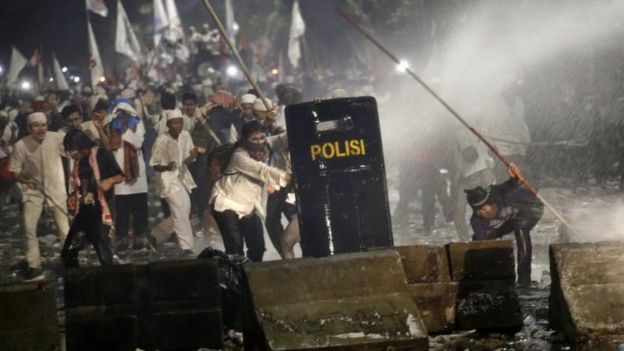
    Indonesian police have used tear gas and water cannon to subdue protesters as thousands of hard-line Muslims marched against Jakarta’s governor.

    Basuki Tjahaja Purnama, a Christian, is the first ethnic Chinese to hold the governor’s post in the capital of majority Muslim Indonesia.

    The demonstrators accuse him of having insulted Islam’s holy book, the Koran, and want him to be prosecuted.

    Clashes broke out between police and protesters who refused to disperse.

    One elderly man died, the Associated Press reports, citing police. Several other people, including police officers, have been injured.

    Protesters had earlier marched upon the presidential palace.

    Police had been braced for the possibility of religious and racial tensions erupting at the rally, which an estimated 50,000 people attended.

    It had mostly been peaceful but groups of angry demonstrators clashed with police after nightfall and set vehicles alight.

    In 1998, a wave of anti-Chinese sentiment led to mobs looting and burning Chinese-owned shops and houses. Ethnic Chinese make up about 1% of Indonesia’s population of 250 million people.

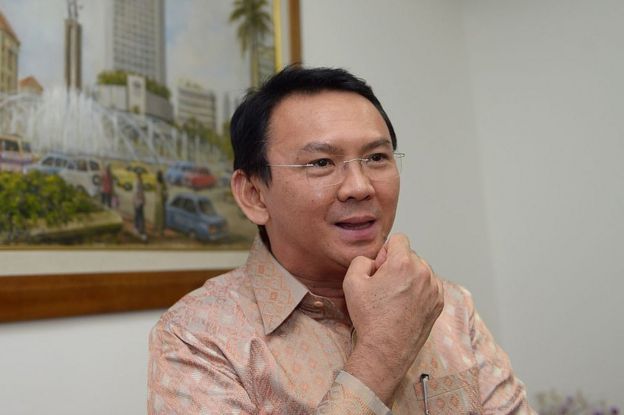
    Basuki Tjahaja Purnama, known by his nickname Ahok, speaks to journalists at his office in Jakarta in 2014
    Protesters are sprayed with water from a police water cannon truck during a clash outside the presidential palace in Jakarta, Indonesia, Friday, Nov. 4, 2016

    The protest was held to demand that Mr Purnama be prosecuted for blasphemy over comments he made in September that were seen as criticising a Koranic verse.

    He said that Islamic groups using a passage of the Koran to urge people not to support him were deceiving voters, who will go to the polls in February.

    The verse is interpreted by some as prohibiting Muslims from living under the leadership of a non-Muslim.

    Mr Purnama has since apologised but formal complaints were lodged against him by Islamic groups for defamation. He is now being investigated by police.

    Who is Governor Ahok?

    Some protesters at Friday’s rally carried signs calling for the governor’s death, the BBC’s Rebecca Henschke in Jakarta says.

    Representatives met with Vice-President Yusuf Kalla, who promised that the investigation into Mr Purnama would be completed within two weeks.

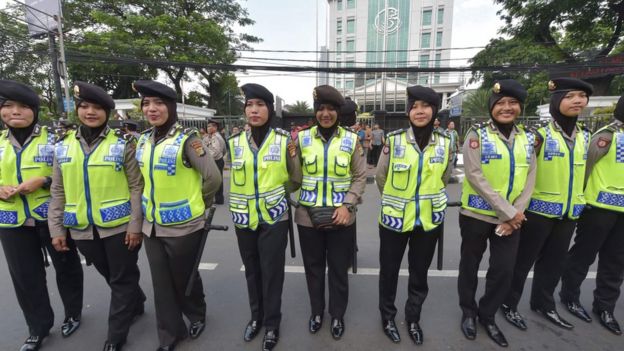
    Indonesian policewomen stand guard as Muslims march towards the presidential palace during a protest against Jakarta governor Basuki Tjahaja Purnama also known as Ahok over an alleged blasphemy in Jakarta on November 4, 2016

    There have long been tensions around Mr Purnama political role.

    In 2014, he was the deputy governor under Joko Widodo. When Mr Widodo was elected president the main group behind the current protest – Islamic Defenders Front (FPI) – did not want Mr Purnama to succeed him.

    They argued that a Christian should not govern a Muslim-majority city. The campaign against him has since taken on anti-Chinese overtones, though the FPI said the rally was not about the governor being from a minority group.

    Jakarta police said there were “provocative statements and images” on social media urging people to take violent action against Mr Purnama, including calls to kill him.

    Despite being seen as brash and outspoken, the governor is popular among many in the capital and has been praised for his effectiveness.

    Muslims in Indonesia are largely moderate and the country’s largest Islamic organisation, Nahdlatul Ulama, had advised its 40 million members not to take part in the protest.


    Source: www.bbc.com