Tag: Lee Wei Ling

  • Lee Wei Ling: Honour The Spirit Of What Lee Kuan Yew Stood For

    Lee Wei Ling: Honour The Spirit Of What Lee Kuan Yew Stood For

    On April 6 a journalist from the Chinese evening paper Lianhe Wanbao sought to interview me about my father Lee Kuan Yew.

    This was two weeks after Papa died, yet the outpouring of adulation from usually unemotional and often undemonstrative Singaporeans remained unabated. There were long queues to see Papa’s memorabilia at the National Museum. Stories and anecdotes about Papa continued in the media.

    One example was a short telegram Papa sent home telling when he would arrive and a cryptic one word, “battleship”, which he used to tell his family he wanted steamboat for dinner. Unfortunately, no one understood what he meant and there was no steamboat for dinner. While it was entertaining, I found the story neither newsworthy nor educational.

    One village in Tamil Nadu is planning to build a statue of Papa, another a museum, while a third wants to devote a memorial hall to honour his memory. If Papa were not cremated, he would be turning in his grave in shock and distress.

    Closer to home, I was baffled by the news that our MPs were suggesting naming various structures or institutions after Papa.

    Papa had worked hard to prevent any personality cult from growing around him. It would most certainly go against what he would want and what he stood for in life, such as service to Singapore and Singaporeans, because that was the right thing to do, without any ulterior motive, least of all self-promotion.

    In life, Papa had to face publicity as he galvanised Singaporeans and put his views across to them, to persuade them to accept his decision about what needed to be done for their own welfare. He never courted publicity merely for the sake of publicity. When I wrote articles that mentioned him, I always checked with him before doing so, and his reply would be, “OK, but no hagiography”.

    His reply to an ex-MP’s suggestion to name a monument or public structure after him was simply: “Remember Ozymandias.”

    Ozymandias was a pharaoh in ancient Egypt. A sonnet by the 19th-century English Romantic poet Percy Bysshe Shelley refers to a huge but fragmented statue of Ozymandias with these words carved on its pedestal: “My name is Ozymandias, king of kings: Look on my works, ye Mighty, and despair!”

    But nothing remained except the desert. Shelley’s moral was that all prominent figures and the empires they build are impermanent, their legacies doomed to decay into oblivion.

    The best response to Papa’s passing is to honour the spirit of what he stood for, which is the welfare of Singaporeans. There is much that we can all work towards for this purpose.

    Similarly, to fuss over Papa’s personal objects or portrait defeats the purpose that he had strived for so diligently in life, which was the welfare of Singaporeans.

    Yet, what I am told is stirring up Singaporeans is the house Papa lived in which was built more than 100 years ago. In his book, Hard Truths, he said he wanted it demolished because it was too expensive to preserve.

    That he did not want the house preserved is obvious from his will which states: “It is my wish, and the wish of my late wife, Kwa Geok Choo, that our house at 38 Oxley Road, Singapore 238629 be demolished immediately after my death or, if my daughter Wei Ling would prefer to continue living in the original house, immediately after she moves out of the house. I would ask each of my children to ensure our wishes with respect to the demolition of the house be carried out.

    “If our children are unable to demolish the house as a result of any changes in the law, rules or regulations binding them, it is my wish that the house never be opened to others except my children, their families and descendants.

    “My view on this has been made public before and remains unchanged. My statement of wishes in this paragraph may be publicly disclosed notwithstanding that the rest of my will is private.”

    Fellow Singaporeans, let us move on in a post-Lee Kuan Yew era and continue to behave with kindness and consideration towards each other and work for a better Singapore for Singaporeans.

    If we, by the way, also benefit fellow humans who are not Singaporeans, that would not be a bad thing either. We are all born into this life and we shall all eventually die. Our existence between these points in time would be more meaningful and fulfilling if we can help other fellow human beings.


    Source: www.straitstimes.com

  • Family Will Respect Lee Kuan Yew’s Wish For Oxley Rise House To Be Demolished

    Family Will Respect Lee Kuan Yew’s Wish For Oxley Rise House To Be Demolished

    The late Mr Lee Kuan Yew had specified in his will that the house he shared his late wife on Oxley Road be demolished after his death, and this wish will be “administered strictly”, said his children Dr Lee Wei Ling and Mr Lee Hsien Yang.

    In a statement issued yesterday (April 12), Dr Lee and Mr Lee Hsien Yang, who are the executors and trustees of the late Mr Lee’s will, said their father had given them clear instructions directly and in his will — dated Dec 17 2013 — to demolish the house immediately after his death. If Dr Lee continued to live in the house, then the house should be demolished immediately after she moved out.

    The late Mr Lee, who passed away on March 23, had been aware of the calls to preserve his home, but his wish expressed to his children and publicly was “unwavering” — that the house to be torn down upon his passing, said Dr Lee and Mr Lee Hsien Yang.

    “He was concerned an order might be issued against his wishes. He therefore added in his Lee Kuan Yew Will that ‘If our children are unable to demolish the House as a result of any changes in the law, rules or regulations binding them, it is my wish that the House never be opened to others except my children, their families and descendants’,” they said.

    They added: “Our father has given his life in service to the people of Singapore. We hope that the people of Singapore will honour and respect his stated wish in his last will and testament.”

    Prime Minister Lee Hsien Loong, the late Mr Lee’s eldest child, will address the issue of his father’s home in Parliament today (April 13).


    Source: www.todayonline.com

  • Top 10 Searches On Yahoo Singapore Were Related To Lee Kuan Yew

    Top 10 Searches On Yahoo Singapore Were Related To Lee Kuan Yew

    On the day Singapore bid farewell to Lee Kuan Yew, the former Prime Minister was obviously on the minds of everyone in the country. The top 10 searches on the Yahoo Singapore search engine were all connected in some way to him and his funeral.

    Here they are:

    Lee Kuan Yew Funeral

    The state funeral of the late Lee Kuan Yew took place on Sunday. Tens of thousands braved the heavy rain to line the route of the funeral procession.


    Lee Hsien Loong

    He delivered the first eulogy for his father and at times, he had trouble choking back his tears.


    Lee Wei Ling

    The only daughter of the late Lee Kuan Yew, the director of the National Neuroscience Institute was rarely seen during the Lying-in-State of her father.

    Lee Hsien Loong and family walking during funeral procession. 


    Lee Hsien Yang

    The younger son of the late Lee Kuan Yew and the chairman of the Civil Aviation Authority of Singapore, he delivered the final eulogy and spoke on behalf of the Lee family.

    Lee Hsien Yang, son of former leader Lee Kuan Yew, delivers his eulogy during the funeral service at the University Cultural Centre at the National University of Singapore March 29, 2015. Grieving Singaporeans were joined by world leaders on Sunday to pay their final respects to the country's first prime minister, Lee Kuan Yew, as the nation came to a near-halt to honour its "founding father". REUTERS/Edgar SuLee Hsien Yang, son of former leader Lee Kuan Yew, delivers his eulogy during the funeral service at the University …


    Remembering Lee Kuan Yew

    A website and Facebook page called“Remembering Lee Kuan Yew” was set up to provide important information to mourners. Details such as queue updates to the Lying-in-State and funeral procession can be found on the site. It was also a trending term on Twitter after Lee’s death.

    Screengrab of the Remembering Lee Kuan Yew website.


    Kwa Geok Choo

    She is the deceased wife of the late Lee Kuan Yew, who passed away before him in 2010. After her death, Lee was never quite the same.

    FILE - In this May 1, 2006, file photo, Singapore's then Minister Mentor Lee Kuan Yew, left, shares a light moment with his wife, Kwa Geok Choo, right, during the Labour Day Rally in Singapore. Lee Kuan Yew, the founder of modern Singapore who helped transform the sleepy port into one of the world's richest nations, died Monday, March 23, 2015, the government said. He was 91. (AP Photo/Wong Maye-E, File)


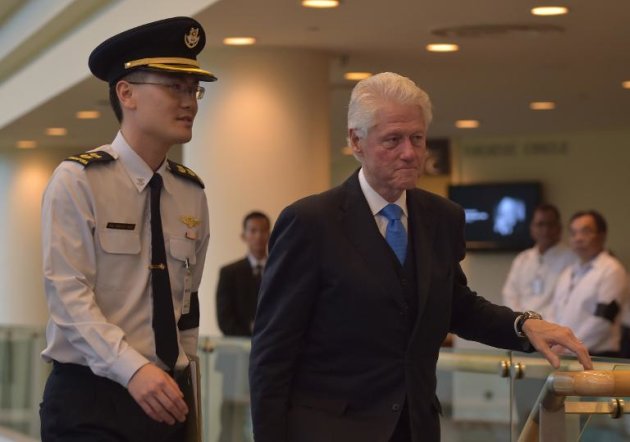
    Bill Clinton

    The former US president lead a high-powered delegation from the US who included Henry Kissinger, the former US Secretary of State.

    Former US president Bill Clinton arrives at the University Cultural Center (UCC) for the funeral services for Singapore's former prime minister Lee Kuan Yew in Singapore on March 29, 2015


    Goh Chok Tong

    Goh Chok Tong is the emeritus senior minister of Singapore. He succeeded Lee as the second prime minister of Singapore from 1990 to 2004. In his eulogy, Goh said, “For me, he would always be my teacher.”

    Emeritus Senior Minister Goh Chok Tong and wife paying their respects to Mr Lee Kuan Yew at the Family Wake on 23 Mar 2015 at the Sri Temasek, Istana. (Photo courtesy of Ministry of Communications and Information, Singapore) 


    Lee Kuan Yew Biography

    The late Lee Kuan Yew has written a two-volume set of memoirs, among many other books and essays.


    King of Bhutan

    The King of Bhutan, Jigme Khesar Namgyel Wangchuck, came to Singapore to pay his respects to the late Lee Kuan Yew and attend his state funeral.

    The King of Bhutan pays his respects to the late Lee Kuan Yew. 
    Source: https://sg.news.yahoo.com


  • Dr Lee Wei Ling’s Eulogy To Lee Kuan Yew At The Mandai Crematorium

    Dr Lee Wei Ling’s Eulogy To Lee Kuan Yew At The Mandai Crematorium

    The late Mr Lee Kuan Yew had developed Parkinson’s disease three years ago which severely limited his mobility, said his only daughter Lee Wei Ling at the family’s private cremation service on Sunday evening.

    “He had great difficulty standing and walking. But he refused to use a wheelchair or even a walking stick. He would walk, aided by his SOs,” Dr Lee said at the Mandai Crematorium.

    He was also plagued by bouts of hiccups, and his ability to swallow both solids and liquids was impaired.

    Mr Lee, who died at the age of 91 on March 23, “searched the Internet and tried a wide variety of unorthodox hiccup therapies”.

    “For example, he once used rabbit skin and then chicken feathers to induce sneezing, so as to stop the hiccups. Although the sneezing sometimes stopped his hiccups, it did not do so consistently enough,” she told a gathering of family and people who had worked closely with Mr Lee.

    She said Mr Lee also tried reducing his food intake because he felt that eating too much could precipitate hiccups, “hence he lost a lot of weight, and appeared thin and gaunt”.

    She said her father was stubborn and determined. He would insist on walking down the steps at home, from the verandah to the porch where the car was parked.

    Mr Lee’s daughter-in-law Ho Ching had a lift installed so he need not negotiate those steps. But when he was aware and alert, he refused the lift though it was a struggle for him to walk down those steps even with three security officers (SOs) helping.

    “But the lift was not installed in vain,” she said. “On several occasions when he was ill and needed to be admitted to SGH, he did not protest when the SO guided him onto the lift. Still, even when ill, if he was asked if he wanted to use the lift, the answer would invariably be ‘no’.”

    Dr Lee devoted a part of her eulogy to thanking the SOs whom she said were an integral part of Mr Lee’s life, even more so in the last five years.

    “They looked after him with tender loving care, way beyond the call of duty. One doctor friend who came to help dress a wound Papa sustained when he fell, noticed this and said to me: ‘The SOs look after your father as though he is their own father.’”

    She said her father was also very considerate towards his SOs. During an official trip to Saudi Arabia, an SO came down with chicken pox. Rather than leave him behind in a hospital there as doctors suggested, he insisted the SO return to Singapore with the rest of the delegation.

    “He wasn’t going to leave any Singaporean behind, not least an SO.”

    Sensing he was special, all the SOs have been very kind to Mr Lee she said, adding: “On behalf of my family, I would like to thank all of them. I know each of them well, even the number of children they have. To me, they were not only staff whose job was to look after Papa, but also friends of the family. They helped me pull out the SIM card from my blackberry when it hung; they were friends for me to share food and goodies with whenever the opportunity arose.”

    She said that soon after her father died, one of the SOs, Yak, called to inform her of it.

    “After being in my room alone and unable to go back to sleep, I went downstairs to the SOs room, and sat with the two SOs on duty, watching black and white footage of Papa in his younger days. I needed the company of friends. Junji jichaou dan ru shui. There is a Chinese saying that the relationship between two honourable gentlemen is as understated as plain water. That was the relationship between the SOs and me,” she said.

    She also revealed that once, Mr Lee choked on a piece of meat. The quick-thinking SOs – Liang Chye, ASP Yak and Kelvin – managed to save him through the Heimlich manoeuvre.

    “They coordinated their pull, and after several attempts, the piece of meat was finally ejected. By this time, Papa had already turned purple. But within seconds of the meat being dislodged, he was mentally alert.”

    She gave special thanks to Liang Chye and Kelvin, and especially ASP Yak, whose presence of mind saved Mr Lee’s life, she said.

    “To all the SOs who have served Papa over the years, I thank you on behalf of my family,” she said.

    She also thanked all the nurses, doctors and specialists who had looked after Mr Lee over the years, especially those involved in the last five years of his life, when his medical problems multiplied and became more complicated.

    “I am grateful to each and every one of them for all the care they have provided to Papa,” she said. “Thank you all – doctors, nurses and physiotherapists – who have helped Papa be as comfortable as possible in his final days. My family is extremely grateful to all of you.”

    Dr Lee also thanked the staff of the Prime Minister’s Office who kept the office running smoothly in Mr Lee’s absence. “Thank you all for being with Papa and for helping to ease his suffering in the last five years of his life. Thank you for being here with us today, to bid farewell to Papa.”

    She spoke about the influence her father had on her, and how they were similar temperamentally, for example their determination to exercise.

    Mr Lee would complete his 12 minutes on the treadmill, even on days that he was tired, she said. “The SOs were amused because they knew I was equally fanatical about exercise. Today, I have run up and down my 20 metre corridor 800 times, making it to 16 km.”

    She also said: “Papa, I know you would have preferred if I had married and had children. But I have no regrets, no regrets I was able to look after you and Mama in your old age.”

    The most important lesson she learnt from her father, she said, was “never to push around anyone simply because he or she is weaker than me or in a socially inferior position”. Also, “never to let anyone bully someone else if I am in a position to stop such bullying.”

    She added on a poignant note: “This morning I noticed that the maid, in setting the dining table, had moved away Papa’s chair and placed it against the wall. It was a poignant reminder that this farewell is for ever. I have been controlling my feelings for this past week, but looking at this unexpected scene, I nearly broke down. But I can’t break down, I am a Hakka woman.

    “Farewell Papa. I will miss you. Rest in peace.”


    Source: www.straitstimes.com