Tag: Lui Tuck Yew

  • Lui Tuck Yew: Drop In Oil Price Could See Decrease In Public Transport Fares

    Lui Tuck Yew: Drop In Oil Price Could See Decrease In Public Transport Fares

    The drop in energy prices seen in 2014 could translate to a reduction in public transport fares in the next fare review exercise at the end of the year.

    Based on available data for 2014, the fare adjustment could be “in the region of negative one per cent”, said Transport Minister Lui Tuck Yew in Parliament on Monday (Jan 19), in response to a question on the fall in oil prices.

    MP Gan Thiam Poh had asked, with regard to the ongoing 2014 fare review exercise, whether the Public Transport Council would consider a reduction of transport fares, as a result of the fall in oil prices since June 2014.

    However, Mr Lui noted that the ongoing fare review exercise, which started in November 2014, looks at changes in indices for 2013.

    “We will have to leave it to the Public Transport Council to assess the public transport operators’ applications for fare increase, the fare adjustment quantum as given by the formula and the affordability of public transport for Singaporeans, amongst other things, and decide on the fare adjustment,” the minister said.

    The fare formula is pegged to changes in the core consumer price index, wage index and energy index over the preceding year. This reflects the operating cost structure of public transport operators, said Mr Lui.

    The core consumer price index and wage index account for 40 per cent of the formula each. The energy index component, which accounts for energy and fuel costs, makes up 20 per cent.

    In the ongoing 2014 exercise, the value of the energy index component was negative 12.6 per cent – due to lower energy prices in 2013 – but the core consumer price index went up by 1.7 per cent, while the wage index saw an increase of 4.3 per cent.

    The fare adjustment quantum yielded by the formula would have been negative 0.6 per cent for the 2014 fare review exercise. However, the previous fare review exercise had announced a fare increase of 6.6 per cent in two steps.

    A 3.2 per cent hike was introduced in April last year, with the 3.4 per cent increase to be carried over to the ongoing review. Mr Lui explained that is why there is a 2.8 per cent fare adjustment quantum for the ongoing fare review exercise.

    The next fare review exercise is set to take place towards the end of 2015 and is based on data for the full year of 2014.


    Source: www.channelnewsasia.com

  • Shorter Waiting Times Expected During Peak Periods Beginning Late 2015

    Shorter Waiting Times Expected During Peak Periods Beginning Late 2015

    SINGAPORE: Train commuters can expect shorter wait times, particularly during peak periods, from later this year, with new measures announced by the Land Transport Authority (LTA) on Thursday (Jan 15).

    Waiting times are expected to be reduced with the deployment of new trains from the second half of 2015 and the completion of re-signalling works on the North-South Line (NSL) and the East-West Line (EWL) in 2016 and 2018 respectively.

    Trains should also come more frequently during rush hour as LTA further tightens the Operating Performance Standards (OPS) for train frequencies during morning, evening and shoulder peak periods for the North-South and East-West Line, North-East Line and Circle Line. This will be introduced progressively from 2016.

    “Tightened Operating Performance Standards should lead to shorter wait times, increased reliability and better journeys,” said LTA’s chief executive, Mr Chew Men Leong, at a press conference.

    “New trains will be put into service from the second half of 2015 onwards, and the expanded train fleets will allow train trips to eventually increase by an estimated 8 per cent. During peak periods, peak capacity is estimated to increase by about 25 per cent for rising travel demand,” LTA said.

    Under new standards, passengers should see trains arriving faster. Commuters Channel NewsAsia spoke to welcomed the move.

    Said one commuter: “The trains can be so crowded – I have to squeeze in. In future, if the trains arrive faster, I won’t have to.”

    Another commuter hoped the measures would kick in sooner: “If you can implement it sooner, it would be better.”

    A third commuter said: “At Somerset, Orchard, there will be a lot of people waiting for trains. Dhoby Ghaut is quite crowded and City Hall as well. If the trains come faster, or have a higher frequency, then we do not have to wait as long. The platform won’t be as crowded, because, obviously, who wants to wait?”

    MORE TRAINS OUT ON THE TRACK

    LTA also intends to introduce a new fleet availability standard to ensure train operators maximise the number of trains available in their expanded fleets for passenger service during peak periods. This will include train availability standards of no less than 90 per cent for the morning peak period.

    Transport Minister Lui Tuck Yew had said last November that LTA is reviewing the MRT OPS to further tighten headways requirement during peak periods and to reduce incidents of service degradation.

    TRACKING SEVERE INCIDENTS

    LTA also plans to further tighten the Frequency of Occurrence standard in relation to “severe service degradation”, which it defined as incidents persisting for more than 60 minutes. This could include times when trains are available but running at slower speeds, or longer stretches between trains for prolonged periods which might result in longer journey times for commuters.

    This standard is different from train disruptions which, LTA officials pointed out, referred to incidents when there are no trains arriving at stations for more than 30 minutes.

    “Operators will thus be held to higher service standards with the tracking of more incidents that inconvenience commuters,” it said.

    Asked how often these “severe service degradation” incidents must occur before operators are censured, LTA’s deputy chief executive, Mr Chua Chong Kheng, said at the sidelines of the briefing that “it depends on a case-by-case basis”.

    LTA said it has started consulting the operators to implement the tightened standards in stages.

    HIGHER SECURITY STANDARDS

    The agency also intends to introduce new standards to enhance the security of the MRT network, in particular the reliability of operators’ Video Surveillance Systems (VSS) for stations, trains and depots.

    Said Mr Chew: “Video surveillance systems as well as the perimeter fencing as well as lighting within the depot, all that will ensure that equipment relating to security will be at its highest operational state, ensuring that we can have good security around key depots and installations which are part of our train system.”

    This is separate from an existing Code of Practice which sets out security standards for MRT systems as of Jan 1, 2014.

    Asked what is the expected availability operators should maintain for the VSS, LTA officials said it should “be as high as can be achieved”, without elaborating.

    TIGHTENED OPS ‘CONSISTENT’ WITH SMRT’S FOCUS

    In a press release on Thursday, Mr Lee Ling Wee, managing director for SMRT Trains, said LTA’s statement on improving rails services in Singapore is “consistent” with the company’s focus on robust operational and maintenance regimes, and efforts to deliver “safe, reliable and customer-centric services to all commuters”.

    “SMRT will work towards meeting the new Operational Standards set by LTA, while efforts are underway to renew an ageing rail infrastructure and to cater to much higher passenger loads,” Mr Lee stated.

    He noted the transport operator has made “good progress” in the past year, particularly in sleeper replacement works on the NSL. These efforts will continue over the next few years with sleeper replacement works on the EWL.

    SBS TRANSIT ‘WORKING CLOSELY WITH LTA’ ON PROPOSED CHANGES

    In response to media queries, SBS Transit said it is “working closely with the LTA on the proposed changes”.

    “We always have, and will continue, to work hard at improving our level of service to commuters,” said its spokesperson.

    JOINT EFFORT BY LTA, PUBLIC TRANSPORT OPERATORS TO RESULT IN BETTER TRANSPORT SYSTEM: LUI

    In a Facebook post, the Transport Minister said he asked the LTA to review the OPS in 2013, so commuters can experience shorter waiting times for trains.

    Mr Lui added that this further tightening is planned “in anticipation of the completion of the re-sleepering and re-signalling works” and the arrival of more trains. He also noted that Public Transport Operators (PTOs) will be held to higher service standards – these include lifts and escalators in train stations.

    “I know that this joint effort by LTA and the PTOs will result in a better transport system in the coming years,” he said.


    Source: www.channelnewsasia.com

  • Paper Generals Should Be Left Out Of Politics

    Paper Generals Should Be Left Out Of Politics

    The Singapore Cabinet comprises the PM, 2 DPMs and 15 ministers. 5 of them, or slightly more than a quarter, had been generals/equivalent in the military before becoming politicians.

    Another country with many high ranking military officers in the government is North Korea. Myanmar which used to parachute generals into top positions in the government have recently begun a cabinet reshuffle to replace ministerial positions held by the military with scholars. It appears Singapore has regressed – the number of ex generals increased after the last election (ex general George Yeo replaced by Chan Chun Sing and Tan Chuan Jin).

    Military men do not make good leaders in the government for the simple fact that they are used to giving orders. They are not listeners but control freaks. This is evident in Singapore where the mainstream media, grassroots organisations and government bodies continue to be controlled by the PAP.

    Our leader, PM Lee, is himself an ex general, the youngest in Singapore’s history. That PM Lee does not listen is obvious from his ‘solutions’ to our chronic problems ie.

    – Overcrowding/increased cost of living – increase the population to 6.9 million under PAP’s PWP.
    – CPF retirement shortfall – sell HDB homes and downgrade with assistance from HDB.
    – CPF and statutory board failure – edit government web pages and continue to conceal data from the public.
    – High cost of public housing – change the Resale Price Index to make prices look lower.
    – Rat infestation – HDB, town council and NEA not responsible but blame feeding of stray dogs.
    – Foreigners displacing Singaporean employees – employ more foreigners because Singaporeans are overpriced and foreigners help to create jobs for us.
    etc.

    Ten years under ex-general PM Lee’s leadership, Singaporeans have only experienced policy failure after failure. Instead of addressing them, the PAP only masks its failure with the implementation of the PGP, dishing out more grants, shoves its own ‘right’ version of Singapore’s history down our throat, attempts to control online media, silence the CPF ‘noises’ at Hong Lim Park, etc.

    What’s worse about our system is that ALL the generals DO NOT have any combat experience. These paper generals have been fast-tracked because of their stellar academic results and nothing else. What are their real achievements? Transformation of the army by throwing tax dollars at costly state-of-the-art weapons? Introducing pixelised uniforms which have been ditched by the US army? It’s a waste of tax dollars to have about 20 to 30? paper generals on a little red dot.

    SAF/President’s scholars are destined for top jobs in the military since day one. These scholars are ‘untouchable’ and their superiors are acutely aware of their limitations. They simply are not able to understand what the rank and file/ordinary citizens go through.

    The 5 (ex) paper generals in our cabinet are:

    1 (Major General) Chan Chun Sing

    Chan is a PAP MP of Tanjong Pagar GRC which was a walkover in the 2011 election. As such, the popularity or unpopularity of Chan is unknown. Chan has not even spoken at an election rally but from this video, you can be certain he will be a flop without the GRC system.
    Chan has not worked a single day in the private sector and his understanding of local issues is suspect. He served in the army from 1987 to 2011 and was (coincidentally) promoted to army chief during his last year in the army.

    Chan was promoted to Brigadier General (BG) in June 2007. Three short years later, he was promoted to Major General (MG) without accomplishing anything significant. He stayed on as the chief of army and ‘retired’ after only 1 year of service/OJT, wasting precious tax dollars. If Chan had already decided to go into politics, he should have allowed others who would have stayed on to contribute to the army. Or was Chan promoted to look better in politics? Combat experience – zero.

    2 (Brigadier General) Tan Chuan Jin

    Like Chan, Tan also served in the army from 1987 to 2011. Among all the newbie ministers, Tan was the most respected. But from Tan’s handling of the CPF issue and the MOM’s reluctance to address the flawed immigration policy, Tan’s credibility has taken a beating. Tan’s fast-tracked career in the military has disconnected him from ordinary citizens. He has yet to realise PAP’s policy failure and prefers to continue with tweaks.

    3 (Rear Admiral) Lui Tuck Yew

    As an SAF scholar, Lui was fast-tracked to top navy position within 20 years, including his taxpayers-funded studies of course. He was also the CEO of HDB in 2005.

    4 (Rear Admiral) Teo Chee Hean

    Like scholar Lui, Teo’s military career saw him promoted to head the navy within 20 years.

    5 (Brigadier General) Lee Hsien Loong

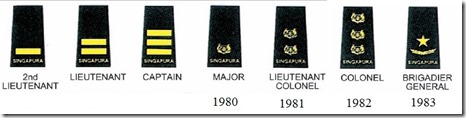
    Lee joined the SAF in 1971 and rose through the ranks to become the youngest BG in 1983 within a mere 13 years. Excluding the 5 years of studies funded by taxpayers, Lee achieved his miraculous promotion within 8 years. According to Dr Michael Barr, Lee “graduated in 1980 …by this stage he had risen to the rank of Major .. despite having only served for about three years on operational duty”.
    The interesting thing is Lee’s final years in the army where he had received a promotion every year from 1981 to 1983 without a single day in combat!

    In other democratic countries, it takes ‘forever’ to be promoted when one is already holding a very high ranking position. Guess our generals are not known as ‘paper generals’ for nothing.

    Lee’s phenomenal rise in the SAF?

    With a military career as smooth as silk, it is not that PM Lee doesn’t want to understand the reality of mere mortals like us but he really can’t.

    The table (below) is a summary of our paper generals.

    NAME ENLIST RESIGN YEARS RANK
    LEE HSIEN LOONG 1971 1984 13 BRIGADIER GEN
    TEO CHEE HEAN 1972 1992 20 REAR ADMIRAL
    LUI TUCK YEW 1983 2003 20 REAR ADMIRAL
    CHAN CHUN SING 1987 2011 24 MAJOR GEN
    TAN CHUAN JIN 1987 2011 24 BRIGADIER GEN

    * Lee Hsien Loong holds the world record for attaining the rank of BG in the shortest time, without any combat experience, in a democratic country. Our military is designed by scholars, for scholars. Every Tom, Dick and Harry scholar will become a general so long as he toes PAP’s line.

    PM Lee and DPM Teo were both born with a silver spoon in the mouth. One shouldn’t expect them to understand the struggles of ordinary/low wage citizens and PAP’s flawed policies confirm their disconnect.

    Real leaders should never be fast-tracked to top positions based on academic results. Currently, all paper generals are not really elected because of our unique GRC system designed to perpetuate PAP’s power.

    Running a government requires a consultative approach while it’s a top-down approach in the military. After years of a top-down approach, it becomes impossible to teach old dogs new tricks. Paper general George Yeo has already paid the price for not listening. Paper generals are failed politicians as is evidenced by their refusal to engage in a meaningful manner with their ‘wayangs’.

    Without a doubt, generals are army-trained and best left in the military. If paper generals can run our country, pigs should be able to fly.


    Source: http://likedatosocanmeh.wordpress.com


  • More Scope For Improvements In Public Transport

    More Scope For Improvements In Public Transport

    Years after the Government had pledged to improve the state of public transport — given the growing discontent with breakdowns and overcrowding — the biggest question on everyone’s minds is this: Have the aggressive measures worked and are the billions of dollars pumped in to lift the transport industry out of the doldrums reaping results?

    Official figures indicate some measure of improvement, but not all is rosy.

    Though the number of major train service delays — episodes lasting more than 30 minutes — for the entire MRT network has hit a new high this year, analysts said these were probably due to structural wear and tear of the ageing infrastructure, which takes time to rectify. They pointed to the occurrence of shorter delays — those lasting five minutes or so — and train withdrawals as evidence that the overhaul to the MRT and bus systems has seen incremental improvement.

    Still, more intermediary options can be added to augment the system, the experts felt.

    For instance, the number of City Direct Services — express bus routes run by private operators — could be ramped up, said National University of Singapore professor Lee Der-Horng.

    Nanyang Technological University (NTU) transport economist Walter Theseira added that as long as headline-grabbing major delays are still happening, it is difficult for commuters to feel the benefits from the improvement in the number of short delays.

    He also felt that what could make a difference to the commuter experience are a reduction in overcrowding and better reliability. Demand management policies, such as free travel during early hours and flexible work hours by companies, can make a perceptible difference in peak-hour crowding, he said, providing a respite until infrastructure improvements are completed.

    Indeed, the Government has been aggressively ramping up the capacity of existing train lines.

    The first of the 18 new North East Line and 24 new Circle Line trains are undergoing testing and will be progressively put into service from the middle of next year.

    Stage 2 of the Downtown Line, which comprises 12 stations running through the Bukit Timah corridor, is also set to open in a little more than a year, in the first quarter of 2016.

    The target of doubling the rail network from about 180km to about 360km in 2030 also appears to be on track.

    The Thomson-East Coast Line — a joint line between the Thomson Line and the Eastern Region Line with 31 new stations and seven interchanges — will be ready in stages from 2019. Two new rail lines, the Cross Island Line and the Jurong Region Line, are also being planned.

    Meanwhile, existing lines will get a facelift. Commuters staying between the Yishun and Sembawang MRT stations on the North South Line (NSL) can look forward to Canberra station, slated to be completed in 2019, with work starting in the middle of next year.

    On the maintenance front, re-sleepering work along the northern portions of the NSL, particularly the stretches between Bishan and Woodlands, has been progressing well. As of last month, about 76 per cent of sleepers on the line have been replaced and trains are now travelling at full speed from Yio Chu Kang to Khatib, said the Land Transport Authority (LTA).

    Other stretches will soon see a gradual lifting of speed restrictions next year. Work on the NSL is slated to finish by the middle of next year and the East West Line (EWL) by the end of 2016.

    An upgrade to the North South-East West Line signalling system is also set for completion in 2016 for the NSL, with the new signalling system installed at more than 73 per cent of the stations and tracks. New signalling equipment has also been installed and is being tested on 14 trains in the existing fleet. The EWL will begin its upgrade early next year and is expected to be completed by 2018.

    As for buses, the LTA’s billion-dollar Bus Service Enhancement Programme (BSEP), which aims to add 1,000 more buses by 2017, is showing preliminary results.

    Associate Professor Gopinath Menon, who teaches transportation engineering at NTU, acknowledged that there had been visible improvement in the bus industry under the BSEP. The recent reliability framework also helped in better assessing expected delays to passengers at bus stops, he added.

    With more than half of the buses under the BSEP having been added so far, the LTA said waiting times for commuters had been shortened by three to seven minutes on more popular services. The number of bus services that were persistently crowded during peak hours has also been reduced by 60 per cent. Thirty-six new bus services have been rolled out since the programme began in 2012, along with nine City Direct Services and 10 Peak Period Short Services.

    The authorities have also been rolling out “soft approaches” to improve the commuting journey, such as offering free travel to commuters who hop on before peak hours to eye-catching graciousness campaigns.

    An LTA spokesman said the shift of commuters from morning peak periods to pre-peak periods has been consistent since the introduction of free pre-peak travel in June last year, at around 7 per cent.

    This has resulted in a more even distribution of morning peak hour crowds, she noted, adding that capacity during the pre-peak period remained adequate.

    The Corporate-Tier Travel Smart Rewards programme has also seen results. Introduced in July after a two-year pilot, the scheme offers monetary incentives to companies that implement flexible travel arrangements. From only 12 organisations in the pilot in 2012, the scheme has seen 39 companies and about 6,700 employees signing up to date, said the LTA. New sign-ups include Standard Chartered Bank, DBS, Barclays and Arup.

    “As travel patterns typically take some time to stabilise, we expect to see preliminary results from the … participants some time mid-next year, with more definitive results around the end of 2015,” added the LTA spokesman.

    Despite the various efforts, it could be worthwhile to consider more alternative transport modes besides electric-vehicle sharing, for example, said Professor Lee. The authorities can explore “making use of low air space to allow cable cars or even elevated Personal Rapid Transit (PRT) to come into the picture”, he suggested. PRT, also known as a podcar, is a system of small automated vehicles operating on a network of specially-built tracks.

    With Certificate of Entitlement prices remaining high, there are more people scrapping their vehicles than new vehicles being registered, he said, signalling that more people could be switching to public transport.

    Assoc Prof Menon pointed out that the current usage ratio during peak hours for public to private transport is 63:37, still some distance away from the Government’s target of 70:30 by 2020.


    Source: www.todayonline.com

  • Congestion At New Bedok Integrated Transport Hub

    Congestion At New Bedok Integrated Transport Hub

    While the opening of the Bedok Integrated Transport Hub on Sunday (Nov 30) was marred by some commuter complaints of traffic jams, LTA said on Tuesday that anti-congestion measures had been put in place ahead of the opening of the transport hub.

    These measures include the widening of roads, assigning traffic marshals to control traffic, and the installation of sensors within the interchange that are meant to interact with the traffic lights to control the flow of buses in and out of the terminus, an LTA spokesperson told Channel NewsAsia.

    “However, some time is required for bus operations to familiarise with the new interchange, and to allow some fine tuning during the start of operations,” added the spokesperson.

    ‘BUS FLOW WAS PRETTY BAD’

    After Bedok Integrated Transport Hub opened, some complained that buses seemed to take longer than acceptable to leave and enter Singapore’s largest bus interchange.

    “The bus flow was pretty bad” on Sunday, said a commuter who chose to remain unnamed. He pointed the finger at the traffic light at the junction of Bedok North Drive – the road leading to the transport hub – and Bedok North Ave 1. “The roads here are also too narrow,” he added.

    Ms Emily Kan, 73, said the feeder bus trip from her home to the interchange, which used to take less than 15 minutes, took about half an hour on Sunday and Monday.

    Another commuter, Mr Eric Ng, said that the bus he took to the interchange on Monday at 8.30am took about 15 minutes just to enter the interchange. He noted that on the return journey, the bus he boarded left the interchange without any delays.

    The owner of a shop nearby, who identified herself as Ms Lin, 27, said one of her staff was late for work on Monday evening, having waited 40 minutes for the bus she was on to turn into the interchange. From 5pm to 5.40pm, the staff “could see the interchange but could not get down”, Ms Lin said.


    On Tuesday, a resident of one of the blocks directly facing the interchange said the traffic situation had improved since the day before, when she said there was a traffic jam during the morning rush hour. “Traffic has been smooth today,” said the resident, who also asked to remain unnamed.

    “LTA is monitoring the traffic situation closely and will continue to review for further adjustments to enhance the traffic flow,” the LTA spokesperson added.

    “THERE ARE SO MANY BUSES HERE”

    When Channel NewsAsia visited during the morning off-peak period, a string of buses were seen waiting for the traffic light to change in their favour, allowing them to turn right into Bedok North Drive from Bedok North Ave 1. Previously, buses entered the old terminal via New Upper Changi Road. No marshals were seen assigned to direct traffic.

    A commuter at the interchange on Tuesday afternoon, Madam Fathma Adam, 73, said she was not surprised about the jams. “There are so many buses here, and roads are very small, and there’s only one lane leading to the terminal,” she said.

    A shopowner, Ms Liang, noted that compared to the previous interchange, in which about “five or six” buses could stop concurrently to let passengers alight, only three buses can stop at the same time at the new transport hub.


    A bus captain who asked to remain unnamed also cited the number of traffic lights outside the terminal and the narrow lanes as possible causes of delays. “There is also limited parking space for the buses inside the interchange,” said the bus captain, who added that it was confusing that two of the three lanes exiting the terminal filtered to the left.

    Not all the chatter on social media was negative, with many lauding the new addition to the Bedok landscape.

    New bedok interchange. Life is good now pic.twitter.com/qnr5p1hjMj

    bedok inter expanding eastpoint opening whitesands renovating airport expanding & siglap restaurants life in the east has never felt so good

    Post by StarHub.


    The 1.6-hectare interchange, which is linked to Bedok Mall, allows commuters an air-conditioned transfer to Bedok MRT Station. A total of 29 bus services call at the hub.


    Source: www.channelnewsasia.com