Four Western tourists accused of being part of a group who posed nude at the top of Malaysia’s Mount Kinabalu have appeared in court in Sabah state.
Authorities said the two Canadians, a Briton and a Dutchman may be charged with causing public nuisance.
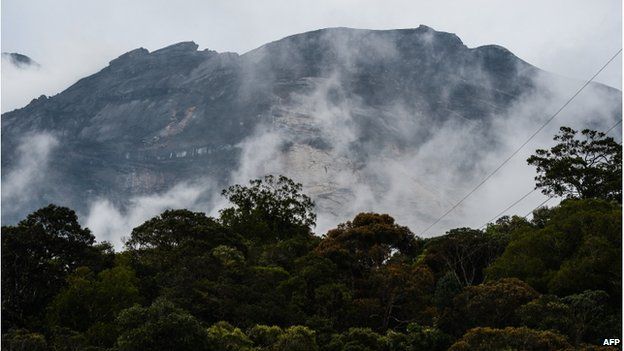
Mt Kinabalu was hit by a magnitude 6.0 earthquake last Friday which left 18 people dead, including children.
A senior minister last week said the tourists had angered the spirits of the mountain, which is considered sacred.
Six people sought
Ranau district police chief Mohd Farhan Lee Abdullah confirmed to the BBC that the authorities had arrested a British woman at Tawau airport in Sabah on Tuesday.
The two Canadians, who are siblings, and the Dutchman turned themselves in to police on the same day.
Their lawyer, Ronny Cham, told the BBC’s Jennifer Pak that he had requested the four be held apart from other detainees in order to ensure their safety.
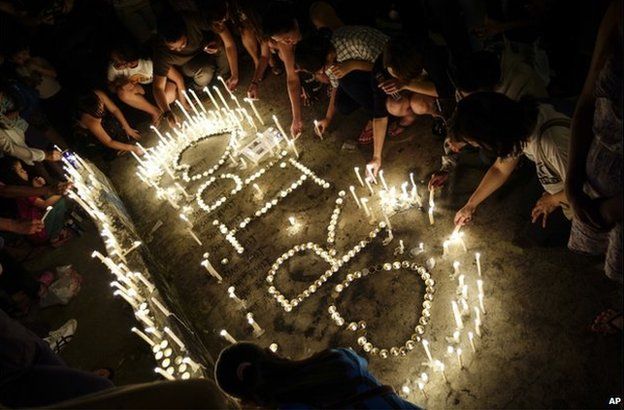
A candle-lit vigil was held on Tuesday for the victims of the Mount Kinabalu earthquake
The group appeared in court on Wednesday to have their remand extended, according to Malaysian newspaper The Star. They will now be held until Saturday while police continue their investigation.
Jalaluddin Abdul Rahman, Sabah’s police commissioner, was quoted by AFP news agency as saying that the authorities may charge them with causing a public nuisance.
He said they were still looking for six other tourists from the same group “and we will catch them”.
The father of the British tourist who has been arrested, Eleanor Hawkins from the English city of Derby, said he was extremely worried about her. “I have got every faith in [Malaysia’s] judicial system. I just hope they don’t make an example of them,” Tim Hawkins told the Guardian newspaper.
‘Disrespect’
The group of 10 foreigners had allegedly stripped naked and posed for pictures on 30 May. They were also said to have urinated on the mountain.
The Muslim-majority country is socially conservative, and Mount Kinabalu is also considered sacred by Sabah’s Kadazan Dusun tribe.
Pictures posted on social media angered many in Malaysia, but public sentiment intensified after the quake.
Why is Kinabalu sacred?
Sabah’s Kadazan Dusun tribe believe the mountain houses the spirits of their dead ancestors.
The name Kinabalu is derived from the tribe’s phrase “Aki Nabalu”, which means resting place of the dead.
Climbers are told by guides, many of whom are Kadazan Dusun, to treat the mountain with respect and to refrain from shouting, screaming or cursing at it.
Every December the tribe conducts a ritual called the Monolob to appease the spirits and allow climbers to continue visiting the mountain.
A priestess, called a Bobolian, makes an offering of seven white chickens accompanied by seven chicken eggs, betel nuts, tobacco, limestone powder, and betel plant leaves. The Bobolian leads a chant and the chickens are then slaughtered, cooked, and given to the ceremony participants.
In the past, this ceremony was conducted before every ascent, and climbers used the cooked meat as rations for their journey.
Last weekend, Sabah’s deputy chief minister, Joseph Pairin Kitingan, had linked the earthquake to the tourists’ act. He said the tragedy was a “confirmation” that they had showed “disrespect” to the mountain.
Sabah’s tourism minister, Masidi Manjun, said later that this idea was “misconstrued”, but added that the tourists’ actions “were against the people of the largest tribe in Sabah”.
Some officials have demanded that the foreigners be tried in a native court for flouting local customs.
Mr Masidi said on Wednesday that searchers had found the bodies of the last two missing people.
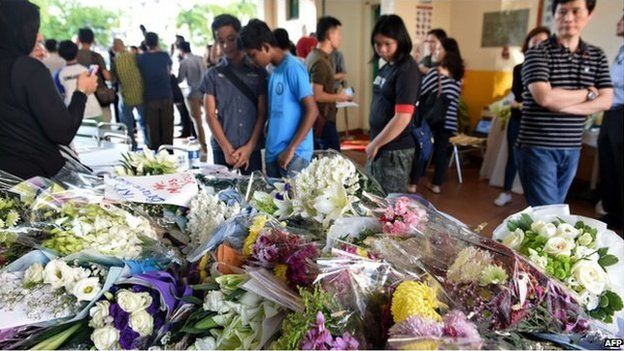
Mourners left tributes to primary school victims in Singapore over the weekend
Singapore’s education ministry identified the two bodies as pupil Navdeep Singh Jaryal Raj Kumar and teacher Mohammad Ghazi Bin Mohamed.
They were part of a group from Tanjong Katong Primary School who were climbing the mountain with guides when the earthquake struck. Seven pupils, two teachers and a guide were killed.
Others killed included Malaysians and citizens from China, Japan and the Philippines.
A Singaporean who was among four charged with attempting to fix a SEA Games football match between Timor Leste and Malaysia was denied bail on Wednesday.
Rajendran R. Kurusamy, 55, who is facing three corruption charges, had tried through his lawyer Edmond Pereira to get bail to attend to family matters as well as a medical condition.
Mr Pereira said his client had a problem with his liver, and had missed two scannings scheduled at Mount Elizabeth.
He said Rajendran’s family is in Singapore, and there is no likelihood of him leaving the country.
He added that his client was in Malaysia in 2010 after selling his business here. While Rajendran was facing labour-related offences in 2011, he returned to answer them and was allowed to attend to his business in Malaysia, he said. The matter was eventually dealt with.
Mr Pereira said if need be, his client could report to the investigation officer daily and the court could impose conditions for bail.
“He should not be held just for the sake of being held because he has been involved in such match-fixing activities,” he added.
But Deputy Public Prosecutor Navin Naidu argued that Rajendran’s charges were non-bailable offences, and there was a high risk of him absconding if released on bail.
He said Rajendran had a previous conviction for match-fixing in Malaysia and had a strong propensity to commit such offences.
He has the means and ability to survive overseas, the DPP added.
There is a real risk that the SEA Games – which are ongoing – could still be fixed, and the danger of witnesses being tampered with, he told the court.
To date, several people have been arrested in the course of investigation and released on agency bail. These were either potential witnesses or even potential accused persons, the DPP said.
District Judge Eddy Tham rejected counsel’s application for bail and remanded Rajendran, whose pre-trial conference is fixed on June 18.
A pre-trial conference for the other accused – Orlando Marques Henriques Mendes, 49, a technical director of the Football Federation of Timor Leste; former Timor Leste player Moises Natalino De Jesus, 32, and Nasiruddin, 52, an Indonesian who goes by one name – is fixed for June 15.
Four individuals are seeking to stop PAS president Datuk Seri Abdul Hadi Awang and Parliament from tabling a Bill to amend the Syariah Courts (Criminal Jurisdiction) Act 1965 at any Parliament sitting.
Mansoor Saat, Azira Aziz, Hasbeemaputra Abu Bakar and Hazwany Jamaluddin want the defendants to retract their plan or be prevented from continuing the discussions over the proposed amendments at any of its sessions.
The injunction application, filed last Thursday, is fixed for case management at a High Court here on June 12, said their lawyer Siti Kasim.
Hadi, Dewan Rakyat Speaker Tan Sri Pandikar Amin Mulia, his deputies Datuk Ismail Mohamed Said and Datuk Ronald Kiandee and secretary Datuk Roosme Hamzah have been named defendants.
The plaintiffs also filed a main suit on June 4 naming the same parties as defendants.
In the main lawsuit, they are seeking for a declaration that if the amendments were approved then it would be unlawful, invalid and in contradiction with various Articles of the Federal Constitution, which among others guarantee on liberty of the person, equality and protection against retrospective criminal laws.
Among others, they want to get a declaration that the tabling of the amendment by Hadi at any Parliament sittings would be a breach of the terms of Pakatan Rakyat’s common policy framework Buku Jingga agreed on Dec 19, 2010.
They are also applying to get any related relief from the court.
In an affidavit-in-support of their main suit, their representative Mansoor, 61, said that Hadi had on March 18 given a letter to the Dewan Rakyat secretary to table a private members bill over the
proposed amendment to the said Act at a Parliament sitting.
Mansoor said he believed that the attempts to amend the Act was unconstitutional.
He said any approval by the Dewan Rakyat speaker and his deputies for the Bill to be discussed by parliamentarians and subsequent approval of the proposed law would violate their rights.
He said they would have to face different punishment from other non-Muslim Malaysians under the proposed amendments, reflecting that they will not enjoy equal rights like others.
Besides that, he said that it will have a tendency to effect on the jurisdiction of the high court (superior courts) and syariah court (inferior courts).
He said that certain new provisions were wrong in law, confusing and may be used to upgrade the jurisdiction of the syariah court.
He said he believed that Hadi’s action was a breach of promise made to his voters.
Asked by reporters here, Siti said that the main suit has been fixed for case management at a High Court here on June 18.
After weeks of smear campaigns and bitter infighting, the PAS muktamar which ended on Saturday saw leaders from the so-called “professionals” faction almost wiped out by the ulama class, whose characteristic long robes made a clean sweep of one of the Islamist party’s most controversial elections.
Among the losers were the faces PAS usually trots out at forums attended by all races – “progressive” leaders deemed more non-Muslim-friendly, and who often find themselves conducting damage control for the party to audiences hostile to PAS and its plans for hudud, the Islamic penal code.
One of them is Datuk Dr Mujahid Yusof Rawa, who, since his early days, has made an attempt to push the party beyond its Malay-Muslim vote bank by pioneering the PAS Supporters Club – a group of non-Muslim PAS fans – which later evolved into the PAS Supporters’ Congress in 2010.
The chairman of PAS’s national unity bureau, Mujahid coined the party’s 2013 general election slogan “PAS for All”, which softened the Islamist party’s hard-line image and ultimately gained the support of non-Muslim voters, despite MCA’s concerted anti-hudud campaign.
Mujahid, son of former PAS president Yusof Rawa, is also known for his efforts to foster interfaith ties with Christians, and wrote a book about his experiences, titled “Engaging Christianity: A travelogue of peace”.
Outspoken leader Mohamed Hanipa Maidin was booed and jeered at the PAS muktamar last weekend when he defended his criticism of Hadi, and was even struck twice last year during a PAS central committee for calling the president weak and biased.
But the lawyer has been instrumental in engaging with the public over hudud on PAS’s behalf, and has written two books related to it: “Undang-Undang Hudud Perspektif Perbandingan” and “Prima Facie”.
He is also one of the few, if not only, PAS leader who has publicly stated that he believed the Islamic criminal law should be put on hold until people were ready to accept it.
In his career, Hanipa was the lawyer for former air force major Zaidi Ahmad who faced a court martial for issuing a statement to the media on how the indelible ink used in the general election in 2013 washed off easily.
Academic Dr Dzulkefly Ahmad, who heads PAS’s Research Centre, has always been seen as the voice of reason and moderation in the party and, like Mujahid, has strived to turn the party into one that is more “middle ground”.
During the controversial tussle over the word “Allah” among Muslims and Christians, the former Kuala Selangor MP was one of the few who were vocal in defending the Christians’ use of the Arabic word, on the grounds that it was not the exclusive right of Muslims.
In open letters and in forums, Dzulkefly has also defended the party’s decision to enforce hudud in Kelantan, citing democracy and the state government’s responsibility to fulfil the people’s wishes.
Meanwhile, Salahuddin Ayub’s loss in the contest for the PAS vice-presidency came as a surprise to many, as he was an uncontroversial figure and had held important posts in PAS for more than three decades, including the PAS Youth chief.
Dubbed “Mr Clean”, Salahuddin was seen as the bridge between the professionals and the ulama, but never took sides with any faction.
Like the ulama, he has maintained that any PAS member pushing for “liberal Islam” should be expelled, but was also quick to defend so-called “liberals” Mujahid, Dzulkefly and Khalid Samad by stating that they should be allowed to argue their views.
However, in the run-up to the PAS elections, Salahuddin, too, was implicated in an alleged plot to topple PAS president Datuk Seri Abdul Hadi Awang.
Although investigations into the plot petered out because the accusers failed to attend a party inquiry, rumours of the conspiracy persisted and cost Salahuddin his votes, along with the other Pakatan Rakyat-friendly PAS leaders.
But not all of the professionals lost in the elections. The sole non-ulama to have survived is Felda activist Mazlan Aliman – but even he is mulling quitting his central committee post after being “disturbed” by the party’s turmoil.
Mazlan, who heads non-governmental organisation National Felda Settlers’ Children’s Association (Anak), rallies for the rights of the settlers and has made a name fighting against Felda Global Ventures Holdings Bhd (FGVH).
During Thursday’s polls, delegates appeared to have voted according to a list of candidates endorsed by the ulama wing of the party which is largely pro-Hadi and influential over party affairs.
The list was circulated at the assembly of the Dewan Ulama.
The use of such lists is said to be rare in previous PAS elections, which have typically seen a mix of clerics, professionals and activists elected to the central committee.
But the PAS elections this year were held amid internal strife over differences towards Hadi’s leadership and the direction of PAS in balancing its Islamist agenda with political pragmatism.
The seven tourists who allegedly posed in the nude for photographs on top of Mount Kinabalu and whose actions are said to have angered the spirits there which unleashed Friday’s earthquake, will face charges in a native court for violating local native laws, said the chairman of the Board of Trustees of the Sabah Parks.
Datuk Seri Tengku Zainal Adlin told reporters at the Sabah Park headquarters in Kundasang last night that the tourists were in police custody in Kota Kinabalu and could be charged as early as tomorrow.
He, however, could not say if they would be charged in the court in Kota Kinabalu or the one in Kundasang.
The death toll from the quake that hit Sabah on Friday morning is now 13, while six people remain missing.
Most KadazanDusuns interviewed believed in their ancestors’ belief in the spirits of the mountain, and that the spirits were provoked by the tourists’ reported nude jaunt at the summit of the mountain last week.
The tourists also allegedly urinated in “improper places” at the summit.
“It’s akin to someone going to a mosque or temple and urinating in them,” said Zainal, describing the act as desecration.
Photos of their antics were posted on Facebook, which quickly went viral.
Even Sabah deputy chief minister Datuk Seri Joseph Pairin Kitingan shared the sentiment that the Westerners provoked the spirits and that they should be punished.
He reportedly said a ritual would be conducted to appease the angry spirits.
The mountain is revered by locals who called it Akinabalu, which in the native language means resting place of the dead.
“Kadazandusuns have long believed the mountain to be sacred, and in the past even pointing at the mountain was absolute taboo,” said Zainal.
“They still believe it to be sacred today and that is why the sogit (a sacrificial ritual) is performed at the end of every year to appease the spirits and seek their permission to climb it for another year,” he said.
“They (the tourists) have no respect for local beliefs. It is only appropriate they be punished for disrespecting and breaking local native laws.”
Even though he is Muslim, Zainal believed there is “something” in the mountain from personal experience.
The former Royal Air Force pilot narrated how a Frenchman in the 50s refused to perform the sogit before climbing the mountain and was seriously injured in a fall.
He said a series of unusual and unexplained incidents also occurred in the attempt to take the injured Frenchman to hospital.
The incidents, said Zainal, so unnerved the Frenchman that he later had the sogit performed.
The sogit is a ritual where seven white “kampung” chickens are slaughtered and seven of everything including beetlenut leaves and kapor, are offered to appease the spirit before any climb.
Seven, said Zainal, is an important number in ancient Kadazandusun religious belief.