Tag: Muslims

  • Zayed Talib: Singaporean Muslims Are Well-Integrated And Rational, Cannot Buy Into Idea Of Importing Saudi-Brand Of Islam Wholesale Into Singapore

    Zayed Talib: Singaporean Muslims Are Well-Integrated And Rational, Cannot Buy Into Idea Of Importing Saudi-Brand Of Islam Wholesale Into Singapore

    Muslims Here Growig More Distant

    The above is what most Singaporeans woke up to on 20 Jan 2016 in this article here.

    I am a Singaporean Muslim and my family have been in Singapore since the late 1800s. (Yes, Singapore was built from the ground up by Arabs, Malays, Europeans, Persians, Jews, etc. – not just the current majority Chinese) We helped build this country to what it was and still is – an outpost of rational modernity where people from all corners of the world can come to work on their business, freely practice their faith and build a home together that we could be proud of.

    I would first like to address the headline of this Article. The TODAY Newspaper – with this one headline – has in my eyes reduced its integrity as a newspaper to that of a tabloid the likes of The New Paper. When its copies are given out for free it means its value is less than the paper its printed on. At the very least, The  New Paper has to be bought.

    Why do I say this? The writer SIAU MING EN who can be contacted here, has decided to sensationalise the speech. Now I know for a fact the Editor may also have a role to play in this so i reserve judgement on being solely the fault of the writer. This writer took it upon himself to write an article that effectively misrepresents the Minister’s words and alienate the local Muslim population at one go – how efficiently stupid.

    When our country is facing a rising tide of intolerance from many faiths – the TODAY newspaper felt that selling more newspapers was more important that communicating as effectively and calmly as possible an issue that is inherently sensitive.

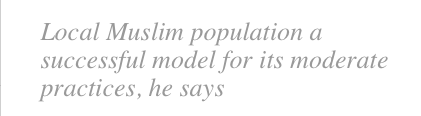
    It in fact hid is the sub-header the following line
    image

    This tells me, as a graduate in Mass Communication, that the article was MEANT to inflame and outrage and therefore receive more attention – a tactic only used by the basest of journalists.

    The TODAY newspaper, by allowing this article to be published, is effectively nothing more than a money chasing fear-mongerer.

    Now I would like to pursue the text of what was ascribed to Minister Shanmugam. According to the article:

    A sentiment among some younger Muslims that sending greetings to friends on other religious festivals or reciting the National Pledge and serving National Service are at odds with their faith.

    I am supposing that the Minister Shanmugam has access to data that we are not exposed to but once again the writer has chosen not to furnish or pursue such details. This communicates that whatever the Minister said is true – something we as Muslims in Singapore recognise to be wrong. So I issue this challenge to both the Minister Shanmugam and Siau Ming En to furnish the data behind how much exactly of this rising tendency exists and what part of the Muslim population truly are at comfort with living together with peoples of other faiths.

    The article also highlights portions of the speech –

    …a developing trend is being watched with concern by the Government: A sentiment among some younger Muslims that sending greetings to friends on other religious festivals or reciting the National Pledge and serving National Service are at odds with their faith.

    As religiosity sweeps the world, the Muslim population here is also growing “somewhat more distant” from the rest of the community, partly due to influences from the Middle East. Some people also feel that the democratic elected governance system here is “incompatible with Islam” and Singapore should be part of a caliphate, he added.

    “These are worrying trends, and if these sentiments become widespread, the Muslim community that grows apart from the mainstream is not good for the Muslim community and not good for Singapore, with serious long-term implications,” said Mr Shanmugam.

    As a Muslim, I see far more Muslims sending greetings to friends to other faiths than not. In fact – the majority of Muslims here laugh at those who insist on not sending greetings because of a misplaced ideal of religiosity. It is ridiculous because it isn’t who we are as a people. In fact we welcome the opportunity to engage with our non-Muslim neighbours as evident in the picture below:
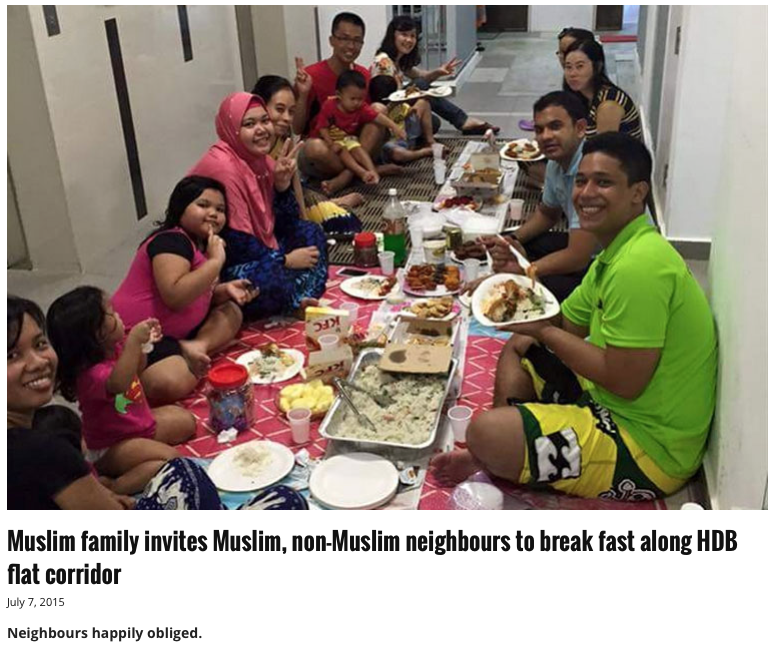
    The article on this actual overwhelmingly neighbourly behaviour of Singaporean Muslims can be found here.

    With regards to the Muslim population here being influenced by Middle Eastern influences – I must agree to this statement. Religion whether in the Middle East or any other part of the world – is still the same religion. The only difference is cultural influences. For example, there is a rising trend of believing what works in Saudi Arabia should work in Singapore. This idea is empirically false. The geo-politics, history and cultural nuances between the Middle East and South East Asia couldn’t be more apart from each other. On this respect – I find it amusing that Muslims in Singapore are increasingly seen to ditch their own culture, even their cultural dress in order to dress themselves like Middle Easterners so as to be more religious. The idea that your cultural dress influences your piety is a laughable construct. For this – the Muslims in Singapore are wrong.

    The article, only after pointing out the Muslims as examples of growing intolerance, goes on to say that the current model for Muslims in Singapore is a successful one and that we should cherish it. In media, we understand what is referred to as attention span. The average reader doesn’t read beyond the fourth paragraph. In this respect anything positive about our Muslim population only appeared after 5th paragraph.

    Why are the above points on how the article was written a great disservice to Singapore? The immediate impact was the Muslims taking a defensive posture, demanding data and statistics to back up the statements in the article. This puts the Minister who is in charge into a difficult position because it doesn’t clearly portray his stand on the issue. It also pits non-Muslims and Muslims at odds into a game of finger-pointing. It makes talking more difficult and accusing far easier.

    Ultimately it points out the the Today newspaper is more interested in sensationalising news than taking into consideration what impacts how and what they publish might have on the social fabric of our country.

    To Muslims I say this – stop being the victim. You are not. Stand up and be counted amongst those who value life and peace. To the non-Muslims I say this – before easily drawing the lines in the sand consider that there is more to be had without doing so.


    Source: http://zayedtalib.tumblr.com/

  • Singapore’s Sunni Muslims And Shiites Live In Harmony

    Singapore’s Sunni Muslims And Shiites Live In Harmony

    Muslims from the religion’s two major sects in Singapore have been living harmoniously with a sense of mutual respect for over a century, said Syed Hassan Al-Attas, a respected Sunni imam (Islamic leader).

    The comments by the imam from Ba’alwie Mosque came amid tensions in the Middle East arising from the recent execution of Shiite cleric Nimr Baqr al-Nimr by Saudi Arabian authorities, which has highlighted a schism between Sunni and Shiite Muslims in the region.

    “For Sunnis and Shiites in Singapore, the relationship is very deep, and has existed in Singapore for more than 100 years… we don’t identify ourselves as Sunnis or Shiites in Singapore, we identify ourselves as Muslims. We’ve never pointed fingers (at each other),” said Syed Hassan in a recent interview with Yahoo Singapore.

    When asked about the perception of some Sunnis around the world that Shiites are not true believers, the imam disagreed.

    “If they are not Muslims, how can the Saudi government approve their visas to enter Mecca? They are Muslims too,” he said.

    He felt that the squabbles between Sunni-majority Saudi Arabia and its allies, and Shiite-majority Iran are political in nature and have nothing to do with religion.

    About 15 per cent of the Singapore population practice Islam, with the majority being Sunnis, according to the 2010 Census of Population statistics.

    Of the 70 mosques in Singapore, only the Burhani Mosque at Hill Street belongs to the Shiites.

    View photos

    Photo: Ba’alwie Mosque on Lewis Street 

    Historical background of Sunnis and Shiites

    Sunni and Shiite Muslims believe in Prophet Muhammad and that he revealed the monotheistic religion to the people of Mecca. The key difference in the beliefs of the two sects is over the choice of the prophet’s immediate successor.

    Sunnis believed that the successor should be Abu Bakar, who was the prophet’s father-in-law, while Shiites believe Ali ibn Abi Talib, who was the prophet’s son-in-law, should be chosen instead.

    Both sects share similarities in terms of some of the obligations of Muslims, such as the performing of the Haj, fasting and reading of the Koran.

    Sunnis and Shiites working to build the Muslim community

    Syed Hassan said the believers from both sects in Singapore see each other as part of one religion and have joined together in building the Muslim community.

    For instance, both Sunnis and Shiites in Singapore had worked together to establish the Islamic Religious Council of Singapore (MUIS).

    “(During) the formation of MUIS in 1970, the legal adviser was the late (prominent Persian lawyer) Mohamed Javad Namazie, who is a Shiite.”

    Other Shiites have also contributed to the Sunni-dominated Muslim community here, Syed Hassan pointed out.

    “MKAC (Muslim Kidney Action Association) Ameerali (Abdeali), he’s a Shiite. Jumabhoy, the one from Scotts, Dr Kutubuddin, Mr Tayebali, and many others, are all Shiites who contributed to the betterment of Singapore, but nobody goes around saying ‘I’m Shiite, I’m Sunni’,” he said.

    Ameerali Abdeali is the president of MKAC while the Jumabhoy family once owned property developer Scotts Holdings (now called The Ascott Limited) from 1975 to 1984.

    J.M. Jumabhoy, who was the minister for commerce and industry between 1956 and 1959, was a Shiite too.

    A Shiite with deep roots in Singapore

    Gholamreza Kashkooli, a 58-year-old Iranian Shiite who has lived in Singapore for 35 years, is happy to see Sunnis and Shiites in the country working together.

    The relationship between the two sects is peaceful, contrary to how it is depicted in the media, Gholamreza told Yahoo Singapore.

    “In Iran, the majority of them (citizens) are educated. They do not look into this matter and create problems between themselves,” said Gholamreza, the owner of an import and export company.

    Gholamreza pointed out that there are many Sunni scholars in Iran, and there is no discord between the minority Sunnis and the majority Shiites in the country over the differences in their beliefs.

    Sunnis and Shiites agree that there is “one God, Muhammad is a prophet, and the Koran”, he said.

    Singapore’s strong legal framework protects religious harmony

    Lawyer Noor Mohamed Marican, who is a Sunni Muslim, said the violence that was seen in the Middle East recently would never happen in Singapore.

    He said the strong legal framework in Singapore is in place to prevent such a scenario. In any event, there is no reason for concern as the local Muslim community’s relations are cordial.

    “You are given your space (to worship), so don’t abuse your space. If you are here to create disharmony, the law will come in,” said Marican in a recent interview with Yahoo Singapore.

    “We are all Muslims living together; our fundamentals are the same,” he added.

    Source: https://sg.news.yahoo.com

  • Alfian Sa’at: Outrageous To Suggest Muslims Should “Own” The ISIS Problem

    Alfian Sa’at: Outrageous To Suggest Muslims Should “Own” The ISIS Problem

    I don’t know how to ‘own’ this problem of ISIS.

    And the simple reason is that ISIS has not, does not, will never own my allegiance. This is stating the obvious but there are people too thick to figure this out by themselves.

    ISIS has killed more Muslims than non-Muslims. Some were killed for refusing to swear loyalty to them. Female Muslim doctors were killed for refusing to wear veils when treating patients. There is a whole catalogue of horrors that they have perpetrated, including the rapes of women and the killing of children. I can’t even bring myself to watch any of their execution videos because just the description sickens me to the core of my being.

    I don’t know how to ‘own’ a problem in which there is every possibility that I will be one of those executed.

    So those of you who insist on telling Muslims to ‘own the problem’, do ask yourself why you are doing it. Does it give you the bully’s pleasure to associate someone with the very worst of (in)humanity? Do you think that there is not enough self-criticism within the Muslim community and having a discussion about ISIS will force some soul-searching? (In which case you really haven’t hung out with enough Muslims.) Or do you just need some ‘moderate Muslims’ to ‘apologise’ so that you can seize the opening to go off on one of your Islamophobic rants?

    I keep hearing all these demands about ‘moderate Muslims’ needing to publicly denounce what the extremist ones are doing. And very often these platforms are subsequently hijacked by those who go on to denounce Islam. So it’s not surprising that many of us would prefer to keep our thoughts–the sorrow at the senseless murder of innocents, the anguish at how verses are interpreted into an ideology we can’t even recognise–private.

    If you know of anyone who endorses what ISIS is doing, then go ahead and ask them to ‘own the problem’.

    Leave the other Muslims alone. We don’t owe you any explanation or statement on something which we can even barely imagine or comprehend, much less condone or justify.


    Source: Alfian Sa’at

  • Zulfikar Shariff: Discussion Of The Singapore System Will Open Minds, Helps Uncover Better Solutions For Malay-Muslim Community

    Zulfikar Shariff: Discussion Of The Singapore System Will Open Minds, Helps Uncover Better Solutions For Malay-Muslim Community

    A common response made against activists who operate on social media is to tell them to stop discussing on these platforms and instead to do something.

    There are several misconceptions exhibited in such suggestions.

    First, it assumes that social media discussions, especially those that involves substantive exploration and interrogation of ideas is not doing something.

    Our understanding of the world, of systems that are created and sustained in our political system, policy choices and preferences, are all based on ideas.

    The government does not craft policies independent of their values, preferences, beliefs or interests. All these ingredients of policy formulation are based on ideas.

    So is the system we live in. The rules that define what we can or cannot do, who represent us, the platforms we are allowed to use, the actions we can take, are all based on ideas.

    To challenge, clarify and develop ideas is to do something that will have a much greater impact than simply acting without clarity.

    We should acknowledge, embrace and celebrate the role of ideas and its formulation in our community.

    Second, before we act, we need to know why we act, know how to act, what the scope and limits of our action.

    Too often, we act without knowing the why, how and what. We assume to know what we do but do not understand what defines our behaviour.

    I have seen so many Muslim leaders discuss engagement with the government to modify policies.

    And yet, they do not understand the context of the policy. They do not know the values, preference and interests that not only allow but create the conditions for the policy to exist.

    So they engage, in expectation of a change, while being constrained by the very system they exist in.

    The policies, (whether hijab, imposition of leadership, domestic and international preferences) are based on a system that defines what can be done and the preferences of the elites.

    To assume that all we need to do is engage on policy is to ask for a meal while trapped in a well.

    Understand the system. Understand what creates the preferences.

    And then we can understand what we can do.

    And these understandings can only be gained when we discuss ideas.

    Whether it is done in a classroom or social media, these discussions have to take place.

    Social media provides amazing access to activists. We can reach out to hundreds or thousands of followers and friends.

    Unlike using the mainstream media, our voice and opinions do not need to be filtered. There are no gatekeepers to decide what we can say or how we can say it.

    We can develop and share ideas.

    We can explore, provide clarity, impart knowledge and mobilise.

    Every discussion is an opportunity shift a position.

    An effective discussion will create new understanding or solidify old ones. Or create perceptual drifts.

    Social media discussions, even if limited, can change society.

    And that is more substantive than what many realise.


    Source: Zulfikar Shariff

  • PRC Waitress At Tang Tea House Takes Effort To Speak Malay To Malay-Majority Clientele

    PRC Waitress At Tang Tea House Takes Effort To Speak Malay To Malay-Majority Clientele

    It is sad that there are still people who don’t recognize that Malay is our National Language. And worse still, they insist the minorities should learn Mandarin instead of the majority picking up the National Language.

    It is also sad that there are some foreigners who don’t want to learn English.

    I went to Tang Tea House for lunch just now. These days even Halal food outlets employ PRC. There was this waitress. She spoke with a Mainland accent. But what struck me was that she made the effort to learn Malay and took my order in Malay. I am a very happy customer. I patronize Tang Tea House because they trained their staff very well especially the foreigners.


    Source: Hazrul A. Jamari