A second-half free-kick from Ko Oo Ye consigned Singapore Under-23s (U23) to a 2-1 defeat in their second Group A game against Myanmar U23.
Nay Lin Tun had initially given Myanmar the lead in the first half, before Faris Ramli equalised from the spot ten minutes later. Ye struck in the second half to give his side the winner.
While Myanmar dominated possession mostly in the first half, it was the hosts who enjoyed a plethora of chances, although they wasted most of it.
Sahil Suhaimi had a golden opportunity with just two minutes on the clock after latching onto Aung Si Thu’s poor clearance, but the striker shot over instead.
Safirul Sulaiman followed suit three minutes later before Sahil blasted a free-kick from 25 yards over.
At the other end, Myanmar almost crafted out a chance from a set-piece, but Pravin Guanasagaran was alert and managed to head the ball behind for a corner instead.
Sahil then continued his wastefulness in front of goal, before Pravin headed narrowly over after rising highest to meet Safirul’s corner.
Myanmar took the lead in the 24th minute through Nay Lin Tun, after he escaped his marker’s attention to bundle home Aung Zone Moe’s free-kick.
Singapore tried to force an immediate equaliser, but Sahil saw his volley blocked once more.
Their pressure paid off eventually in the 34th minute. The referee pointed to the spot following a handball by Aung inside the area, and Faris dispatched it into the top corner for the equaliser.
The Young Lions almost took the lead a couple of minutes later following a good move, but Stanely Ng was unable to make contact with Adam Swandi’s driven cross.
The home side came out of the second half more determined and could have gone ahead a minute after the restart, but Pravin drilled his effort inches wide of the left post from just outside the area.
It was the visitors who retook the lead instead on the hour mark, after goalkeeper Syazwan Buhari misjudged the trajectory of the ball and allowed Ko Oo Ye’s low free-kick to bounce into goal.
Sahil had a great opportunity eight minutes later after Irfan Fandi nodded on a long ball from Syazwan, but he fired over instead.
Faris then forced a save from Kyaw Zin from just outside the area in the 73rd minute, before Irfan put the ball into the net only for the referee to disallow it for a foul on Kyaw Zin.
A rare mistake from Kyaw Zin presented Sheikh Hadi with a chance, but his improvised shot was off the target.
Singapore kept piling on the pressure and in the last minute of injury time, Irfan managed to get onto the end of Sheikh’s cross, but he headed agonisingly wide from point-blank range.
That put paid to Singapore’s hopes of finding the equaliser, with the referee blowing the full-time whistle seconds later.
After the match, Singapore U23 coach Aide Iskandar thought his boys were unlucky to lose after putting up a battling performance.
“I’m not here to point fingers at anybody, we win as a team and we lose as a team,” Aide said. “In general, we did well. Myanmar did not trouble us with many chances. We created chances, yet we did not score and in order to win games we need to score.
“I have to take my hats off, the players tried hard and fought. We have to thank the fans for coming and staying till the final whistle. The boys have showed and they kept battling. Today’s performance is better than the one against Philippines even.”
Meanwhile, Myanmar coach Kyi Lwin thought it was indeed a tough match against Singapore.
He said: “Singapore is the host team, and it was very difficult to play against them but we hope they will win the next two matches and make it through.”
Singapore line-up: Syazwan Buhari (GK), Al-Qaasimy Rahman (C), Sheikh Abdul Hadi, M Anumanthan, Shakir Hamzah, Pravin Guanasagaran, Safirul Sulaiman (Suria Prakash 69’), Adam Swandi, Stanley Ng (Irfan Fandi 57’), Faris Ramli (Amy Recha 89’), Sahil Suhaimi
Source:www.fas.org.sg

The residents of Wang Kelian sensed something was amiss when a number of people stumbled on to their streets, weak and injured, and began to beg for food and water.
“They would walk into my shop, with injuries covering their hands and feet. Some were just too weak to even speak properly,” said Lyza Ibrahim, who runs a food stall in the town on the northern Malaysian border with Thailand.
“One asked me, ‘[Is this] Malaysia?’ Then he pointed in the other direction, said ‘Thailand’ and shook his head to signal that he was not wanted there.”
Wang Kelian is an unassuming settlement but it has been thrust into the global spotlight this week after the discovery in nearby jungle of dozens of secret camps used by people smugglers and nearly 140 grave sites.
Police say some of those graves contain multiple bodies – raising the terrible prospect of hundreds of unexplained deaths. On Tuesday Malaysian authorities began the grim task of exhumation.
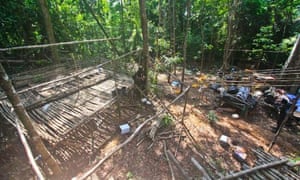
Some of the campsites included wooden pens, some with barbed wire and guarded by sentry posts. In one pen, police found several parts of a decomposed body.
The camps appear to be part of a complex of bases stretching into Thailand on what had been a well-established route smuggling mostly Rohingya people from Burma and Bangladesh.
But the trade has been in chaos since early May, when Thai authorities launched a crackdown after the discovery of mass graves on their side of the border.
Thousands of migrants headed for Thailand started landing elsewhere in south-east Asia. And as the smugglers fled their jungle hideouts, migrants were spotted in Wang Kelian.
Ibrahim said she had seen several migrants, whom she believed to be Rohingya, and heard stories about many others, including that they would go to a nearby mosque to ask for help.
Others echoed her story. Another woman said she had spotted a Bangladeshi migrant wandering in the area and knocking on her neighbour’s door.
“It is very sad. We have been hearing these stories, but we can’t do much,” said the woman, who declined to give her name. “We could only offer food, clean clothes, but we have to call the police and they will be taken away by the police after that.”
Malaysian officials acknowledged the camps had been around for some time but defended themselves against criticism that no action was taken earlier. Authorities had previously vehemently denied there were any such sites in the country.
“We have been building up intelligence and information,” the national police chief, Khalid Abu Bakar, told reporters on Monday, vowing tough action against any Malaysians involved.
But anti-trafficking groups said the latest discovery came as little surprise and would cast an even harsher spotlight on Malaysia, which was listed as ‘tier three’ by the US State Department’s annual human-trafficking report, the worst ranking for countries which are failing to stop the trade.
“There were stories about these camps that went back nearly 10 years,” Matthew Friedman, the former chief of the UN inter-agency project on human trafficking, told the Guardian. He now heads the Mekong Club, which campaigns against slavery in Asia. “We passed the information on to the local authorities, but there was no follow-up.”
A report in 2009 by the US Senate committee on foreign relations found that “a few thousand” Burmese migrants had become victims of extortion and trafficking once they were deported across Malaysia’s border with Thailand.
In addition, it said there were questions about the “level of participation” of government officials in Malaysia and Thailand.
Villager Mahyuddin Ahmad said he has seen migrants in Wang Kelian for the past two years but more had been spotted in the past month – the largest group being about 10 people, including women and children.
The 55-year-old businessman, who said he had given food such as instant noodles and clothes to migrants, added: “It is a common sight here. We didn’t suspect anything because we thought they just come from Thailand.
“So we are really shocked to hear what the police revealed yesterday about the grave sites and jungle camps.”
Source: www.theguardian.com

NAYPYIDAW (MYANMAR), Selasa – Etnik muslim Rohingya terus ditekan kumpulan pelampau Buddha dengan terbaru, dihalang menghantar anak ke sekolah, tidak boleh membuat perjalanan di antara kampung ke kampung, dan memulakan perniagaan kecil.
Kerajaan Myanmar memberi tempoh sehingga 31 Mei ini sebagai tarikh akhir kepada warga Rohingya untuk menyerahkan ‘kad putih’ yang diberi sebelum ini.
“Tiada pergerakan bermaksud tiada perniagaan, tidak ada peluang untuk kehidupan yang lebih baik, tiada wang.
“Ia akan menyebabkan keadaan menjadi terdesak dan akan melarikan diri,” kata Shwe Maung, salah seorang daripada dua anggota Parlimen dari etnik Rohingya.
Etnik minoriti Muslim Rohingya juga berdepan dengan undang-undang perancangan keluarga baru yang telah ditandatangani oleh Presiden Thein Sein beberapa hari yang lalu.
Undang-undang baru itu menarik kemarahan beberapa kumpulan hak asasi dan aktivis di seluruh dunia.
“Kami berkongsi kebimbangan bahawa rang undang-undang ini boleh memburukkan lagi perpecahan etnik dan agama,” kata Timbalan Setiausaha Negara Amerika Syarikat, Antony Blin Ken.
Kekejaman pelampau Buddha terhadap muslim Rohingya semakin teruk sejak akhir-akhir ini sehingga memaksa etnik minoriti itu melarikan diri dengan bot kecil, meminta pertolongan dari negara Asia lain.
Penghijrahan terdesak di laut itu telah menyebabkan ratusan mati dan beribu-ribu terkandas, menyebabkan satu krisis pelarian paling teruk di dunia dalam beberapa dekad.
Pelampau Buddha terus menerus menanam kebencian agar memerangi umat Islam Rohingya, yang turut disokong kerajaan kerajaan apartheid Myanmar.
“Mengapa mereka sanggup lari ke laut dengan bot? Mengapa mereka mengambil risiko mati di laut? Kerana kewujudan mereka (pelampau Buddha), dan masa depan yang buruk,” kata Penny Green, Pengarah Inisiatif Jenayah Antarabangsa dari Queen Mary University of London.
Rohingya disenaraikan oleh PBB sebagai etnik paling tertindas di dunia.
Selain berdepan ‘penghapusan etnik’, mereka juga dinafikan hak kewarganegaraan sejak pindaan undang-undang negara itu pada tahun 1982 yang menyebabkan mereka dilabel pendatang haram di negeri sendiri.
Kerajaan Myanmar dan juga majoriti Buddha enggan mengiktiraf istilah “Rohingya”.
Antara 2012 dan 2013, serangan Buddha telah mengakibatkan ratusan muslim Rohingya terbunuh dan 140,000 lagi dipindahkan dari rumah mereka.
Source: www.ismaweb.net

Malaysia today said it has found mass graves, feared to contain bodies of Bangladeshi and Rohingya migrants from Myanmar, near detention camps used by human traffickers on the border with Thailand, weeks after its police unearthed several bodies from similar shallow graves.
The mass graves were found near 17 abandoned camps in Padang Besar area on the Thai side of the border and they are believed to be a part of human-trafficking activities involving migrants, Home Minister Zahid Hamidi said.
The Minister said the General Operations Force (GOF) had found 14 large tents and three other smaller tents, believed to have been operational for at least five years but were abandoned when the authorities came to the location.
“Today, the inspector-general of police (IGP) and his deputy are at the Malaysia-Thailand border for identification and confirmation. The graves were identified as those for the refugees in the human trafficking trade. Probably, one grave has maybe three, four bodies or maybe only one. So we are counting at the moment,” he said.
As governments in Thailand, Malaysia and Indonesia have launched crackdowns amid intensified international spotlight, human traffickers have abandoned camps on land and even boats at sea to avoid arrest.
In many instances, these traffickers have been paid by the miniority Rohingya Muslims from Myanmar to help them flee to Malaysia or Indonesia.
The traffickers reportedly held them to ransom in the jungle camps demanding more money and in many cases leaving them to die quickly burying them in mass graves.
A few weeks ago hundreds of Muslim Rohingyas were found crammed in boats heading to Malaysia and Indonesia.
Human rights groups and activists say the area on the Thai-Malaysia border has been used for years to smuggle migrants and refugees, including Rohingya Muslims, a persecuted minority in Myanmar.
Since May 10 alone, more than 3,600 people – about half of them from Bangladesh and half Rohingyas from Myanmar – have landed ashore in Indonesia, Malaysia and Thailand.
Thousands more are believed to be trapped at sea in boats abandoned by their captains.
Mass graves were discovered in Thailand earlier this month mostly in southern Songkla province bordering Malaysia.
The Rohingya, numbering around 1.3 million in Myanmar, are believed to be one of the most persecuted minorities in the world.
Source: www.siasat.com