The Internet takes on an important function in maturing democracies with an under-developed civil society. Citizens see the cyberspace as an important avenue to perform checks and balances. This have led some to call for a rethinking of the rules of engagement.
A couple of years ago, Singapore’s Minister for Information, Communication and the Arts called for the crafting of an Internet code of conduct. Attempts to regulate the cyberspace through the suggested “netiquette” and the recent passing of the MDA regulations to legislate online news were met with disagreement on the part of the netizens. About 1,500 people registered their discontent against this new implementation and an Internet Blackout Thursday saw more than 130 bloggers trading their web pages with black screens carrying the slogan ‘Free My Internet’.
The complexity of the issue is compounded by the ambiguity as to whether social networking sites such as facebook represent the private or public sphere. Comments posted on personal capacities are often shared among hundreds or thousands of people. With this development, the phenomenon of public lynching on the Internet is becoming more common in Singapore. The cases of Amy Chua’s comments on the Malays, a PRC Chinese student’s remarks on Singaporeans, Anton Casey’s observations on the poor and Dr Aljunied’s views on homosexuality are some examples.
Consequently, the opportunity to engage deeper on contentious issues such as race, nationality, religion and social class are lost due to the manner in which these discussions have placed too much emphasis on the personalities. Surely, the strategy of removing or silencing the protagonist cannot be a better alternative to addressing the root of the concerns in open discussions. More important questions such as who represent these views, how pervasive these views are, and who are discriminated, remain unanswered. If there is one rule of engagement on the internet, it is this – every contentious point should be engaged in a civilized and respectful manner, regardless of age, hierarchy or any other social divisions.
An accompaniment to the culture of public lynching is the culture of online petitions. The petitions against and for Dr Aljunied circulating online over the last week denouncing or championing their professor is neither the first nor will it be the last that we will see. Certainly, for every social group that feels aggrieved, there will be another that feels validated. Such is the complex cosmopolitan society that we live in today.
However, if university students were to start petitioning against every disagreeable point spouted by their professors, the university will lose its critical edge and become an undesirably monotonous place. These points of views should be debated in a mature, open and inclusive manner taking on board views from all sides.
The problem with the culture of public lynching is that living in a state where there are many punitive measures to sanction the citizenry against making contentious comments that may potentially cause public disorder, it will be more convenient to slip back to an era where people are governed by a culture of fear and not speak on critical issues, anxious that they will tread on the wrong side of vague OB markers. This will surely retard Singapore’s progress and quest for a more consultative society.
Written by Kamaludeen Mohamed Nasir
Kamaludeen Mohamed Nasir is an Assistant Professor of Sociology at the Nanyang Technological University. He is the author of The Future of Singapore: Population, Society and the Nature of the State (Routledge, 2014).
Benjamin felt a nose nuzzling at his shoulder. He looked round. It was Clover. Her old eyes looked dimmer than ever. Without saying anything, she tugged gently at his mane and led him round to the end of the big barn, where the Seven Commandments were written. For a minute or two they stood gazing at the tatted wall with its white lettering.
‘My sight is failing,’ she said finally. ‘Even when I was young I could not have read what was written there. But it appears to me that that wall looks different. Are the Seven Commandments the same as they used to be, Benjamin?’
For once Benjamin consented to break his rule, and he read out to her what was written on the wall. There was nothing there now except a single Commandment. It ran:
ALL ANIMALS ARE EQUAL BUT SOME ANIMALS ARE MORE EQUAL THAN OTHERS
In George Orwell’s Animal Farm, an allegory of the system under the Soviet Union, the animals of Manor Farm successfully overthrow the farmer Mr Jones and other humans to establish their new way of life in Animal Farm. They inscribe Seven Commandments based on the principles of Animalism articulated by the pig Major, the great thinker. The Seventh Commandment originally read, “All animals are equal.” However, in a twisted tale of deceit and betrayal, the pigs became increasingly like the humans they deposed. Finally, Clover the stout motherly mare sought to remind herself of the Seven Commandments and urged Benjamin the donkey to read the Seven Commandments to her, only to find that all the commandments had been erased and the only commandment left read, “All animals are equal but some animals are more equal than others.”
Recent events involving National University of Singapore professor, Dr Syed Muhd Khairudin Aljunied, beg this question. TODAY gives the following background in ”NUS professor acknowledges ‘poor judgment’ in posts on sexuality” (6 March 2013):
Two current students and a former student had earlier lodged a complaint to NUS over Professor Khairudin’s Facebook posts, claiming that Professor Khairudin had described “alternative modes of sexual orientation” as “wayward”, and as “cancers” and “social diseases” to be “cleansed”.
In turn, the Fellowship of Muslim Students Association released a statement supporting the professor, while a petition has been circulated online disapproving of the conduct of the three individuals who complained against him.
Deputy President (Academic Affairs) and Provost, Prof Tan Eng Chye, sent out a circular on 5 March, which reads:
Faculty Members, Staff and Students
Building an Inclusive and Mutually Respectful Community for Learning and Scholarship
NUS is widely known for its academic and educational standards, and is a respected university in Asia and the world. A central element of our community is an open and inquisitive academic culture. Faculty and students are free to study as well as pursue scholarship and research in a wide range of topics, to express their views, and to debate and discuss ideas and issues.
We value the diversity of people, cultures, perspectives and experiences that we have on campus, and in our wider Singaporean community. Diversity enables and enriches the mutual sharing, learning and exchange of ideas and perspectives that mark a vibrant intellectual and academic environment. NUS embraces faculty, staff and students regardless of gender, ethnicity, religion, nationality, political beliefs or sexual orientation. Respect for people is also one of the three fundamental principles that underpin the University’s Code of Conduct for staff and for students.
The recent incident involving Associate Professor Syed Muhd Khairudin Aljunied is a learning opportunity for our community. He had posted comments expressing his views on lesbianism that contained provocative, inappropriate and offensive language. I have counselled Associate Professor Khairudin, who has acknowledged that whilst his only intention had been to convey his point of view, his original posts reflected poor judgment in the tone and choice of words. He has since amended or removed these posts.
This incident reminds us that issues concerning race, gender, religion, sexual orientation, and value systems continue to be sensitive, contentious and potentially divisive in Singapore, as in many other societies. The situation is aggravated by the ease with which views once expressed can be rapidly and widely disseminated via social media to much larger audiences. Members of our community, both staff and students, should be mindful of this, and show restraint, due care and respect with their words and actions, particularly when communicating online.
I look forward to your continued strong support to collectively contribute to a vibrant NUS community and environment that promotes and supports exploration, discovery, debate, learning and development; one where members of our community can express themselves openly but in a manner which is civil and encouraging of positive engagement, particularly on issues which are complex and contentious.
Thank you.
Yours sincerely Prof Tan Eng Chye Deputy President (Academic Affairs) and Provost
Are some people “more equal” than others? The proximity of events and similarity of issues bring to mind the recent Health Promotion Board’s (HPB) FAQs on Sexuality, which stirred quite some controversy, and which the Government has defended in a spectacular show of doublethink and self-contradiction (see “Welcome to the Animal Farm: MOH’s response to HPB FAQs on Sexuality“).
In particular, the responses to each incident bear out a serious case of double standards.
There, HPB essentially accused Singapore society, including religious groups, of being mentally ill. It had accused society of “homophobia” and “biphobia”; “phobia” being a psychiatric or medical term which refers to term for a severe mental disorder. Nevertheless, many in various circles had praised the HPB FAQs for being “objective” and “unbiased”. Furthermore, in the Government’s response, no effort whatsoever was made to either apologise for a wholly unwarranted slur on Singapore society or religious groups.
Yet on the other hand, when Professor Syed Khairudin made certain remarks, these were regarded as reflecting “poor judgment” as well as “provocative, inappropriate and offensive”. Whatever happened to the valuing of “diversity”, including religious diversity?
Freedom of speech and religion Freedom of speech and freedom of religion are fundamental rights under the Singapore Constitution; a point worth remembering.
Comparison may be made with the Swedish case involving Pentecostal pastor Åke Green, who delivered a sermon denouncing homosexuality as “a deep cancerous tumor in the entire society” and condemned Sweden’s plan to allow same-sex legal partnerships. He was convicted and sentenced to 30 days in prison for the crime of expressing contempt “for a national, ethnic or other such group of persons with allusion to race, colour, national or ethnic origin, religious belief or sexual orientation”. On appeal to the Supreme Court, his conviction was struck down. It was noted that a conviction would violate the rights to free speech and freedom of religion under the European Convention of Human Rights. The courtheld:
In an overall assessment of the circumstances – in the light of the practice of the European Court of Human Rights – in the case of [Åke Green] it is clear at the outset that this is not a question of such hateful statements that are usually referred to as hate speech. This also applies to the utterance of his that may be regarded as most far-reaching, where sexual abnormalities are described as a cancerous tumor, since the statement, seen in the light of what he said in connection with his sermon, is not of such a nature as can be regarded as promoting or justifying hatred of homosexuals. The way in which he expressed himself cannot perhaps be said to be so much more derogatory than the words in the Bible passages in question, but may be regarded as far-reaching even taking into account the message he wished to convey to the audience. He made his statements in a sermon before his congregation on a theme that is in the Bible. The question of whether the belief on which he based his statements is legitimate or not is not to be taken into account in the assessment…
Under such circumstances it is probable that the European Court of Human Rights, when examining the limitation on [Åke Green’s] right to preach his ideas based on the Bible which a verdict of guilty would constitute, would find that the limitation is not proportionate and thereby would constitute a violation of the European Convention.
Should NUS have responded differently? Quite possibly so, especially since there is an added dimension of academic freedom in question.
Tolerance and “Tolerance” A final word should be said about tolerance. Tolerance is an important value which is essential to freedom of speech and religion, but a distinction should be made between the classical version of tolerance and a postmodern version.
The classical version of tolerance has been best expressed by Evelyn Beatrice Hall in her biography on Voltaire, “I disapprove of what you say, but I will defend to the death your right to say it”. Strictly speaking, it is people who are tolerated, not viewpoints.
By contrast, a postmodern version of “tolerance” goes beyond the classical version in claiming that one should not even judge that other people’s viewpoints are wrong. Typical of a politically-correct culture, this is actually an intolerant inversion of classical tolerance, where all viewpoints are tolerated while people are discriminated against.
In fact, postmodern “tolerance” does not even do justice to the idea of tolerance. The very concept of tolerance entails that one does not agree with that which one tolerates. If I think that you are right, I wouldn’t need to tolerate you, I would agree with you. That is not tolerance, but approval.
Conclusion The entire saga involving Dr Syed Muhd Khairudin Aljunied can only be described as unfortunate on many levels, for the reasons stated above.
Perhaps the greatest threat to our society today is not religion or homosexuality, whichever side of the debate one stands. Instead, the greatest threat is political correctness and the inconsistent application of standards. It lies in a misconceived understanding of tolerance. It is rooted in doublethink and self-contradiction.
It is a society where some people are “more equal” than others.
Having studied at a local university, I have observed that students and even professors faced intimidation and retaliation when they attempted to discuss issues such as homosexuality.
Those holding and expressing conservative views were often ridiculed as ignorant or homophobic and subject to religiously offensive comments, while those who made such comments received no sanction.
I am thus disappointed with the National University of Singapore’s stance towards Associate Professor Syed Muhd Khairudin Aljunied. (“NUS professor acknowledges ‘poor judgment’ in posts on sexuality”; March 6)
Homosexuality is a contentious issue and it is important that we respect academic freedom when debating this matter. NUS’ restriction on academic freedom by censuring Assoc Prof Khairudin is antithetical to our development as a society, which depends on robust debate and critical inquiry.
NUS should rethink its policies if it sees itself as a respectable university in Asia and the world.
Associate Professor Reuben Yik-Pern WongWalid Jumblatt Abdullah
THE recent controversy over a National University of Singapore professor’s Facebook posts on homosexuality has thrust the issue of academic freedom to the fore (“Protests over NUS don’s Facebook post”; last Saturday).
Academic freedom extends from the core peer-reviewed activities of research and teaching to include extramural domains of speech – where faculty members speak or write on larger political, social or religious matters outside their institutions.
While academics, who enjoy a privileged position in society, should be held to a high standard of accountability for what they say in or outside academia, society should not curtail them from expressing their ideas. Otherwise, social innovation, knowledge creation and creativity would be seriously hampered.
Clearly, these two imperatives need to be reconciled.
The term “academic freedom” emerged in German universities in the 19th century. The three basic principles were the freedom to teach, the freedom to learn, and the freedom to do research. These principles were adapted to different circumstances in higher education all over the world.
The 1940 Statement of Principles on Academic Freedom and Tenure by the American Association of University Professors (AAUP) is regularly cited in legal cases involving academic freedom.
An AAUP interpretive comment from the 1970 update of the 1940 statement noted that “controversy is at the heart of the free academic inquiry which the entire statement is designed to foster”.
Academics should be allowed, indeed encouraged, to express alternative or non-conformist opinions, however counter-intuitive these opinions may seem.
Of course, they should do so with tact and respect, and within society’s moral and legal limits. Academics must also protect the intellectual space they so cherish, by allowing others to voice opposing opinions.
How we respond to the latest incident is indicative of how we wish to move as a society. Do we value engaging people and dissonant ideas on a calm and intellectual basis, and respond to dissenting ideas respectfully and via reasoned argumentation?
In a civilised society, ideas should be discussed, debated, developed or demolished at the liberal marketplace of ideas, without fear of being accused of bigotry or thought crimes. Otherwise, we risk slipping into a culture of intolerance and self-censorship, a perpetual pressure to conform to the “politically correct” or “progressive” ideas of the day.
I hope that responses to contentious views can follow the dictum famously ascribed to the thinker Voltaire: “I may disagree with what you say, but I will defend to the death your right to say it.”
Written by Walid Jumblatt Abdullah & Reuben Wong (Associate Professor)
Alex Au, a blogger at Yawningbread and founder of a Singapore gay rights group, People Like Us.
When the story first broke, what struck me most was the focus on lesbians. It is far more common in anti-LGBT speech for the reference to be either directed at gay males or framed with reference to gay male sex, at least in Singapore and the West. But coming from a lecturer in Malay Studies, I wasn’t surprised.
On 20 February, Syed Muhd Khairudin Aljunied made a post on Facebook in which he lambasted “liberal Islam” and its support for lesbianism, describing them not only as “wrongful ideologies” — a matter of opinion, perhaps — but also as “diseases” and “cancers”. The latter may have stepped into hate speech.
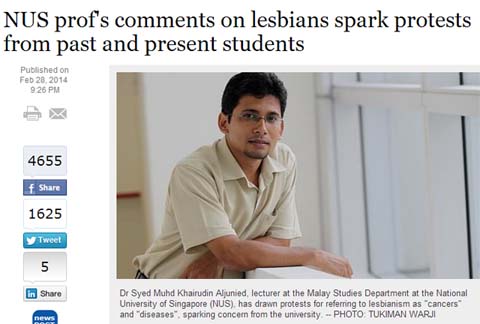
As the story in the Straits Times (headline shown above) shows, it generated protests and several petitions.
Now, before I go further, it is important to look at what Khairudin actually said. An anonymous comment led me to the Rilek1Corner site which had a screengrab (see thumbnail at left). His Facebook post seems to have been an answer to a question by an unnamed person, concerning a “new development” in which liberal Islam may be affirming unorthodox sexual identities. In his answer, Khairudin suggested giving advice, going to “proper religious classes”, and seeking help from counsellors. He urged using the “power of technology” to alert groups and movements about spreading these “wrongful ideologies”.
The recommendation may sound reasonable, even if we disagree with his view. Nevertheless, the dehumanising tone he used to describe lesbians — and for that matter, adherents of “liberal Islam” too — is what made the post stand out.
I have on several occasions argued that homophobia is deeply linked to insecurity stemming from a loss of male privilege. You get clues to this when you read some of the things Pope Benedict XVI used to say, speaking of both “radical feminism” and “homosexual lifestyles” in virtually the same breath, and how both have undermined “family life”. Traditionalists’ conception of a happily ordered family is one where the husband is the dominant member, and where the sexes had clearly demarcated roles. Feminism, which argued for equality and autonomy for women, was a serious threat. The gay rights movement sprang from this, making the point that true autonomy includes autonomy in sexual orientation and gender identity.
It is not easy to see this linkage between feminism and gay rights when one looks at the speech of the US-based Christian Right, and that may be why we forget that there is a link. This, in my view, is because in the US, it has become socially impossible to speak openly against equality for women. Thus, even as the Christian Right goes ballistic over gays and lesbians, they know it won’t be politick to attack heterosexual women as well.
However, this does not mean they don’t engage in side actions that try to limit women’s autonomy. The same people also tend to support tighter restrictions on abortion. But they have cleverly packaged it as a “right to life” issue, not as an “attack women’s right to control their bodies” issue, which in reality it is.
Islam is much less reticent about speaking out against equality and autonomy for women. I used to joke that Muslim clerics aren’t as prominent in attacking the LGBT movement as the Christian Right because they were too busy trying to control women. Things may be changing now, not because they are any more accepting of equality for women, but because the LGBT issue has made enough progress that we can’t be ignored any longer.
But it is probably no coincidence that the religions that feel most threatened by this “deadly mix” of feminism and gay rights, and are more explicit about linking the two, are the ones that still segregate men and women, either in prayer halls or in clerical roles. Gender distinctions are not just important in Islam and Roman Catholicism, they are part of the teaching. It is much easier for them to speak out against both feminism and gay rights simultaneously than it is for conservative Protestants, who have already conceded the point on women’s equality (even if they have not internalised it).
This dual threat perception comes together to explain why the question that Khairudin had to answer focussed on lesbians. Lesbians represent both a refusal to be subordinate to men and a challenge to heteronormativity. They are the “worst of the worst”.
* * * * *
In the wake of the news reports, I asked around if anyone knew Khairudin or had heard him speak on previous occasions. One friend gave me a particularly interesting answer, painting a negative picture of the man. She had attended one (or maybe more than one — I didn’t clarify with her) lecture by him and came away with the impression that he was insufferably sexist. She remembered how the notion of male privilege and dominance held up many of the ideas he propounded.
The other strong impression she came away with was his condescension towards Malays. She said, “His opening remarks was something along the lines of ‘I want to stress that while my field is Malay Studies, I myself am not Malay, but Arab’. Why was it necessary to stress that? He then added, ‘However, I married a Malay wife,’ and saying how much he ‘loved’ Malays.”
My friend got quite agitated just retelling this to me. I don’t blame her. It sounds awfully like people who say, “I have nothing against gays, in fact some of my best friends are gay, but . . . “
It’s a bit ironic then that a group called Fellowship of Muslim Students Association (FMSA), responding to petitions being circulated, described in a statement it issued,
Dr Syed Khairudin is an icon of the Malay/Muslim community in the field of academic achievement. He continues to play a contributing role to the Malay/Muslim community and the mainstream society.
Another thing you’d note from the FMSA statement is its reference to a “Neo-Sodom-Gomorrah community”, presumably newly coined by them. However, as playwright Alfian Sa’at pointed out,
They do use the term LGBT as well, which clearly shows that the coinage is a silly and childish attempt at testing the limits of provocative and inflammatory speech.
Which brings me back to the question of hate speech.
* * * * *
There is at least one petition calling on the university authorities to sanction Khairudin for committing hate speech. Khairudin’s defenders argue that if the university did so, it would be a violation of academic freedom.
Where is the line between academic freedom and hate speech? It may be hard to draw, for indeed there is value in allowing space for counter-mainstream, even offensive ideas. But a necessary test may be whether the idea being espoused is intellectually grounded: What is the basis for the idea? How sound is it?
This test may be easier to apply in some disciplines than others. It is, for example, quite clear that advocating the “truth” of creationism can seek no protection from academic freedom, but arguing the moral value of large-scale genetic engineering of humans — well, that may not be so clear-cut.
But lost in the debate about whether Khairudin was exercising his academic freedom is this: Was his Facebook posting on a matter that was within his area of expertise? It is doubtful. From what little I know, his area is that of Malay Studies, which I would think is quite distinct from Islamic Studies. He was pronouncing on religion, particularly on liberal Islam. I am sure there are scholars out there with much deeper knowledge about Islamic perspectives.
This is important. A professor of monetary theory can have no special claim to be an expert on transgender identities.
If on balance his passing judgement on liberal Islam and lesbians wasn’t within Khairudin’s area of expertise, then the greater laxity that one might give for academic freedom will not apply. He was in fact just exercising his right to free speech, the same right that you and I have. That speech will need to be tested on the same basis as anyone else’s speech for hate content. So the question comes back to this: Is labelling a class of people a “disease” and “cancer” something that would cross the line? Suppose one said that the migration of dark-complexioned people from such and such a place to Singapore was a “cancer” — would that be OK? Suppose one said that a new religion making inroads and gaining adherents was a “disease” infecting Singapore society, would that be acceptable?
POST-SCRIPT
In Straits Times’ Breaking News,
The National University of Singapore (NUS) professor who drew criticism last week for referring to lesbianism as “cancers” has been counselled by the university.
In an e-mail to all faculty members, staff and students on Wednesday, NUS provost Tan Eng Chye said he had counselled Associate Professor Syed Muhd Khairudin Aljunied, who acknowledged that his original post “reflected poor judgment in the tone and choice of words”.
Prof Tan, who is also NUS deputy president of academic affairs, said Dr Khairudin’s comments “contained provocative, inappropriate and offensive language”.
– Straits Times, 5 March 2014, NUS professor “counselled” by university for Facebook posting on lesbianism, by Pearl Lee
In a Clarification Statement which I found on Rilek1Corner (the source was Khairudin’s Facebook page) he wrote that he has not removed the original post, except the words “cancer” and “social diseases”. He also wrote that “My position as a Muslim about LGBT remains clear and is in line with the view of Muslims scholars”, and that “There is no disagreement in Islam on the prohibition of homosexuality.” Although Khairudin stressed that this was his personal view, the sense one gets from the foregoing is an attempt to invoke his religion for justification and defence.