Tag: parliament

  • Lee Hsien Loong: Electoral Boundaries Committe Formed Two Months Ago

    Lee Hsien Loong: Electoral Boundaries Committe Formed Two Months Ago

    The committee that reviews electoral boundaries was formed two months ago, a sign that the general election is round the corner.

    Prime Minister Lee Hsien Loong announced the formation of the Electoral Boundaries Review Committee on Monday, in response to questions in Parliament.

    The forming of the committee, which redraws constituency boundaries ahead of a general election, is the first formal step towards calling a GE.

    Leading up to the polls in 2006 and 2011, the committee had taken four months to do its work before issuing its report.

    While there is no fixed date for the election to be called after the report is submitted, it has taken as short as one day and as long as one month and 26 days in the past.

    Mr Lee told the House that he had asked the Committee in its review to consider the population shifts and housing developments since the last boundary delineation exercise.

    He also asked them to consider having smaller group representation constituencies, so as to reduce the average size of such constituencies to below five members, and have at least 12 single member constituencies. There are currently 15 group representation constituencies and 12 single-seat constituencies.

    “As per past practice, the Committee is chaired by the Secretary to Prime Minister. It is now in the midst of its deliberations and will make its recommendations to me when it is ready,” said Mr Lee.

    He was responding to questions from People’s Action Party MP Arthur Fong (West Coast GRC) and Non-Constituency MP Yee Jenn Jong of the Workers’ Party on whether the committee has been formed.

    Mr Lee added that he could not promise a minimum period between the publication of the report and the calling of a general election, which Mr Yee had asked for.

    The reason is that “it depends very much on the exigencies of the situation, and … on when elections become necessary,” said the Prime Minister.

    The committee’s work is to split or shrink group representation constituencies, and absorb or create more single-member constituencies, based largely on population shifts.

    It is appointed by the Prime Minister and is usually made up of five civil servants.

    Mr Yee had asked if the committee’s members can be drawn from various political parties as well, as it was done before Singapore became independent.

    Mr Lee said the committee has, for many years, comprised civil servants with experience and domain knowledge.

    This allows them to make considered decisions on how to divide up the constituencies, taking into account population shifts and housing developments in Singapore, and prevents “complete upheaval” each time the boundaries are redrawn, he added.

    “As for bringing political parties in, I’m not sure that’s an entirely good idea,” he said, adding that this is the practice in the United States.

    In America, members of the House of Representatives decide on the demarcation of electoral boundaries, said Mr Lee, and “what happens is they carve it up among themselves”.

    “It’s a political deal. I think that’s not a good arrangement. I think it’s best we leave this to the civil servants to work at,” he added.

    Furthermore, Mr Lee said that he would leave the committee to decide whether it would open its meeting minutes to the public, as Mr Yee had requested.

    But he added: “I don’t believe that it is helpful to have every twist and turn in the minutes reported and published. I think the committee’s report is the final word.”

    After the committee’s report is released, Parliament is dissolved and the writ of election issued. Nomination Day – which must take place no earlier than five days and no later than one month after the writ is issued – then signals the start of the campaign period, leading up to Polling Day.

    This process took between two and seven months in the past GEs.


    Source: www.straitstimes.com

  • Don’t Hope Of Getting Back All Your CPF Money At 55 As Long As PAP Has Parliamentary Majority

    Don’t Hope Of Getting Back All Your CPF Money At 55 As Long As PAP Has Parliamentary Majority

    Dear CPF members

    With PAP in power, you should not hope for a miracle to happen and somehow you will be able to spend any/much of your hard-earned CPF before you meet your maker. Do not continue to rely on sacrifices from fellow citizens like Roy to help you get back YOUR money. It’s about time you help yourself.

    Do read up on CPF issues and question/discuss all that you have read, including this post. It is likely that you will be convinced PAP has abused the CPF scheme for its own benefit. There will be more delaying tactics to prevent full CPF withdrawal. Learn to read the ‘right’ things instead of propaganda fed to you by PAP’s mainstream media.

    What I have written is based on information from various government websites. If I were merely speculating, PAP could have provided counter arguments and put all ‘speculators’ to shame. (Not necessary to resort to legal threats) The fact that PAP has not been able to do so confirms most of what I have written to be factually accurate.

    1 You need to realise that:

    – CPF is YOUR hard-earned retirement savings and no political party can have more say than you. You should not allow PAP total control over YOUR CPF through frequent policy tweaks.
    – Many of you NEED your CPF at 55 but somehow keep supporting PAP, a political party whoseobjective is to retain increasing amounts of our CPF. Perhaps you have bought into PAP’s propaganda but it’s not too late to realise this and stop victimising yourself.

    Ignorance is not bliss.

    2 CPF was used by the PAP to fund the construction of HDB flats, infrastructures and the set up of profitable government companies which were subsequently transferred to Temasek Holdings below market value. After tasting their ‘success’, PAP had proposed to delay the CPF withdrawal age from 55 to 60 in the Howe Yoon Chong report 31 years ago. The clear rejection of this proposal is evidenced by theunprecedented 12.9 % vote swing at the 1984 GE.

    Without parliamentary checks, PAP has become more brazen and progressively increased the withdrawal age to 65 by 2018. The MS of almost $200,000, including Medisave, is senseless because the majority of CPF members do not even have this amount.

    CPF members were unhappy with PAP in 1984 for attempting to retain our CPF and we are unhappier now because the withdrawal age has been increased by 10 years instead of 5 years.

    3 CPF appears to be the mother of all Ponzi schemes. A Ponzi scheme entices ‘investors’ with the promise of high short-term returns; CPF scheme promises low long-term returns.

    The “guarantee” of low CPF interest rate by the PAP government is a joke at our expense. CPF members are also taxpayers and when the “guarantee” comes from taxpayers (government), we are effectively guaranteeing ourselves. PAP has fooled many in the past and it’s about time you reject the role of being a fool by reading the ‘right’ things in order to break free from PAP’s BS.

    4 PAP has effectively hijacked public monies into a private company called GIC. Once our CPF is privately managed, PAP owes no one any explanation as to how or where our CPF is invested.

    Since GIC was formed in 1981, it has never disclosed any absolute figures such as it profits,losses, dividends, etc. Without a proper set of accounts, GIC’s real performance is concealed from CPF members. It does not even disclose the tens of million$ paid to its directors or hundreds of million$ to fund managers. All the percentage figures disclosed are meaningless to its stakeholders.

    GIC has been concealing relevant information from its stakeholders for 34 years. A functioning government needs trust from the people but citizens are not stupid to trust a government which insists on concealing information for decades.

    If you are a scholar with stellar academic results from Harvard, would you conceal the information? So if GIC has indeed been a fund manager par excellence, why has it chosen to conceal information for 34 years?

    One can only logically assume such information could embarrass the PAP if disclosed. Many have alsospeculated GIC has made huge losses which necessitates the retention of larger amounts of CPF.

    We have now been forced into a pay-until-you-die CPF installment scheme by the PAP because the government lacks the funds to return a lump sum payment to CPF members at 55.

    PAP has the propensity to cook up ridiculous justifications and you should not rule out PAP increasing the withdrawal age to 80 or even 90 from 65.

    5 Like you, I used to be impressed by the GIC reported in the mainstream media. But after some research the last couple of years, I believe Singaporeans have been fooled.

    Investment losses are inevitable but massive losses could have been avoided if only GIC had a game plan. Holding on to bad investments after fundamentals have changed confirms GIC has no discipline.

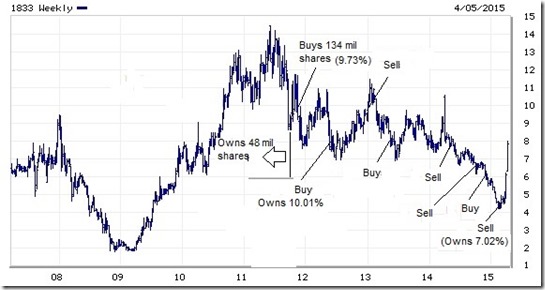
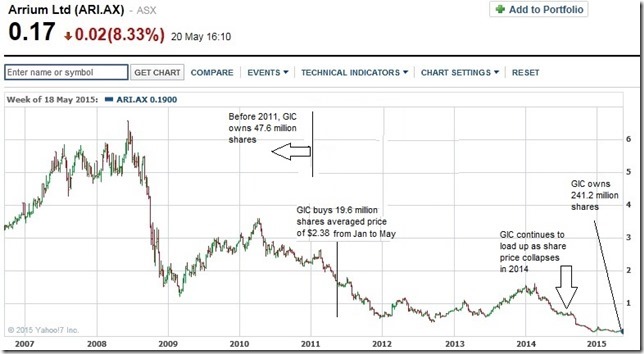
    By becoming a substantial shareholder in many companies with no track record, GIC is merely speculating on capital gains. GIC has no margin for error in its judgement as any mistake will wipe out the investment. And GIC has lots of these wipeout investments. Here are a few:


    Link


    More details on GIC’s China Coal Energy here.

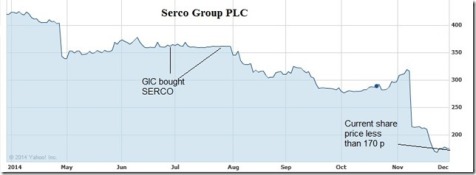
    Less than a year ago, GIC invested in Serco Group PLC in what appears to be ‘bottom picking’. But the bottom has since fell out and Serco’s shares are now worth one third of GIC’s original price.

    intime5.jpg?w=1000&h=

    More details on GIC’s investments at this link.

    There are of course many more such investments.

    6 GIC will never learn from its mistakes because there has been no accountability. Not even after Citigroup or UBS. There are simply too many bad investments which confirm GIC has not conducted due diligence.

    Since a steady stream of about $20 billion CPF is being channeled into GIC every year, it can sit on every underwater investment. It is like our local punters who ‘cold storage’ a collapsed penny stock and then hope for the best in the next bull cycle.

    GIC’s investment ‘strategy’ does not provide for a lump sum withdrawal by CPF members.

    7 Last year, DPM Tharman revealed in Parliament that “In eight out of 20 years, GIC’s returns were lower than the rate promised to CPF members, but the Government absorbed the losses”. GIC claims to have made annual real return of 4.1% over a 20 year period.

    Although Tharman’s statement appears to have revealed little, it has actually confirmed GIC’s mediocre performance.

    It would be fine if GIC’s return was lower than CPF rate for a couple of years but it did so 40% of the time.

    “Lower than the rate promised to CPF members” could also mean GIC had made losses in a number of years. And when PAP is unable to state factually its underachievements, rest assured it must be an embarrassing number.

    It could also be due to GIC’s mediocre performance that it is unable to return a lump sum CPF to members at 55.

    8 GIC has disclosed its 20-year rate of return in Singapore dollar since 2001. It was only after the financial crisis in 2007/2008 that GIC suddenly reported this in US dollar.

    GIC’s 20-year rate of return in Singapore dollar
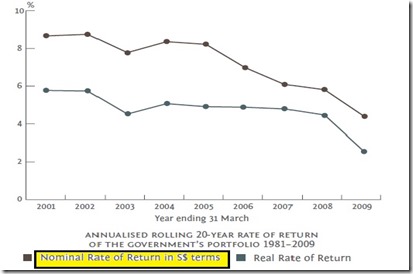
    If GIC had reported in Singapore dollar, its real rate of return would have been much lower – between 2% and 3%.

    GIC’s profits were impacted by forex losses due to the appreciation of our currency
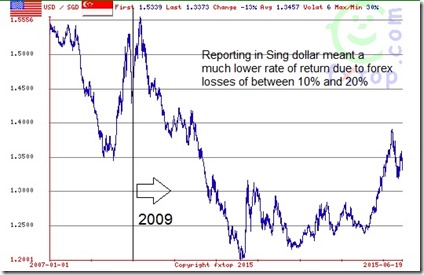
    (Sing dollar strengthened against every major currency except the Swiss Franc during the last decade)

    Reporting in Sing dollar after 2009 would have meant a disastrous performance for GIC. The sub par performance was masked by the change from reporting in Sing dollar to US dollar. Should Sing dollar depreciate, rest assured the reporting currency will be reverted to Sing dollar.

    There have been too many attempts to project GIC’s ‘superior’ performance. If GIC’s client and board of directors isn’t the Singapore government, it would have folded years ago.

    Do you think GIC has the funds to pay every CPF member a lump sum at 55?

    9 By admitting that “the Government absorbed the losses”, Tharman must have meant our reserves were used to pay CPF members for 8 years. If so,why was this not highlighted in Parliament?

    Since GIC had to resort to using our reserves to pay CPF interest on 8 occasions during a 20-year period, does this not confirm it did not have the funds to make lump sum payments to CPF members?

    10 CPF is not invested in foreign companies with strong earnings which are able to pay regular dividends. GIC has taken excessive risks by speculating for capital gains. If this is factually inaccurate, GIC could quell speculation by simply producing a complete list of its investments.

    GIC could have been as transparent as Norway’s GPFG and easily provided FULL disclosure. (2014 GPFG annual report)

    PAP has no reason to invite unnecessary speculation on GIC but why does it continue to conceal basic information of CPF investments?

    11 It is obvious GIC does not have sufficient funds to return all CPF monies to CPF members at 55 or 65. Perhaps it’s time you query your MPs but don’t get your hopes too high – chances are they know only as much as you do.

    redwire-singapore-janil-sleep.png
    Image credit: Redwire Times

    Conclusion

    Your CPF belongs to you, it is YOUR money but how you spend your hard-earned savings is nowdictated by PAP.

    The CPF scheme the mother of all Ponzi schemes. A Ponzi scheme promises high returns to attract investors whereas CPF legislates low returns.

    GIC does not seem to be managing our investments, appears to be speculating and does not have an exit plan when market fundamentals have changed. If due diligence has been conducted, there is no reason for investments to lose half their market value in a year, wiped out within 2 years.

    PAP should not expect CPF members to trust an organisation managing more than $1/4 trillion of our retirement savings when it has not produced a proper set of accounts for 34 years.

    There are obvious question marks all over our CPF scheme but PAP has repeatedly refused to provide relevant answers.

    The original contract for the government to return our CPF at 55 was amended by PAP because Singaporeans voted for a PAP majority in Parliament. The only way to undo this self-created problem is to deny PAP its 2/3 parliamentary majority. There is no alternative.

    Without any checks on the PAP, all your hard-earned CPF will never be returned to you at 55.


    Source: https://likedatosocanmeh.wordpress.com

  • 90% Of People Polled Say They Will Vote For Opposition

    90% Of People Polled Say They Will Vote For Opposition

    “90% of those polled say they will vote for opposition”.  That’s the kind of sensational headline that will grab the attention of the reader.  That’s what my unrepresentative poll results indicate.  Hopefully, you have, by now, picked yourself up after falling off your chair.

    Poll results

    I had carried out an online poll that attracted 135 persons to vote.  It is a small sample and hardly indicative of the actual voting pattern in the country.  My readers are, quite obviously, largely opposition voters.  So, the 90% vote in favour of the opposition is indicative of the profile of my readers rather than being indicative of how Singaporeans are likely to vote.  From the outset, I had no intention to find out about the level of support for PAP.  My little survey was motivated by a recent research finding released by Blackbox Research that indicated that 80% of Singaporeans felt that PAP would either perform better or the same as the last elections if elections are to be held now.  Blackbox went on to conclude that “the PAP are now in the box seat to improve on their 2011 election result”.

    I was a little skeptical about the conclusion.  My gut instinct is that there is a general perception right now that either PAP will perform better or the same as the last elections and this perception is largely a result of pessimism among individuals that would themselves vote for the opposition anyway.  Poll results that indicate that there is a perception as to how PAP will perform are not at all indicative of how those that were polled would themselves vote.  So, Blackbox Research’s findings are neither here nor there.  My conversations with friends (who are largely opposition voters) after the passing of LKY has provided me with anecdotal evidence that there is a high degree of pessimism in the opposition camp.  Three factors loom large in the assessment of many opposition voters:

    1.   LKY’s death and the propaganda overdose following that

    2.   SG50 celebrations and the feel good factor that is likely to be generated (with taxpayers footing the bill)

    3.   WP’s continuing legal troubles with Town Council management.

    It stands to reason that middle ground voters may veer back to the PAP (as it happened in 1997) or there may be a stalemate and we may not see any change between 2011 and 2015 in terms of the popular vote.

    Given the negative sentiments among opposition voters, it is quite inevitable that Blackbox Research’s findings indicate a low 20% stating that they thought PAP will perform worse than in 2011. My view is that their research should not be interpreted to indicate that there will in fact be a vote swing towards the PAP.  Blackbox didn’t ask the crucial question: “Who would you vote for?”

    If that question had been asked, we might have ended up with a result that indicates 35% to 40% stating that they would vote opposition and nevertheless 80% stating that PAP would perform better or the same.  The other problem with the Blackbox findings is that they don’t indicate the percentage that stated that PAP would perform better and those that stated that it would perform the same.

    My poll was done to show that there exists a deviation among opposition voters.  There are a significant number of opposition voters that would vote for opposition but are nevertheless pessimistic about the general outcome in the current elections.  Among the 135 that voted, 90% would have voted for the opposition but only 66% felt that PAP would do worse.  This strongly attests to the fact that even in my small sample of 122 opposition voters, there must have been a significant percentage that were pessimistic about the opposition’s chances in the coming elections.

    There is a percentage deviation of 23% between the actual votes by opposition voters and the perception of improvement in the opposition performance.  In the course of the two weeks that I kept the poll open, at various stages of voting I saw this voting-perception deviation fluctuate from a low of 15% to a high of 25%.  For the most part, the percentage was hovering between 20% to 25%.

    I wouldn’t be surprised if the findings of Blackbox Research are somewhat tainted by the fact that there exists this voting-perception deviation.  I suspect that it does exist at a national level.  So, whilst my small sample yielded a 23% deviation, at the national level this figure is bound to be different (higher or lower) but without data, it is impossible to arrive at any conclusion.  Blackbox didn’t ask the crucial question as to which party would those polled vote for.  All we have is a finding that indicates that only 20% think that PAP will do worse.  This does not mean that only 20% will vote for the opposition.  It indicates, merely, the existence of a certain degree of pessimism among those that would vote for the opposition.  It is not inconceivable that we might have had 40% of those polled intending to vote for the opposition with a large number of them feeling that PAP will perform the same or better (thereby contributing to the statistics provided by Blackbox).

    Another problem with the Blackbox Research findings is that they have conveniently failed to indicate the percentage of those that think that there will be no difference in the voting and those that think that PAP will do better.  I wouldn’t be surprised if the actual figures were along the following lines (speculating, of course):

    50% –  PAP will perform better

    30% –  PAP will perform the same

    20% –  PAP will perform worse

    We don’t know why Blackbox chose not to give a breakdown of the ‘better’ and ‘same’ categories.

    For Blackbox to make the assertion that PAP is in the box seat to improve on its performance in 2011 is a rather bold step.  Another research firm, BMI Research, whilst being generally positive on the outlook for the PAP, did not venture to assert that the vote share will improve.  “While it is difficult to ascertain whether or not the PAP’s vote share will fall again in the upcoming election, the party’s ability to form a strong majority in the parliament is virtually assured,”  Personally, I think that a general election this year is not going to threaten PAP’s majority in Parliament.  The only thing that we are really speculating about is the increase or decrease in their vote share.

    For those in the opposition camp that feel a little despondent after reading the Blackbox report, they should brush aside polls like these as they serve only to measure voter perception rather than how those voters would in fact vote.  There is bound to be a deviation between the two.  For those in the PAP camp, they would be well advised to avoid being too complacent.  Don’t underestimate the actual anger and dissatisfaction on the ground.


    Source: https://article14blog.wordpress.com

  • Do We Want Another 5 Years With PAP?

    Do We Want Another 5 Years With PAP?

    More than 100 days have passed since 23 March, and business seems to be back to normal in Singapore. There is no more outpouring of gratitude whatsoever and in typical pragmatic style people have begun to realise that the next general elections could be as near as 100 days away. Given the trend of downwards support for PAP, things certainly look interesting.

    For one, the PAP has always preached that the opposition should not be given a blank cheque less they make things hard by blocking policies in parliament. As the past 5 years have shown, this is complete and utter bullshit; the WP has shown that they have acted responsibly by voting to strengthen regulatory oversight of town councils despite placing a higher burden on them.

    In fact, quite the contrast can be said. The PAP has made use of their parliamentary majority to pass laws such as the population white paper and the implementation of new media laws, which may not have been favourably received by the majority at large. Hence, more opposition power in parliament may be seen as a positive thing as democracy becomes the new norm.

    Are we willing to accept that alternative political parties in parliament have added more value? While Aljunied town council may have been portrayed as a failure, the fact that WP’s presence in parliament has proven its worth as they serve as a platform to raise difficult questions and elicit answers from the PAP to allow us an insight into their thinking.

    The questions range from the millions spent on scholarships to foreign students to government intentions on the use of ‘unaccredited’ degrees. In both instances, this left some sour feeling on the expected returns from these foreign scholars as well as the PAP government’s lack of empathy. As this catches on, slowly but surely people have begun to realise the merits of having more voices.

    So let’s think about it: do we want another 5 years with PAP?


    Source: http://mythoughtsinafewparagraphs.net

  • George Yeo: No To Parliamentary Politics, Maybe To Presidency

    George Yeo: No To Parliamentary Politics, Maybe To Presidency

    Squashing the prospect of him returning to the rough and tumble of parliamentary politics, former Cabinet Minister George Yeo has said that he has no desire to return to his old stomping ground, even as the clock ticks towards the next General Election.

    However, he is leaving the door open – albeit just slightly – for a potential run for the presidency.

    “My position is the same. I don’t see myself going back into parliamentary politics,” he told TODAY. “For presidential politics, I’ve kept that open but I don’t see myself going into presidential politics either.”

    In a wide-ranging interview on Wednesday (Jun 3) for a new book of his past speeches and writings – George Yeo on Bonsai, Banyan and the Tao, a 686-page tome that has already sold more than 3,000 copies in two weeks and is into its second print run – Mr Yeo reiterated he does not feel himself temperamentally suited for the role of President.

    And if duty called? “One should not engage in self-flattery about duty calling. I think most people who are in politics have a certain ambition, and I don’t see myself having the ambition for presidential politics,” said Mr Yeo, 60, who nevertheless described himself as “a person very given to a sense of duty”.

    In the book’s introduction, Mr Yeo had revealed that Prime Minister Lee Hsien Loong had supported his candidacy for President in the lead up to the Presidential Election in Aug 2011. But Mr Yeo bowed out when Dr Tony Tan indicated his willingness to run with the ruling party’s support. “I would only have contested out of duty, not ambition,” he wrote.

    Mr Yeo had led the People’s Action Party team that lost Aljunied Group Representation Constituency to the Workers’ Party in the 2011 General Election.

    After a 20-year run in Cabinet helming four ministries – he last held the position of Foreign Affairs Minister – Mr Yeo is now chairman and executive director of Kerry Logistics Network, whose head office is in Hong Kong, as well as deputy chairman of Kerry Group.

    During the interview held at his office in Great World City, Mr Yeo – who is based in Hong Kong and returns to Singapore every month – said he still keeps in touch with Aljunied grassroots volunteers through meals or jogs. He shares his views when approached, “but as a commoner”, and asks others for their views in turn, he said. “I think for most people I’m a known quantity. I suppose it’s good to be consistent but one should be alive to new situations and be sensitive to changes in society and the larger environment.”

    Despite spending most of his time overseas, Mr Yeo continues to keep tabs on happenings in the Republic.

    “WE ARE NOW IN TRANSITION”

    Giving his observations on the “Singapore soul” – a topic he had spoken about in his seminal 1991 speech about pruning the “banyan tree” of the state institutions to allow civil society to grow – Mr Yeo said: “I think we’re going through, in the post-Lee Kuan Yew era …. a certain sense that this is where we were, we’re now in transition, but where we will be is not quite settled. And we’re feeling our way into that future.”

    As an example, he brought up the case of teenage blogger Amos Yee who was convicted of posting an obscene image online and posting content intended to hurt the religious feelings of Christians. “People all feel very conflicted by it. You ask yourself, if you’re a parent, how would you feel? If you’re a teenager, how would you feel? He’s obviously very bright, it would be such a sad thing if his life were to be destroyed by some of the things he’s done or said. There should be a reaction but it should not be an overreaction,” said Mr Yeo.

    “Is it possible to somehow manage it in such a way that he will grow up to be an adult who will make a big contribution to society rather than be a problem to society? I think whatever we do, we should always be motivated by a sense of wanting to do good and to save lives, which sometimes means being tough.”

    On life after politics, Mr Yeo said he thought he would be in semi-retirement. Instead, he has found himself travelling as much as before. He has also taken on multiple roles: He will become chancellor of Nalanda University in India from July, and was in 2013 appointed by Pope Francis to a Vatican commission. Mr Yeo also sits on the Hong Kong chief executive’s economic development commission.

    Asked if there is anything he misses about being in Government, Mr Yeo said it had a “different flavour” from the private sector, where considerations tend to be shorter-term. Being in Government, “it’s a large cause you’re working for, you take a longer term perspective”, he said. “You’re on duty all the time, wherever you are … at a hawker centre, or in a shopping centre or overseas, you’re on call 24/7. So that’s the life of a politician and you must be energised by that and not feel that it’s any imposition.”

    With three of his four children residing overseas in various countries, Mr Yeo said he and his wife rely on technology to keep in touch with them. His daughter works in private equity in Singapore, while his three sons are studying in the United States, China and Britain. “The family is far flung so we keep a family WhatsApp account and try to keep each other informed and updated,” he said.


    Source: www.channelnewsasia.com

deneme bonusu