Exactly a week ago, The Online Citizen ran a story after a Facebook post by Jose Raymond about government agency Sport Singapore’s current funding policy for national athletes.
In the Facebook post and subsequent story, it was revealed how Singapore national athletes were receiving a meagre $600 a year, or an average of $50 a month in training assistance grants from the government.
The grants are disbursed to the athletes twice a year, or $300 each time.
The post by Mr Raymond, who is a Vice-Chairman of the Chiam See Tong Sports Foundation and Vice-President (Partnerships) of the Singapore Swimming Association, has since been shared more than 120 times as at 30 June, including both former and current athletes.
Said national sprinter Calvin Kang, one of those representing Singapore at the upcoming SEA Games in Kuala Lumpur: “The harsh reality of sports in Singapore.”
National squash player Vivian Rhamanan, a gold medalist at the last SEA Games in Singapore in the jumbo doubles, said: “I’m one of the fortunate athletes to get funding by Singapore Sports Institute. Currently carded as L4, n get $600 annually from this system.”
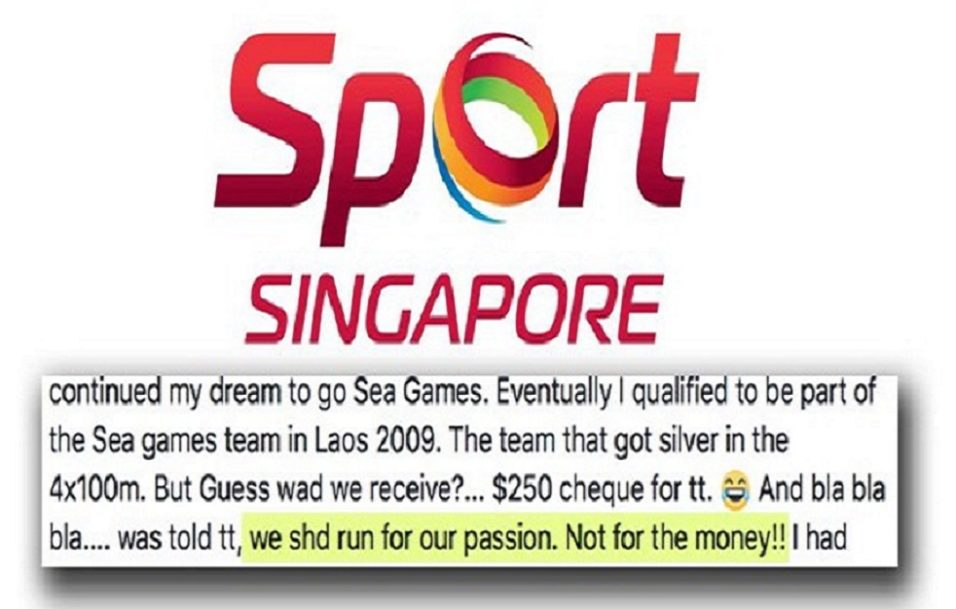
Added former national sprinter Izwan Firdaus, a silver medalist from the 2009 SEA Games in Laos: “I have to beg my parents for a new training shoe each time my shoe broke.”
Sharing how athletes were told that they should run for their passion and not for the passion, Izwan said that he could not live with the way the athletes were being funded and decided to choose to focus on his rice bowl instead.
Former national swimmer and Olympian May Ooi, who is now a mixed martial arts fighter chimed in and added that “appropriate allocation of resources for deserving athletes should be a priority.”
Responses by other athletes as follows:
Government agency Sport Singapore has not responded to the story by TOC, or the Facebook post by Mr Raymond as yet.
When contacted, Mr Raymond said: “The frank and unedited responses by the athletes is loud and clear. It makes for painful reading but it is a harsh reality. The athletes must always be at the heart of whatever we do in sports administration.”
“I know I’m coming across as harsh,” said poet and playwright, Alfian Sa’at. “But I have to register my disappointment at the responses coming from SOTA students regarding why an overwhelming majority of them, despite having an arts-based education, would ultimately choose non-arts careers.”
Mr Sa’at was referring to recent news that 83 per cent of students from the School of the Arts (SOTA) in 2015 went on to non-arts related degrees in university. This is a jump from 60 per cent in 2012.
In her speech at the school’s Arts Awards Day on 15 May, the Minister of Culture, Community and Youth, Grace Fu, praised the school for providing “multiple pathways and varied career options.”
“Over 70 per cent of its graduates have gone on to pursue non-arts related university courses such as Law, Journalism and Engineering and some have taken arts and arts-related courses in prestigious arts institutions and conservatories,” she said.
Straits Times
However, the news was greeted with concern by some, who also questioned the purpose of an arts school and its very existence.
“The staggering number of students from a specialised arts school designed to provide a first-class arts education dropping arts when they enter university is extremely disconcerting,” wrote Jeffrey Say to the Straits Times on 22 May.
Mr Sa’at – known for his provocative works which are performed here and abroad – says that students need to respect the arts as a career in the first place.
“[I] also want to tell you that unless you start according an arts career the respect and commitment that it deserves, and that means not treating it like an after-hours hobby, or a post-schooling co-curricular activity, or making statements like ‘well who’s to say that I won’t still dabble in the arts?’, we will never reach a stage where professionalisation is possible, and we will never create a real industry, the kind you might aspire to be part of one day.”
A SOTA student says: “I’m allowed to have more than one passion. And you don’t get to tell me that I can’t have it both ways. So, no, I’ve never met a SOTA student who gave up on their ambition. And that’s because SOTA students understand that it’s human nature to have more than one. And we’re never going to play the zero sum game with our dreams.”
Sure, you’re young, you’re idealistic. You probably don’t believe, at this point, that it’s possible to bite off more than you can chew. But I also want to tell you that unless you start according an arts career the respect and commitment that it deserves, and that means not treating it like an after-hours hobby, or a post-schooling co-curricular activity, or making statements like ‘well who’s to say that I won’t still dabble in the arts?’, we will never reach a stage where professionalisation is possible, and we will never create a real industry, the kind you might aspire to be part of one day.
When you come in late for rehearsals, because of the overtime from your ‘real’ job, the work suffers. When you don’t get your lines down because you don’t have the head space and bandwidth for the play, the work suffers. When your stage manager has to try working around your schedule and has to even cut rehearsals to accommodate your ‘real’ job, the work suffers. And you expect everyone around you to make compromises and sacrifices so that you can chase your double rainbow?
I know I’m coming across as harsh. But I have to register my disappointment at the responses coming from SOTA students regarding why an overwhelming majority of them, despite having an arts-based education, would ultimately choose non-arts careers. What I’m hearing are ‘you haven’t been to SOTA so please don’t comment’, ‘I’m still young and have every right to change my mind’, ‘don’t talk about your tax dollars subsidising my expensive arts education, I refuse to be blackmailed by any talk of obligations’, ‘people were so discouraging when I joined SOTA and now that I have internalised that discouragement you want to blame me?’ The kind of defensiveness that comes from avoiding the real issues.
And for me the fundamental issue here is: in spite of a prolonged exposure to the arts, a career in the arts remains a deeply unattractive option for many of these students. And I really would like to know why. Yes, I know some students found out along the way that they were interested in something else. Some felt that they were more suited for a life as arts patrons and consumers than as artists. I have no doubt that these are honest responses, but I also feel there is something else if you scratch hard enough.
When I talk about honesty in one’s writing, I tell students that you must be honest in addressing your desires, and you must also be honest in addressing your fears. And I feel that there are fears involved in such decision-making, fears that are not articulated because there is that additional fear of being outed as fearful.
I feel that there are systemic things to talk about, about how after so many years we’re still talking about rice bowls and backup plans and safety nets, about things to do with conformity, risk, innovation, failure, dreams, thwarted dreams, stillborn dreams, dreams that are skewed and resized, trimmed and pruned, dreams nibbled by fear, dreams folded into paper aeroplanes, tucked into crevices between concrete slabs, dreams that were made art in a student’s hands and then turned into rubbish in the hands of the administration..
I have not always been a fan of the local football scene, be it the Prime or S.League but I do come down and support for home games that involve the Singapore National Football Team.
Today on the 29th of November, Singapore loss to Malaysia with a score of 3-1 . I won’t rant on how the game was conducted by those awfull referees (Let’s face it, hands down – Malaysia did outplayed us and we did give our best.The ref’s decision making was totally not agreeable and that made the game more bitter than it ever should) but rather I would want to talk about SingaMania.
For some of you who doesn’t know, “Singamania” is a group made up of smaller die hard football fan groups in Singapore. They can be said as the voice of Singapore Fans when it comes to National Games like how the Ultra Malaya are to Malaysia.
What made me dissapointed was on a few factors:
1) Game was played at home. We should have had bigger national flag than what the Ultras brought. It was disgusting to see how these Ultras had a huge Flag over their entire seat stand but SingaMania had two smaller national flags – nothing compared to half of what the Ultras had. Probably the Ultras had support from the Malaysian football federation for they could not have acquired a large flag if they were an independent group so does SingaMania has support from F.A.S?
It’s Kallang Stadium not Bukit Jalil Stadium. We should have a flag as big as them, if not bigger.
2) It is known that the match tickets sold out in a few hours so I presume 50,000+ people were present including me. The Ultras were louder even though they were only a handful. They were more organised in cheers and their rythm was as close to as a marching band.
Singamania on the other hand couldn’t be clearly heard and the rythm was too fast paced and long. For God’s sake, if you want us to sing & shout with you, make it slower and repetitive so we could know what you guys are chanting. Even when we do get what we think you are saying, you guys just change to another cheer that will be faster than the previous.
I have done my research after the match & I have watched almost all the ultras video that I could find on the net and youtube. It seems they have upload their own songs with lyrics in it. Songs that are easy to learn and sing. I could only found one Singamania cheer video but it wasn’t as catchy neither was it short. It wasn’t a cheer anymore, it was a song. An uncatchy song.
What I could suggest for Singamania: Rather than you guys keep and stay together at one spot like a flock of birds, why don’t you guys divide yourself into smaller groups and stand infront of each wing to teach and get us going. How to coordinate it? Simple, use walkies. Walkies that are sold in Giants or Challenger are affordable to say the least. Sure, it might be expensive but in the long run, Singapore Football Players could finally feel that they are playing at home and not away. They would know that every single fan are standing behind them, cheering them on in every home games.
Don’t forget to make videos on the cheers that you want us to sing. Please do include lyrics in it. Make it short and catchy. Listen to some ultras cheers for inspiration but do not copy any of them. Let’s have our own cheer rather than we, Singaporeans be known as football fans who copy ideas from other Ultras. (I say this because I realised one of your cheer is exactly the same as a cheer made by the Ultras in Pahang, Malaysia)
But hey, if this doesn’t come into effect as soon as possible, i wouldn’t be surprised either. Afterall the Football Association of Singapore doesn’t really encourage home fans to support the team since Horn Makers (such like the vuvuzelas and the Air Horn – all this info can be found on their website) are not allowed.
F.A.S, please do change your policy. Please revived the old kampong spirit in every football fan. Please revived the Kallang Stadium into what it was before – a Lion’s Den. A lion’s den that every away fan wouldn’t even dream of coming to cheer for their teams and be louder than us.