Stomper Chloe was noticed a discrepancy when she checked her credit card bills recently.
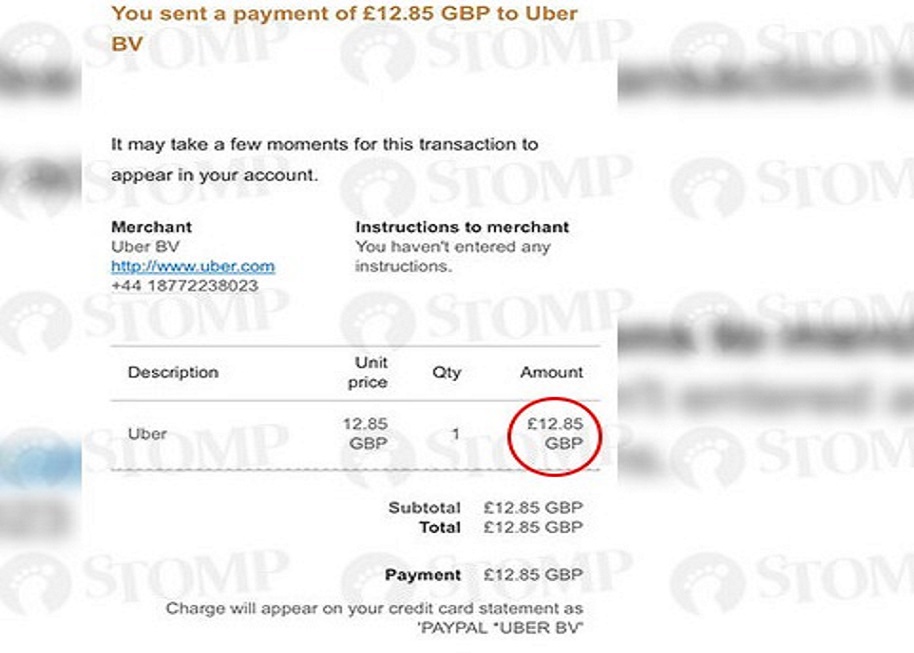
She realised that she had been charged GBP12.85 for an Uber trip she supposedly did not take.
Chloe said that she had not made any Uber trips during the time period, and moreover she was in Singapore, so she could not fathom why the charges were calculated in British Pounds.
She subsequently wrote emails to Uber and Paypal, but alleged that they did not get back to her.
Chloe noted two more fraud transactions charged to her PayPal account, indicating that she had used Uber services.
Said Chloe:
“This has provided much inconvenience and cause me to lose confidence.”
In response to Stomp’s media query, a spokesman from Uber said:
“We do not comment on individual cases due to our privacy policies which protect both riders and drivers.
“Our team will review the incident and address it accordingly.
“However, it is important to stress that there are myriad reasons why this could occur – including whether the user is maintaining good habits in safeguarding personal information security, whether the device had been compromised, or even issues with the financial institution and its products.
“It would not be right to speculate, but we will continue to monitor the issue closely.
“Riders are encouraged to contact our 24/7 customer support team through the in-app Help, Account and Payment Options, or online through Account and Payment Options, should they suspect that their account has been compromised.”
The Republic offers some of the most generous expatriate salary and benefits packages in Asia-Pacific, according to the latest survey by ECA International, released on Wednesday.
Among the 16 countries surveyed in the MyExpatriate Market Pay survey — which is published annually by the information provider on employment conditions abroad — Singapore offers the second-most generous pay package, after Pakistan. South Korea, Japan and Hong Kong round out the top five locations in terms of the highest expatriate salaries.
“Singapore is a very attractive proposition to both companies and expatriates alike. Companies sending expats here offer some of the most generous salary and benefits packages in the region, sitting in the top three for both elements in the Asia-Pacific rankings,” said Mr Lee Quane, ECA’s regional director of Asia.
When considering the cost of an expatriate package, companies need to factor in three main elements: The cash salary, benefits — such as accommodation, international schools, utilities or cars — and tax.
When tax is factored in, Singapore is ranked ninth in the Asia-Pacific’s overall most-expensive locations as it has one of the lowest personal tax rates in the world, said Mr Quane.
“This ensures that Singapore remains one of the cheaper locations for companies to send their expats to in the region — behind Japan, Hong Kong, and China.”
The value of a typical expatriate package for middle managers in Singapore is now S$316,600, which is a five-year low.
In contrast, the comparable package in Hong Kong is around S$356,800, and in China, the package is S$379,800 on average.
Japan, at the top end of the scale, pays an average of S$493,900 to an expatriate middle manager, while Malaysia, at the bottom end, offers an average of S$225,900.
“In local currency terms, although expatriate salaries continue to rise in Singapore, reaching the highest levels since our survey began, the cost of the benefits element has significantly declined. This means that the total cost of an expatriate package for companies in Singapore has fallen over the past few years in local and US dollar terms,” added Mr Quane.
The most expensive part of the expatriate package in Singapore is typically the benefits element, to the extent that the benefits components are often more expensive than the assignee’s net take-home pay.
“Even though international school fees have risen in Singapore, the overall cost of benefits packages have fallen in US dollar terms by 10 per cent over a five-year period due to expatriate accommodation rental prices declining,” said Mr Quane.
The government keeps saying that Singaporeans don’t want the jobs, like in this Certis Cisco case. They turn to foreigners because no Singaporeans can do the jobs. I want to prove a point that the reason why Singaporeans keep resigning is because of low pay and very bad working conditions.
When I signed on, I was promised a pay package in a contract black and white, but the company always finds ways to pay me lesser. I am a Singaporean and i don’t mind the long hours of work, in fact i requested for OT. But they are not giving what I deserve.
You can see how many hours I worked in November.
Today they say that they need 600 APOs but cannot find enough Singaporeans, so they hire 120 Taiwanese. They say Singaporeans don’t want the job so they no choice, must find foreigners. Such a big lie when they make Singaporeans resign by shortchaging them.
Above is the contract they promised in august and 2nd photo is part of my pay slip for last mth Nov 2016.
This is how Certis Cisco treats Singaporean Auxiliary Police Officers (armed) which they claimed to be short of. Ironic much?
Apparently, charges on plastic bags used during supermarket shopping trips.
According to a report on Channel NewsAsia at around 10pm last night, “local supermarket chains could impose a plastic bag charge if there is an industry-wide effort to implement one”.
The statement comes as a response to environmental group Zero Waste’s call for the Government to introduce charges on the use of plastic bags among Singaporeans.
Executive director of Zero Waste, Mr Eugene Tay, said: “If there is a charge [for plastic bags] then people will start thinking about how can they reduce the plastic bags that they take.”
The group proposed that retailers charge their customers 10 cents and 5 cents for large and smaller plastic bags respectively, which already sparked discussions on Facebook on the feasibility of the solution.
For example, a netizen said, “Most dwellers use plastic bags to recycle as trash bag. Imagine them dumping trash directly into our rubbish chutes. It would be environmentally unhygienic when the waste foods start rotting inside.”
On the Government side, Member of Parliament Lee Bee Wah, chairman of the Government Parliamentary Committee for Environment and Water Resources firmly stated that it should be the big supermarkets’ duty to carry out this proposal, as “The Government should look at education; look at bigger issues on the environment, not just plastic bags, per se.”
Spokespeople from the Dairy Farm group (which owns Cold Storage and Giant), and NTUC FairPrice have come forward to tell CNA that at the moment, they already have incentives and efforts in place to reduce the dependence on plastic bags by their shoppers.
NTUC’s”Bring Your Own Bag, FairPrice Green Rewards Scheme” / Image Credit: TODAY
Singaporeans are said to use a whopping 2.5 billion plastic bags each year, and according to statistics from the National Environment Agency’s website, 824,600 tonnes of plastic waste were generated in 2015.
From the latest report, it does seem like these big supermarket chains have decided to respond, albeit without promising anything concrete, to the proposal.
Singaporean Netizens Debate
In response to the news, netizens seem to be somewhat divided.
One begged for others to look at the “bigger issue” as compared to potential inconveniences:
“The rubbish thrown down the chute doesn’t just disappear into thin air y’know.”
Some have mentioned how it is “long overdue”, and suggested ways that the implementation can be carried out:
“[…] Provide one or two reusable shopping bags to the low income group.”“For those who [don’t request for plastic bags], you pay them instead.”
One called for the Government to take the lead, in light of other nations already taking nationwide steps to reduce plastic waste:
“So come on Singapore Government […] make it compulsory across the industry”“Adding charges to [the] consumer is definitely not the way to go.”
However, some are adamantly against the potential changes, and have spoken out strongly against it:
“Don’t buy the hype”“[It’s utter] nonsense.”
Regardless, the sentiments can be accurately summarised in this particular thread, and the number of ‘likes’ for each polarising comment:
Screenshot from CNA’s Facebook page
Online Grocery Providers Can Be Pioneers In Environmentally-Friendly Practices
What’s interesting though, is the fact that a few have taken to the news as even more reason to grocery shop online.
Netizen cites saving time and money on taxi rides
The online grocery shopping scene is a highly competitive one, with honestbee and RedMart being among the few big players in the (pun intended) market.
honestbee team / Image Credit: Vulcan Post
An increasing number of Singaporeans, even without the plastic bag charge fiasco, have been turning to these online providers due to the convenience that comes with the services, especially in light of their busy schedules and the need for a means of transport after an intense grocery shopping session.
Perhaps then, these providers can be the pioneers in encouraging environmentally-friendly practices, and use recyclable bags for their clients’ purchases.
Regardless, the issue seems to be still in pending mode, and there’s no certainty on what the verdict will be.
Parking will no longer be free at selected carparks in 12 popular parks across the island, ruffling the feathers of some park goers.
The National Parks Board (NParks) is rolling out an automated fee system at 18 carparks in 12 parks starting from this month, including Choa Chu Kang Park, Bishan-Ang Mo Kio Park and Labrador Nature Reserve.
The move, introduced at parks serving a large number of users, is meant to regulate usage and prevent abuse, said NParks director of parks Chia Seng Jiang in a Forum letter published in The Straits Times yesterday.
“In recent years, NParks has been receiving complaints on the constant misuse of parking spaces in the above parks, where parking spaces were taken up for extended periods of time by non-park users,” he said.
The new system is already in place at East Coast Park, where users said they are now charged $1 an hour, at all times of the day.
The Straits Times understands that the new charges are standard parking rates.
Some have expressed concern that the new charges could discourage people, especially the elderly and handicapped, from visiting the park regularly.
Housewife Lim Lih Mei, who is in her 40s, told ST: “I can understand why charges would be imposed because land is scarce, but parks are for general public use.
“For those with elderly folk and young children, driving a car is a necessity rather than a luxury. So why should they be penalised?”
Madam Jessy Leow, 70, who visits East Coast Park with her 70-year-old husband at 6am every day, suggested that the authorities could look into giving a grace period during the early morning hours.
“At night, I agree that the carparks are very packed, but in the morning, there’s hardly anyone there as most of the shops don’t open until around 11am,” she said.
Madam Leow, who has arthritis and gout, also added that taking public transport to the park is very inconvenient for elderly folk such as herself.
Others suggested that NParks could have looked into more effective ways to prevent abuse of the parking spaces.
For instance, it could have tried to find out which timings were more prone to misuse.
Mr Jason Fu, 26, a regular West Coast Park visitor, said that the new fees could lead to fewer park visitors. But the charges may help to reduce the number of motorists who park at the parks overnight, he added.
Said the graphic designer, who does not mind having to pay the parking fees: “People will think twice about parking there.”
In its Forum letter yesterday, NParks said it appreciated feedback on the charges and will monitor the situation at these carparks.


!["So come on Singapore Government [...]](https://cdn01.vulcanpost.com/wp-uploads/2016/09/Screen-Shot-2016-09-27-at-11.25.51-AM.png)


