Tag: Pink Dot SG

  • LGBT Agenda And Activism In Singapore

    LGBT Agenda And Activism In Singapore

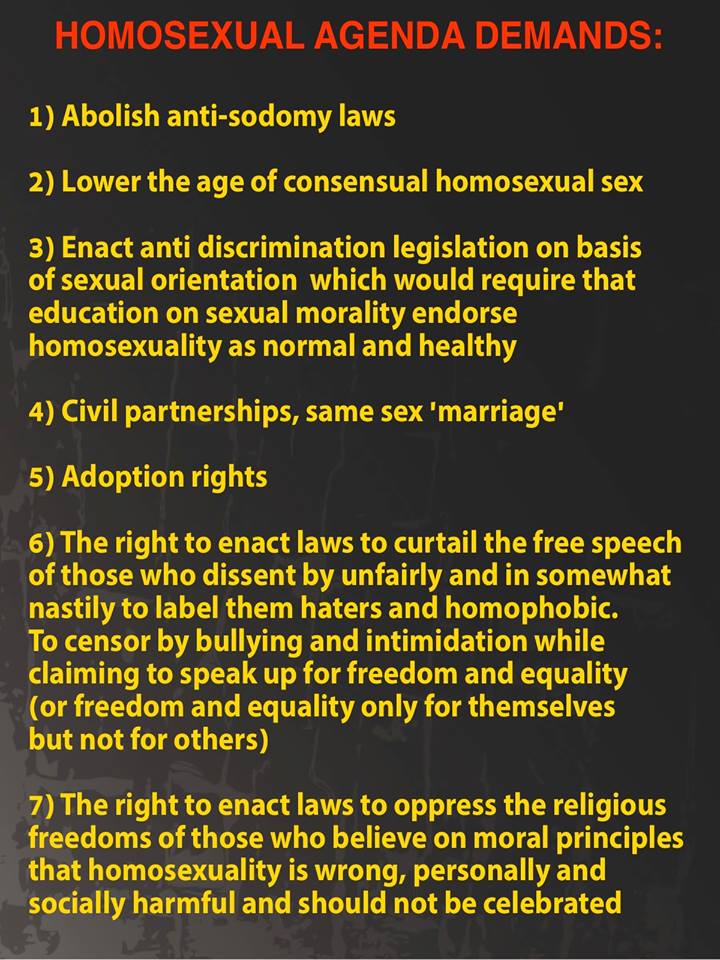
    Homosexual activists have always claimed that there is no gay agenda. However, by watching how homosexuality has gained acceptance elsewhere, especially in some Western countries like the U.S., we know that this is a blatant lie.

    Moreover, U.S. President Barack Obama has criminally pushed its LGBT agenda worldwide by making use of the United Nations as a platform to further its goal. In fact, the Obama administration has made the acceptance of homosexuality one of its prime foreign policies. In a memo to his State Department and US agencies, he said: “Under my Administration, agencies engaged abroad have already begun taking action . . . . . as we in the United States bring our tools to bear to vigorously advance this goal”.

    As have been seen, the U.S. and some of its Western allies have tried to bully African nations into accepting homosexuality by withholding foreign aids. However, kudos to these impoverished nations, they stood their ground. In April 2014, the African, Pacific and Caribbean Group of States (ACP) released a strongly worded resolution condemning wealthy Western nations for their repeated attempts to blackmail African nations into legalizing homosexual behaviour.

    Nevertheless, we must not let our guard down as the scourge of the LGBT agenda continues to spread like wildfire, backed by major U.S. corporations. For example, the wealthiest and most powerful LGBT activist group, the Human Rights Campaign (HRC) is funded by Apple, Google, Microsoft, Citibank, Bank of America, JP Morgan, Coca Cola, Pepsico, Starbucks and IBM, just to name a few. (Access the full list here:http://www.massresistance.com/docs/gen2/14c/hrc-attacks-on-pro-family/hrc-corporate-sponsors.html).

    Funding by such mega corporations can have a big impact in advancing homosexual rights. A good example is Ireland which just voted “Yes” to same-sex marriage. This is done with the financial backing of U.S.-based Atlantic Philanthropies which reportedly invested between 17 to 25 million U.S. dollars between 2004 and 2014 to effectively catalyse the homosexual-rights lobby in the Catholic country.

    Considering that Ireland had only passed a law decriminalizing homosexuality on the basis of equality in 1993 and overturning laws dating back to the 19th century that prohibited homosexual activities, the victory by homosexual activists is indeed stunning.

    To understand how the homosexual agenda has advanced so rapidly, we shall examine the strategies being crafted and meticulously carried out over the years. This was first highlighted by the article “The Overhauling of Straight America”, which was later published in a book titled “After the Ball: How America Will Conquer Its Fear and Hatred of Gays in the ’90s.”

    The strategies are detailed in a simple stair-step fashion that turns homosexuality from a “prohibition” (against natural norms) to “acceptance” (through deceit, deception, propaganda and ambivalence of the silent majority) and then to “dominance” (funding politicians in key government positions to enact LGBT-friendly laws that persecute anyone deemed to act against “human rights”, “equality”, “non-discrimination”, “tolerance” and “freedom to love”).

    We shall also draw parallels to what is happening in Singapore with the Pink Dot LGBT movement.


    “Step 1: Talk About Gays And Gayness As Loudly And As Often As Possible.”

    Make homosexual behaviour looks normal by exposing it as much as possible. When there is enough exposure in close quarters, for example among acquaintances and colleagues, almost any behaviour begins to look normal.

    In the early stages, homosexuality is projected softly to avoid shocking the masses and by downplaying the imagery of sex.

    In The Context of Singapore

    Pink Dot, the homosexual movement in Singapore has been trying to gain as much exposure as possible. Besides organising the annual Pink Dot event at Hong Lim Park, they have also held smaller events in other parts of Singapore throughout the year. For the 2015 Pink Dot event, they even plan to work with the eateries along North Canal Road (just beside Hong Lim Park) to “turn it into a pink street”. The purpose is obvious – pushing the boundaries to expand their reach. However, they may be breaching Singapore laws if their activities spill beyond the confines of Hong Lim Park. If so, they must be taken to task.

    Whatever Pink Dot is doing, their aim is obvious – EXPOSURE. By increasing their exposure, they seek to incrementally desensitize the public. They have also sought local celebrities to grace the event and use them to reach out to the older generation of Singaporeans who are mostly conservative. Again, the motive is to achieve even more publicity.

    On the event day itself, which falls on 13 June this year, many performances are also lined up. This is done for the sole purpose of changing the negative perception of homosexuality. By portraying themselves as friendly, fun-loving and “normal”, they hope to project homosexuality in a favourable light. Their theme of “Freedom to Love”, “Non-Discrimination” and “Inclusiveness” is simply to project themselves as victims of the wider society and gain sympathy from the less informed, which unfortunately, remain quite sizeable on the issue of homosexuality.

    As can be seen, they have been completely silent on the adverse effects of homosexuality and same-sex marriage on society. This is deliberate as studies have shown the advancement of LGBT rights have serious repercussion on society. Some of these are as follow:

    • The destruction of traditional marriage. As we know, marriage is the permanent, exclusive union of one man and one woman. It is the fundamental building block of a society and therefore, upholding marriage is in everyone’s interests.
    • Same-sex marriage leads to the casualization of heterosexual unions and separation of marriage and parenthood. It may be the end-game of long-running anti-marriage, anti-family policy typified by Sweden.
    • Same-sex marriage and commercial surrogacy deprive children of either a father or mother, which is detrimental to their psychological, emotional, intellectual and physical well-being. Commercial surrogacy also treats children as a commodity that can be sold and bought with money.
    • Higher rate of domestic violence and child molestation compared to heterosexuals

    And for people who live a homosexual lifestyle, the following are found:

    • Indulge in risky sexual practice
    • Have high numbers of sex partners in their lifetime, even when married
    • Have high relationship and mental health problems
    • Suffers from substance and alcohol abuse
    • Have disproportionately high numbers of HIV and other sexually-transmitted diseases
    • Have higher suicidal tendencies and mortality rate than heterosexuals
     lgbt manifesto

    “Step 2: Portray Gays As Victims, Not As Aggressive Challengers.”

    In an effort to win over the public, gays are cast as victims in need of protection so that straights will be inclined by reflex to assume the role of protector.

    To be effective, the visual media, film and television are plainly the most powerful image-makers in the Western civilization. By reaching out to the straights using such medium, a Trojan horse might be planted without them knowing consciously. Such efforts to desensitize the mainstream can be seen in gay Hollywood.

    To further portray gays as victims of society, graphic pictures of brutalized gays, dramatizations of job and housing insecurity, loss of child custody, and public humiliation are being brought to the fore of straights in an effort to soften their stance on homosexuality.

    In The Context of Singapore

    One of Pink Dot’s main trusts is to promote its “Freedom to Love” regardless of gender identity and sexual orientation. Anyone who does not subscribe to their definition of “Love” will be accused of “discrimination” and violation of their “human rights”.

    To achieve this objective, Pink Dot has produced videos portraying homosexuals not only as victims of society, but their family as well. In fact, they have produced numerous videos with such themes, with some featuring school children. All these are premeditated in an attempt to draw sympathy from the masses.

    And of course, social media, television and the internet have been used to milk as much publicity as possible. By playing up the plight of homosexuals, they hope to soften the stance on homosexuality by the wider public.


    “Step 3: Give Protectors A Just Cause.”

    By casting gays as society’s victims, they hope to encourage straights to become their protector. However, it is found that there are few straights who would want to defend homosexuality boldly.

    Instead straights would prefer to attach their awakened protective impulse to some principle of justice or law, as well as to some general desire for consistent and fair treatment in society.

    Hence, the homosexual lobby would not demand direct support for their agenda. Instead, they focussed on anti-discrimination as its theme – the right to free speech, freedom of beliefs, freedom of association, due process and equal protection of laws.

    It is especially important for the gay movement to hitch its cause to accepted standards of law and justice because its straight supporters must have at hand a cogent reply to the moral arguments of its enemies. When the homophobes clothe their emotional revulsion in the daunting robes of religious dogma, the defenders of gay rights will counter dogma with principle.

    In The Context of Singapore

    An Institute of Policy Studies survey has found Singaporeans to be mostly conservative and does not accept homosexuality. So are major religions here like Christianity and Islam.

    Therefore, to gain acceptance, Pink Dot has constantly portrayed LGBT people being discriminated against. This can be seen following the failed Constitutional challenge to repeal 377A of the penal code that criminalizes sex between two men. In its statement, Pink Dot said: “It gives carte blanche for discrimination and reinforces prejudice, leading to censorship in the media and the aggravation of negative stereotypes, and impacting the health and well-being of a significant segment of society”.

    Curiously, when homosexuals make up less than 2 per cent of the population in Singapore, how can this be considered “a significant segment of society”? Also, by portraying LGBT people as being widely “discriminated”, they hope that special provisions, rules or even laws must be enacted to protect them. A good example is seen in the University Scholars Programme in NUS that specifically spelt out what “sexual respect” is. (See link:http://www.usp.nus.edu.sg/community-college/sexual-respect-in-the-usp.html)

    No surprisingly, Pink Dot has been deafeningly silent about the adverse impact of LGBT rights on society. The following are just some examples why LGBT rights must never be allowed to advance:

    Therefore, in order to change public perception, words such as “freedom to love”, “diversity”, “non-discrimination”, “tolerance” and “diversity” have been ceaselessly broadcast. They have also reached out to straight friends for support to show that those against homosexuality are “right-wing or religious fanatics”, “homophobes”, “bigots” and “haters”.

    Many LGBT groups have also been established in our tertiary institutions in an attempt to raise their visibility. The purpose is to desensitize the wider student population and to show that LGBT people are “normal” like everyone else. Eventually, it is hoped that homosexuality will be more widely accepted by the next generation.


    “Step 4: Make Gays Look Good.”

    In order to make a Gay Victim sympathetic to straights, portray him as Everyman. But an additional theme of the campaign should be more aggressive and upbeat: to offset any bad press about homosexual men and women, paint gays as superior pillars of society.

    In The Context of Singapore

    As mentioned above, Pink Dot has been trying to change the perception of LGBT people. By courting straight allies, they hope to show that homosexuality is “normal” and LGBT people are just like everyone else.

    On a more aggressive move, they have brought together LGBT student groups from our tertiary institutions to participate in this year’s Pink Dot event for the first time with the stated purpose of “helping student groups support the LGBT community and promote a better school environment”. Again, they are portraying LGBT people as a discriminated class, even in Singapore’s education system.

    As in previous Pink Dot events, sponsors include mega U.S. corporations such as Google, JP Morgan, Goldman Sachs and Bloomberg. By having such corporations supporting them in the name of “diversity”, they want to show that being “inclusive” (which include employing LGBT people) is a necessary ingredient for their successes.


    “Step 5: Make The Victimizers Look Bad.”

    At a later stage of the media campaign for gay rights-long after other gay ads have become commonplace — it will be time to get tough with remaining opponents. To be blunt, they must be vilified.

    To achieve this, the public should be shown images of ranting homophobes whose secondary traits and beliefs disgust Middle America. These images might include: the Ku Klux Klan demanding that gays be burned alive or castrated; bigoted southern ministers drooling with hysterical hatred to a degree that looks both comical and deranged; menacing punks, thugs, and convicts speaking coolly about the ‘fags’ they have killed or would like to kill; a tour of Nazi concentration camps where homosexuals were tortured and gassed.

    In The Context of Singapore

    Luckily for Singapore, we have not reached this stage of development yet. However, we must not let our guard down amid the constant barrage of misinformation from LGBT activist groups. As can be seen, newspaper forums have seen an increased number of articles on LGBT issues. Reporting by our mainstream media on homosexuality issues has also tended to be more liberal than necessary. In fact, we have not seen any reports that portrayed homosexuality in a negative light.

    Comments in newspaper forums have also seen pro-LGBT activists vilifying anyone that do not agree with them, calling them “bigots”, “homophobes”, “haters” and even “dogs”. They will make use of every single opportunity to attack people who do not accept homosexuality. A good example is the recent uproar over Ikea’s offering of discounted ticket prices to its members for the Vision magic show by Pastor Lawrence Kong who is known for his stance against the sin of homosexuality.

    Lastly, deception that there is a growing acceptance of homosexuality is very much at play. Last year, Pink Dot claimed that 26,000 people participated in its event. But, judging from the space constraint of Hong Lim Park and making a comparison in which 26,000 runners participated in a marathon, you decide which is the BIG LIE!


    Can this be 26,000 people?
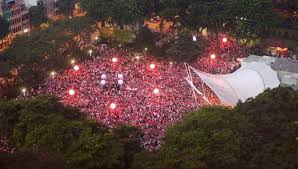
    Can this be 26,000 people?


    When this is 26,000 marathon runners?


    Source: https://homosexualityactivism.wordpress.com

  • Pink Dot SG: An Invitation To Lee Hsien Loong To Attend Pink Dot 2015

    Pink Dot SG: An Invitation To Lee Hsien Loong To Attend Pink Dot 2015

    To Prime Minister Lee Hsien Loong: an Invitation to Pink Dot 2015

    It is very disappointing to hear Prime Minister Lee Hsien Loong’s response to the query on same-sex marriage at a recent interview with regional journalists.

    Firstly, we respectfully differ with PM’s views that ‘we do not harass them (LGBT Singaporeans) or discriminate against them’. LGBT people in Singapore continue to be discriminated against through the existence of Section 377a of the Penal Code.

    While it is claimed that Section 377a is not enforced, its presence alone encourages discrimination and reinforces prejudice, leading to censorship in the media and the aggravation of negative stereotypes, impacting the health and wellbeing of a significant segment of society. Young LGBT people grow up in fear of being bullied by schoolmates, and cast out by family members. Working adults hide their true selves because they fear being ‘outed’ would affect their chances at promotion, or even cost them their jobs and their means to survive. Transgender individuals are often called names on the streets, labelled as deviants, denied many mainstream jobs, and are sometimes assaulted.

    In a recent study – Singapore’s first and currently only – of 450 LGBT respondents¹, a staggering 60% had said that they had faced discrimination or abuse in their lifetime. A significant majority of these individuals also reported an increase incidence of suicidal thoughts and behavioural issues.

    Compounding this issue, is the dearth of information and resources available for community and social groups to provide proper assistance to those in real need of help – an added effect resulting from Section 377a and censorship regulations.

    We hope Mr Lee can empathise with the LGBT community, who – despite the challenges they face: ridicule, verbal and at times even physical abuse from their own kin – continue to contribute faithfully to the Singapore dream, to the only home that they know.

    We acknowledge the concerns raised by PM – given Singapore’s unique position as a multi-cultural, multi-racial and multi-religious society, there will be a plurality of viewpoints, some deeply entrenched. However, we disagree that this is something that should not be discussed – it is not a topic that can be swept under the carpet and allowed to fester.

    We firmly believe that dialogue is our best way forward. As such, we would like to invite Prime Minister Lee to join us in celebrating the Freedom to Love, this Saturday, June 13, at Hong Lim Park, and meet with the individuals, families, and loving couples who form a vibrant part of Singapore’s social fabric.

    In Singapore, racial and religious minorities are protected under the constitution. It is our hope that sexual minorities will one day be afforded the same protections, in order for us to live our lives without fear of being seen as less-than-equal in the eyes of the law.

    Whether Singapore will eventually abolish Section 377a and create a society truly based on justice and equality, that values all contributing citizens regardless of race, religion, sexual orientation or gender identity; a lot will depend on fostering goodwill and encouraging respect among groups and individuals.

    It is also our hope that Singaporeans will one day all come together to celebrate inclusivity and diversity – for it is through this, and love for one another, that we show our true strength as a nation. – Pink Dot SG

    ¹Homophobia and Transphobia Survey by Oogachaga Counselling and Support


    Source: Pink Dot SG

  • In The Aftermath Of Pinkdot And Wear White

    In The Aftermath Of Pinkdot And Wear White

    To many, Pink Dot SG is probably the figurehead of the Lesbian, Gay, Bisexual and Transgender (LGBT) rights agenda in Singapore. It is, to some extent, the local equivalent of Gay Pride.
    Pink Dot has been held at the Speakers Corner at Hong Lim Park since 2009. But only this year has Pink Dot faced significant opposition, particularly from a campaign known as Wear White.
    Why is this so?
    Why Pink Dot 2014 has faced greater opposition
    The reasons why Pink Dot 2014 has faced greater opposition have been concisely summed up in the following statement on the Wear White website:
    The movement’s genesis was from our observations of the growing normalization of LGBT in Singapore. However, we recognize the conduct and it’s support among Muslims is due to the lack of understanding and connection with Islam and our fitrah. We thus came together initially with the expressed purpose of reminding Muslims not to participate in the LGBT event on 28th June.
    The first reason lies in the growing efforts to normalise LGBT lifestyles in Singapore, together with efforts to sanction certain forms of disapproval. Although controversies have arisen over the years, such as the debate in Parliament over section 377A of the Penal Code in 2007, and the AWARE (Association of Women for Action and Research) saga in 2009, several events have intensified the debate in 2014. Early this year, the Health Promotion Board (HPB) stirred controversy in its FAQs on Sexuality by claiming that “[a] same-sex relationship is not too [different] from a heterosexual relationship”. In the debate that ensued, complaints were lodged against National University of Singapore (NUS) Professor Dr Syed Muhd Khairudin Aljunied for describing “alternative modes of sexual orientation” as “wayward”, and as “cancers” and “social diseases” to be “cleansed”. According to NUS, he acknowledged “poor judgment in the tone and choice of words” after he was counselled by the university.
    The second reason is the preservation of religious identity. While the debate has often been portrayed as one between religious conservatives and secular liberals, the video promoting Pink Dot 2014 explicitly threw religion in the mix by featuring a hijab-wearing Malay-Muslim woman and an individual wearing a crucifix. A number of Muslims took offence at this. Among the responses included an open letter titled, “A letter to Muslimah Sister Regarding her Support for PinkDotSG2014“. The Singapore Islamic Scholars and Religious Teachers Association (PERGAS), Fellowship of Muslim Students Association (FMSA), and Masjid Ugama Islam Singapura (MUIS) have since drawn a line in the sand, whether directly or indirectly. Likewise, the Catholic Church and the National Council of Churches in Singapore have made statements calling upon Christians not to support Pink Dot.
    What is at stake here
    At stake in the LGBT debate are competing notions of human dignity, sexuality and the family. Although both sides of the debate hold unequivocally that human beings are rights-bearing individuals, there are marked differences in their appreciation of human nature.
    On one view, marriage – the comprehensive, exclusive and permanent union based on the sexual complementarity of a man and a woman, which is intrinsically ordered to produce new life – is a personal and social good. It fulfils and enriches human personality, and provides the foundation for procreation, family and society. Human dignity is attained by taming desire and directing it according to reason. Therefore, there are both substantive and procedural norms governing sexual expression.
    On the other view, an essential aspect of human dignity is that of self-actualisation or self-realisation, part of which is sexual expression. Reason is instrumental to desire, and the only norm governing sexual expression is consent. Marriage and family, then, are emotional unions based on commitment.
    These two competing conceptions strike at the heart of society and cannot simply be relegated to one of mere opinion or preference. At the moment, the former view is the dominant one in society. Prime Minister Lee Hsien Loong said in 2007:
    Singapore is basically a conservative society.  The family is the basic building block of our society.  It has been so and, by policy, we have reinforced this and we want to keep it so.  And by “family” in Singapore, we mean one man one woman, marrying, having children and bringing up children within that framework of a stable family unit.
    Recent surveys conducted by the Institute of Policy Studies have shown that Singapore continues to remain conservative.
    Given that “[the] family is the natural and fundamental group unit of society”, as affirmed by the Universal Declaration of Human Rights, there will be significant impact on society, whether society adopts one view or the other.
    In fact, the Singapore Government has recognised the social benefits and costs when family is affected. The Shared Values White Paper (Cmd. 1 of 1991) writes:
    12. The sanctity of the family unit is not a value unique to Singapore. All major faiths consider this a cardinal virtue. The family is the fundamental building block out of which larger social structures can be stably constructed. It is the group within which human beings most naturally express their love for parents, spouse and children, and find happiness and fulfilment. It is the best way human societies have found to provide children a secure and nurturing environment in which to grow up, to pass on the society’s store of wisdom and experience from generation to generation, and to look after the needs of the elderly.
    13. In recent decades many developed countries have witnessed a trend towards heavier reliance on the state to take care of the aged, and more permissive social mores, such as increasing acceptance of “alternative lifestyles”, casual sexual relationships and single parenthood. The result has been to weaken the family unit. Singapore should not follow these untested fashions uncritically.

    How the Government has contributed to the culture war

    The Government has repeatedly cautioned against “culture wars”. For example, then-Minister for Home Affairs Wong Kan Seng cautioned in 2009, “We must not import into Singa­pore the culture wars between the extreme liberals and conservatives that are going on in the US.”
    However, in 2014, the Government has itself fanned the flames of the culture war in Singapore by its own doing.
    The first was the controversy over the HPB FAQs on Sexuality, which both conservatives and liberals recognised as a significant shift in the Government’s stance. Gay Star News praised it as a “groundbreaking move”, while PERGAS and Faith Community Baptist Church (FCBC) senior pastor Lawrence Khong made similar observations, to great consternation. The Government’s defence of the FAQs that followed can only be described as weak and self-contradictory (see “Welcome to the Animal Farm: MOH’s response to HPB FAQs on Sexuality“).
    The second was the Government’s statements in response to the Wear White campaign. Minister-in-charge of Muslim Affairs Yaacob Ibrahim said that those who “express support for a cause or a choice of lifestyle should express it in a way that does not divide the community”. These statements were perceived as Government bias against conservatives, sentiments which were perhaps best expressed by Lam Jer-Gen in a letter to TODAY, “Expressions of pro-family support are not divisive” (25 June 2014):
    I disagree with Minister-in-charge of Muslim Affairs Yaacob Ibrahim’s views…
    Why should the Government allow groups, such as the one that organised the Pink Dot event, to promote alternative lifestyles, yet criticise pro-family groups and consider their expressions of support for a cause or a choice of lifestyle divisive?
    Once again, the Government’s response has been little more than a bare denial (see “Impressions of Government Bias in Culture Wars“).


    Conclusion: Where do we go from here?
    During the debates on section 377A of the Penal Code, Prime Minister Lee Hsien Loong said:
    … I do not think it is wise to try to force the issue.  If you try and force the issue and settle the matter definitively, one way or the other, we are never going to reach an agreement within Singapore society.  People on both sides hold strong views.  People who are presently willing to live and let live will get polarised and no views will change, because many of the people who oppose it do so on very deeply held religious convictions, particularly the Christians and the Muslims and those who propose it on the other side, they also want this as a matter of deeply felt fundamental principles.  So, discussion and debate is not going to bring them closer together.  And instead of forging a consensus, we will divide and polarise our society.
    I should therefore say that as a matter of reality, the more the gay activists push this agenda, the stronger will be the push back from conservative forces in our society, as we are beginning to see already in this debate and over the last few weeks and months.  And the result will be counter productive because it is going to lead to less space for the gay community in Singapore.  So it is better to let the situation evolve gradually. [Emphasis added]
    As noted in a previous post, the least the Government can do is to level the playing field in a democratic society by guaranteeing equal rights of freedom of speech and freedom of conscience.

    There are two possible approaches to realise this:

    1. Ban all forms of lobbying. While this is a possible approach, this would raise serious questions about the state of democracy, freedom of speech and freedom of conscience in Singapore. It is not a preferable option.
    2. Permit lobbying by both sides. This is an approach which best comports with democratic principles though, in the Singapore context, the Government will most likely have to mark out the boundaries in such debates with clear and bright lines.
    Any effort perceived as being biased towards one side or the other is likely to provoke a backlash against the Government.
    At the rate things are going, it is foreseeable that both Pink Dot and Wear White will remain a part of the Singapore landscape for a long time.
    Source: http://ionsg.blogspot.sg
  • Response to the Supreme Court Ruling on 377A

    Response to the Supreme Court Ruling on 377A

    Statement from Gary and Kenneth.

    “We are deeply disappointed with the judgement of the Court and though it has ruled that it is beyond its judiciary function to help the lgbt community, we are thankful that the justices have taken the time to consider this appeal in detail. We hope that parliament will be able to do so as well.

    While the legal road for us has ended, we believe and hope that this case has inspired Singaporeans – straight, gay, bisexual and transgender – not to keep silent in the face of prejudice and inequality.

    We have been in a loving relationship for over 17 years and this past year has been an incredible milestone for us. We decided to embark on this journey because we felt that the LGBT community deserves to be recognized as equal to the rest of society in the eyes of the law and have been witness to the discrimination and unfair treatment of the LGBT community on the basis of S377A of the Penal Code.

    Being a part of this historical campaign provided us the opportunity to show young LGBT people that there are gay and lesbi​an couples in Singapore who have weathered the discriminatory nature of our society and though we have to strive harder than heterosexual couples to be together, it can be done. We hope that we and the many other LGBT couples who are increasingly telling their stories will help others, and we hope that Singaporeans will see this as a minor setback for equality and fairness, and that we can as a country recognise the value of LGBT people.

    We would like to thank the many people who have supported us on this fight. From the many who have donated funds to the legal case, to those who have contributed their knowledge and expertise. We also thank our lawyers Deborah Barker and Peter Low both of whom have been immensely supportive during the 2 phases of our legal challenge.

    This particular journey may have ended for us but it continues for the rest of the community.

    Thank you”

    Source: www.indiegogo.com/projects/fundraising-for-s377a-constitutional-challenge

  • Challenge on 377A Rejected by the Supreme Court

    Challenge on 377A Rejected by the Supreme Court

    The nation’s highest court today (Oct 29) ruled that a law that criminalises sex between men is constitutional.

    The Court of Appeal found that Section 377A of the Penal Code did not infringe on the rights of 51-year-old artistic therapist and social volunteer Tan Eng Hong.

    Mr Tan was arrested for engaging in oral sex with another man in a public toilet in 2010. He contested the law but had his application dismissed by the High Court in 2013.

    Mr Tan’s lawyer M Ravi noted that the case had been before the courts for four years and its precedent could be “far-reaching”.

    “Today’s decision has legitimised discrimination against gay men and approved the criminalisation of the conduct of their private lives by statute,” he said in a statement to the media. He called the ruling a “huge step backwards for human rights in Singapore”.

    The Court of Appeal is also hearing a separate appeal to have Section 377A declared unconstitutional, from two men — Gary Lim Meng Suang and Kenneth Chee Mun-Leon — who have been in a relationship for the past 16 years. The High Court had ruled against them in 2013.

    Source: www.facebook.com/TodayOnline