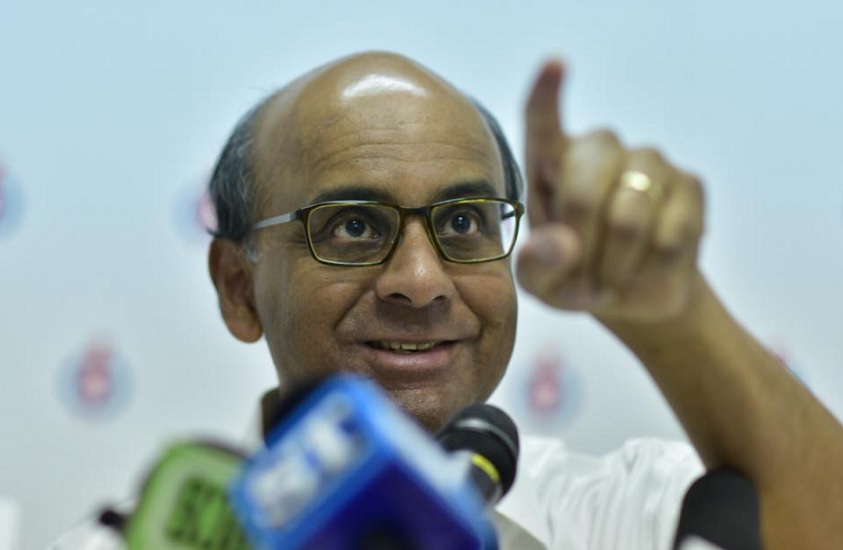
The move on Wednesday by Singapore’s popular deputy premier to emphatically quash suggestions he wants to take over from Prime Minister Lee Hsien Loong exposes the conservative ethnic consensus in the country’s leadership, despite a public clamour for greater political openness, observers say.
Public speculation about Tharman Shanmugaratnam’s fit as Lee’s successor has been swirling in recent years, and resurfaced on Monday after an independent survey showed nearly 69 per cent of Singaporeans would support the 59-year-old ethnic Tamil as the country’s next leader.
“Just to be absolutely clear, because I know there’s this talk going around… I’m not the man for PM, I say that categorically. It’s not me,” Tharman told local media late on Wednesday.
Tharman said the top job was not his ambition.
He is one of two deputy prime ministers and oversees financial and social issues. The former central bank chief took the job in 2011, having entered politics in 2001. He was finance minister from 2007 to 2015, and an education minister before that.
“I’m good at policymaking, good at advising my younger colleagues and supporting the PM, not being the PM,” he was quoted as saying.
Political observers told This Week in Asia Tharman’s comments revealed his tacit acceptance of the long-ruling People’s Action Party’s (PAP) belief that the Chinese-majority country was not yet ready for an ethnic minority leader.
“It may be that he genuinely does not want the job but it is also possible that the results of that survey have exposed the gulf between popular thinking and many of Tharman’s senior PAP colleagues on ethnicity and politics,” said Garry Rodan, professor of Southeast Asian politics at Australia’s Murdoch University.
“The PAP orthodoxy…emphasises that most Singaporeans are reluctant to support candidates from outside their own ethnic group for top leadership posts,” Rodan said.
Singapore’s resident population of 3.9 million is made up of 74.3 per cent Chinese, 13.3 per cent Malays and 9.1 per cent Indians, with others making up the remaining 3.2 per cent.
Alex Au, a prominent political blogger, said Tharman was “being a very loyal colleague”.
 T
T
“He does not wish pressure to build on his cabinet colleagues to choose certain options when it comes to leadership succession,” he said.
Singaporean leaders – including current premier Lee and his father, the late founding prime minister Lee Kuan Yew – have said the country’s conservative majority Chinese electorate had some time to go before it would accept a non-Chinese leader.
But the survey of 897 Singaporeans, commissioned by Yahoo Singapore and conducted by independent polling firm Blackbox Research, showed 73 per cent of people disagreeing that the race of the premier is an important factor.
“The poll results confirm data from other Blackbox surveys that race is not the primary criterion as a basis for choosing a preferred candidate among the Singapore public,” the polling firm said in the report.
Long-time Singapore political observer Bridget Welsh said Tharman’s popularity “stems from his support of spending for social welfare and services, and management of the economy, as well as his ability to bridge groups as a more liberal and open leader compared to his peers”.
But “as an elite-orientated party, the PAP categorically rejects selection by popular opinion,” said Welsh, a Southeast Asian politics expert at the National Taiwan University.
“Tharman is too liberal, too popular, and an ethnic minority – all features that do not fit with today’s hardline PAP,” she added.
Tharman, who concurrently served as the chief of the International Monetary Fund’s powerful policy-steering body from 2011 to 2015 while in government, grabbed the limelight at last year’s general election as he used his avuncular speaking style to take apart the opposition’s economic policies and explain the government’s position.
Video clips of his speeches at the hustings went viral on social media, spurring the hashtag “#TharmanforPM”.

Tharman led a team of legislators to sweep the five-seat Jurong district with 79 per cent of the vote in the country’s unique system of bloc voting. It was the highest winning margin in the country. The PAP won the election with 69.9 per cent of the popular vote.
But the economics-trained Tharman, with degrees from the London School of Economics, Cambridge University and Harvard University, has repeatedly denied having designs on the top job. In July last year he used a sporting analogy to describe his aversion to being premier.
“I was always, in sports, a centre-half rather than centre forward. I enjoy playing half-back and making the long passes, but I am not the striker,” Tharman told CNN anchor Fareed Zakaria in a forum.
“Unless I am forced to be, and I don’t think I will be forced to it, because I think we have got choices,” he was quoted as saying.
Au, the blogger, said Tharman’s popularity signalled that the “public is hungry for a different style of governance”.
There is a perception that he is more “approachable and intellectually flexible than some of the ministers in cabinet who perhaps because of their military background come across as rigid or inarticulate,” Au said.
Former army chief Chan Chun Sing, the current PAP whip and leader of the powerful National Trades Union Congress, is seen as one of the ruling party’s preferred candidates to be the next prime minister.
Finance Minister Heng Swee Keat, who returned to work in August after suffering a stroke earlier this year, is also seen as a contender.
In the Yahoo poll, Chan scored 24 per cent support to be a prime ministerial candidate, while Heng got 25 per cent.
Au said the current public debate on leadership succession is “a function of the moment”.
In past leadership changeovers, prime ministers’ successors were named early and had lengthy understudy.
“As the saying goes, nature hates a vacuum,” Au said. “This is causing public speculation to circulate but the window will close soon when the successor is anointed.”
Source: www.scmp.com