Tag: policies

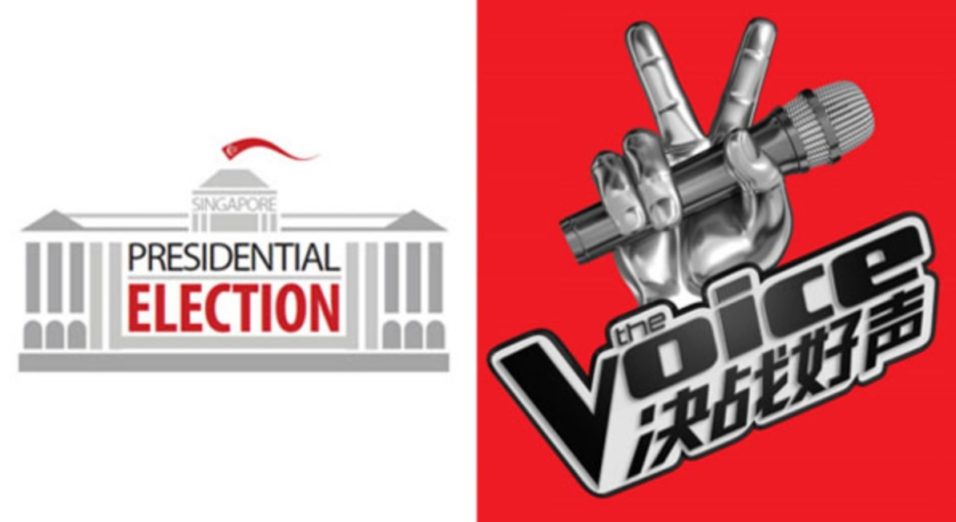
  • Commentary: Reserved PE For Malays Akin To China’s The Voice For Chinese; Both Exclude Certain Communities From Contesting

    Commentary: Reserved PE For Malays Akin To China’s The Voice For Chinese; Both Exclude Certain Communities From Contesting

    For those who dont understand why it’s a bad call to reserve the presidential race for Malays, let me bring you back to a similar incident.

    Remember when ‘The Voice’ came to Singapore but was looking only for Chinese singers to participate in its competition? Many were livid. For what? For the same reason why people are sickened when the presidential election exclude certain community from contesting.

    That’s what this presidential system has created. Unhappiness among the people.

    If for such an inconsequential singing competition can make us feel upset because we are excluded from participating it, the presidential election is on a national scale and such policies from the government creates ill-will between the community.

    Race based policies create division instead of strengthening our social fabric.

    Let me take you further to an environment where you can resonate better.

    Supposed the principal of the school where you send your children to study, decides to bar your child from participating in the school 100m race as he wanted a particular person to win it. What would you have done?

    Your answer to the above will guide you to what you would do today and understand why such policies are destructive and we have to move away from it.


    Source: Khan Osman Sulaiman

  • Osman Sulaiman: Objective Review Of Policies Implemented By Allahyarham Othman Wok Will Benefit Malay Muslim Community

    Osman Sulaiman: Objective Review Of Policies Implemented By Allahyarham Othman Wok Will Benefit Malay Muslim Community

    Othman Wok has passed away. In my community, many believe that we cannot talk about the dead. I disagree. Strongly.

    The belief that we cannot talk about a dead man past has its roots from Islamic teachings that forbid anyone to air out a dead man’s shameful/disgraceful past. This, I agree.

    But what many would do the moment we tried to discuss about a man’s past, his beliefs, his stand, his deeds, his contributions, his ideology and his political leaning, we are swiftly reminded not to talk about it even if it has nothing to do with exposing of the dead man past.

    As with Othman Wok, many would know about the infamous words he uttered on the burning of the corpses. Many also would know of his loyalty to LKY.

    When speaking about this, I dont think this is shaming the man for bringing back what he said before because Othman Wok still stands by it and has never apologized nor is he ever contrite for his words.

    Othman Wok was the de facto leader of the Malay community by virtue of being appointed a minister in the 60s and 70s. As a leader back then, we should be allowed to study and discuss his actions and contributions as it has bearings on how our community socio-cultural environment developed.

    We can see the mainstream media pouring praises on Othman Wok. Are we then not allowed to counter with facts on his actions? If we take on the line not to discuss a dead man past, we would never have known how evil Hitler and Saddam was.

    No, we are not shaming or airing out his personal details and discretion, but rather to visit history and discuss the impact he, Othman Wok has contributed based on his actions and words.

    Othman Wok was never a leader to me. In fact, it was during his time as a minister, policies that were detrimental to my community went unchallenged, passed without much fun fare that ultimately, led to a whole generation of my community to be weakened economically.

    It shaped the political environment my community faced today. Because whatever we fight today, we fight for our future generation. He, Othman Wok never fought for us. He acquiesced and was complicit with the gov questionable act.

    As a Muslim, I pray for his well-being in the afterlife. May god bless his soul.

    But In this life, I cannot put him on a pedestal.


    Source: Osman Sulaiman

  • The Singapore Exception

    The Singapore Exception

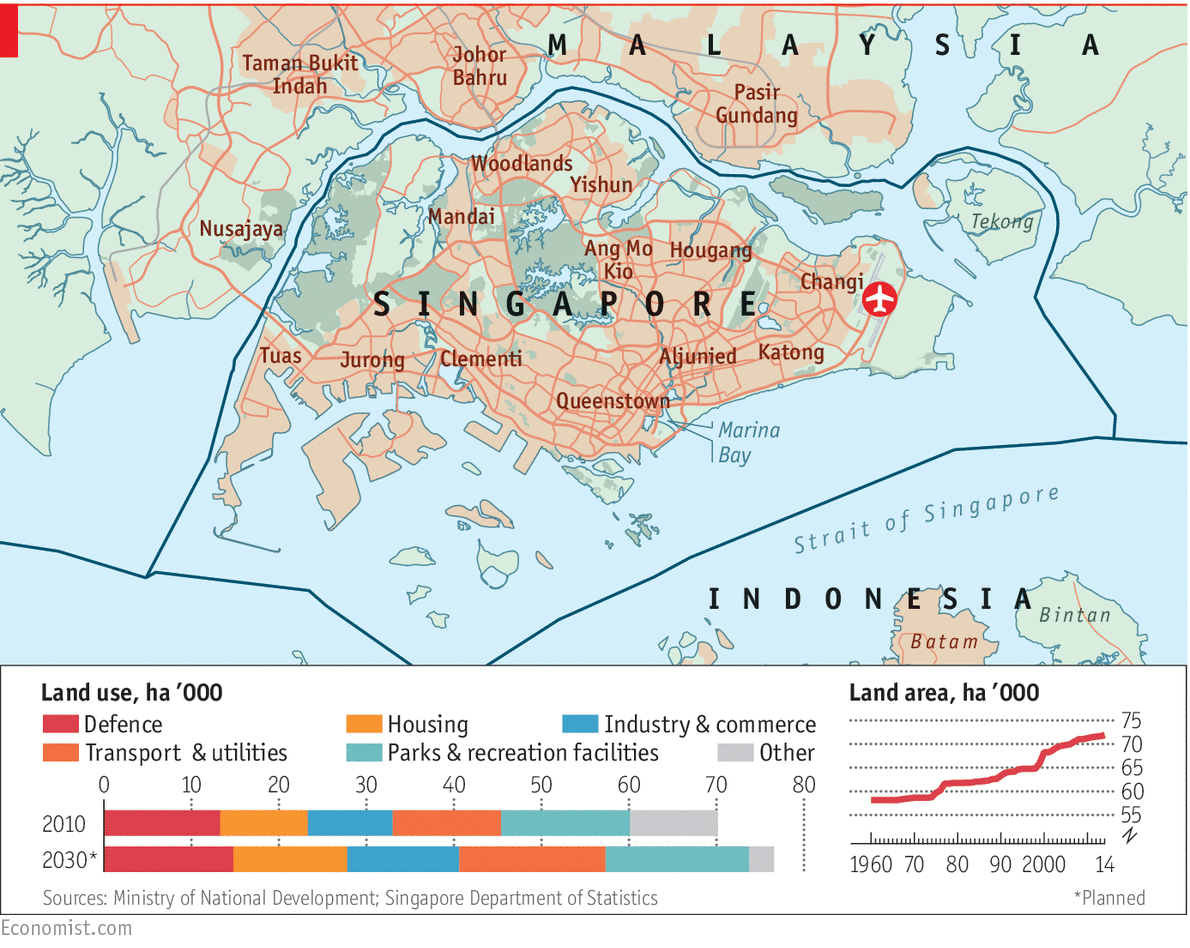
    AT 50, ACCORDING to George Orwell, everyone has the face he deserves. Singapore, which on August 9th marks its 50th anniversary as an independent country, can be proud of its youthful vigour. The view from the infinity pool on the roof of Marina Bay Sands, a three-towered hotel, casino and convention centre, is futuristic. A forest of skyscrapers glints in the sunlight, temples to globalisation bearing the names of some of its prophets—HSBC, UBS, Allianz, Citi. They tower over busy streets where, mostly, traffic flows smoothly. Below is the Marina Barrage, keeping the sea out of a reservoir built at the end of the Singapore River, which winds its way through what is left of the old colonial city centre. Into the distance stretch clusters of high-rise blocks, where most Singaporeans live. The sea teems with tankers, ferries and container ships. To the west is one of Asia’s busiest container ports and a huge refinery and petrochemical complex; on Singapore’s eastern tip, perhaps the world’s most efficient airport. But the vista remains surprisingly green. The government’s boast of making this “a city in a garden” does not seem so fanciful.

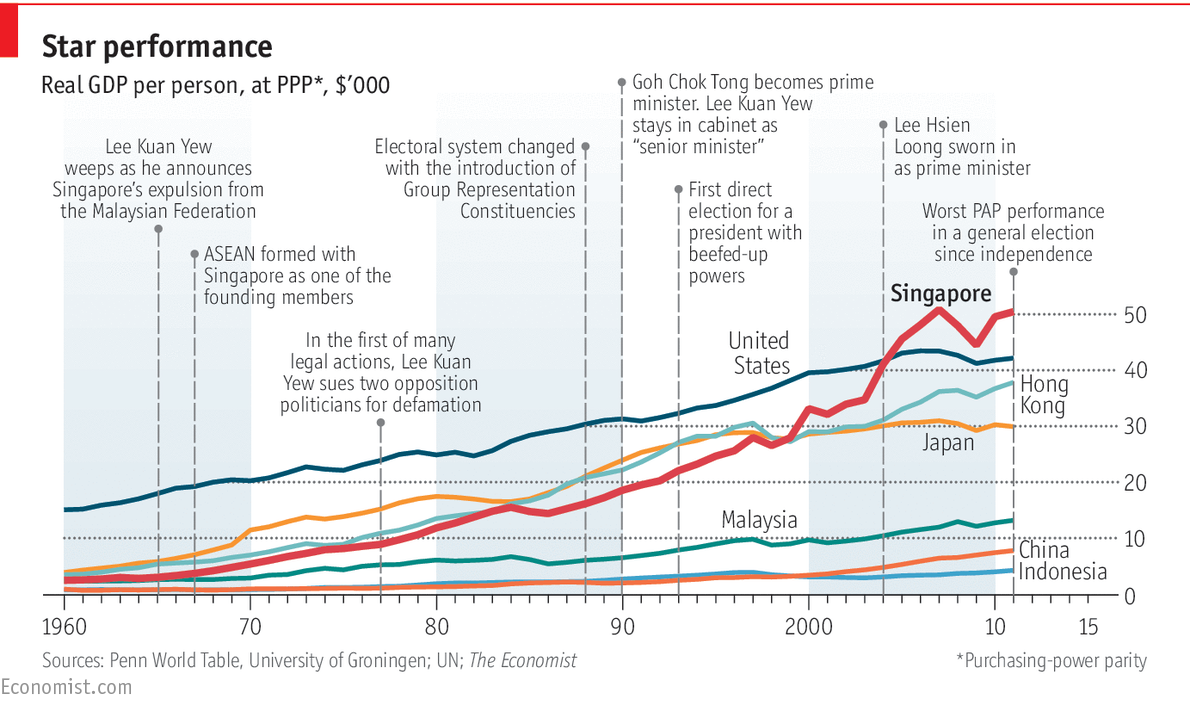
    Singapore is, to use a word its leaders favour, an “exceptional” place: the world’s only fully functioning city-state; a truly global hub for commerce, finance, shipping and travel; and the only one among the world’s richest countries never to have changed its ruling party. At a May Day rally this year, its prime minister, Lee Hsien Loong, asserted that “to survive you have to be exceptional.” This special report will examine different aspects of Singaporean exceptionalism and ask whether its survival really is under threat. It will argue that Singapore is well placed to thrive, but that in its second half-century it will face threats very different from those it confronted at its unplanned, accidental birth 50 years ago. They will require very different responses. The biggest danger Singapore faces may be complacency—the belief that policies that have proved so successful for so long can help it negotiate a new world.

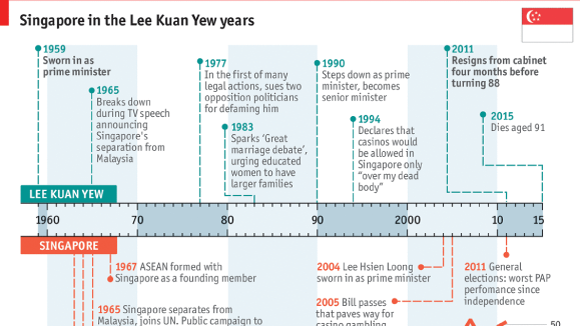
    In 1965 Singapore was forced to leave a short-lived federation with Malaysia, the country to its north, to which it is joined by a causeway and a bridge. Lee Kuan Yew, Lee Hsien Loong’s father, who became Singapore’s prime minister on its winning self-government from Britain in 1959, had always seen its future as part of Malaysia, leading his country into a federation with its neighbour in 1963. He had to lead it out again when Singapore was expelled in 1965. By then he had become convinced that Chinese-majority Singapore would always be at a disadvantage in a Malay-dominated polity.

    Mr Lee’s death in March this year, aged 91, drew tributes from around the world. But Mr Lee would have been prouder of the reaction in Singapore itself. Tens of thousands queued for hours in sultry heat or pouring rain to file past his casket in tribute. The turnout hinted at another miracle: that Singapore, a country that was never meant to be, made up of racially diverse immigrants—a Chinese majority (about 74%) with substantial minorities of Malays (13%) and Indians (9%)—had acquired a national identity. The crowds were not just mourning Mr Lee; they were celebrating an improbable patriotism.

    Lee Kuan Yew himself defined the Singapore exception. As prime minister until 1990, he built a political system in his image. In line with his maxim that “poetry is a luxury we cannot afford,” it was ruthlessly pragmatic, enabling him to rule almost as a (mostly) benevolent dictator. The colonial-era Internal Security Act helped crush opposition from the 1960s on. Parliament has been more of an echo-chamber than a check on executive power. No opposition candidate won a seat until 1981. The domestic press toes the government line; defamation suits have intimidated and sometimes bankrupted opposition politicians and hit the bottom line of the foreign press (including The Economist).

    Singapore, it is sometimes joked, is “Asia-lite”, at the geographical heart of the continent but without the chaos, the dirt, the undrinkable tap water and the gridlocked traffic. It has also been a “democracy-lite”, with all the forms of democratic competition but shorn of the unruly hubbub—and without the substance. Part of the “Singapore exception” is a system of one-party rule legitimised at the polls and, 56 years after Mr Lee’s People’s Action Party (PAP) took power, facing little immediate threat of losing it. The system has many defenders at home and abroad. Singapore has very little crime and virtually no official corruption. It ranks towards the top on most “human-development” indicators such as life expectancy, infant mortality and income per person. Its leaders hold themselves to high standards. But it is debatable whether the system Mr Lee built can survive in its present form.

    It faces two separate challenges. One is the lack of checks and balances in the shape of a strong political opposition. Under the influence of the incorruptible Lees and their colleagues, government remains clean, efficient and imaginative; but to ensure it stays that way, substantive democracy may be the best hope. Second, confidence in the PAP, as the most recent election in 2011 showed, has waned somewhat. The party has been damaged by two of its own successes. One is in education, where its much-admired schools, colleges and universities have produced a generation of highly educated, comfortably off global citizens who do not have much tolerance for the PAP’s mother-knows-best style of governance. In a jubilant annual rally to campaign for lesbian, gay, bisexual and transgender (LGBT) rights on June 13th, a crowd estimated at 28,000 showed its amused contempt for the illiberal social conservatism the PAP has enforced. Younger Singaporeans also chafe at censorship and are no longer so scared of the consequences of opposing the PAP.

    The PAP’s second success that has turned against it is a big rise in life expectancy, now among the world’s longest. This has swelled the numbers of the elderly, some of whom now feel that the PAP has broken a central promise it had made to them: that in return for being obliged to save a large part of their earnings, they would enjoy a carefree retirement. And it is not just old people who have begun to question PAP policies. Many Singaporeans are uncomfortable with a rapid influx of immigrants. These worries point to Singapore’s two biggest, and linked, problems: a shortage of space and a rapidly ageing population.


    Source: www.economist.com

  • Tan Chuan-Jin: Government Policies To Benefit All, Regardless Of Party Voted For

    Tan Chuan-Jin: Government Policies To Benefit All, Regardless Of Party Voted For

    The Government will continue to make policies that benefit all Singaporeans, regardless of how they voted, said Minister for Manpower and Social and Family Development Tan Chuan-Jin, during a visit to opposition-held Aljunied Group Representation Constituency (GRC).

    Reassuring residents of Serangoon ward there that they have not been forgotten by the People’s Action Party (PAP), Mr Tan told them at the start of a dialogue: “Let’s put it this way, it’s a democracy … you decide what you want to choose, for better or worse. I will tell you that we will endeavour to do our best, whatever the outcome.

    “All of you remain Singaporeans. You don’t vote for us but we are here to still continue to provide policies that cut across every division,” he added.

    But he pointed out that while policies are crafted to benefit Singaporeans, they need to be balanced with societal needs and considerations for the future. “On our part as the Government, we do the best we can,” he said.

    Giving little away on the ruling party’s strategy to regain the constituency from the Workers’ Party at the next General Election, which must be held by January 2017, Mr Tan told reporters yesterday: “Strategy-wise, I guess we have to work that out. But our responsibilities as a Government don’t change.”

    The Workers’ Party, led by its chief Low Thia Khiang, fielded a team including chairman Sylvia Lim and star catch Chen Show Mao, to wrest the constituency from the PAP at the 2011 polls, representing the first time an opposition party has won a GRC.

    Asked by reporters for his take on ground sentiment after a community dialogue at The Serangoon Community Club, Mr Tan said the reception, by and large, has been warm.

    He added that he has also visited other areas in Aljunied in recent years to “touch base with the people here”.

    “Yes, it’s organised but people are there, and a lot of people. They come forward, they share their views, whether in a dialogue or during the course of the visit,” he said.

    Municipal issues have been raised by residents but they were “nothing peculiar” and something he also encounters in his ward in Marine Parade GRC.

    During his six-hour ministerial community visit to Serangoon division, Mr Tan mingled with residents at coffee shops, Tavistock Avenue Park and other venues. He was hosted Mr David Tay, adviser to the Serangoon Grassroots Organisations and accompanied by the visit’s organising chairman Chan Hui Yuh and other grassroots leaders.


    Source: www.todayonline.com

  • The Lee Kuan Yew Foundation

    The Lee Kuan Yew Foundation

    Lee Kuan Yew was a giant revered for his brilliant mind, shrewd political instinct, and fearless candor. In the week since his passing, we’ve reminisced about his life – beginning the debate over his legacy and how we will remember him.

    Singaporeans from all walks of life have shared how Lee Kuan Yew touched them, whether through small gestures of warmth or the grand gesture of stewarding us into the nation we are. The story of how he took the CIA to task about an allegedbribery scandal in 1960 lit up social media, with Singaporeans taking pride in the maverick that Lee Kuan Yew was. Leaders from every corner of the globe have taken turns to shower acclaim on his life, his success and his counsel. For their part, his detractors have cautioned against an overly effusive telling of the Lee Kuan Yew story, pointing to his social engineering, lawsuits against the press, and treatment of political opponents.

    Whoever is right, it is indisputable that Lee Kuan Yew’s legacy towers over Singapore like the skyscrapers that dominate the new Marina Bay skyline. Never ornate, their clean lines exemplify the future orientation and simplicity that Lee Kuan Yew adopted in tackling Singapore’s challenges. They can be seen from miles away, commanding an undeniable presence.

    But as with the skyscrapers, it is easy to forget that Lee Kuan Yew’s accomplishments rest on a foundation of unconventional thinking.

    The People’s Action Party was founded in response to his belief that the status quo, Singapore under the British, was no longer right for the country – he fought forMerdeka. He maintained a fearlessness to “defy conventional wisdom” and in the process transformed a society “from where it is to where it has never been – indeed, where it as yet cannot imagine being”. This, in Henry Kissinger’s words, is what makes him a “great leader” and is the same boldness of mind that led to many of Singapore’s audacious projects, including the Marina Bay land reclamation project in the 1970s that literally laid the ground for the pillars that rise from it today.

    These were the building blocks of Lee Kuan Yew’s power as a transformative figure: an enterprising instinct, unconstrained by existing authority or the way things had been; an unmitigated pragmatism that called things as they were – so as to fix them; an ambitious vision, buoyed by compassion. It was unencumbered brilliance that, in his own words, was about trying to be “correct, not politically correct”.

    If Lee Kuan Yew had bowed to his critics, we might still be raw ingredients, separated by race, language or religion. He and his team provided the sweet sauce to bring the rojak together – even if it meant limiting our right to choose what language to study, where to live, or whom to live among.

    Today, new divisions are developing in Singaporean society. We need the same innovativeness – not simply the same policies – to face these new challenges. In a speech to the Singapore Press Club in 1996, he said: “Thirty years ago, my colleagues, younger and more dreamy eyed, settled the words of our pledge. We did not focus our minds on our navels or we would have missed the rainbow in the sky. We pursued that rainbow and that was how we came to build today’s Singapore.”

    His eyes were always fixed on making Singapore better, scanning the horizon without the glare of the past. It is our turn to do the same.

    Like Lee Kuan Yew who stood on the foundation of his British education to build a stronger Singapore without the British, we too must stand on the foundation of his legacy to build a stronger Singapore than we already have, now that we have lost him. And like him, we must fight for it, regardless of the powers that be.

    But we cannot allow his legacy to be constrained by his policies, his past successes, or his party. As important as they are, they are temporal, as was he. Buildings get torn down, political parties gain and lose dominance, ideas lose currency – the world will change, and we must adapt along with it.

    Lee Kuan Yew knew this. In his latest memoir, he wrote, “because of my house, neighbouring houses cannot be built high. (…) Demolish my house, change the planning rules, and the land value will go up. I don’t think my daughter or my wife or I, who lived in it, or my sons who grew up in it, will bemoan its loss.” In the same vein, we mustn’t overly sentimentalize the structures that Lee Kuan Yew built; his legacy must not become the convention he so often combated against.

    He is the father of modern day Singapore not because he leaves us with towering skyscrapers where there once was water, nor because he’s lifted us to a standard of living unimaginable fifty years ago. It is because he leaves behind a people inspired by his bold vision of a stronger Singapore and a blueprint for how to make it possible through his example: his independence and pioneering spirit; his fearlessness in the face of stark odds; his pragmatism, compassion and passion for the cause of Singapore.

    These are the characteristics that made him the man he was and is the enduring legacy that we must be thankful for and live up to.

    It is perhaps fitting that, like Lee Kuan Yew who wept at the shattering of a union he so fervently believed in, Singaporeans today mourn the end of a union that has been at our very heart. In Prime Minister Lee Hsien Loong’s words, “Lee Kuan Yew was Singapore”. His values are the true inheritance a father has bequeathed to his nation – values we must remember, keep safe, and do proud.

    Thank you, Mr Lee.


    Source: http://singaporepolicyjournal.com