Tag: poor

  • Town Council’s Default Bill Of $1688

    Town Council’s Default Bill Of $1688

    It’s really crazy to live in Singapore if you’re poor.

    ***

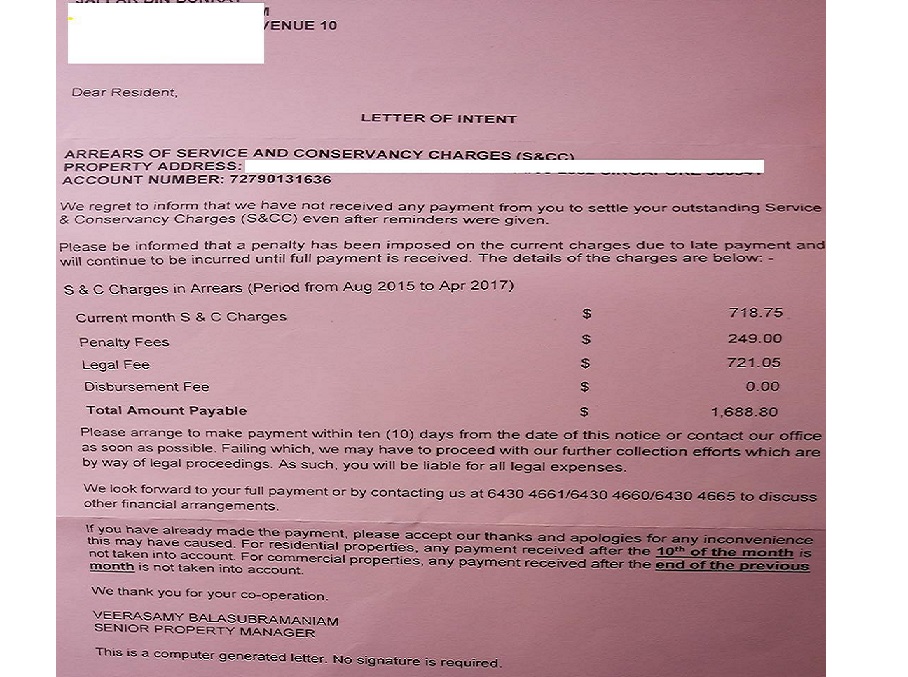
    Was shocked to chance upon this town council’s default bill of $1688 of which the penalty fee is $249 and legal charges a massive $721. The total penalty and legal fee is $970 – much more than the actual town council owed fee of $718 dating from Aug 2015 to Apr 2017. One can’t imagine the government allows a needy Singaporean family to be fleeced off by so much legal cost when their last GE’s slogan is “For you, with you…”?

    The family stays in a 3-room flat and suffers from under-employment. To avoid jail sentences for owed town council bill, the family has been slowly paying them off whenever they have the money. They also have to show the receipts to the town council whenever they have made payment. We also know of some who have to go to jail because of accumulated town council default – after the jail sentence they still have to pay their bill! Its a shame to see so many of our poor vulnerable families living like this – struggling to pay bills of all kinds while living in the world’s costliest city (for expats only as claimed by the government).

    The proposed sugar tax will simply add on to their living cost and deepen their misery. The recent 30% hike in water cost, existing 7% GST and a whole slew of increases for basic living usage imposed early this year will simply drive one to depression by just looking at the bills. Many in fact have avoided opening the bills every month and just throw them in some forgotten corner hoping that they will just evaporate into the thin air magically. Its no wonder many of us can’t avoid to go cashless the right way as we are already very cash-less before we hit the month end.


    Source: Gilbert Goh

  • Budget 2017: Price Hikes Affect Poor More Than Rich

    Budget 2017: Price Hikes Affect Poor More Than Rich

    Water is a vital resource and a basic human right. Yet, the Government of Singapore sees it fit to use utilitarian or volume based pricing model for the provision of water.

    Such a model affects both the rich and poor and some say, the poor are more adversely affected than the rich.

    A 30% price hike will be a stretch for the poorer families while the rich has the means the ride the price hike.

    If it was the intention of the government to elicit any kind if behavioural change in the consumption of water, we’ll probably see the poor conserve a lot more.

    One spokesperson from IPS said that the 30% price hike is to create awareness. It’s a poor choice of words even for a PAP apologist on the IPS payroll. What’s he smoking?

    Call a spade a spade a price hike is not a water conservation campaign or an awareness programme.

    In an article written by Leong Hze Hian, he said that the water price in Hong Kong is priced 14 times lower. Perhaps they have better technology but whatever the reasons are, it’s definitely merits a discussion in parliament.

    The budget seems to benefit the middle class more than the underclass. The 20% tax relief capped at S$500 benefits the middle class for sure.

    Perhaps a tax on manual car wash and a closer watch on how water is used is F&B outlets when dishes are washed is much needed.

    With the advancement in smart metering technologies, it is possible to have different pricing structures for industrial versus residential users by districts, flat-types and household income.

    A different pricing structure definitely adds complexity to the pricing regime but it will definitely have the intended effect of changes in consumption patterns.


    Source: www.theindependent.sg

  • Cardboard Uncle Hit By Taxi More Concerned About His Biscuits Than His Injuries

    Cardboard Uncle Hit By Taxi More Concerned About His Biscuits Than His Injuries

    A man who collects cardboard for a living was hit by a taxi at the junction of Yishun Avenue 3 and Sembawang Road at about 2.30pm on Thursday (Nov 3).

    Mr Wong Kum Chew, 63, was crossing the road with his trolley when a taxi which was making a left turn, hit him. The impact left Mr Wong lying on the road near his trolley stacked with cardboards. He was covered with cuts, grazes and blood all over his body.

    When passers by rushed to his aid, Mr Wong asked, “Where is my trolley? Where is my trolley? I have two packets of biscuits inside.”

    A lady, Ms Irene Lim said it was heart-breaking to see Mr Wong in that state. A Singapore Armed Forces officer, Lieutenant Colonel (Dr) Timothy Teoh checked Mr Wong’s injuries and noted that nothing was fractured.

    Mr Wong lives with his wife and son. His son is the family’s sole breadwinner and earns about $1,000 a month. Mr Wong earns $6 to $7 a day from collecting cardboards.

    After Mr Wong was conveyed to Khoo Teck Puat Hospital, Ms Lim’s husband helped to push Mr Wong’s trolley back to his home.

    Source: www.allsingaporestuff.com


  • Embracing Ramadan – Help Children In Single-Parent Families To Break Poverty Cycle

    Embracing Ramadan – Help Children In Single-Parent Families To Break Poverty Cycle

    Visited this single-parent Malay family at their one-room rental flat in Marsling.

    Reminded me of my growing up years when my parents were staying in such housing for about 16 odd years before we could afford to buy our own place.

    I grew up sleeping on the floor with a mattress and learn to appreciate what I have while growing up.

    I spent alot of my growing up years poring over novels from the Famous Five series to Alfred Hitchcock thrillers as they allowed me to escape into another world.

    We also want to take this opportunity to thank the many Good Samaritan who bought milk powder, pampers and food grocery for the young family when we publicised their request for assistance.

    One of their 8-year-old daughter is also being sponsored in our sponsor-a-child programme for children living in vulnerable condition.

    Some of you have contributed one-off financial help for the needy family.

    It broke my heart to hear that the family does not have any Macdonald meals before due to the cost factor and they only bought the $2 burger for the kids.

    We also agree to break fast with the family during the Ramadan fasting month to foster community goodwill.

    If you welcome us to break fast with you at your home, please let us know. We are more than willing to do so.

    Editor’s note: not all the kids in the photo belong to single mum Suriani – some are from the neighbouring unit next door.


    Source: Gilbert Goh

  • Why Low-Income Families Make ‘Poor Choices’

    Why Low-Income Families Make ‘Poor Choices’

    For three years, I have been researching the lives of low-income people. I visit families in Housing Board rental flats once or twice a week and talk to them about their routines, worries and aspirations.

    My research has taught me important things. First, everyone makes bad and good choices, but the conditions and outcomes of those choices are not equally bad or good for everyone. Second, parents in low-income situations are deeply invested in their children’s well-being.

    Everyone makes bad decisions sometimes. Most people also make some good decisions. People with low incomes have made both. But they do not always have access to good options. For example, many “choose” to leave school early because no one can support them. This seems obviously a bad “choice”, but may be the best among various poor options.

    “Choices” have long-term effects. People with extra money and social capital can mitigate the consequences of “bad” choices, but people without those buffers face severe consequences over time.

    One woman I met had moved here from another country after marrying a Singaporean man. She had not immediately applied for her daughter to be a Singapore citizen, perhaps partly out of uncertainty about where they should live for the long term. Soon after, she was widowed, and several attempts to secure citizenship failed. Her daughter Jen (not her real name) has been living in Singapore for most of her life and knows no other home. Jen’s mother encouraged her in her studies and she has just completed her A levels. Their limited income and Jen’s lack of citizenship, however, means that she has accumulated arrears in school fees. Unless she pays, her certificate will not be released, barring her from university. The few thousand dollars owed seem insurmountable and the “bad choice” of not applying for citizenship immediately means the vast difference between upward mobility and stasis.

    My second point is about parents’ investment in their children’s well-being, in a society where “investments” that do not involve money are valued less than investments that do.

    The women and men I spoke to for my research talked endlessly about their children – their likes and dislikes, quirky habits and talents – as well as the trials of parenting. These parents are deeply invested in their children’s physical, emotional and social well-being. Contrary to stereotypes, low-income parents care for their children in ways no less profound than better-off parents. They include parents who have been drug addicts, incarcerated, or divorced.

    Their devotion to their children is more difficult and requires more of them than my devotion to mine. Many have long, inflexible work hours in physically taxing jobs. They have multiple dependants, heavy burdens of housework, and additional labour due to being low-income (for example, going to the post office weekly to top up their utilities credit). Parents face great financial stress, worrying about food, clothes and shelter. While the better-off in Singapore complain about children having excess tuition and enrichment classes, low-income parents lack resources to provide those things, which are not only necessities for succeeding in the school system, but also keep children occupied. Most poignantly, low-income parents need their children to listen to them at the same time that they tell them “don’t be like me”.

    As we gain awareness about inequality and poverty, how we look at problems has a real impact on the solutions we craft.

    There is a tendency to paint low-income parents as more likely to be neglectful or abusive. This happens for several reasons. First, accounts of the low-income too often focus only on cases that have surfaced as “problematic”, which are then over-generalised as representative. Second, comparable actions are judged differently across class: A child may be left alone at home after school, or left with a grandparent or domestic worker. In both the low-income and better-off cases, the situation arises because parents need to work, but the former is quickly judged as neglect while the latter is acknowledged as necessity.

    Certainly, there are parents who are neglectful or abusive, but this is no less true among higher-income ones. Caricatures of low-income parents cannot be the starting point for public discussions of poverty and social inclusion.

    A recent article (“Lifting families out of poverty: Focus on the children“; last Thursday) admonishes society to pay attention to children in poor households while implying that they are innocent of the “poor choices” their parents make. This narrative that “children are innocent” and therefore particularly worthy of assistance is powerful.

    Yet, it does not accurately reflect the general realities of low-income families’ lives. Most of those parents are doing the best they can – at work and at home – under difficult circumstances. It is not “bad choices” per se that are the problem. They have limited options and face especially negative consequences when they make missteps.

    We cannot detach the well-being of children from that of adults. We would find this approach unfathomable for middle- to high-income families – there is no good reason to imagine that low-income families are different.

    Better-off Singaporeans should care about low-income people because they are a part of our society. I am not from a poor background, but I meet people like my respondents every day – when I pay for my groceries, get petrol, or use any public facility that requires cleaning. Like me, they are people with hopes, joys, needs and disappointments. They work hard and make mistakes, as I do. They deserve respect and dignity, no less than I. The deep social gulf between us negates our shared well-being. I want my child to grow up in a society where she has the same opportunities as their children, not more – a society that truly values hard work, equality and justice.

    • The writer, Teo You Yenn, is an associate professor in sociology at Nanyang Technological University.


    Source: www.straitstimes.com