Tag: press freedom

  • Why Singapore Is The World’s Most Successful Society

    Why Singapore Is The World’s Most Successful Society

    Singapore turns 50 on Aug. 9, 2015. Is Singapore the most successful society since human history began? Or, to put it differently, did Singapore improve the living standards of its people faster and more comprehensively than any other society?

    The only way to answer these questions is with empirical data. The most basic needs of any human being are food, shelter, health, education and employment. Did Singapore improve the delivery of those basic needs faster than any other society?

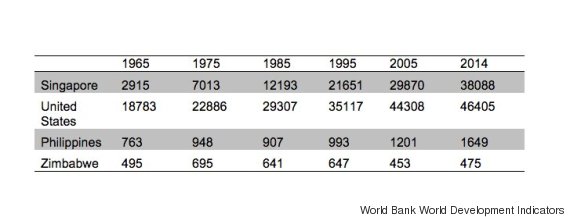
    When Singapore was expelled from Malaysia in 1965 and thrust into an unwanted independence, it was a typical Third World country. Its per capita income of $500 was the same as Ghana’s then. It was not desperately poor, but it had malnutrition. I know this personally as I was put on a special feeding program when I joined school in the first grade, drinking milk from a pail with a ladle shared by other children.

    Table 1: Comparison of real GDP per capita gdpchart
    *Using constant 2005 USD

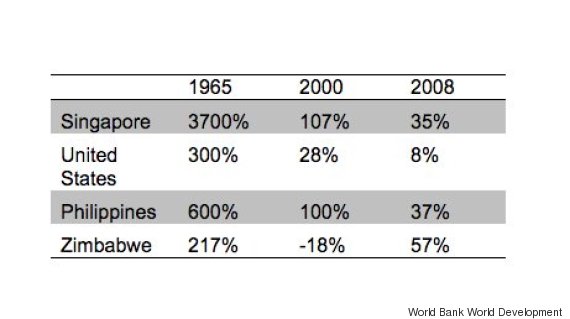
    This malnutrition disappeared quickly. Singapore’s per capita income has shot from $500 to $55,000 today, the largest increase any newly independent nation has enjoyed. This spectacular economic success story of Singapore is clearly amazing. Yet, when I was Singapore’s ambassador to the UN in the 1980s, the then head of UNICEF, the American James Grant, used to chide me for speaking about it.

    Table 2: Percent increase in real GDP from year listed to 2014 gdpchart2
    *Using constant 2005 USD

    He told me that Singapore’s success in another area was even more spectacular. We had reduced our infant mortality faster than any other society, going down from 35 per 1,000 live births in 1965 to 10.90 in 1985. James Grant was right. Babies are the most vulnerable members of any society. When they live instead of dying, they reflect an improving social ecosystem that keeps them alive.

    The babies who lived in Singapore went on to enjoy one of the best education systems in the world. The OECD ranked 15-year-old Singaporean children number one in the world in a recent global ranking of “Universal Basic Skills” in mathematics and science. Singapore students also topped the OECD PISA problem solving test in 2012.

    There are many other areas where Singapore’s social standards top the charts. From the Singapore with slums that I grew up in, we now have the highest home ownership of any country in the world, with 90 percent of residents living in homes they own. Even amongst households in the lowest 20 percent of incomes, over 80 percent own their own homes. Rapidly rising salaries and strong compulsory saving schemes, through the Central Provident Fund, led to this incredibly high home ownership.

    So why did Singapore succeed so comprehensively? The simple answer is exceptional leadership. Many in the world have heard of Mr. Lee Kuan Yew, the founding prime minister who passed away in March this year. Far fewer have heard of Dr. Goh Keng Swee, the architect of Singapore’s economic miracle, and Mr. S. Rajaratnam,Singapore’s philosopher par excellence.

    Together, they made a great team.

    This exceptional team also implemented three exceptional policies: Meritocracy, Pragmatism and Honesty. Indeed, I share this “secret” MPH formula with every foreign student at the Lee Kuan Yew School, and I assure them that if they implement it, their country will succeed as well as Singapore. Meritocracy means a country picks its best citizens, not the relatives of the ruling class, to run a country. Pragmatism means that a country does not try to reinvent the wheel. As Dr. Goh Keng Swee would say to me, “Kishore, no matter what problem Singapore encounters, somebody, somewhere, has solved it. Let us copy the solution and adapt it to Singapore.” Copying best practices is something any country can do. However, implementing “Honesty” is the hardest thing to do. Corruption is the single biggest reason why most Third World countries have failed. The greatest strength of Singapore’s founding fathers was that they were ruthlessly honest. It also helped that they were exceptionally shrewd and cunning.

    Still, Singapore has its fair share of detractors. Its political system was widely viewed as being an “enlightened dictatorship,” even though free elections have been held every five years. Its media is widely perceived to be controlled by the government and Singapore is ranked number 153 out of 180 by Reporters Without Borders in 2015 on the Press Freedom Index. Many human rights organizations criticize it. Freedom House ranks Singapore as “partially free.”

    Undoubtedly, some of these criticisms have some validity. Yet, the Singapore population is one of the best educated populations and, hence, globally mobile. They could vote with their feet if Singapore were a stifling “un-free” society. Most choose to stay. Equally importantly, some of the most talented people in the world, including Americans and Europeans, are giving up their citizenship to become Singapore citizens. Maybe they have noticed something that the Western media has not noticed: Singapore is one of the best places to be born in and to live in. Quite amazingly, a society destined to fail in 1965 has become one of the world’s greatest success stories.


    Source: www.huffingtonpost.com

  • Amos Yee: Allegation Of Molest Is To Manipulate Press

    Amos Yee: Allegation Of Molest Is To Manipulate Press

    Amos Yee has just clarified on his facebook fanpage that his allegation of molest by his former bailor today was to manipulate the press into waiting for him at the Pasir Panjang MRT.

    16-year old blogger, Amos Yee, who was found guilty of two charges brought against him by the Attorney General’s Chambers on Tuesday, 12 May, made an allegation of molest against his former bailor, Mr Vincent Low.

    Amos was found guilty of the charge of obscenity and wounding the feelings of Christians in a YouTube video criticising former prime minister, Lee Kuan Yew.

    Amos had said earlier in his facebook page status that reporters have been gathering at his doorstep, seeking exclusive interviews and some photos of him.

    He went on to say that he should entertain the reporters despite being given advice not to do so and that he would be giving information to reporters on how he was molested by his former bailor.

    Mr Vincent Law, a family counselor, has since clarified to TOC that Amos’ allegation against him is false and has no truth whatsoever.

    Mr Law had bailed Amos Yee out from police remand on 21 April and subsequently discharged himself as bailor on 30 April, Wednesday.

    After 7 hours from his initial posting, Amos wrote another facebook post to clarify that his allegation against his former bailor was his way to troll the media.

    Amos wrote,

    Yeah… I think some people found out by now… I did, in fact, make use of the voracious desire of the reporters, to xxxx with the mainstream media.

    I think it’s pretty obvious when I have arranged a meeting with a person named ‘Dick Ow’, and there is no video game store in Red Hill, at least one that I’m aware of.

    I manipulated the press to indulge in the thoroughly exhausting experience of waiting in Pasir Panjang fruitlessly for several hours, which they did with their quote unquote ‘diligence’. They are all quite obscure and hard places to reach in Singapore aren’t they?

    And Vincent Law didn’t really molest me, haha. Though he is immensely creepy. I’ll save the specific details for another time.

    Yeah it was all a troll, a troll that can only be possible by the inherent stupidity of the media. Have fun!

    TOC understands that Mr Vincent Law is still being hounded by reporters from the mainstream media and declined to give a response to Amos’ clarification.

    Over the past few hours, many individuals have voiced their disappointment on social media over the allegation made by Amos about Mr Law.

    Ravi Philemon, director of a NGO wrote,

    “Vincent Law is a youth and family counsellor. Besides the stigma that comes with allegations of sexual misconduct, any such allegation could potentially end his career, and the loss of income as a result of that may adversely affect his family and children. But all these are beyond some inconsiderate 16-year-olds, who think allegations like that are just pranks – never mind the potential harm it may cause the person who tried to help you.”

    Damien Chng, legal student and anti-death penalty activist wrote,

    “All this nonsense only shows that Amos Yee has issues. I think the false allegation against Vincent deserves to be condemned to the fullest extent. No I still don’t think he deserves to be thrown in jail, because thats not the way to deal with this. The way to deal with this was to have just ignored Amos right from the start.”

    Basil Lee, former volunteer at Healthserv who had worked with Mr Law, wrote,

    “And even if it is a joke, the distress you caused to the person who has been with alongside you cannot be justified by the fact you claim to ‘manipulate’ the media. In my opnion, this is the highest level of dick-ness.

    I can vouch for Vincent Law, and his love for people. Not many people I know will willingly wake up every monday at 5 in the morning every just to have breakfast with someone at the other end of the island. Yet he does it because he cares and loves people.

    You never alienate your support system. That is just suicidal.”


    Source: www.theonlinecitizen.com

  • Can We Still Call This The Light Touch?

    Can We Still Call This The Light Touch?

    Forget the irony of the Media Development Authority asking The Real Singapore to cease and desist on World Press Freedom Day itself – and to be honest, someone at MDA must really have a hugely twisted sense of humour.

    What is even more concerning is the fact that there are so-called analysts who are “media observers and academics” who believe that MDA’s move reflects a “light touch” towards content regulation.

    The points made by these “experts” would sound reasonable on any given day – MDA’s action was justified and reasonable because TRS is really an “extreme case”. But when we take a closer look at what this “extreme case” is, the argument becomes problematic.

    For a start, almost all of them cited the legal woes of TRS as a means of justifying MDA’s action. MDA has, of course, lately stressed that it “would still have initiated the suspension even if there were no sedition charges. MDA’s move is also not dependent on the outcome of the sedition charges. As such, the issue of sub judice does not arise.”

    If so, why then would these experts point explicitly to TRS’s legal woes? The views held by these independent observers, evidently based on MDA’s media statement, suggests that MDA need not have the intention for sub judice – really, who would, given our punitive laws? It does not, however, reduce the risk of sub judice. Otherwise, can anyone else charged for contempt now say, “I would have posted those remarks independent of the outcome of the court case”? Go figure.

    Disregarding the legal reasons – which to date has yet to be decided by the courts – we would also find problems with the other reasons cited for the suspension: Namely, TRS’s alleged “bad behaviour”.

    Professor Ang Peng Hwa of the Wee Kim Wee School of Communication and Information at Nanyang Technological University said that MDA’s decision “helped shed some light on how the Internet Code of Practice… can be used”. Prof Ang justified this by saying that TRS’s case “is not just any case that comes along, but one that has public sentiment against it and a court case”.

    Presumably by “public sentiment”, Prof Ang would have an objective measurement, as a person of academic outlook would, and it might not be wrong to assume that he was referring to the petition for TRS to close down, which garnered about 1,300 signatures. If so, then a necessary comparison was the petition for STOMP to close down, which garnered 24,000 signatures.

    mdaWhen TOC raised queries to MDAabout what they intend to do with the STOMP petition, the reply was for us to identify for the agency where STOMP has done wrong and bring it up to them for evaluation.

    “STOMP, like other class licensed and individually licensed sites, is required to comply with the Internet Code of Practice. If you have come across instances where STOMP is in breach of the Code, you are advised to bring these to our attention and MDA will investigate accordingly.”

    However, MDA’s tone in relation to TRS was vastly different. In its media statement, the media regulator said that it was “satisfied that Takagi and Yang have contravened the Internet Code of Practice (ICOP). They have published prohibited material as defined by the Code to be objectionable on the grounds of public interest, public order and national harmony.”

    How was MDA “satisfied” that TRS was in breach of the Code? Did someone come across instances where TRS breached the Code and submitted a report to MDA? If not, then how different was it from “public sentiment” against STOMP?

    Between STOMP and TRS, how then has this case “shed light” on how MDA used the Internet Code of Practice? Has the light touch gone so light as to become invisible?

    Then we have Singapore Management University law professor Eugene Tan, who opined that “this is the first time that MDA has resorted to suspension, but when you put it against the backdrop of TRS’ alleged egregious conduct, it becomes more of a question of when (to suspend), rather than whether.”

    Earlier, when Breakfast Network decided to close down because it found MDA’s regulatory regime too onerous, media academic professor Cherian George had called it the end to the “light touch” policy. He opined that Breakfast Network tipped the scale because the “death by red tape” was unprecedented.

    “Singapore’s vibrant ecosystem of socio-political blogs was spared the discretionary licensing regime that has blocked the development of alternative print and broadcast media. Blogs could be punished if what they published broke the law – but they were never expected to persuade regulators that they deserved the right to publish before they were allowed to do so.”

    Ai Takagi and Yang Kaiheng with lawyer Choo Zheng Xi (image - CNA)
    Ai Takagi and Yang Kaiheng with lawyer Choo Zheng Xi (image – CNA)

    Indeed, bloggers can be punished if what the published broke the law, and TRS is facing the same now in a pending court case. But since when does it justify closing down an entire website, which is by all counts just as punitive, if not more so, than denying Breakfast Network the right to exist? How can the current order to close a website be a “lighter touch” than requesting its owners to take down objectionable content? To begin with, has MDA tried getting TRS to remove the pages it was “satisfied” contravened the Internet Code of Practice?

    In that sense, the first time that MDA has “resorted to suspension” is not a light touch approach, as Prof Tan would have you believe. If anything, the touch just got heavier, simply because we have no reason to believe that MDA tried any other approach that would have been less heavy-handed.

    And to cap it, we have this comment attributed to former NMP Calvin Cheng – “socio-political websites that operate within Singapore’s laws and social norms have nothing to fear”.

    Unfortunately, Mr Cheng is gravely wrong, and the gravity would be worse if MDA has indeed censored TRS for flouting “social norms”. Efforts to repeal the death penalty, 377A or capital punishment are not “social norms” any way you look at it. Is Mr Cheng then suggesting that websites which champion these causes also go up for a review under the Code? What other “codes” would MDA tag onto the Broadcasting Act for its evaluation? Would it even tell us?

    Personally, I’m not a fan of TRS. I find their content laughable at best, and downright unsavoury at worst. I’m definitely not agreeable to how they source for their content. But what bugs me more than a website like TRS, which I can always ignore, is MDA’s rationale and standards for the action it has taken against TRS, which I definitely cannot ignore.

    To call it a “light touch” approach is to continue dabbling pointlessly in that tiring argument that the government will keep its hands off, until it has to. MDA has thus far not brought to the table clarity about when it has to step in, or on what basis it is stepping in.

    And we are supposed to be assured that there is a “light touch” – TRS got shut down only because it did the bad stuff. If so, can MDA now step up and identify where exactly all this bad stuff is, and why it warrants closing down an entire website? Under what circumstances does a government agency have the right to make that judgement call?

    MDA has been offered the opportunity to respond to this commentary.


    Source: www.theonlinecitizen.com