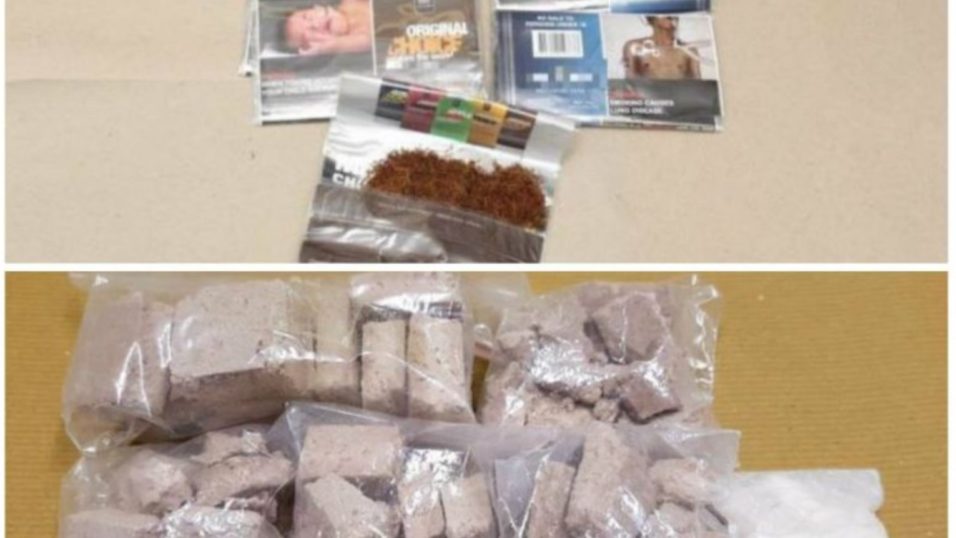
68 suspek pesalah dadah ditangkap dan dadah bernilai lebih S$29,000 dirampas selepas operasi empat hari dijalankan di merata negara ini, menurut Biro Narkotik Pusat (CNB) dalam satu kenyataan hari ini (7 Jul).
CNB menambah operasi itu, yang dijalankan dari 3 hingga 7 Julai, menyaksikan serbuan anti-dadah dijalankan di kawasan-kawasan termasuk Bedok Reservoir, Bukit Batok, Bukit Panjang, Chai Chee, Punggol, Tampines dan Woodlands.
CNB menyatakan sekitar 461g ganja sintetik, 48g ganja, 303g heroin, 40g Ice, 98 pil Ecstasy, 74 pil Yaba, lima pil Erimin-5, satu setem LSD dirampas semasa serbuan itu.
CNB meramalkan harga dadah yang dirampas ialah sekitar S$29,400.
Siasatan sedang dijalankan terhadap semua suspek yang ditangkap.
Akta Penyalahgunaan Dadah menetapkan hukuman mati jika jumlah dadah diamorphine (atau heroin asli) diseludup melebihi 15g.
Hairline cracks have been found on 11 first-generation Sengkang-Punggol LRT (SPLRT) trains, SBS Transit and the Land Transport Authority (LTA) said in a joint statement on Friday (Sept 9).
The trains were withdrawn from service as a precautionary measure after the discovery of the defects during SBS Transit’s fleet-wide inspection in July. Six of the trains have been repaired and returned to service.
The remaining five are expected to be reinstated by the middle of next month.
The cracks were found on the bogie frames of the trains and do not compromise its weight bearing property, said the statement. One of the core functions of the bogie frame is to support the guidance system of the trains.
Location of crack on bogie frame:
An independent assessor, TUV Rheinland, and the manufacturer Mitsubishi Heavy Industry (MHI) had separately assessed that the defects are not safety-critical, the statement added.
Friday’s news came about two months after Hong Kong news agency FactWire broke the news that 26 China-made SMRT trains hairline cracks were found to have hairline cracks and would be sent back in batches to their manufacturer’s plant in China for repairs.
An LTA spokesperson said checks by SBS Transit were “intensified” after the discovery of cracks on the Kawasaki-Sifang MRT trains operated by SMRT. “The latest checks concluded that there are no new discovery of cracks on the other lines. The operators will continue to carry out regular inspections on all train components,” she said in response to TODAY’s queries.
The FactWire report on the SMRT train defects, which was published in early July, sparked a public outcry. Transport Minister Khaw Boon Wan had described the cracks on the SMRT trains – the first of which was discovered in July 2013 – as a routine matter that had been “mis-spun into a controversy”. He added that had the hairline cracks found on the trains compromised safety or service availability, the authorities would have released the information “immediately”.
While SMRT did not withdraw the affected trains from service before they were sent for repairs, in order to minimise disruption to train operations, SBS Transit said it immediately pulled the affected trains from service as it had adequate capacity to keep operations going.
A sample of the affected bogie frame has been sent to MHI’s research and development centre in Japan to determine the cause. When contacted, an MHI spokesperson said it is unable to comment as a detailed analysis is being carried out.
The affected trains have been operating since the SPLRT was launched in 2003. There are a total of 57 trains in the SPLRT fleet and a maximum of 36 trains are deployed at any one time, SBS Transit and LTA said. The operator has been inspecting all its LRT trains on a weekly basis for any new defects.
SBS Transit and LTA said they are working with MHI to “redesign, strengthen and replace” the bogie frame structures on all 57 trains. They added: “The detailed improvement timeline is being worked out and MHI will bear the replacement costs.”
The LTA spokesperson said there was no need to ship the affected trains back to Japan as the rectification works were “less complex” as compared to the works to rectify the hairline cracks on the 26 SMRT trains.
Mountbatten Member of Parliament Lim Biow Chuan, who sits on the Government Parliamentary Committee for transport noted that the Government was more transparent in sharing information about the latest discovery of hairline cracks.
The defects of the 26 SMRT trains had “caused quite a bit of alarm” among the public as to whether there was a cover-up, he noted.
“Having learnt a precious lesson that if you don’t tell people, people (will) speculate and attribute all sorts of unsubstantiated comments about why (the) trains are being brought back,” said Mr Lim. “So to avoid any kind of speculation, then I think (LTA and SBS Transit) felt that in this case (it would be) better to tell… although they assessed (the hairline cracks) not to be a major issue.”
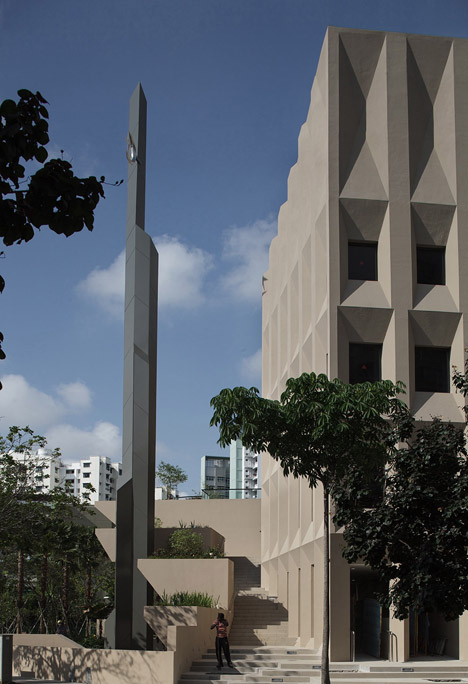
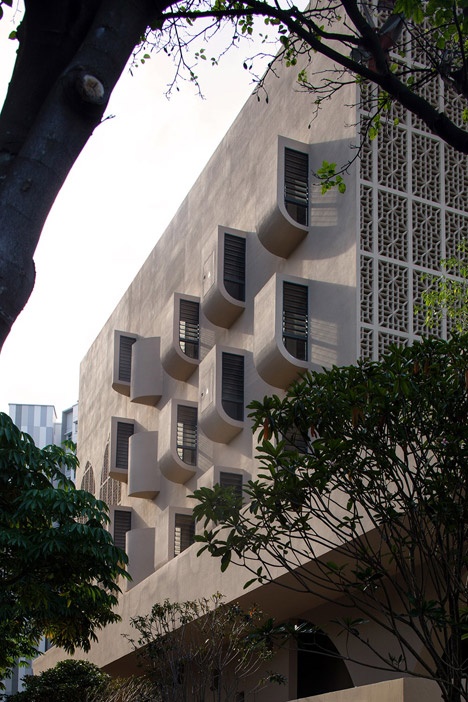
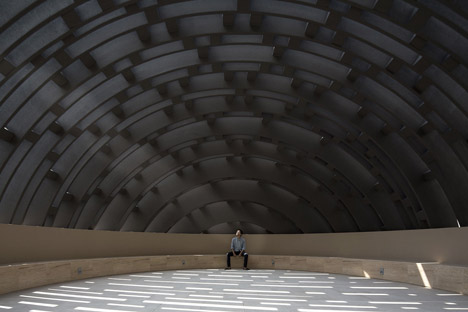
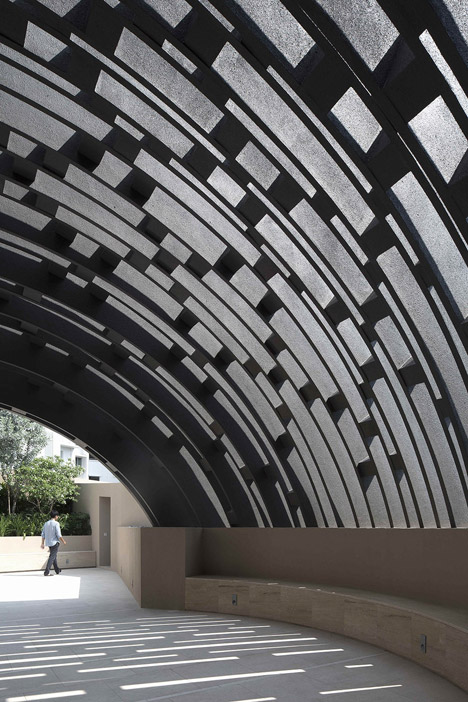
Singapore studio Formwerkz Architects took references from traditional Islamic design to create the intricately patterned and moulded surfaces of this mosque.
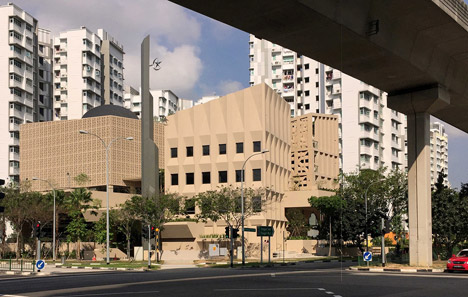
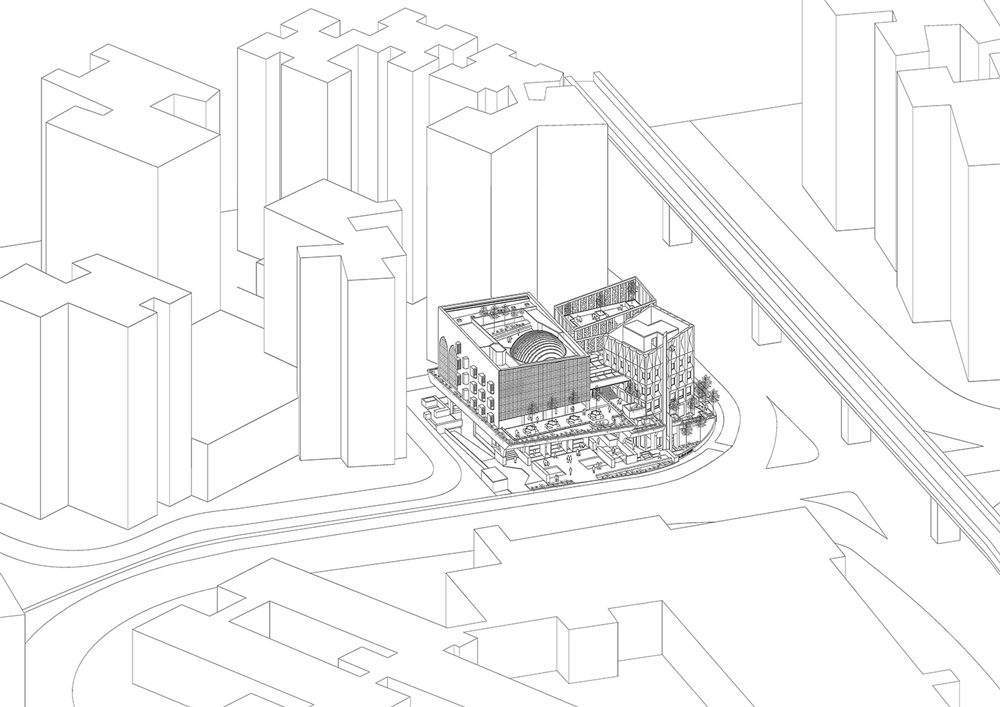
The Al-Islah Mosque by Formwerkz Architects caters for the Muslim population of Punggol, a densely populated neighbourhood in north-east Singapore.
The area is currently undergoing significant redevelopment, with the Singapore Institute of Technology due to relocate to a new campus near a waterfront park by LOOK Architects and high-rise housing being erected to accommodate the rising population.
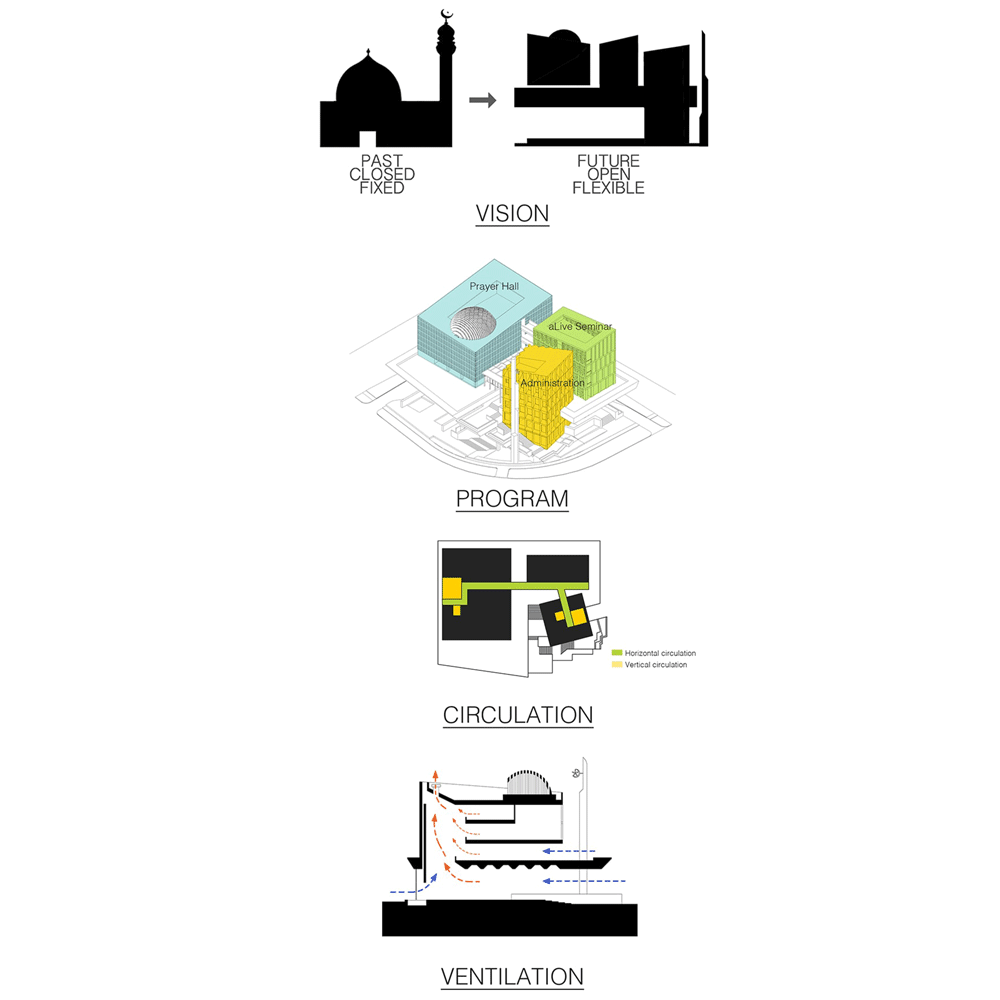
The mosque is segmented into three volumes – a prayer hall, an Islamic education centre and an administration block – to give the structure a more domestic scale within the built-up area.
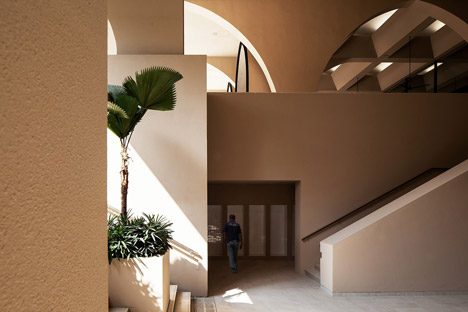
These blocks are linked by a series of elevated and landscaped terraces that are open to the public.
“The new mosque aspires to be a model of openness, reflective of contemporary Islamic aspirations in Singapore,” said architect Alan Tay. “This ambition for the openness posed much challenges in view of the tight site and its proximity to the neighbouring flats.”
“Physical porosity allows a visual connection to the neighbourhood and extends its spatial field beyond its boundary but poses the issues of sanctity and threshold expected of a mosque.”
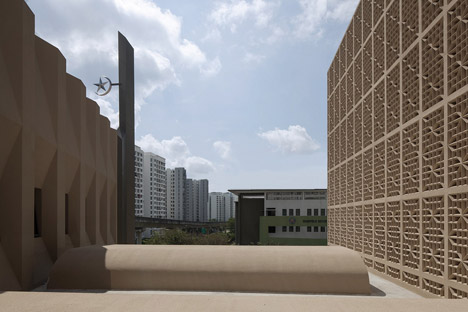
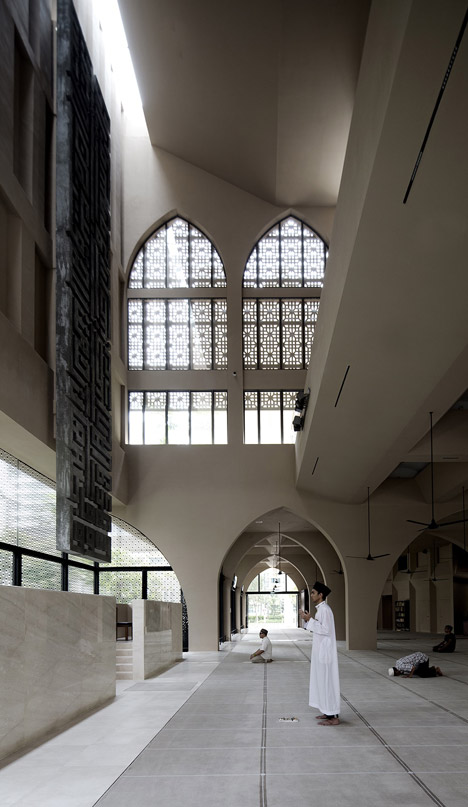
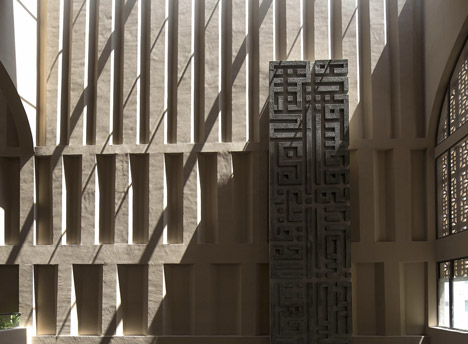
Latticed screens form walls and the dome over the prayer hall, to enhance the feeling openness while also providing ventilation and natural lighting for the spaces within.
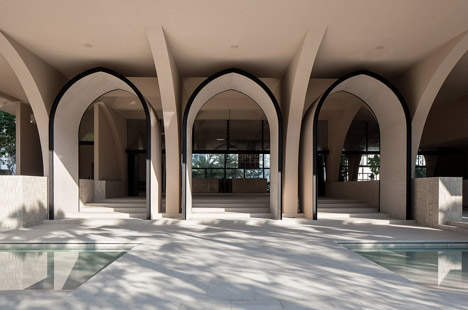
The reinforced concrete structures are covered with sand-coloured textured paint. Elements such as the dome, arched doorways and a slender minaret are picked out in dark grey paintwork.
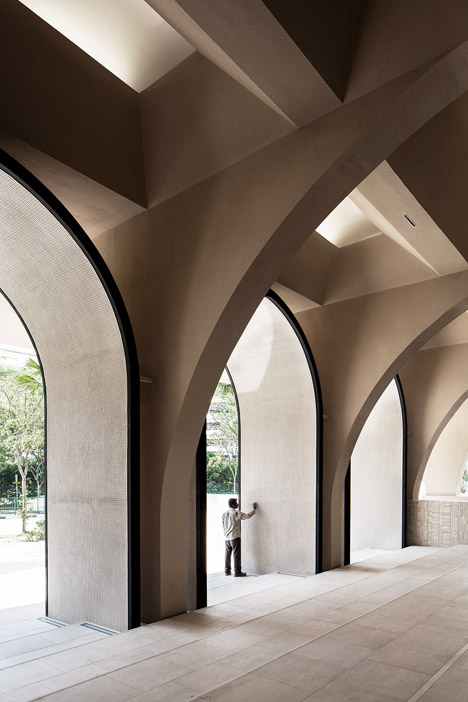
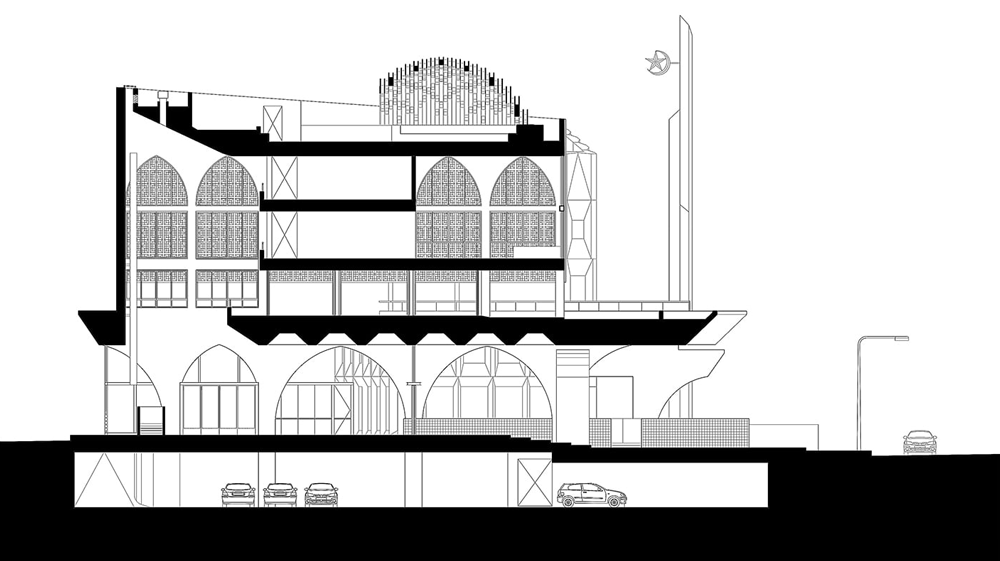
“The basic arabesque pattern and arches are influenced by traditional Islamic forms,” explained studio co-founder Alan Tay. “The arches are designed to allow a wider span in the prayer hall and cantilever in the main entrance foyer.”
The 3,700-square-metre mosque can accommodate up to 4,500 worshippers at any one time, with service areas including an underground car park all designed to be used as extensions of a domed prayer hall.
The prayer hall has open sides that allow the congregation to spill into adjacent spaces during peak worship times. These areas are shielded from the weather by a large overhanging canopy.
“In peak periods, most of the floor space – with the exception of bathrooms, admin space and service rooms – is utilised for prayer,” Tay told Dezeen. “Corridors, classrooms, roof terraces and even the basement car park double up as prayer spaces.”
“With no boundary walls and minimum enclosing wall, the worship hall is visually and physically accessible on all sides, blurring the distinction between the mosque premise and the street,” he added.
Please help share if you care, for parents with young children, please take note, please be aware, please be vigilant, please take extra precaution.
For the ladies as well.
It was brought to my attention that my cousin’s domestic helper was heading of from the house to pick up my 4yrs old niece after school at the school transport drop of point. She has my 2yrs old nephew along waiting for my niece, it happened during bright daylight, a middle age Indian guy followed the helper to the bus-stop in Punggol, and came seated beside the helper exposing his private part and touching it beside the helper. Bright daylight! You heard it right. Hence the helper move away holding my nephew and the guy was seated there doing his gross actions. When my niece’s school bus came, the guy ran off. The poor Panicking and crying helper seek help from the transport lady which she came forward with the driver and saw the guy running away. During that moment, transport auntie called up my sis and told her about the incident, and that was when the transport auntie usher the helper together with my niece and nephew to the block assuring that the guy ran off.
The helper held my nephew and grab my niece and took the lift home, the scariest thing happened, the Indian man appeared at the lift on level 2, when the lift door opened, he walked into the lift, the panicking helper grab the kids and hide them away from this fellow, he unzipped himself and exposing himself in the lift and asking the helper to touch his private area, poor her was crying and the kids were so scare and started crying as well, the worst has yet to come, he commented to the helper, if she don’t want to touch his private part, get the little girl which is my 4yrs old niece to touch (how sick!!!), being a good helper to the family shield the traumatizing kids away from guy and escaped moment when the lift door opened!
Police report has been made, and investigation is on going, we would like to urge everyone to be extra careful, there’s camera in the lift but we have yet to receive information from the police then which resulted us to have to head down for update.
We all know that it’s The big thing going on now GE2015, but I suppose that this type of crime is every more important, we are now talking about the safety of the general public, traumatizing children, traumatizing helper and worry parents & relatives.
Please help share this post even if you are not staying in Punggol estate, I believe the more people who are aware of this incident, the more voices made, the more efficiency and faster action can be taken. Your every share can help and prevent the future crime and harm to the vulnerable ones especially young children.
From end September, drivers entering Sengkang and Punggol towns from Tampines Expressway (TPE) can enjoy smooth travel, even during peak hours, according to the Pasir Ris-Punggol and Punggol East Grassroots Organisations and the Land Transport Authority (LTA) on Friday (Aug 28).
Over the past year, residents have complained about the bottleneck in traffic at the Sengkang-Punggol exit, which was the result of two bus lanes that opened in 2014. The bus lanes serve two bus stops and 11 bus services, while motorists currently travel on the other two lanes.
The bottleneck issue was brought up to the Chairperson of the Public Transport and Traffic Committee for Punggol North Loke Choon Wai, and Chairman of the Punggol East Citizens’ Consultative Committee Raymond Lye.
“When the bus stop opened in August last year, I think what became apparent very soon was that the traffic flow changed, because there were two dedicated bus lanes and there were two car lanes,” said Mr Lye. “So when the bus stop opened, I think the bus users were very happy because the bus stop was generally clear all the time for the buses, so the buses had a very smooth journey.
“But for the car owners, they realised that the traffic flow became worse. Jams started to build up, and during peak periods the jam could go all the way back to the KPE exit into the TPE.”
Mr Lye went on to explain that they had received feedback that the bus lanes were sometimes relatively empty while motorists faced congestion in the other two lanes during peak hour.
“I think some of the car owners got a little bit frustrated when they were caught in the jam, and they started driving into the bus lane,” he said, adding that when there appeared to be more unhappiness when traffic enforcers took photos of motorists who drove through the bus lanes.
“It’s like, ‘look, the car lanes are congested, the bus lanes are empty, so when I use the bus lanes, I’m not causing any congestion for the buses, so why are you doing this?’” said Mr Lye.
After months of discussions with the LTA, motorists will be able to travel on the outer bus lane, although they must still give way to buses when on this lane. The lane will feature a second Mandatory Give-Way To Bus road marking.
This will benefit buses exiting the first bus stop at the exit, before they continue straight on to TPE or turn right towards Punggol Town. It is expected to ease traffic congestion, and ensure commuters can continue enjoying smooth rides while travelling on public transport.
Mr Teo Ser Luck, Minister of State for Trade and Industry, and Vice Chairman of Pasir Ris-Punggol Town Council Janil Puthucheary, who lobbied for the enhancements to improve traffic at the exit, welcomed the approval of the proposed solution.
“This new bus lane enhancement is actually quite useful, because it gives the bus the right and also a path that is clear to bring our residents home,” said Mr Teo.