Names such as Tan Tock Seng are well known in Singapura’s history. He was a philanthropist and best known for founding the Tan Tock Seng Hospital.
But Tan was not the only person involved in setting up TTSH.
Syed Omar Aljunied was another major contributor in establishing TTSH.
Due to funding problems from the 1820s onwards, the British colonialists were unable to properly fund a hospital.
They sought support from the rich in Singapura to help out.
Apart from Tan Tock Seng…
Syed Omar Aljunied also donated some land to build the hospital.
The Hospital was initially named Chinese Pauper’s Hospital. It was subsequently changed to Tan Tock Seng Hospital.
A few years later, Syed Omar’s nephew, Syed Ali Aljunied contributed a further $1,000 to help the hospital function and another plot of land for the hospital.
Syed Omar Aljunied also contributed land for other causes.
Apart from the hospital and Masjid Omar Kampung Melaka,
St Andrews Cathedral (opposite City Hall MRT) was also build on land he donated.
Special Assistance Plan (SAP) schools were established in 1979 with the aim of developing in students high competency in English and Chinese.
There are about 15 primary schools and 10 secondary schools under the programme.
The inherent nature of the two languages in focus precludes most non-Chinese from enrolling in these schools, resulting in a lack of diversity among the students.
Our common space is shaped by the friendships we develop in our early formative years.
Hence, I fear the perspective on interracial issues these students will bring into their working lives and when they assume leadership positions in various sectors.
Do they possess that keen awareness of interracial, interfaith sensitivity and respect that can be learnt only through personal friendship forged in their student years?
The aim of fostering higher competency in languages is now being fulfilled by the Higher Mother Tongue subject.
Thus, for the sake of enlarging our common space, let us do away with the SAP school system.
This letter written by Teo Tze Wei was published in ST Forum, on 25 Jan 2015
The above is what most Singaporeans woke up to on 20 Jan 2016 in this article here.
I am a Singaporean Muslim and my family have been in Singapore since the late 1800s. (Yes, Singapore was built from the ground up by Arabs, Malays, Europeans, Persians, Jews, etc. – not just the current majority Chinese) We helped build this country to what it was and still is – an outpost of rational modernity where people from all corners of the world can come to work on their business, freely practice their faith and build a home together that we could be proud of.
I would first like to address the headline of this Article. The TODAY Newspaper – with this one headline – has in my eyes reduced its integrity as a newspaper to that of a tabloid the likes of The New Paper. When its copies are given out for free it means its value is less than the paper its printed on. At the very least, The New Paper has to be bought.
Why do I say this? The writer SIAU MING EN who can be contacted here, has decided to sensationalise the speech. Now I know for a fact the Editor may also have a role to play in this so i reserve judgement on being solely the fault of the writer. This writer took it upon himself to write an article that effectively misrepresents the Minister’s words and alienate the local Muslim population at one go – how efficiently stupid.
When our country is facing a rising tide of intolerance from many faiths – the TODAY newspaper felt that selling more newspapers was more important that communicating as effectively and calmly as possible an issue that is inherently sensitive.
It in fact hid is the sub-header the following line
This tells me, as a graduate in Mass Communication, that the article was MEANT to inflame and outrage and therefore receive more attention – a tactic only used by the basest of journalists.
The TODAY newspaper, by allowing this article to be published, is effectively nothing more than a money chasing fear-mongerer.
Now I would like to pursue the text of what was ascribed to Minister Shanmugam. According to the article:
A sentiment among some younger Muslims that sending greetings to friends on other religious festivals or reciting the National Pledge and serving National Service are at odds with their faith.
I am supposing that the Minister Shanmugam has access to data that we are not exposed to but once again the writer has chosen not to furnish or pursue such details. This communicates that whatever the Minister said is true – something we as Muslims in Singapore recognise to be wrong. So I issue this challenge to both the Minister Shanmugam and Siau Ming En to furnish the data behind how much exactly of this rising tendency exists and what part of the Muslim population truly are at comfort with living together with peoples of other faiths.
The article also highlights portions of the speech –
…a developing trend is being watched with concern by the Government: A sentiment among some younger Muslims that sending greetings to friends on other religious festivals or reciting the National Pledge and serving National Service are at odds with their faith.
As religiosity sweeps the world, the Muslim population here is also growing “somewhat more distant” from the rest of the community, partly due to influences from the Middle East. Some people also feel that the democratic elected governance system here is “incompatible with Islam” and Singapore should be part of a caliphate, he added.
“These are worrying trends, and if these sentiments become widespread, the Muslim community that grows apart from the mainstream is not good for the Muslim community and not good for Singapore, with serious long-term implications,” said Mr Shanmugam.
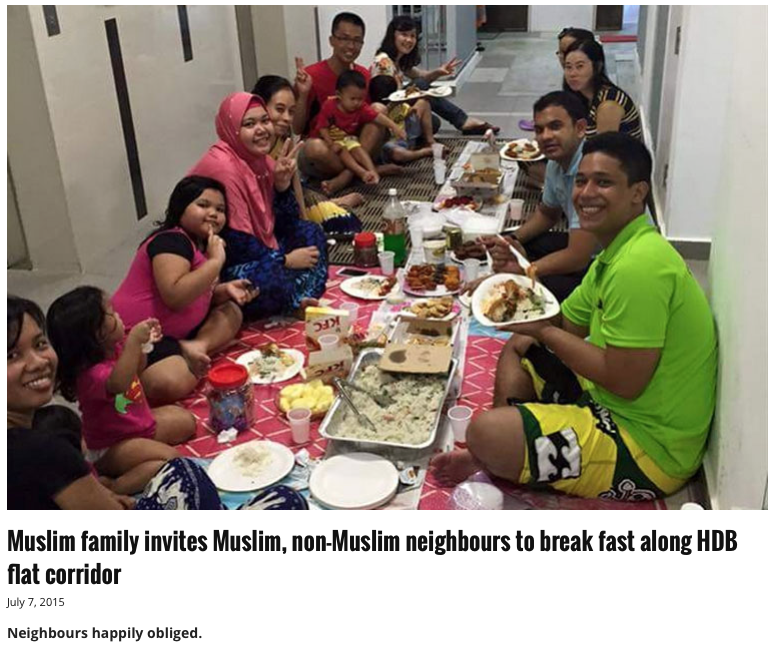
As a Muslim, I see far more Muslims sending greetings to friends to other faiths than not. In fact – the majority of Muslims here laugh at those who insist on not sending greetings because of a misplaced ideal of religiosity. It is ridiculous because it isn’t who we are as a people. In fact we welcome the opportunity to engage with our non-Muslim neighbours as evident in the picture below:
The article on this actual overwhelmingly neighbourly behaviour of Singaporean Muslims can be found here.
With regards to the Muslim population here being influenced by Middle Eastern influences – I must agree to this statement. Religion whether in the Middle East or any other part of the world – is still the same religion. The only difference is cultural influences. For example, there is a rising trend of believing what works in Saudi Arabia should work in Singapore. This idea is empirically false. The geo-politics, history and cultural nuances between the Middle East and South East Asia couldn’t be more apart from each other. On this respect – I find it amusing that Muslims in Singapore are increasingly seen to ditch their own culture, even their cultural dress in order to dress themselves like Middle Easterners so as to be more religious. The idea that your cultural dress influences your piety is a laughable construct. For this – the Muslims in Singapore are wrong.
The article, only after pointing out the Muslims as examples of growing intolerance, goes on to say that the current model for Muslims in Singapore is a successful one and that we should cherish it. In media, we understand what is referred to as attention span. The average reader doesn’t read beyond the fourth paragraph. In this respect anything positive about our Muslim population only appeared after 5th paragraph.
Why are the above points on how the article was written a great disservice to Singapore? The immediate impact was the Muslims taking a defensive posture, demanding data and statistics to back up the statements in the article. This puts the Minister who is in charge into a difficult position because it doesn’t clearly portray his stand on the issue. It also pits non-Muslims and Muslims at odds into a game of finger-pointing. It makes talking more difficult and accusing far easier.
Ultimately it points out the the Today newspaper is more interested in sensationalising news than taking into consideration what impacts how and what they publish might have on the social fabric of our country.
To Muslims I say this – stop being the victim. You are not. Stand up and be counted amongst those who value life and peace. To the non-Muslims I say this – before easily drawing the lines in the sand consider that there is more to be had without doing so.
Saya berjiran dengan keluarga berbangsa india berugama hindu untuk hampir 15 tahun. Kami saling menghormati dan menyayangi walaupun saya tidak pernah mengucapkan happy deepavali kepada mereka.
Malahan semasa memakai kain ihram untuk berangkat menunaikan haji beberapa tahun lalu, jiran hindu ini menawarkan untuk hantar saya ke airport. dia sempat kata, kain ihram yang saya pakai seumpama kain yang dia pakai untuk upacara keugamaan hariannya.
…
I am neighbours with an Indian-Hindu family for about 15 years. We respect and appreciate each other even though I never wish them Happy Deepavali.
In fact when I was wearing the ihram before heading for the haj a few months ago, this Hindu neighbour offered to send me to the airport. He even said that the ihram that i was wearing is similar to the cloth he uses for during his Hindu events.
We really need to think through the idea of ‘tolerance’ and ‘harmony’, and ‘extremism’.
Is a person intolerant because (s)he refuses to say merry christmas to someone else? Does one turn into an extremist for having the belief that religious practices should be exclusive to one’s own faith? And if we start here, i wonder where do we draw the line: what do we make of a person who refuses to marry outside his/her faith? Is that person an ‘extremist’?
Personally, i know of a couple of elderly Muslims who do not attend events at churches or temples (it’s a personal preference, as they would mostly acknowledge), but no one in the right mind would ever make the claim that they are ‘distant’ or ‘intolerant’: they are probably some of the nicest neighbours one could have. They give food to their neighbours (yes, non-Muslims too), always strike a conversation with strangers in the block, and never fail to smile at anyone.
At the same time, i have many non-Muslim neighbours who have never wished me ‘Selamat Hari Raya’ or ‘Eid Mubarak’ (for whatever reasons): but of course, no one bats an eyelid when that happens. When a Muslim does/does not do the same thing, it is suddenly problematic. Unfortunately, Islam is always on trial.
One of the ways that we should not make a community feel ‘distant’, is to stop viewing the world in false binaries. We should not be too quick to accuse and ‘advise’ a particular group, based on our own worldviews and understandings of the world.