Tag: ramadan

  • Ramadan In St Petersburg – The City Where The Sun Doesn’t Set

    Ramadan In St Petersburg – The City Where The Sun Doesn’t Set

    When Ramadan starts on Thursday, the faithful in St Petersburg and elsewhere in northern Russia will face an obstacle that the prophet surely didn’t envision: in June, the sun never truly sets.

    These are the celebrated “white nights”, the period lasting from roughly late May to early July when a few hours of twilight is the closest it gets to true night. Although they are observed across the far north, white nights have the strongest association with St Petersburg, the northernmost city with a population of more than 1 million and Russia’s unofficial cultural capital.

    For the city’s Muslim population, it’s an exacting time. The Qur’an makes exceptions to the Ramadan fast for people suffering from illness, travellers and women who are menstruating or pregnant. But it does not give explicit instructions on observing the fast in the far north.

    According to some St Petersburg Muslim authorities, the long-lasting daylight in the city at this time of year is simply an extra challenge to their faith.

    “In St Petersburg, Muslims see this as a test. In the time that is now starting they will observe the fast,” said an employee of the St Petersburg and Northwest Regional Muslim Spiritual Centre, who declined to give his name. “Those Muslims who are observing the fast will wait 21-22 hours to break the fast, they will eat for only three hours.”
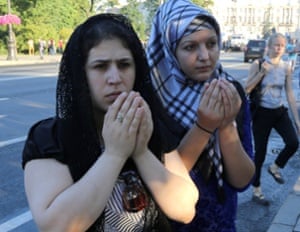
    Muslims pray at the main mosque in St Petersburg

    When asked about the difficulty of keeping to this strict schedule, he said it was no burden for the faithful. “Islam is a way of life,” he said. “For us, fasting is the same as getting up in the morning and brushing your teeth.”

    Yelizaveta Izmailova, an administrator at a local school who is originally from the largely Muslim region of Ingushetia, said her parents, brother, sister and husband all observed the Ramadan fast with her, following a schedule handed out each week at the central mosque.

    “This month, the time for breaking the fast is really late. We don’t eat or drink from the morning prayer, at about two in the morning, until the sun goes down at around 10pm,” Izmailova said, explaining that twilight typically arrived as late as 10.30pm in June. “Of course, this is a heavy burden for the human body, but every Muslim makes this choice consciously.”

    Although there are no exact figures on how many Muslims live in St Petersburg, last year’s Eid al-Fitr festivities, which mark the end of Ramadan fasting, drew 42,000 worshippers to the city’s two main mosques, according to the interior ministry. As often happens on major holidays, most could not fit inside and had to take part from the street.

    Some Muslim scholars have written that residents of northern regions can forgo the fasting ritual, which is meant as a way to strengthen the will and rule over desires.

    “According to the instructions of the Holy Qur’an, fasting in regions [near the poles] is never obligatory, for it is established as such only for a set amount of days, that is, in those places where night and day are comparable in length,” Russian Tatar scholar Musa Bigiev wrote in a text on fasting.

    Other religious literature suggests that Muslims living in the far north can observe the Ramadan fast according to the time of sunrise and sunset in Mecca or the nearest Muslim city.

    In many cases, those performing hard manual labour don’t fast for safety reasons. Many of the Muslims in St Petersburg are migrants from former Soviet republics in central Asia and the Caucasus working in construction and other low-wage industries. The labour ministry approved a quota of 164,000 migrant workers in St Petersburg in 2014, but the actual number is likely to be much higher.

    Shakir, a metal-worker originally from Tajikistan, said generally only the elderly and those without work followed the fast in St Petersburg.

    “I have a hard job, I can’t observe it,” he said. “The day is long, and you can’t drink water or eat before the sunset. For that reason not everyone observes it … There aren’t any white nights where [most] Muslims live.”


    Source:www.theguardian.com

  • 10 Things To Know About Ramadan

    10 Things To Know About Ramadan

    The first day of Ramadan, traditionally a time for prayer and abstinence, started on Wednesday (June 17) evening.

    The ninth month of the Hijri (Islamic) calendar involves a month of fasting from sunrise to sunset for nearly 1.6 billion Muslims across the world.

    Here are 10 things to know about the holy month.

    1. The dates for Ramadan change every year as the calendar is based on the lunar cycle, and it usually falls 11 days earlier than the previous year.

    It begins at the first sighting of the new crescent moon.

    2. Fasting is one of the Five Pillars of Islam. It is meant to cultivate self-discipline and direct one’s heart away from distractions, as well as to cleanse one’s soul by freeing it of impurities.

    The meal that Muslims consume at dawn before fasting begins is called sahur. The breaking fast meal is known as iftar.

    Hari Raya Aidilfitri is celebrated after the last break fast of the month. It also marks the start of a new month, Syawal.

    A street light-up in Tampines to coincide with the launch of a Hari Raya bazaa nearby.  — ST PHOTO: MARK CHEONG

    3. Besides abstaining from eating and drinking, Muslims must also refrain from smoking, sexual activities and sinful speech or behaviour while fasting.

    4. During Ramadan, praying is emphasised throughout the day (for the full list of times, click here). Special evening prayers, when long portions of the Quran are recited, called terawih, are also conducted.

    Filipino Muslim children being taught how to pray properly outside the Pink mosque in Datu Saudi Ampatuan town, Maguindanao province.  — PHOTO: EPA

    5. Not all adult Muslims need to fast – the elderly and people who are sick or travelling overseas are exempted, although in the latter cases, they are expected to make up for it.

    Women who are pregnant, menstruating or breastfeeding are also excused. Children are not required to fast until they reach puberty.

    6. Under the Labour Law in the United Arab Emirates, employees are entitled to work reduced hours during this period without a reduction in their salaries. Workers across the country get two hours cut from their regular work days.

    The law does not differentiate between Muslims and non-Muslims.

    This rule, however, does not apply in Singapore.

    7. The most important day of Ramadan takes place some time during the last 10 days of the month. It usually falls on the 9th, 21st, 23rd, 25th, or 27th days of Ramadan. Muslims believe it was the day when the first verses of the Quran were revealed to the Prophet Muhammad.

    It is known as Laylat al-Qadr, or Night of Power.

    8. A recent local study conducted by experts from the National University of Singapore found that fasting during the Ramadan period can help improve blood sugar levels in people with type 2 diabetes.

    For a guide on how Muslims with diabetes can fast safely, click here.

    9. Fasts are usually broken by eating dates, which is known for being easy to digest and possessing a high level of sugar. Soups, bread and fruits such as watermelon are also recommended.

    Dates for sale at a roadside stall in Karachi, Pakistan ahead of Ramadan.  — PHOTO: EPA

    Click here for a list of local eateries offering Ramadan specials.

    10. The theme for this year’s festivities in Singapore is “Celebrating Ramadan with family”.

    Social media is expected to play a significant part in it, with Muis organising a photo contest on Instagram where uploaded photos with the themes of family, care or spirituality and with the hashtag #BlessingsofRamadan stand to win $300 every week.

    Minister-in-charge of Muslim Affairs Yaacob Ibrahim marked the start of Ramadan with a Facebook post on Wednesday evening. “May the Holy month strengthen our ties with our families and loved ones, and bring out the best in us,” he wrote.


    Source: www.straitstimes.com

  • Why Are Muslims So Happy In Ramadan?

    Why Are Muslims So Happy In Ramadan?

    If you have non-Muslim colleagues who are missing their lunch buddies this month, perhaps this will give them a better idea of what’s really going on with Muslims this Ramadan.

    Your Muslim classmates and colleagues may look pale, have chapped lips and look adoringly at the clock counting down to 713pm to break their fast, but despite the hunger and thirst, they’re kind of …. peaceful. Happy even! What sorcery is this, you wonder? Here are some reasons why:

    1) Rewards are multiplied.

    Ramadan is like the Great Singapore Sale of worship. In other months, we are told that our good deeds are rewarded in the ratio 1:10 (yeah, Allah is pretty great) up to 1:700 but for Ramadan, a narration by Prophet Muhammad (peace be upon him) informs us that God says “Fasting is for Me, and I reward it accordingly.” And that means infinitely (and more!) probably because one of the attributes of God is that He is the Most Generous. There is no logic or system in His Accounting WHICH IS GREAT because we are so in need of extra points.

    So that’s why we’re still smiling despite looking at you and your Big Mac during lunch time. Coz we’re hopeful of the rewards of remaining patient for that few hours.

    2) We see our potential.

    In Ramadan, we believe Satan gets locked up. No more bothersome whispers to do evil things! Although Muslims do believe that we all have innate bad characteristics (with or without Satan) that we have to remove, it does help that we get a free pass for a month from him and focus on cleaning our hearts!

    Screen Shot 2015-06-18 at 10.40.55 am

    This, coupled with the fact that its the GSS of worship, is why you may notice your Muslim friends who drink, stop drinking. Those who can rival a pirate with his swearing and cursing, bite his tongue in this month. And others turn down invitations for movies, parties and other general entertainment.

    It’s because we realise what we’re capable of. We spend 11 months of the year trying so hard to be better people and it’s usually a great struggle. Yet in Ramadan, things get easier and we focus more on our spirituality and realise what we’re capable of. And that makes us mighty pleased and hopeful.

    3) Great sense of community

    Living in a fast-paced city like Singapore and with an increasingly individualistic system of living, it gets difficult to feel a sense of community sometimes. Ramadan reverses that. Makciks all over insist that their children come home to break their fast together, if not everyday, at least once a week.

    This sense of community is most beautifully manifested during the special night prayer that’s only done in Ramadan. It is called the Tarawih prayer (tarawih literally comes from the word rest, or refers to the period of rest in between 4 cycles of the prayer). Mosques all over Singapore which are usually only packed for Friday prayers, are generally packed every single night in Ramadan for these prayers and not just men too. Women, children and the elderly all make their way to the mosques to perform this voluntary prayer together. And it’s an amazingly happy sight.

    Fasting also teaches and reminds us of those less fortunate. When we’re hungry, we are able to empathise with those who are hungry not out of choice. Since Ramadan is basically our happy hour for extra good deeds, you will see many charity initiatives in this month too. SimplyIslam’s Ramadan Charity Basket has been ongoing for 8 years now and we help to provide financial aid and also food provisions to over 150 needy families. You can click on the link above to find out more, donate and also volunteer during the drive!

    4) Salvation from Hell

    Do I really need to explain? Ok. So Muslims believe in a Heaven and a Hell. If your good deeds outweigh your bad deeds, to Heaven you go! (With God’s Mercy of course!) If it’s the opposite, …. you know where this is going.

    BUT! Ramadan is great because Prophet Muhammad (peace be upon him) says: “Fasting serves as a shield from Hellfire.”

    And in another narration, “Whoever observes fasts during the month of Ramadan out of sincere faith, and hoping to attain Allah’s rewards, then all his past sins will be forgiven.”

    ALL his past sins guys, ALL. So of course we’re happy in this month!

    5) Ramadan Food

    I know I was going for the spirituality angle in this piece but I’ll be a hypocrite if I say we don’t get excited about the special Ramadan food. These are things that even the non-Muslims enjoy too I’m sure!

    There’s this milky, nutty, cold and yummy drink that magically appears in Ramadan and it’s called Katira. Katira is to Singaporean Muslims what the Butterbeer is to Harry Potter. (If you don’t get that reference, seriously why have you not read Harry Potter?!)

    Katira Goodness

    There’s also Dendeng which is basically our awesome, halal version of your Bee Cheng Hiang’s Bakkwa. ‘Nuff said.

    Then there’s the simple, understated Bubur Masjid (literally Mosque Porridge) that we actually send our kids to collect at the mosque once they’re done with school because if we go after our office hours, it might run out. Seriously, we take our Bubur Masjid very seriously. Seriously.

    So now you know what’s up with your Muslim friends this month. We’ll catch up with you on Hari Raya when we’ll all celebrate over pineapple tarts and fizzy drinks! But till then, please don’t post your lunch on Instagram, thanks.


    Source: http://muzlimbuzz.sg

  • Preparing For Ramadan – Advice From Habib Umar Bin Hafiz

    Preparing For Ramadan – Advice From Habib Umar Bin Hafiz

    “Make sure you end Sha’ban in the best of states, for Allah records the rewards that we will receive and the supererogatory actions that we will perform before Ramadan enters. He also records the bad deeds and the wretchedness of those that will be deprived the blessings of Ramadan.  What will be your state on the last Friday of Sha’ban and the night before it? Attend the gatherings at the end of this month with a heart focused on the All-Merciful.

    Prepare for the first night of Ramadan, for on this night Allah gazes at His creation, a special gaze which is unique to this Ummah. Allah will never punish the one upon whom He gazes.[2] Look at how many gifts have been given to this Ummah – when Ramadan enters the gates of the Garden are opened and the gates of the Fire are closed.[3]

    If someone who is destined for the Fire dies during Ramadan he will see that the gates of the Fire are closed!

    The odour that comes forth from the mouth of the fasting person is sweeter in the sight of Allah than the scent of musk!

    Every night Allah decrees the safety of 600,000 people from the Fire (in some narrations one million). Then on the last night he decrees the safety of the same number of people that he decreed on every night of the month. He also decrees the safety of others during the day – particularly at sunrise and sunset.

    This is not to mention what happens on Laylat al-Qadr! Allah make us amongst those who reach that night and attain all that it contains. Ask from Allah in the best of ways because Allah does not accept a du`a from a heart which is heedless. Likewise a du`a from a sound heart is more likely to be accepted than a du`a from a tongue which is fluent.

    Al-Sayyida `A’isha asked the Messenger of Allah (Allah bless him and grant him peace) what she should ask for if she knew that it was Laylat al-Qadr.

    He replied: “O Allah, truly You are all-Pardoning, You love to pardon so pardon us.”[4]

    He also said (Allah bless him and grant him peace): “Do four things in abundance: two things with which you please your Lord, and two things which you cannot do without. As for the two things with which you please your Lord: your testifying that there is nothing worthy of worship other than Allah and your seeking His forgiveness. As for the two things which you cannot do without: your asking Allah for Paradise and seeking refuge in Him from the Fire.”[5]

    So say these things in abundance, for they are the best things for which you can use your tongue. Say them in your homes, in the streets, in the mosques not just at Iftar or after Tarawih.

    [On the basis of these two hadiths the scholars and people of Tarim repeat the following du`a throughout the month of Ramadan:

    أشْهَدُ أن لا إلهَ إلا الله نَسْتَغْفِرُ الله نسأَلُكَ الجنَّةَ ونَعُوذُ بِكَ مِنْ النَّار (3)
    ‪ ‬
    Ashadu alla ilaha illallah, nastaghfirullah, nas’aluk’l-jannata wa na`audhu bika min an-nar

    “I testify that there is nothing worthy of worship other than Allah and we seek the forgiveness of Allah. We ask You for Paradise and take refuge in You from the Fire.” (3 times)

    اللهمَّ إنَّكَ عَفُوٌ تُحِبُّ العَفْوَ فَاعْفُ عَنَّا (3) يا كَرِيم

    Allahumma innaka `afuwun tuhibbu-l’`afwa f`afwa `anna

    “O Allah, truly You are all-Pardoning, You love to pardon so pardon us” (3 times). On the third time say “O Most Generous” (Ya Karim).]

    Allah give us the biggest portion of all goodness. Make Ramadan a cause of rectification and the removal of tribulations.

    [1] Jalsat al-Ithnayn, Dar al-Mustafa the night of 25th Sha`ban 1432/25th July 2011
    [2] Narrated by al-Bayhaqi
    [3] Narrated by al-Bukhari and Muslim
    [4] Narrated by Ahmad, Ibn Majah and Tirmidhi with a sahih chain of transmission
    [5] Narrated by Ibn Khuzayma


    Source: http://seekershub.org

  • Uighur Community: China Again Bans Fasting In Ramadan

    Uighur Community: China Again Bans Fasting In Ramadan

    China has, once again, banned Ramadan in parts of the far western Xinjiang district for Muslim party members, civil servants, students and teachers.

    Muslims throughout the district – which is known to have a minority population of Uighurs – have been told not to fast during the Holy Month.

    The Uighur leader, Dilxat Raxit, sees the move as China’s attempt to control their Islamic faith and warned that the restrictions would force the Uighur people to resist the rule of the Chinese government even more.

    He added: “The faith of the Uighurs has been highly politicised and the increase in controls could cause sharp resistance.”

    In recent years, Chinese authorities have blamed separatist Uighurs for a string of terrorist attacks on civilian crowds and government institutions, but the group has consistently denied involvement.

    Activists have long-accused Beijing of exaggerating the threat as an excuse to impose restrictions.

    Mr Raxit told Radio Free Asia: “They [the Chinese government] are extracting guarantees from parents, promising that their children won’t fast on Ramadan.”

    According to the government’s website, halal restaurants near the Kazakh border are being encouraged by food safety officials to stay open during daylight hours in Ramadan.

    Shops and restaurants owned by Muslins have also been ordered to continue selling cigarettes and alcohol over the course of the month – or be shut down altogether.

    Beijing is continuing to crack-down against ‘religious extremism’ although human rights groups call it ‘religious repression’, adding that authorities want to prevent Muslims from ‘instilling religion’ into public bodies.

    The ruling party says religion and education should be kept separate and students should not be subject to ‘religious influences’, although this rule is rarely enforced for children of Han Chinese, who – if they have a religion – are mostly Buddhist, Daoist or Christian.


    Source: www.independent.co.uk

deneme bonusu