Tag: Raqqa

  • Seeking A Dream, Indonesian Family Finds Nightmare In Raqqa

    Seeking A Dream, Indonesian Family Finds Nightmare In Raqqa

    The 17-year-old Indonesian girl made a persuasive case to her family: Lured by what she had read online, she told her parents, sisters, aunts, uncles and cousins they should all move to Syria to join the Islamic State group.

    Each of her two dozen relatives found something in it for them. Free education and health care for the girls. Paying outstanding debts for her father and uncle. Finding work for the youngest men.

    And the biggest bonus: a chance to live in what was depicted as an ideal Islamic society on the ascendant.

    It didn’t take long before their dreams were crushed and their hopes for a better life destroyed as each of those promised benefits failed to materialize. Instead, the family was faced with a society where single women were expected to be married off to IS fighters, injustice and brutality prevailed, and a battle raged in which all able-bodied men were compelled to report to the frontline.

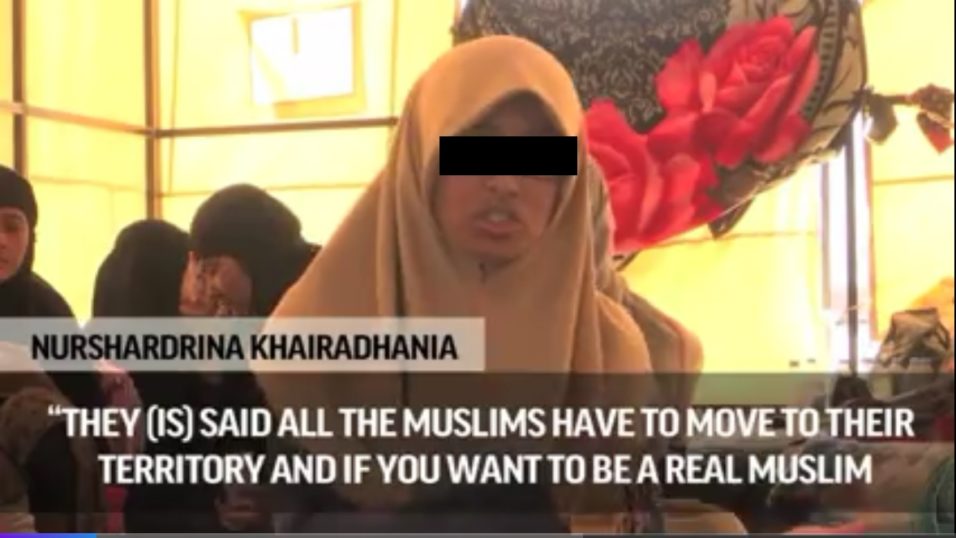
    In an interview with The Associated Press, Nurshardrina Khairadhania, now 19, recalled her family’s fateful decision to immigrate to the IS stronghold of Raqqa two years ago — and how, only months later, their bid to escape began.

    During that time the family endured separation, her grandmother died and an uncle was killed in an airstrike.

    “IS shared only the good things on the internet,” said the young woman, who goes by her nickname, Nur.

    She now lives with her mother, two sisters, three aunts, two female cousins and their three young sons in Ain Issa, a camp for the displaced run by the Kurdish forces fighting to expel IS from Raqqa. Her father and four surviving male cousins are in detention north of there. While the men are being interrogated by the Kurdish forces for possible links to IS, the women wait in a tent in the searing heat, hoping for the family to be reunited and return to their home in Jakarta.

    Nur’s family is among thousands from Asia, Europe, Africa, North America and the Middle East who chased the dream of a new Islamic society advertised by IS in slickly produced propaganda videos, online blogs and other social media. By the time they got there, the group’s brutal campaign of beheadings, kidnappings and enslaving women was well underway.

    For Nur and her sister, such images were part of a hate campaign against the nascent Islamic caliphate or simply justified punishment for crimes committed there.

    “I was afraid to see that. I first thought it was another group … who hates IS,” Nur said.

    Nur recalled calling her family together just months after the extremists’ declared their “caliphate” on territory seized in Syria and Iraq in the summer of 2014.

    Making her pitch, she recounted the benefits laid out on the IS blogs: her 21-year-old sister could continue her computer education for free. Her 32-year-old divorced cousin, Difansa Rachmani, could get free health care for herself and her three children, one of whom was autistic. Her uncle could get out from under the debt he incurred trying to save a struggling auto mechanic business in Jakarta — and could even open a new one in Raqqa, where mechanics were in high demand to build car bombs, the extremists’ signature weapon.

    For Nur, the Islamic State seemed to be the perfect place to pursue her desire to study Islam and train to be a health practitioner.

    “It is a good place to live in peace and justice and, God willing, after hijrah, we will go to paradise,” she recalled thinking, using the Islamic term for migration from the land of persecution to the land of Islam. “I wanted to invite all my family. … We went to be together forever, in life and afterlife.”

    The family sold their house, cars and gold jewelry, collecting $38,000 for the journey to Turkey and then on to Syria.

    But once in Turkey, the first quarrels began, over how or even whether to sneak into Syria. Seven relatives decided to head out on their own and were detained by the Turkish authorities while trying to cross the border illegally. They were deported back to Indonesia where, the family says, they remain under surveillance because the rest of their relatives had lived in IS territories.

    The saga of family separation had only just begun, however.

    After arriving in Islamic State group territory in August 2015, the family was divided again: the men were ordered to take Islamic education classes, and ended up jailed for months because they refused military training and service. After their release, they lived in hiding to avoid forced recruitment or new jail sentences. The women and girls were sent to an all-female dormitory.

    Nur was shocked by life in the IS-run dormitory. The women bickered, gossiped, stole from each other and sometimes even fought with knives, she said. Her name and those of her 21-year-sister and divorced cousin were put on a list of available brides circulated to IS fighters, who would propose marriage without even meeting them.

    “It is crazy! We don’t know who they are. We don’t know their background. They want to marry and marry,” she said.

    “IS wants only three things: women, power and money,” she and her cousin, Rachmani, said in unison.

    “They act like God,” Nur added. “They make their own laws. … They are very far from Islam.”

    In a separate, monitored, interview with the AP at a security center run by Kurdish forces in Kobani, north of Raqqa, where he and the other male family members were being questioned for possible IS ties, her 18-year-old cousin said that living under the extremists was like living in “prison.”

    “We (didn’t) want to go to Syria to fight,” he said, speaking on condition of anonymity for fear of retribution from IS or trouble with the Kurdish authorities or those back home in Indonesia. “We just wanted to live in an Islamic state. But it is not an Islamic state. It is unjust, and Muslims are fighting Muslims.”

    IS officials ignored Nur’s persistent queries about continuing her education in Raqqa. And because they refused to enroll in military service, the men never got the jobs they had been promised. When the battle for Raqqa intensified in June, IS militants set up checkpoints around the city, searching for fighters and came looking for the men.

    Rachmani did get free surgery for a chronic neck ailment and her son got attention for his autism and was finally able to walk. Soon after the family’s arrival, she was sent to the then-IS stronghold of Mosul in Iraq for the surgery.

    “I left my country for my stupid selfish reason. I wanted the free facilities,” Rachmani said. “Thank God I got my free (surgery) but after that all lies.”

    The family searched for months for a way to escape, a risky endeavor in the tightly controlled IS territory.

    When the Kurdish-led campaign to retake Raqqa from IS intensified in June, the family finally saw their opportunity. At great personal risk, Nur used a computer in a public internet cafe to search for “enemies of IS,” despite the danger posed by frequent raids carried out by IS there. She contacted activists and eventually found smugglers, who, for $4,000, got the family across the front line and into Kurdish-controlled territory. They turned themselves in to Kurdish forces on June 10.

    An Indonesian Foreign Ministry official said authorities have known for several months about the presence of Indonesian nationals, including Nur’s family, in the Ain Issa camp and were investigating their condition.

    “However, they have been two years living in the IS area, so the risk assessment of them is required and we have been facing obstacles to reach them as they are in an area not controlled by any official government, either Iraq or Syria,” said Lalu Muhammad Iqbal, the ministry’s director of Indonesian citizen protection.

    “I am very regretful. I was very stupid and very naive. I blame myself,” Nur said of the family’s plight. “May God accept my repentance because you know … it is not like a holiday to go to Turkey. It is a dangerous, dangerous trip.”

    Source: https://sg.news.yahoo.com

  • Experts Not Convinced Malaysian IS Terrorist Muhammad Wanndy Is Dead

    Experts Not Convinced Malaysian IS Terrorist Muhammad Wanndy Is Dead

    KUALA LUMPUR: Security officials, reacting to a Facebook post by the wife of notorious Islamic State (IS) terrorist Muhammad Wanndy Mohamed Jedi that he is dead, doubt its accuracy.

    “This is probably a ruse by Mu­­hammad Wanndy to escape from those on his heels,” said a source.

    The source said Muhammad Wann­dy, 27, had probably staged his own death to “emerge as a new person” and avoid detection.

    “He is really desperate and will try anything,’’ the source added.

    News of Muhammad Wanndy’s alleged death on Saturday was triggered by a Facebook post by Nor Mahmudah Ahmad, 28, that day.

    She said Muhammad Wanndy could have been killed in Syria in a drone strike.

    Stating that she accepted her husband’s fate, she vowed to carry on with his struggle in Syria.

    “My Mujahid, finally it is your time to go. I will remain here and carry on with the work you started. I accept this as fate,” Nor Mah­mudah wrote in her latest posting.

    (A mujahid is one engaged in a jihad, especially as a guerrilla war­rior.)

    Muhammad Wanndy, who is from Durian Tunggal in Malacca, left for Syria in 2014 with Nor Mahmudah.

    Known as a top IS recruiter, he is on the United States’ most wanted list for his involvement in funding and providing operational support for the terror group.

    In an exclusive report in The Star on Wednesday, intelligence sources were quoted as having said that Muhammad Wanndy had lost the faith of IS militants as he had failed to carry out attacks in Malaysia as planned.

    The report stated that Muhammad Wanndy had “limited time” to try and con­vince his Syrian leaders of his ability to conduct terror attacks.

    One source had said that he had until the end of the year to prove himself, or risk having his status as the IS’ Malay­sian leader stripped.

    Sources said yesterday that seve­ral Malaysian and Indonesian militants were unhappy with Muham­mad Wanndy as he had used up sympathisers’ donations.

    “Fellow IS fighters in Raqqa are looking for him. He has been on the run for about two weeks,” said a source.

    Other militants also took to social media to post pictures of the car that Muhammad Wanndy allegedly was in when the drone attack happened.

    “Even the wordings in his wife’s post sounds more like Muhammad Wanndy’s writing,” said a source.

    The source added that Muham­mad Wann­dy was the mastermind be­­hind many failed IS attacks in Malay­sia “and he is not a fighter in Syria”.

    “It was long suspected that he used funds donated towards the IS cause to settle his family expenses in Syria and other debts.

    “He cleverly used the IS platform for his own gain. His cover has been blown open,” said the source.

    It is believed that Muhammad Wanndy, also known as Abu Hamzah Al-Fateh, had accumulated RM100,000 in donations from sympathisers.

    “He used some of it to fund attacks in Malaysia but most was for his own use.

    “It can be said that he enjoyed life in Syria while others did the fighting for him,” another source said.

    Bukit Aman Special Branch director Comm Datuk Seri Mohamad Fuzi Harun said they were trying to find out whether Muhammad Wanndy was in fact dead.

    “We are checking. We want to know quickly,’’ he added.

    Comm Mohamad Fuzi had said earlier that the Counter Terrorism Division was working closely with the United States to hunt down Muhammad Wanndy, who has been on Bukit Aman’s wanted list for the past two years.


    Source: www.thestar.com.my


  • ISIS’ Malaysian Head Running Out Of Time

    ISIS’ Malaysian Head Running Out Of Time

    Muhammad Wanndy Mohamed Jedi is desperate to retain his title as the top Malaysian Islamic State in Iraq and Syria (ISIS) operative, despite the terror network having lost faith in him.

    “He has failed to carry out attacks in Malaysia as planned. This has infuriated its (ISIS) Syrian and Iraqi leaders,” an intelligence source told The Star.

    Among the botched ISIS attacks in the country was the Movida nightclub bombing in Puchong, Selangor, last May. Eight people were injured in the attack.

    Last month, Inspector-General of Police Khalid Abu Bakar said Wanndy was still working to expand ISIS influence in Malaysia.

    According to the source, Wanndy has “limited time” to try and convince his Syrian leaders of his ability to conduct terror attacks. “He has been given until the end of the year, or risks having his stature as the ISIS’ Malaysian leader stripped,” said the source.

    The source said that due to his predicament, Wanndy will go all out to prove his mettle by staging bombings at targeted spots in Malaysia. Wanndy and his 26-year-old wife left for Syria in January last year, and the former is believed to be based in Raqqa, ISIS’ de facto capital.

    He is said to have sought the help of Syrian ISIS leaders for hackers to penetrate Malaysia’s social media network.


    Source: www.tnp.sg

  • ISIS Militants Being Killed At Level They Cannot Sustain, Says British General

    ISIS Militants Being Killed At Level They Cannot Sustain, Says British General

    The US-led coalition effort against Islamic State in Iraq and Syria (ISIS) is killing the group’s fighters more quickly than it can replace them, a senior British general said on Tuesday (Feb 28), with more than 45,000 killed by coalition air strikes up to August last year.

    On Tuesday, US-backed Iraqi forces continued their offensive in Mosul, where several thousand ISIS militants, including many who travelled from Western countries to join up, are believed to be based.

    “We are killing Daesh at a rate that they simply can’t sustain,” said Major-General Rupert Jones, deputy commander for the Combined Joint Task Force coalition, using an Arabic acronym for ISIS.

    “The enemy cannot sustain the attrition that they are suffering and therefore they lose terrain, they lose battles.”

    The top American commander in Iraq said earlier this month he believed US-backed forces would recapture ISIS’ two major strongholds – Raqqa in Syria and Mosul in Iraq – within the next six months.

    Jones said that while the battle would not be over with the fall of Mosul or Raqqa, it would be the beginning of the end.

    “The inevitability of their destruction just becomes really a matter of time,” he said, adding that the group’s leadership was now focussed on little more than survival.

    ‘BRUTAL REGIME’

    The coalition estimates that the number of ISIS fighters in Iraq and Syria is at its lowest level in more than 2.5 years, with the group having lost 62 per cent of the territory it once controlled in Iraq and 30 per cent in Syria.

    Jones said the number of foreign fighters travelling to join ISIS had dropped by between 75 and 90 per cent, both due to it being harder to get in and out of Iraq and Syria and because the reality of doing so had been exposed as unappealing.

    “The big idea that Daesh were putting out there, the kind of glamour… has been exposed for what it is, it is a lie,” he said. “They recognise that what you are actually signing yourself up to is going to live under a brutal regime.”

    He said ISIS had refocused its attention on radicalising people outside Iraq and Syria to carry out attacks locally, so the coalition still had work to do on countering the group’s ideology.

    The coalition estimates that ISIS activity on Twitter has fallen by 45 per cent since 2014, with 360,000 of the group’s Twitter accounts suspended, and the lifespan of an ISIS-linked social media account reduced to less than two days.


    Source: ST