Tag: religion

  • Tamil-Hindu Student Felt Real Discrimination And Racism In His Junior College

    Tamil-Hindu Student Felt Real Discrimination And Racism In His Junior College

    Post #1:

    “I entered the next phase of my life in JC not knowing much about the inequalities and discrimination faced by Singaporeans. I was from an English speaking Christian school and mixing around with other races was not much of an issue. I must also admit that I was from a rather privileged family background.

    I am Indian, more specifically a mix of a Tamil and Gujarati heritage, and am born a Hindu. These labels are important as we embrace diversity – not to divide, but to appreciate the rich diversity around us.

    In JC, the first thing I noticed as I stepped into my new class was how nearly everyone was speaking in Chinese (Mandarin). Most of the students in my class (and my JC) were from Chinese SAP Schools. I still remember one of the first questions a classmate asked me – “”Are you Malay?””. I do not look Malay in any way, but to him as I later found out, as long as you are lighter skinned, you are Malay – likewise, if you are darker skinned you are definitely Indian.

    The acute lack of awareness of other races became more and more apparent as the term progressed. Another one of my classmates (who is from another notable SAP School), did not know what Halal food meant and my exasperated reply to him led me to discover further that he didn’t know that Hindus were not allowed to eat beef. The ignorance only scratched the surface.

    A disturbing number of of these SAP school students sang their school songs in Chinese, spoke in Chinese at home, to their friends, and everywhere else. They learnt a lot about China and Confucius teachings. They have an unhealthy obsession and love for China, it’s history and the rise of China as a superpower. The lives were almost entirely sino-centric and failed to appreciate and understand the diversity in our own home, let alone the rest of the world. There I said it. Many people think it, but do not talk about it. On their own, there is nothing wrong with the above. But SAP schools do not equip their students for a further beyond their safe zone of Chinese friends, colleagues, bosses etc. As many Indians can attest to, the discrimination and prejudice faced by Indians in the working world arises partly from the above.

    Another of my classmate, who was also Indian (thankfully, ‘cos I wouldn’t have survived alone), was called names such as “”blacky””, the usual “”you’re so dark I can’t see you in the photo””, “”do you get sun burns?””, “”why do you have such curly hair?”” etc. Many of these comments would stun Indians who have never experienced them. For example, this girl has the loveliest hair, was very pretty and had a gorgeous smile. I must admit, I did have a little crush on her when I first met her. Coming from an all-boy school, this was indeed refreshing. On a side note, most of the other classes did not have any Indians. I guess most Indians preferred to head to the other top JC where diversity was not much of an issue (if only I’d known this sooner).

    I digress. So, I admired her tenacity and grit as she acted nonchalant, and occasionally defended herself. I mean when 18 students gang up against you, there’s only so much you can say and do. While I never partook in calling her names, I regret not having done more to defend, not just her, but Indians and minorities in general.

    Part of the reason I did not was because I did not understand the issues at play. We are taught that there were race riots and that we live in a perfect utopia now, but that utopia cannot be tarnished by discourse. I now know that what she went through (and I) was more than just verbal abuse. It is a systemic bullying that is institutionalised and readily passed on from grandparents to parents, and now their children.

    We do not have open and frank conversations about racism and discrimination. For starters, what is racism? Is it just about hating a particular race? I daresay, no! Sadly, many Singaporeans still think that their ignorance is not racism, their lack of trust, stereotypes of other races, are harmless. It is not. These very thought processes have led to the systemic marginalisation, prejudice, discrimination that Indians face later on in their lives (I’m sure Malays face these problems too, if not worse).

    So when are we really gonna sit up and get real with ourselves? I watched Viola Davis’ Emmy acceptance speech and was wow-ed. In Singapore though, an Indian person could not have said that, and even if s/he did, s/he would not have gotten away with it.

    I see everything much clearer now, and I hope more minorities, and the majority (sorry, but I have very low expectations of the majority), would stand up and make our voices heard.

    Thank you for creating this platform. I apologise if I’ve touched on many issues (labels, diversity, SAP schools, ignorance, lack of discourse etc.), I just have too much I would like to say. Hope I have brought up some thought provoking points! ”


    Also keep the posts coming, the entire point to this platform is to touch on touchy issues, we’ll never be able to deal with them if we can’t talk about them!


    Source: I’m Not Racist, But

  • Violence In KL As Men Smash Gate And Assault Members Of Public In Lead Up To Rally

    Violence In KL As Men Smash Gate And Assault Members Of Public In Lead Up To Rally

    Stomper Yvonne sent two videos of separate incidents documenting violence in Kuala Lumpur believed to linked to the ‘red shirt’ rally due to happen tomorrow (Sep 16).

    In the first video, around three to four men can be seen kicking and trying to pull apart the grills of a door of a shophouse, possibly attempting to gain entry into the unit.

    The Stomper mentioned that the shophouse belonged to a Malaysian politician.

    The second video first shows a big group of men gathering outside a seafood restaurant. The door of the restaurant was then broken by an aggressor

    Chaos ensued after a man in long hair started grabbing and assaulting another man while the group watched.

    Yvonne continued:

    “Police were at the scene but they were not doing anything about what was going on.

    “I hope Singaporeans will take extra care when going to Kuala Lumpur or stay away as the situation there is quite complicated.

    According to The Straits Times, the controversial ‘red shirt’ rally in the Malaysian capital organised by Malay rights group Pesaka has been called to counter the Bersih 4 protest last month.

    Critics have said the Bersih rally, which was called to demand electoral reforms, was dominated by the Chinese to challenge the political power of the Malays.


    Source: http://singaporeseen.stomp.com.sg

  • Janil Puthucheary: Racial Harmony Cannot be Taken For Granted

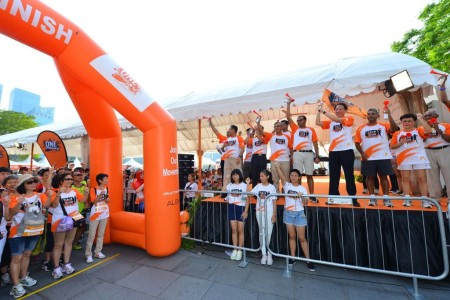
    At the sidelines of the Orange Ribbon Run 2015 that marked 50 years of racial harmony in Singapore, Chairman of OnePeople.sg, Dr Janil Puthucheary shared with Popspoken that he feels racial harmony in Singapore is “really quite exceptional” but “is not something to be taken for granted”. A whopping 7,000 people participated in the third edition of the Orange Ribbon Run – an event organized by OnePeople,sg, a national body that promotes multiracialism in Singapore. The event saw the support of Team Singapore athletes including former Olympian, Mr. C. Kunalan, SEA Games 2015 athletes and players from the Football Association of Singapore.

    When we probed further on how racial harmony could be promoted, Dr Janil replied, “There’s no one single approach… We organise different types of dialogues, debates and discussions about the issues of racial harmony, religious harmony and moving beyond this, tolerance and trust is our mission. So we are talking about it. We are talking about it, and we are encouraging people to think about it and to believe that this is something worth fighting for, worth standing for.”

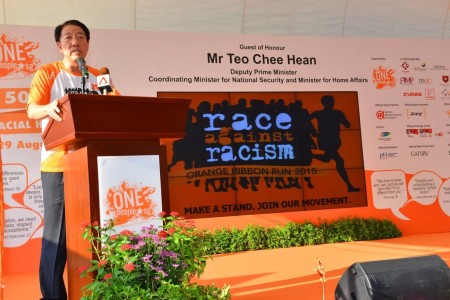
    Guest-of-Honour (GOH) Mr Teo Chee Hean, Deputy Prime Minister (DPM) and Coordinating Minister for National Security and Minister for Home Affairs flagged off the Orange Ribbon 3.5km Fun Walk along with Dr. Janil Puthucheary, Chairman of OnePeople.sg and Orange Ribbon Run’s ambassador, Mr.C Kunalan (last from right)

    On how rising racial tensions in neighbouring Malaysia affecting Singapore, Dr Janil noted, “Well, you know, our political structure in Singapore is such that we can’t play racial politics. That was something that was set up in 1965, very deliberately. And I think it’s something most Singaporeans – almost, I believe, all Singaporeans – believe it’s a strength that we have in our nation. That people are not going to get support if they try to feed into racial anxieties, if they try to stir up racial tensions, and it amounts to some degree of agitation.” He believes that our political structure is mature enough to move away from a model of having to “appeal to, engage with, and serve the broad middle ground of most Singaporeans, if not all Singaporeans.”

    11707865_10156055475295451_8815350489409281522_o

    We all share a common humanity: DPM Teo

    Mr Teo Chee Hean, Deputy Prime Minister (DPM) and Coordinating Minister for National Security and Minister for Home Affairs graced the event.In his speech, heCREDITED the government for progress made in the sphere of racial harmony.

    He touched upon the government’s success of deliberate policy making (e.g. bilingualism, common education system, integrated housing, fairness in the workplace etc), which has succesfully resulted in cohesively integrating people from different backgrounds.

    DPM Teo also rallied the crowd to open their hearts and minds, and come together as one people. He believes that reaching out to another to understand someone better, will definitely bring people closer together. At the same time, he cautioned against people with their own “agendas” who try to “accentuate” differences.

    Everyone sharing a ‘common humanity’,was to him, something worthwhile to celebrate. It is hence imperative for us to think about how we can enlarge the existing areas we have in common “and not allow anyone who wants to accentuate differences to succeed in dividing us,” said DPM Teo.


    Source: http://popspoken.com

  • When It Comes To Role Models, Race Is Irrelevant

    When It Comes To Role Models, Race Is Irrelevant

    Earlier this month, there was a media article on how a toy-plane lover and former television child star was now a high-flying colonel in the Republic of Singapore Air Force (RSAF).

    The article began by saying that Col Zakir Hamid, 46, had become the RSAF’s first Malay pilot in 1992 and was now the highest-ranked Malay officer there.

    I wondered why there was an emphasis on Colonel Zakir’s race, alongside his achievements. This emphasis seems to occur in instances when Malays rise to high positions in society.

    In April, when Minister in the Prime Minister’s Office Masagos Zulkifli was promoted to a full minister, all news reports said this was the first time that Singapore had two Malay full ministers. Prime Minister Lee Hsien Loong, in his Facebook post announcing the appointment, said this reflected the progress of the Malay community.

    I agree that stories of success serve to motivate and inspire younger Singaporeans. In the case of Malays who have done well, the Malay community celebrates their achievements, and younger Malays see these figures as good role models.

    Their success stories exemplify the meritocratic system in Singapore. They also help to convince the Malays that, even though we are a minority — the community forms 13.4 per cent of the citizen population — we can, like anyone else, and with effort and determination, succeed.

    However, in mentioning race when highlighting the achievements of Malays, might it not create a sense of inferiority, that we are not as capable and so any success attained by a Malay needs to be tied back to their race?

    It does not reflect Singapore’s meritocratic value of seeing ourselves as a united people regardless of race, language or religion.

    Academic Hussin Mutalib, in his book Singapore Malays — Being Ethnic Minority And Muslim In A Global City-State, wrote about the Malay “marginality” that some Malays felt as Singapore progressed. Could such mentions of race-based achievements be an attempt to remove those perceptions?

    It is a fact that the Malay community falls behind the Chinese and Indian communities in terms of educational qualifications and other socioeconomic attributes. But the gap is narrowing.

    The Malay community is moving forward and we want to continue doing so. According to the Education Statistics Digest published by the Ministry of Education, close to eight in 10 of Malay students in the 2003 cohort received admission to post-secondary education institutions.

    In 2012, almost nine in 10 achieved this — the biggest improvement seen among the races.

    Another positive trend by the Ministry of Social and Family Development data also showed that the home ownership rate among Malay residents is highest among the other races at 93.2 per cent.

    DO NOT LET RACE GET IN THE WAY

    I believe that members of the Malay community want to be seen as being as capable as other Singaporeans, and able to achieve similar success to their friends in school and at work.

    It will be even more encouraging if Malays who have benefited from the system in Singapore are willing to guide and mentor young Malays. Self-help groups such as Mendaki have programmes that require volunteers and mentors to lead them, and this will be a great opportunity to engage and empower future generations of the community.

    This will go a long way in dispelling perceptions of inferiority or discrimination that these young Malays may have internalised.

    The media can also play a part. They are instrumental in telling the stories of Singaporeans and also in moulding perceptions of the different communities and groups.

    While it is perfectly fine to showcase celebrations of racial cultures or cultural events, I believe there is no need to emphasise race, especially when articles are accompanied by photos of the people mentioned.

    This special mention for Malays in stories of success may unintentionally cause Singaporeans of other races to see Malays as less capable. This can affect how they relate to and communicate with their Malay friends.

    As we progress, I hope to see less emphasis put on a person’s race when highlighting his or her achievements.

    In my opinion, Singapore will never be a race-blind country because race, for good reasons, will continue to be a huge part of a person’s identity.

    Based on a survey by the Institute of Policy Studies on race, religion and language, 70.7 per cent of the respondents indicated that race is important to their overall sense of identity.

    Race should be less of a social marker and more of a cultural marker. We can be proud of our individual ethnicities and share our unique cultures, while still having a strong national identity. But we should not let race shape our interactions or perceptions of others.

    Stories of success should be read as they are — the achievements of fellow Singaporeans. I, for one, am sure that members of the Malay community can find any successful Singaporean, regardless of race, a worthy role model.

    ABOUT THE AUTHOR:

    Muhammad Syakir Bin Kamal is a second-year student at Imperial College London, where he is reading aeronautical engineering. He is currently interning at the Institute of Policy Studies, National University of Singapore.


    Source: www.todayonline.com

  • Proud To Be Among Rare Breed Of Malay Commandos In Singapore

    Proud To Be Among Rare Breed Of Malay Commandos In Singapore

    Dear Sir,

    What you may not understand is the history of Malays serving in the army especially in the Commandos. I served my NS in 1st Commando Bn and during that time (mid90s), I was the only Malay in my batch.

    I had to overcome many challenges then, e.g. no Muslim cookhouse in Hendon camp then, restrictions placed on me, etc. But I managed to survive my NS days with the help of all my Commando buddies, regardless of race. We were a band of brothers.

    Even now, Malays in Commandos are few and far in between. So you can understand my pride when I see a fellow Malay Commando who have managed to become an officer, doing the unit proud.

    Thank you.

    Zullkarnain Aziz


    Source: Ng Eng Hen